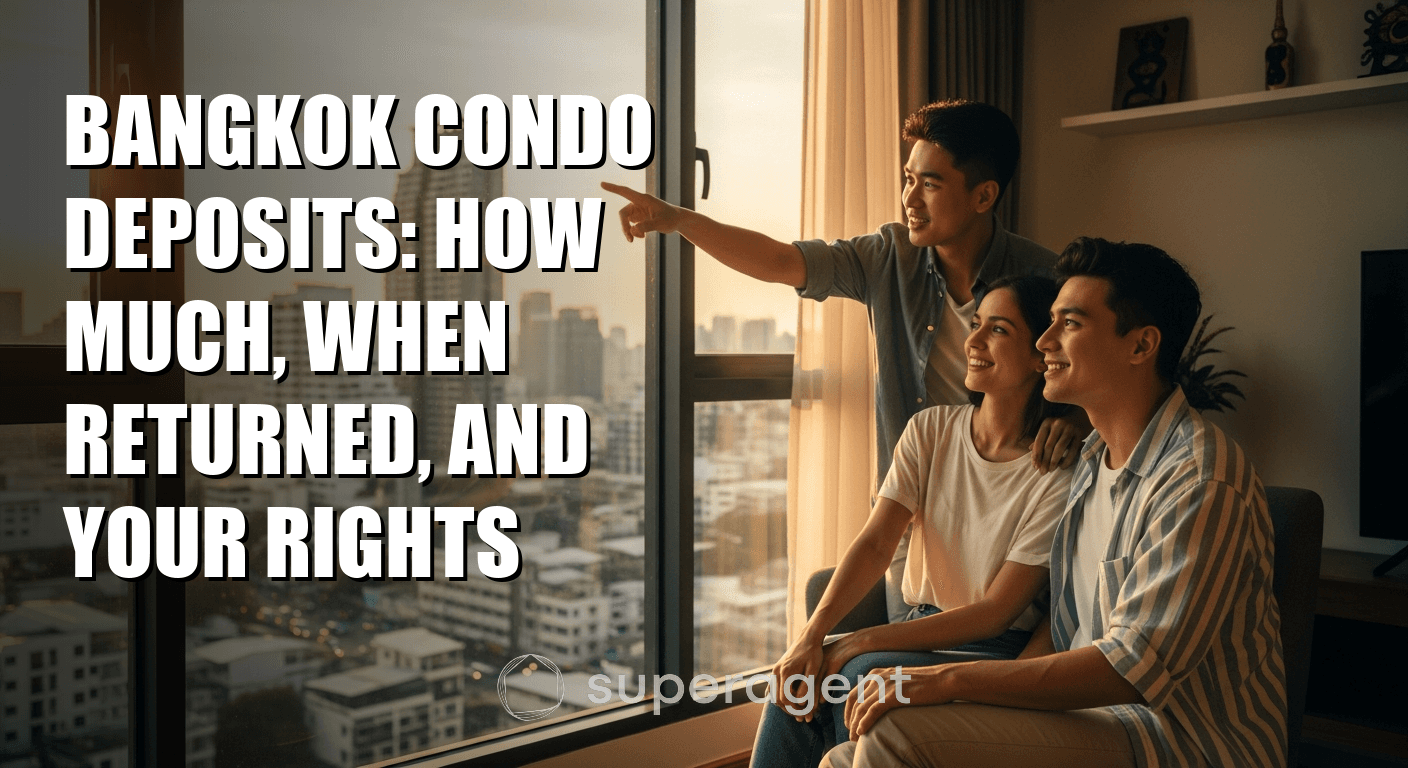
Bangkok Condo Deposits: How Much, When Returned, and Your Rights
Guides
Bangkok Condo Deposits: How Much, When Returned, and Your Rights
Understand Bangkok condo deposit requirements, timelines, and tenant protections.
Summary
Learn Bangkok condo deposit rules including amounts, return procedures, and your legal rights as a tenant in Thailand's rental market.
You just signed a lease for a one-bedroom condo near BTS Ari at 18,000 THB per month. The landlord asks for two months' deposit plus one month's advance rent. That's 54,000 THB before you've even slept a single night in the place. You hand it over, move in, and everything is great. But twelve months later, when you move out, suddenly there's a mysterious list of deductions and your deposit has shrunk to almost nothing. Sound familiar? It happens constantly in Bangkok, and most tenants have no idea what their actual rights are. Let's fix that.
How Much Deposit Do Bangkok Landlords Actually Charge?
The standard deposit for condo rentals in Bangkok is two months' rent. This is the norm across the market, from a 12,000 THB studio near MRT Huai Khwang to a 120,000 THB luxury two-bedroom in the Thonglor area. Some landlords will ask for one month, and a few will push for three, but two months is what you should expect in the vast majority of cases.
On top of the deposit, you'll almost always pay one month's rent in advance. So your total move-in cost is typically three months' rent. For context, CBRE Thailand's latest market reports indicate that the average asking rent for a one-bedroom condo in central Bangkok ranges from 15,000 to 35,000 THB per month, meaning your upfront payment will usually fall between 45,000 and 105,000 THB.
Here's a real scenario. Say you're renting a 30-square-meter unit at Lumpini Park Rama 9 near MRT Rama 9. The rent is 14,000 THB per month. Your landlord asks for two months' deposit (28,000 THB) plus one month in advance (14,000 THB). Total move-in cost: 42,000 THB. That's a significant chunk of money, and you deserve to know exactly what happens to it.
Some serviced apartments and higher-end buildings charge three months' deposit, especially for short-term leases under six months. Always negotiate. Plenty of landlords will drop to 1.5 months if you commit to a longer lease term.
What Thai Law Actually Says About Rental Deposits
Thailand does not have a comprehensive standalone tenant protection law the way some Western countries do. However, the Land Department and the Thai Civil and Commercial Code do establish some baseline protections for renters. The key provisions cover lease agreements, the obligation to return property in its original condition (minus normal wear and tear), and the landlord's duty to refund the deposit after lease termination.
In 2018, the Thai government introduced Ministerial Regulation under the Consumer Protection Act specifically for residential rentals. This regulation limits security deposits to no more than one month's rent for residential leases. However, and this is important, it mainly applies to operators who rent out multiple units as a business. Individual condo owners renting out a single unit often fall outside the strict scope of this regulation, which is why you'll still see two-month deposits across the board.
The practical reality is this: your lease contract is the document that matters most. Whatever deposit amount is written in that contract is what both parties are bound by. If the contract says the landlord will return the deposit within 30 days of move-out, that's the rule. If it's silent on the timeline, you may be waiting a while with limited legal recourse.
Consider what happened to a friend renting a two-bedroom condo at Ideo Q Chula near MRT Sam Yan for 28,000 THB per month. His contract stated a 30-day return period. The landlord tried to hold the deposit for 90 days. Because the lease was clear, a simple letter referencing the contract terms got the deposit returned within a week.
When Should You Get Your Deposit Back?
Most Bangkok lease agreements specify that the deposit will be returned within 30 days of the lease ending and the tenant handing back the keys. Some contracts say 7 days, others say 45 or even 60 days. If your contract doesn't mention a specific timeline, 30 days is the generally accepted standard.
The clock starts ticking from the day you complete the move-out inspection and hand over the keys. Not from the day you tell the landlord you're leaving. Not from your last day living there. From the formal handover. Make sure you do a proper walk-through with the landlord or agent, take photos of every room, and get written confirmation of the unit's condition.
Here's a common situation. You're leaving a unit at The Base Sukhumvit 77 near BTS On Nut. Rent was 16,000 THB per month, deposit was 32,000 THB. You do the walk-through, everything looks fine, the landlord says "I'll transfer the money soon." Two months later, nothing. Without a clear contract clause and documentation of the walk-through, you have very little to push back with. With those things in hand, you have real standing.
Always request the deposit refund in writing via email or messaging app so you have a record. Verbal promises evaporate quickly in any rental market, and Bangkok is no exception.
Common Deductions and How to Fight Unfair Ones
Landlords can legally deduct from your deposit for damage beyond normal wear and tear, unpaid utility bills, and any outstanding rent. That's reasonable. What's not reasonable is charging you for a full repaint when you lived there for two years, or deducting 5,000 THB for a "deep cleaning" that was never discussed in the lease.
Normal wear and tear includes things like minor scuff marks on walls, slight discoloration of grout in bathrooms, and small scratches on floors from regular furniture use. These are expected after a year or more of living in a unit. A landlord cannot charge you for the natural aging of their property.
Unfair deductions you should push back on include repainting costs for normal use, replacement of appliances that were already old, charges for pre-existing damage you documented at move-in, and cleaning fees not specified in the lease. According to listings data on DDproperty, the average condo in Bangkok changes tenants every 12 to 18 months, and landlords who routinely deduct unfair charges tend to face longer vacancy periods due to poor reviews.
Take the example of a tenant at Life Asoke Hype near MRT Phetchaburi. She was charged 8,000 THB for replacing a microwave that was already seven years old when she moved in. She had photos from move-in day showing the microwave's condition and model number. After presenting the evidence, the landlord dropped the charge entirely. Documentation is everything.
- Full unit repaint (after 12+ months): Usually No | 5,000 to 15,000 | Document wall condition at move-in and move-out
- Deep cleaning fee: Only if in lease | 2,000 to 5,000 | Check lease for cleaning clauses before signing
- Broken appliance replacement: Yes, if tenant caused damage | 3,000 to 20,000 | Photo and video inventory of all appliances at move-in
- Unpaid utility bills: Yes | Varies | Request final meter readings and pay before move-out
- Pre-existing damage charges: No | Varies | Detailed move-in inspection report with timestamps
- Key or access card replacement: Yes, if lost | 500 to 2,000 | Return all keys and cards at handover
The Move-In Inspection: Your Single Most Important Step
If there is one thing you take away from this article, let it be this: do a thorough move-in inspection and document everything. Take photos of every wall, every appliance, every fixture, every stain, every scratch. Open every cabinet. Test every faucet. Turn on the air conditioning. Check the water heater. Flush the toilet. Try every burner on the stove.
Send all photos and any notes to the landlord or agent via email on the day you move in. This creates a timestamped record that is extremely difficult to dispute later. If possible, do a video walk-through as well. Most smartphones timestamp videos automatically, which adds another layer of proof.
A tenant moving into a unit at Aspire Sukhumvit 48 near BTS Phra Khanong found a crack in the bathroom mirror during his move-in inspection. He photographed it, emailed it to the agent, and got a written acknowledgment. Twelve months later, when the landlord tried to deduct 4,500 THB for "mirror damage," he pulled up the email chain. Deduction removed, full deposit returned.
Create a simple checklist: living room, bedroom, bathroom, kitchen, balcony. Go room by room. It takes 30 minutes and can save you tens of thousands of baht.
What to Do If Your Landlord Refuses to Return the Deposit
If your landlord ghosts you or flat-out refuses to return your deposit, you have options. Start by sending a formal written demand via email or registered mail. Reference the specific clause in your lease that covers the deposit return. Be polite but firm. Most disputes resolve at this stage because landlords know they're on shaky ground.
If that doesn't work, you can file a complaint with the Office of the Consumer Protection Board. This is a free government service, and filing a complaint often motivates landlords to settle quickly. For amounts under 300,000 THB, you can also pursue the case in the Thai Consumer Court, which is designed to be accessible without a lawyer.
Keep in mind that many landlords who rent out condos in buildings like The Line Jatujak near BTS Mo Chit or Whizdom Essence near BTS Punnawithi are individual investors, not professional property managers. They may not know the rules themselves. Sometimes a clear, well-documented request is all it takes.
For expats, it's also worth contacting your embassy's consular services for guidance if the amount is significant. They can't intervene legally, but they can sometimes connect you with reputable legal resources.
Protecting your deposit in Bangkok comes down to three things: reading your lease carefully before signing, documenting the unit's condition obsessively at move-in, and communicating everything in writing. The rental market here moves fast, and landlords come in all varieties, from excellent to genuinely difficult. Your best defense is preparation. If you're searching for your next condo and want a platform that makes lease terms transparent from the start, check out superagent.co to find verified listings with clear rental conditions across Bangkok.
You just signed a lease for a one-bedroom condo near BTS Ari at 18,000 THB per month. The landlord asks for two months' deposit plus one month's advance rent. That's 54,000 THB before you've even slept a single night in the place. You hand it over, move in, and everything is great. But twelve months later, when you move out, suddenly there's a mysterious list of deductions and your deposit has shrunk to almost nothing. Sound familiar? It happens constantly in Bangkok, and most tenants have no idea what their actual rights are. Let's fix that.
How Much Deposit Do Bangkok Landlords Actually Charge?
The standard deposit for condo rentals in Bangkok is two months' rent. This is the norm across the market, from a 12,000 THB studio near MRT Huai Khwang to a 120,000 THB luxury two-bedroom in the Thonglor area. Some landlords will ask for one month, and a few will push for three, but two months is what you should expect in the vast majority of cases.
On top of the deposit, you'll almost always pay one month's rent in advance. So your total move-in cost is typically three months' rent. For context, CBRE Thailand's latest market reports indicate that the average asking rent for a one-bedroom condo in central Bangkok ranges from 15,000 to 35,000 THB per month, meaning your upfront payment will usually fall between 45,000 and 105,000 THB.
Here's a real scenario. Say you're renting a 30-square-meter unit at Lumpini Park Rama 9 near MRT Rama 9. The rent is 14,000 THB per month. Your landlord asks for two months' deposit (28,000 THB) plus one month in advance (14,000 THB). Total move-in cost: 42,000 THB. That's a significant chunk of money, and you deserve to know exactly what happens to it.
Some serviced apartments and higher-end buildings charge three months' deposit, especially for short-term leases under six months. Always negotiate. Plenty of landlords will drop to 1.5 months if you commit to a longer lease term.
What Thai Law Actually Says About Rental Deposits
Thailand does not have a comprehensive standalone tenant protection law the way some Western countries do. However, the Land Department and the Thai Civil and Commercial Code do establish some baseline protections for renters. The key provisions cover lease agreements, the obligation to return property in its original condition (minus normal wear and tear), and the landlord's duty to refund the deposit after lease termination.
Continue reading after that.
Looking for a condo
to rent?
Leave your name and phone. We'll follow up while you keep reading.
100% Secure
Fast Response
Free Consultation
In 2018, the Thai government introduced Ministerial Regulation under the Consumer Protection Act specifically for residential rentals. This regulation limits security deposits to no more than one month's rent for residential leases. However, and this is important, it mainly applies to operators who rent out multiple units as a business. Individual condo owners renting out a single unit often fall outside the strict scope of this regulation, which is why you'll still see two-month deposits across the board.
The practical reality is this: your lease contract is the document that matters most. Whatever deposit amount is written in that contract is what both parties are bound by. If the contract says the landlord will return the deposit within 30 days of move-out, that's the rule. If it's silent on the timeline, you may be waiting a while with limited legal recourse.
Consider what happened to a friend renting a two-bedroom condo at Ideo Q Chula near MRT Sam Yan for 28,000 THB per month. His contract stated a 30-day return period. The landlord tried to hold the deposit for 90 days. Because the lease was clear, a simple letter referencing the contract terms got the deposit returned within a week.
When Should You Get Your Deposit Back?
Most Bangkok lease agreements specify that the deposit will be returned within 30 days of the lease ending and the tenant handing back the keys. Some contracts say 7 days, others say 45 or even 60 days. If your contract doesn't mention a specific timeline, 30 days is the generally accepted standard.
The clock starts ticking from the day you complete the move-out inspection and hand over the keys. Not from the day you tell the landlord you're leaving. Not from your last day living there. From the formal handover. Make sure you do a proper walk-through with the landlord or agent, take photos of every room, and get written confirmation of the unit's condition.
Here's a common situation. You're leaving a unit at The Base Sukhumvit 77 near BTS On Nut. Rent was 16,000 THB per month, deposit was 32,000 THB. You do the walk-through, everything looks fine, the landlord says "I'll transfer the money soon." Two months later, nothing. Without a clear contract clause and documentation of the walk-through, you have very little to push back with. With those things in hand, you have real standing.
Always request the deposit refund in writing via email or messaging app so you have a record. Verbal promises evaporate quickly in any rental market, and Bangkok is no exception.
Common Deductions and How to Fight Unfair Ones
Landlords can legally deduct from your deposit for damage beyond normal wear and tear, unpaid utility bills, and any outstanding rent. That's reasonable. What's not reasonable is charging you for a full repaint when you lived there for two years, or deducting 5,000 THB for a "deep cleaning" that was never discussed in the lease.
Normal wear and tear includes things like minor scuff marks on walls, slight discoloration of grout in bathrooms, and small scratches on floors from regular furniture use. These are expected after a year or more of living in a unit. A landlord cannot charge you for the natural aging of their property.
Unfair deductions you should push back on include repainting costs for normal use, replacement of appliances that were already old, charges for pre-existing damage you documented at move-in, and cleaning fees not specified in the lease. According to listings data on DDproperty, the average condo in Bangkok changes tenants every 12 to 18 months, and landlords who routinely deduct unfair charges tend to face longer vacancy periods due to poor reviews.
Take the example of a tenant at Life Asoke Hype near MRT Phetchaburi. She was charged 8,000 THB for replacing a microwave that was already seven years old when she moved in. She had photos from move-in day showing the microwave's condition and model number. After presenting the evidence, the landlord dropped the charge entirely. Documentation is everything.
- Full unit repaint (after 12+ months): Usually No | 5,000 to 15,000 | Document wall condition at move-in and move-out
- Deep cleaning fee: Only if in lease | 2,000 to 5,000 | Check lease for cleaning clauses before signing
- Broken appliance replacement: Yes, if tenant caused damage | 3,000 to 20,000 | Photo and video inventory of all appliances at move-in
- Unpaid utility bills: Yes | Varies | Request final meter readings and pay before move-out
- Pre-existing damage charges: No | Varies | Detailed move-in inspection report with timestamps
- Key or access card replacement: Yes, if lost | 500 to 2,000 | Return all keys and cards at handover
The Move-In Inspection: Your Single Most Important Step
If there is one thing you take away from this article, let it be this: do a thorough move-in inspection and document everything. Take photos of every wall, every appliance, every fixture, every stain, every scratch. Open every cabinet. Test every faucet. Turn on the air conditioning. Check the water heater. Flush the toilet. Try every burner on the stove.
Continue reading after that.
Looking for a condo
to rent?
Leave your name and phone. We'll follow up while you keep reading.
100% Secure
Fast Response
Free Consultation
Send all photos and any notes to the landlord or agent via email on the day you move in. This creates a timestamped record that is extremely difficult to dispute later. If possible, do a video walk-through as well. Most smartphones timestamp videos automatically, which adds another layer of proof.
A tenant moving into a unit at Aspire Sukhumvit 48 near BTS Phra Khanong found a crack in the bathroom mirror during his move-in inspection. He photographed it, emailed it to the agent, and got a written acknowledgment. Twelve months later, when the landlord tried to deduct 4,500 THB for "mirror damage," he pulled up the email chain. Deduction removed, full deposit returned.
Create a simple checklist: living room, bedroom, bathroom, kitchen, balcony. Go room by room. It takes 30 minutes and can save you tens of thousands of baht.
What to Do If Your Landlord Refuses to Return the Deposit
If your landlord ghosts you or flat-out refuses to return your deposit, you have options. Start by sending a formal written demand via email or registered mail. Reference the specific clause in your lease that covers the deposit return. Be polite but firm. Most disputes resolve at this stage because landlords know they're on shaky ground.
If that doesn't work, you can file a complaint with the Office of the Consumer Protection Board. This is a free government service, and filing a complaint often motivates landlords to settle quickly. For amounts under 300,000 THB, you can also pursue the case in the Thai Consumer Court, which is designed to be accessible without a lawyer.
Keep in mind that many landlords who rent out condos in buildings like The Line Jatujak near BTS Mo Chit or Whizdom Essence near BTS Punnawithi are individual investors, not professional property managers. They may not know the rules themselves. Sometimes a clear, well-documented request is all it takes.
For expats, it's also worth contacting your embassy's consular services for guidance if the amount is significant. They can't intervene legally, but they can sometimes connect you with reputable legal resources.
Protecting your deposit in Bangkok comes down to three things: reading your lease carefully before signing, documenting the unit's condition obsessively at move-in, and communicating everything in writing. The rental market here moves fast, and landlords come in all varieties, from excellent to genuinely difficult. Your best defense is preparation. If you're searching for your next condo and want a platform that makes lease terms transparent from the start, check out superagent.co to find verified listings with clear rental conditions across Bangkok.
Share this article
Properties you may like
![[For Rent] CONDO I Las Colinas Condominium I 2 Beds I 3 Baths I 85,000THB/mo](/_next/image?url=https%3A%2F%2Fstorage.googleapis.com%2Fsuperagent-web%2Fattachments%2Flistings%2F6828%2F80f345c4-488e-43b2-b017-c9fbb17b520d-99486dd8-4237-4ba2-9207-01ce4f66b21f-media.jpg&w=3840&q=75)
฿85,000
2 Bed3170 sqm
[For Rent] CONDO I Las Colinas Condominium I 2 Beds I 3 Baths I 85,000THB/mo
Asoke
Condo![[For Rent] CONDO I Ashton Asoke I 1 Bed I 1 Bath I 30,000THB/mo](/_next/image?url=https%3A%2F%2Fstorage.googleapis.com%2Fsuperagent-web%2Fattachments%2Flistings%2F6876%2Fb7ce9bbe-f877-4ff5-bb54-8ad0026db940-1272-4.jpg&w=3840&q=75)
฿30,000
1 Bed135 sqm
[For Rent] CONDO I Ashton Asoke I 1 Bed I 1 Bath I 30,000THB/mo
Asoke
Condo![[For Rent] CONDO I Skyrise Avenue Sukhumvit 64 I 2 Beds I 2 Baths I 27,000THB/mo](/_next/image?url=https%3A%2F%2Fstorage.googleapis.com%2Fsuperagent-web%2Fattachments%2Flistings%2F2001%2F670f91de-c251-4e81-971c-8e30ed2158cd-screenshot-2026-07-05-at-11.38.53-pm.png&w=3840&q=75)
฿27,000
2 Bed252 sqm
[For Rent] CONDO I Skyrise Avenue Sukhumvit 64 I 2 Beds I 2 Baths I 27,000THB/mo
Punnawithi
Condo![[For Rent] CONDO I Park Origin Ratchathewi I Duplex I 2 Beds I 1 Bath I 32,000THB/mo](/_next/image?url=https%3A%2F%2Fstorage.googleapis.com%2Fsuperagent-web%2Fattachments%2Flistings%2F6896%2Fb79a7d21-7533-4b0d-bb19-762ebfafab62-1318-6.jpg&w=3840&q=75)
฿32,000
2 Bed135.9 sqm
[For Rent] CONDO I Park Origin Ratchathewi I Duplex I 2 Beds I 1 Bath I 32,000THB/mo
Ratchathewi
Condo![[For Rent] CONDO I Park Origin Phayathai I Studio I 1 Bath I 28,000THB/mo](/_next/image?url=https%3A%2F%2Fstorage.googleapis.com%2Fsuperagent-web%2Fattachments%2Flistings%2F6757%2Fb226df93-94c6-46fa-aeba-ebfadc7f81b8-1000006042.jpg&w=3840&q=75)
฿28,000
Studio129 sqm
[For Rent] CONDO I Park Origin Phayathai I Studio I 1 Bath I 28,000THB/mo
Phaya Thai
Condo![[For Rent] CONDO I Ideo Mobi Sukhumvit 81 I Duplex I 1 Bed I 1 Bath I 28,000THB/mo](/_next/image?url=https%3A%2F%2Fstorage.googleapis.com%2Fsuperagent-web%2Fattachments%2Flistings%2F1849%2Fc8b2c033-3b5f-4615-b2b0-4972f40141f0-705-13.jpg&w=3840&q=75)
฿28,000
1 Bed143 sqm
[For Rent] CONDO I Ideo Mobi Sukhumvit 81 I Duplex I 1 Bed I 1 Bath I 28,000THB/mo
On Nut
Condo![[For Rent] CONDO I Siamese Sukhumvit 48 I 1 Bed I 1 Bath I 28,000THB/mo](/_next/image?url=https%3A%2F%2Fstorage.googleapis.com%2Fsuperagent-web%2Fattachments%2Flistings%2F6841%2Febc2dce2-2e9b-4e6d-a01c-0cfa619dfa13-1231-6.jpg&w=3840&q=75)
฿28,000
1 Bed144 sqm
[For Rent] CONDO I Siamese Sukhumvit 48 I 1 Bed I 1 Bath I 28,000THB/mo
Condo![[For Rent] CONDO I Ashton Asoke I 1 Bed I 1 Bath I 22,000THB/mo](/_next/image?url=https%3A%2F%2Fstorage.googleapis.com%2Fsuperagent-web%2Fattachments%2Flistings%2F6802%2Fe06b9b73-1207-414a-ab04-1685de0c7eaa-20220808_153124_0.jpg&w=3840&q=75)
฿22,000
1 Bed134 sqm
[For Rent] CONDO I Ashton Asoke I 1 Bed I 1 Bath I 22,000THB/mo
Asoke
Condo![[For Rent] CONDO I HQ Thonglor Soi 4 I 1 Bed I 1 Bath I 35,000 THB/mo](/_next/image?url=https%3A%2F%2Fstorage.googleapis.com%2Fsuperagent-web%2Fattachments%2Flistings%2F1445%2F72352585-1bc2-41a8-bd62-ddcbf8189fe9-376-5.jpg&w=3840&q=75)
฿35,000
1 Bed143.6 sqm
[For Rent] CONDO I HQ Thonglor Soi 4 I 1 Bed I 1 Bath I 35,000 THB/mo
Thonglor
Condo![[For Rent] CONDO I The Master Centrium Asoke - Sukhumvit I Duplex I 2 Beds I 3 Baths I 75,000 THB/mo](/_next/image?url=https%3A%2F%2Fstorage.googleapis.com%2Fsuperagent-web%2Fattachments%2Flistings%2F1545%2F97932b6a-c358-45e4-b5f9-995dbf5a3cf0-441-2.jpg&w=3840&q=75)
฿75,000
2 Bed3150 sqm
[For Rent] CONDO I The Master Centrium Asoke - Sukhumvit I Duplex I 2 Beds I 3 Baths I 75,000 THB/mo
Asoke
CondoMore like this
 In Guides · Superagent EditorialHidden Costs of Renting a Condo in Bangkok Nobody Warns You AboutBangkok condo rent looks affordable until month one hits. Here are the real costs beyond the headline figure that catch most renters off guard.25 May 20261 min read
 In Guides · Superagent EditorialWhat a Long-Vacant Bangkok Condo Unit Is Actually Telling YouA Bangkok condo vacant for months signals overpricing, landlord issues, or real problems. Here is how to read the signs.25 May 20261 min read
 In Guides · Superagent EditorialRed Flags in a Bangkok Rental Contract to Watch Out ForBangkok rental contracts often hide risky clauses. Here are the red flags every tenant must catch before signing any lease.25 May 20261 min read
 In Guides · Superagent EditorialWorking Online from a Condo: How to Choose the Perfect Room for ProductivityLearn how to choose the best condo room for working online with tips on lighting, noise, and furniture setup to maximize productivity.9 May 20261 min read