Bangkok Condo Electricity Bills: What's Normal and How to Reduce It
Guides
Bangkok Condo Electricity Bills: What's Normal and How to Reduce It
Discover what Bangkok renters actually pay for electricity and proven strategies to cut your monthly costs.
Summary
Learn what's a normal electric bill in Bangkok condos and get practical tips to reduce consumption. Expert advice for expat renters managing costs.
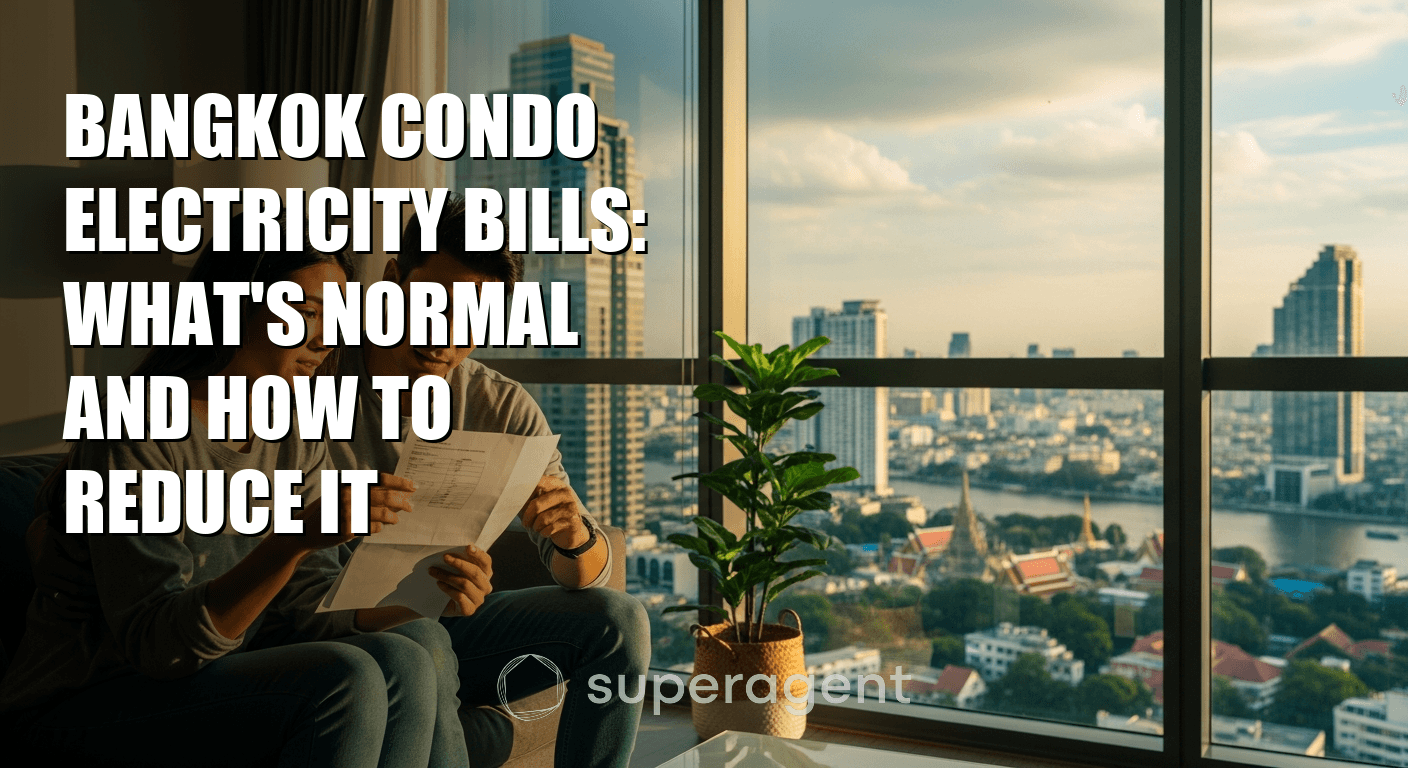
That moment when your first electricity bill arrives at your Bangkok condo and the number is double what you expected. We've all been there. Whether you just moved into a studio near BTS Ari or a two bedroom off Sukhumvit Soi 39, understanding your electric bill in a Bangkok condo is essential to keeping your monthly budget on track. The good news? Once you know how the system works, there are real ways to bring that number down.
How Bangkok Condo Electricity Billing Actually Works
Here's the first thing that catches most renters off guard. Many Bangkok condos do not charge the standard government rate from the Metropolitan Electricity Authority, known as MEA. The MEA residential rate runs roughly 3.2 to 4.2 THB per unit depending on usage tiers. But a huge number of condo buildings and landlords mark that up, charging anywhere from 6 to 9 THB per unit.
Why? Building juristic offices often buy electricity in bulk from MEA, then redistribute it to individual units at a flat per unit rate. That markup covers common area electricity, administrative costs, and sometimes a tidy profit. If you're renting a unit at The Line Sukhumvit 101, for example, you might see 7 THB per unit on your monthly bill. Meanwhile, your friend renting directly from a landlord in a smaller building on Soi Ari 1 might be paying just 8.5 THB per unit because the landlord sets the price independently.
Before signing any lease, always ask two questions: what is the electricity rate per unit, and is there an option to register your own MEA meter? Getting your own meter can save you thousands of baht per year, though not every building allows it.
What's a Normal Monthly Electric Bill in Bangkok?
Let's talk real numbers. Your electric bill depends on three things: the size of your condo, how many hours you run the air conditioning, and the per unit rate your building charges.
For a studio or one bedroom condo, say 30 to 45 square meters near BTS On Nut, a typical monthly electric bill runs between 1,500 and 3,500 THB. That assumes you run one AC unit for about six to eight hours a day, mostly at night. For a two bedroom unit around 60 to 80 square meters, think 3,000 to 6,000 THB per month, especially if you're running two AC units.
Here's a concrete example. A friend of mine rents a 35 sqm one bedroom at Ideo Mobi Sukhumvit near BTS Ekkamai. He pays 7 THB per unit. During the hot season from March through May, his bill hits 3,200 THB. In the cooler months around December and January, it drops to about 1,800 THB. The AC is the single biggest factor, accounting for roughly 60 to 70 percent of his total bill.
If your bill is consistently above 5,000 THB for a small one bedroom, something is off. Either the rate is too high, your AC is old and inefficient, or you're running it colder and longer than you realize.
Practical Ways to Lower Your Electric Bill
You don't need to sweat through Bangkok heat to save money. Small changes make a measurable difference.
Set your AC to 25 or 26 degrees Celsius instead of 22. Every degree lower forces the compressor to work significantly harder. Use a fan alongside the AC to circulate cool air. This combination lets you keep the thermostat higher while still feeling comfortable. Also, set the AC timer so it shuts off a couple of hours before your alarm goes off. Bangkok mornings are cooler, and you probably won't notice the difference while sleeping.
Choose an inverter AC if you ever get the option. Many newer condos along the Purple Line near MRT Tao Poon and newer builds around Ratchada Soi 32 come with inverter units pre installed. These adjust compressor speed rather than cycling on and off, using up to 30 to 40 percent less electricity than older fixed speed units.
Unplug appliances you're not using. Your TV, microwave, and water heater all draw standby power. It sounds minor, but standby power can account for 5 to 10 percent of your bill. And clean your AC filters every two weeks. Dust buildup forces the unit to work harder. This is free, takes five minutes, and genuinely works.
Negotiate the Rate Before You Sign the Lease
Most renters don't realize the electricity rate is negotiable, especially when renting directly from a landlord. If you're looking at a unit in a building like Lumpini Suite Phetchaburi Makkasan near MRT Phetchaburi and the landlord quotes 8 THB per unit, counter with 7 THB. Many will agree, particularly if you're signing a 12 month lease.
Some landlords will even let you register a personal MEA meter, which brings you down to the government tiered rate. This is most common in older, low rise buildings around areas like Ari, Ladprao, and Sathorn. It's less common in large high rises where the juristic person controls the meter setup, but always worth asking.
If a landlord won't budge on a high rate, factor that cost into your total monthly budget. A condo advertised at 12,000 THB per month with electricity at 9 THB per unit could effectively cost you 15,500 THB or more once bills are included. That changes the math on whether the unit is actually a good deal.
Watch for Red Flags on Your Bill
Always check your meter reading yourself. Some buildings estimate usage or make errors. Take a photo of your meter on the first and last day of each month. Compare it against what appears on your bill. If the numbers don't match, raise it with building management immediately.
Also watch for "minimum charges." A few buildings impose a monthly minimum of 500 to 1,000 THB regardless of actual usage. This matters if you travel often or keep a condo as a part time base. A couple renting a unit at Rhythm Asoke near MRT Phra Ram 9 discovered they were paying 800 THB minimum even during months they were away. Knowing this upfront would have influenced their decision.
Your electric bill doesn't have to be a monthly headache. Ask the right questions before signing, keep your AC habits in check, and monitor your usage. These small steps can easily save you 1,000 to 2,000 THB every month. If you're searching for your next condo and want transparent info on electricity rates, building fees, and real monthly costs, check out Superagent at superagent.co. We help renters in Bangkok find the right place with no surprises on the bills.
That moment when your first electricity bill arrives at your Bangkok condo and the number is double what you expected. We've all been there. Whether you just moved into a studio near BTS Ari or a two bedroom off Sukhumvit Soi 39, understanding your electric bill in a Bangkok condo is essential to keeping your monthly budget on track. The good news? Once you know how the system works, there are real ways to bring that number down.
How Bangkok Condo Electricity Billing Actually Works
Here's the first thing that catches most renters off guard. Many Bangkok condos do not charge the standard government rate from the Metropolitan Electricity Authority, known as MEA. The MEA residential rate runs roughly 3.2 to 4.2 THB per unit depending on usage tiers. But a huge number of condo buildings and landlords mark that up, charging anywhere from 6 to 9 THB per unit.
Why? Building juristic offices often buy electricity in bulk from MEA, then redistribute it to individual units at a flat per unit rate. That markup covers common area electricity, administrative costs, and sometimes a tidy profit. If you're renting a unit at The Line Sukhumvit 101, for example, you might see 7 THB per unit on your monthly bill. Meanwhile, your friend renting directly from a landlord in a smaller building on Soi Ari 1 might be paying just 8.5 THB per unit because the landlord sets the price independently.
Continue reading after that.
Looking for a condo
to rent?
Leave your name and phone. We'll follow up while you keep reading.
100% Secure
Fast Response
Free Consultation
Before signing any lease, always ask two questions: what is the electricity rate per unit, and is there an option to register your own MEA meter? Getting your own meter can save you thousands of baht per year, though not every building allows it.
What's a Normal Monthly Electric Bill in Bangkok?
Let's talk real numbers. Your electric bill depends on three things: the size of your condo, how many hours you run the air conditioning, and the per unit rate your building charges.
For a studio or one bedroom condo, say 30 to 45 square meters near BTS On Nut, a typical monthly electric bill runs between 1,500 and 3,500 THB. That assumes you run one AC unit for about six to eight hours a day, mostly at night. For a two bedroom unit around 60 to 80 square meters, think 3,000 to 6,000 THB per month, especially if you're running two AC units.
Here's a concrete example. A friend of mine rents a 35 sqm one bedroom at Ideo Mobi Sukhumvit near BTS Ekkamai. He pays 7 THB per unit. During the hot season from March through May, his bill hits 3,200 THB. In the cooler months around December and January, it drops to about 1,800 THB. The AC is the single biggest factor, accounting for roughly 60 to 70 percent of his total bill.
If your bill is consistently above 5,000 THB for a small one bedroom, something is off. Either the rate is too high, your AC is old and inefficient, or you're running it colder and longer than you realize.
Practical Ways to Lower Your Electric Bill
You don't need to sweat through Bangkok heat to save money. Small changes make a measurable difference.
Set your AC to 25 or 26 degrees Celsius instead of 22. Every degree lower forces the compressor to work significantly harder. Use a fan alongside the AC to circulate cool air. This combination lets you keep the thermostat higher while still feeling comfortable. Also, set the AC timer so it shuts off a couple of hours before your alarm goes off. Bangkok mornings are cooler, and you probably won't notice the difference while sleeping.
Choose an inverter AC if you ever get the option. Many newer condos along the Purple Line near MRT Tao Poon and newer builds around Ratchada Soi 32 come with inverter units pre installed. These adjust compressor speed rather than cycling on and off, using up to 30 to 40 percent less electricity than older fixed speed units.
Unplug appliances you're not using. Your TV, microwave, and water heater all draw standby power. It sounds minor, but standby power can account for 5 to 10 percent of your bill. And clean your AC filters every two weeks. Dust buildup forces the unit to work harder. This is free, takes five minutes, and genuinely works.
Negotiate the Rate Before You Sign the Lease
Most renters don't realize the electricity rate is negotiable, especially when renting directly from a landlord. If you're looking at a unit in a building like Lumpini Suite Phetchaburi Makkasan near MRT Phetchaburi and the landlord quotes 8 THB per unit, counter with 7 THB. Many will agree, particularly if you're signing a 12 month lease.
Some landlords will even let you register a personal MEA meter, which brings you down to the government tiered rate. This is most common in older, low rise buildings around areas like Ari, Ladprao, and Sathorn. It's less common in large high rises where the juristic person controls the meter setup, but always worth asking.
Continue reading after that.
Looking for a condo
to rent?
Leave your name and phone. We'll follow up while you keep reading.
100% Secure
Fast Response
Free Consultation
If a landlord won't budge on a high rate, factor that cost into your total monthly budget. A condo advertised at 12,000 THB per month with electricity at 9 THB per unit could effectively cost you 15,500 THB or more once bills are included. That changes the math on whether the unit is actually a good deal.
Watch for Red Flags on Your Bill
Always check your meter reading yourself. Some buildings estimate usage or make errors. Take a photo of your meter on the first and last day of each month. Compare it against what appears on your bill. If the numbers don't match, raise it with building management immediately.
Also watch for "minimum charges." A few buildings impose a monthly minimum of 500 to 1,000 THB regardless of actual usage. This matters if you travel often or keep a condo as a part time base. A couple renting a unit at Rhythm Asoke near MRT Phra Ram 9 discovered they were paying 800 THB minimum even during months they were away. Knowing this upfront would have influenced their decision.
Your electric bill doesn't have to be a monthly headache. Ask the right questions before signing, keep your AC habits in check, and monitor your usage. These small steps can easily save you 1,000 to 2,000 THB every month. If you're searching for your next condo and want transparent info on electricity rates, building fees, and real monthly costs, check out Superagent at superagent.co. We help renters in Bangkok find the right place with no surprises on the bills.
Share this article
Properties you may like
![[For Rent] CONDO I Las Colinas Condominium I 2 Beds I 3 Baths I 85,000THB/mo](/_next/image?url=https%3A%2F%2Fstorage.googleapis.com%2Fsuperagent-web%2Fattachments%2Flistings%2F6828%2F80f345c4-488e-43b2-b017-c9fbb17b520d-99486dd8-4237-4ba2-9207-01ce4f66b21f-media.jpg&w=3840&q=75)
฿85,000
2 Bed3170 sqm
[For Rent] CONDO I Las Colinas Condominium I 2 Beds I 3 Baths I 85,000THB/mo
Asoke
Condo![[For Rent] CONDO I Ashton Asoke I 1 Bed I 1 Bath I 30,000THB/mo](/_next/image?url=https%3A%2F%2Fstorage.googleapis.com%2Fsuperagent-web%2Fattachments%2Flistings%2F6876%2Fb7ce9bbe-f877-4ff5-bb54-8ad0026db940-1272-4.jpg&w=3840&q=75)
฿30,000
1 Bed135 sqm
[For Rent] CONDO I Ashton Asoke I 1 Bed I 1 Bath I 30,000THB/mo
Asoke
Condo![[For Rent] CONDO I Skyrise Avenue Sukhumvit 64 I 2 Beds I 2 Baths I 27,000THB/mo](/_next/image?url=https%3A%2F%2Fstorage.googleapis.com%2Fsuperagent-web%2Fattachments%2Flistings%2F2001%2F670f91de-c251-4e81-971c-8e30ed2158cd-screenshot-2026-07-05-at-11.38.53-pm.png&w=3840&q=75)
฿27,000
2 Bed252 sqm
[For Rent] CONDO I Skyrise Avenue Sukhumvit 64 I 2 Beds I 2 Baths I 27,000THB/mo
Punnawithi
Condo![[For Rent] CONDO I Park Origin Ratchathewi I Duplex I 2 Beds I 1 Bath I 32,000THB/mo](/_next/image?url=https%3A%2F%2Fstorage.googleapis.com%2Fsuperagent-web%2Fattachments%2Flistings%2F6896%2Fb79a7d21-7533-4b0d-bb19-762ebfafab62-1318-6.jpg&w=3840&q=75)
฿32,000
2 Bed135.9 sqm
[For Rent] CONDO I Park Origin Ratchathewi I Duplex I 2 Beds I 1 Bath I 32,000THB/mo
Ratchathewi
Condo![[For Rent] CONDO I Park Origin Phayathai I Studio I 1 Bath I 28,000THB/mo](/_next/image?url=https%3A%2F%2Fstorage.googleapis.com%2Fsuperagent-web%2Fattachments%2Flistings%2F6757%2Fb226df93-94c6-46fa-aeba-ebfadc7f81b8-1000006042.jpg&w=3840&q=75)
฿28,000
Studio129 sqm
[For Rent] CONDO I Park Origin Phayathai I Studio I 1 Bath I 28,000THB/mo
Phaya Thai
Condo![[For Rent] CONDO I Ideo Mobi Sukhumvit 81 I Duplex I 1 Bed I 1 Bath I 28,000THB/mo](/_next/image?url=https%3A%2F%2Fstorage.googleapis.com%2Fsuperagent-web%2Fattachments%2Flistings%2F1849%2Fc8b2c033-3b5f-4615-b2b0-4972f40141f0-705-13.jpg&w=3840&q=75)
฿28,000
1 Bed143 sqm
[For Rent] CONDO I Ideo Mobi Sukhumvit 81 I Duplex I 1 Bed I 1 Bath I 28,000THB/mo
On Nut
Condo![[For Rent] CONDO I Siamese Sukhumvit 48 I 1 Bed I 1 Bath I 28,000THB/mo](/_next/image?url=https%3A%2F%2Fstorage.googleapis.com%2Fsuperagent-web%2Fattachments%2Flistings%2F6841%2Febc2dce2-2e9b-4e6d-a01c-0cfa619dfa13-1231-6.jpg&w=3840&q=75)
฿28,000
1 Bed144 sqm
[For Rent] CONDO I Siamese Sukhumvit 48 I 1 Bed I 1 Bath I 28,000THB/mo
Condo![[For Rent] CONDO I Ashton Asoke I 1 Bed I 1 Bath I 22,000THB/mo](/_next/image?url=https%3A%2F%2Fstorage.googleapis.com%2Fsuperagent-web%2Fattachments%2Flistings%2F6802%2Fe06b9b73-1207-414a-ab04-1685de0c7eaa-20220808_153124_0.jpg&w=3840&q=75)
฿22,000
1 Bed134 sqm
[For Rent] CONDO I Ashton Asoke I 1 Bed I 1 Bath I 22,000THB/mo
Asoke
Condo![[For Rent] CONDO I HQ Thonglor Soi 4 I 1 Bed I 1 Bath I 35,000 THB/mo](/_next/image?url=https%3A%2F%2Fstorage.googleapis.com%2Fsuperagent-web%2Fattachments%2Flistings%2F1445%2F72352585-1bc2-41a8-bd62-ddcbf8189fe9-376-5.jpg&w=3840&q=75)
฿35,000
1 Bed143.6 sqm
[For Rent] CONDO I HQ Thonglor Soi 4 I 1 Bed I 1 Bath I 35,000 THB/mo
Thonglor
Condo![[For Rent] CONDO I The Master Centrium Asoke - Sukhumvit I Duplex I 2 Beds I 3 Baths I 75,000 THB/mo](/_next/image?url=https%3A%2F%2Fstorage.googleapis.com%2Fsuperagent-web%2Fattachments%2Flistings%2F1545%2F97932b6a-c358-45e4-b5f9-995dbf5a3cf0-441-2.jpg&w=3840&q=75)
฿75,000
2 Bed3150 sqm
[For Rent] CONDO I The Master Centrium Asoke - Sukhumvit I Duplex I 2 Beds I 3 Baths I 75,000 THB/mo
Asoke
CondoMore like this
 In Guides · Superagent EditorialHidden Costs of Renting a Condo in Bangkok Nobody Warns You AboutBangkok condo rent looks affordable until month one hits. Here are the real costs beyond the headline figure that catch most renters off guard.25 May 20261 min read
 In Guides · Superagent EditorialWhat a Long-Vacant Bangkok Condo Unit Is Actually Telling YouA Bangkok condo vacant for months signals overpricing, landlord issues, or real problems. Here is how to read the signs.25 May 20261 min read
 In Guides · Superagent EditorialRed Flags in a Bangkok Rental Contract to Watch Out ForBangkok rental contracts often hide risky clauses. Here are the red flags every tenant must catch before signing any lease.25 May 20261 min read
 In Guides · Superagent EditorialWorking Online from a Condo: How to Choose the Perfect Room for ProductivityLearn how to choose the best condo room for working online with tips on lighting, noise, and furniture setup to maximize productivity.9 May 20261 min read