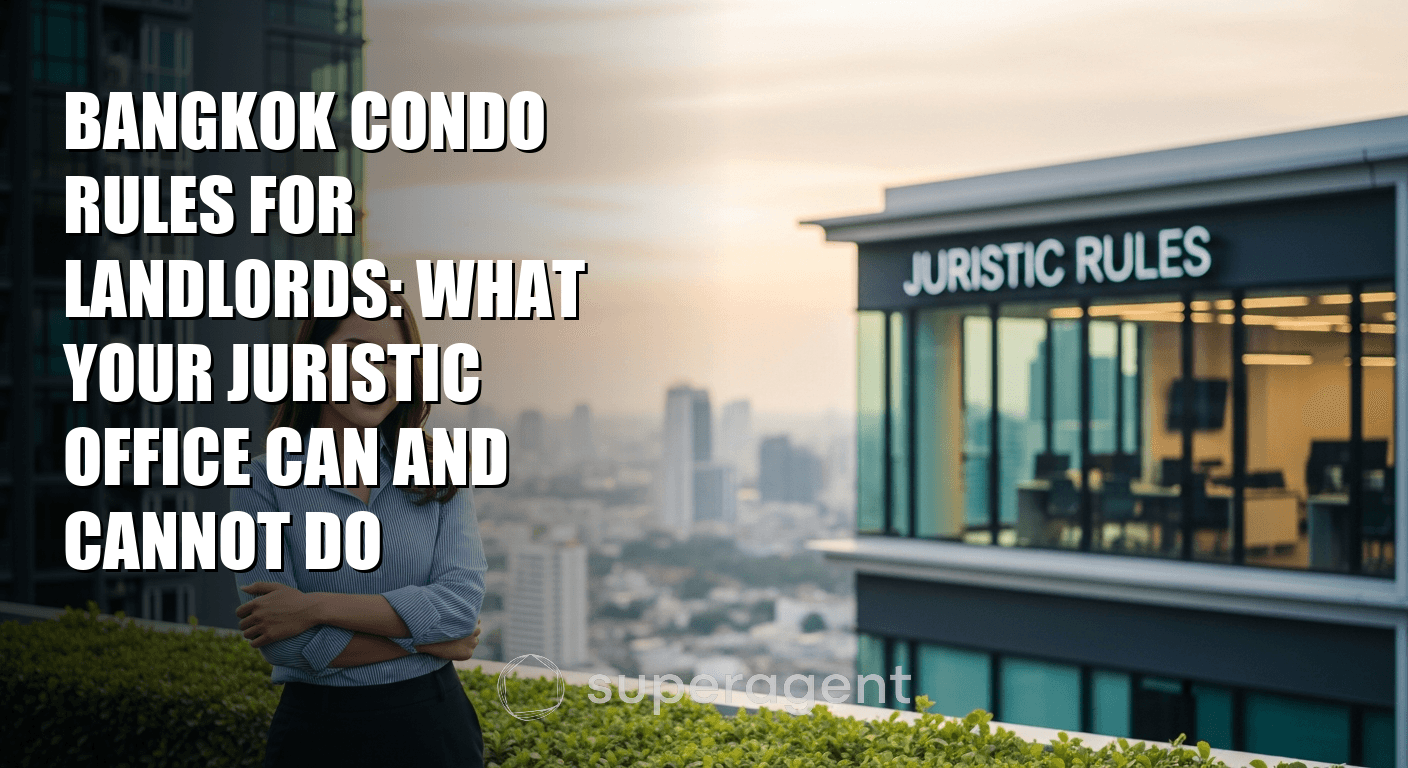
Bangkok Condo Rules for Landlords: What Your Juristic Office Can and Cannot Do
Guides
Bangkok Condo Rules for Landlords: What Your Juristic Office Can and Cannot Do
Understand your juristic office's legal boundaries and protect your rental investment.
Summary
Learn what Bangkok juristic offices can and cannot do as a landlord. Understand condo rules, tenant rights, and your legal obligations in Thailand.
You just bought a condo at Life Asoke Hype near MRT Phetchaburi to rent out. The tenant moves in, everything is smooth, and then you get a letter from the juristic office saying your tenant cannot use the pool after 8pm because "rental tenants are restricted." Wait, can they actually do that? The short answer is: sometimes yes, sometimes no. And if you are a landlord in Bangkok, understanding what the juristic office can and cannot enforce will save you from headaches, lost tenants, and money down the drain.
What Exactly Is a Juristic Office and Why Should Landlords Care?
Every registered condominium in Thailand has a juristic person, essentially the management body that runs the building. They handle common area maintenance, security, finances, and building rules. The juristic office operates under the Condominium Act B.E. 2522 (and its amendments), which gives them real legal authority to set and enforce regulations.
Here is the thing most landlords miss: the juristic office answers to the co-owner committee and ultimately to the AGM (Annual General Meeting) where unit owners vote. If you own a condo at Ideo Q Sukhumvit 36 near BTS Thong Lo and you never attend the AGM, you are letting other people decide the rules your tenants have to follow.
For example, a landlord renting out a one bedroom at 25,000 THB per month in that building discovered at renewal time that the AGM had voted to ban short-term rentals under 30 days. Because he never attended the meeting, he had no idea until his tenant flagged it. The rule was perfectly legal, and he had to comply.
Rules the Juristic Office Can Legally Enforce
The juristic office has broad power over common areas and building conduct. They can set quiet hours, restrict pet sizes and breeds, regulate moving in and moving out schedules, limit the use of elevators for cargo, and impose fines for violations. These rules apply to everyone in the building, owners and tenants alike.
They can also require tenant registration. At many buildings along the Sukhumvit corridor, places like Noble Refine near BTS Phrom Phong or The Lumpini 24 near BTS Phrom Phong, you must register your tenant with the juristic office and provide a copy of the lease agreement. This is standard and completely within their rights.
One area that surprises landlords is renovation restrictions. If you want to upgrade your unit at Aspire Sukhumvit 48 before listing it for 18,000 THB per month, the juristic office can dictate which contractors are allowed, set working hours (usually 9am to 5pm on weekdays), and require a refundable deposit of 20,000 to 50,000 THB. They can even reject cosmetic changes that affect the building's exterior appearance.
Where the Juristic Office Oversteps
This is where it gets interesting for landlords. The juristic office cannot create rules that contradict Thai law or the Condominium Act itself. They also cannot enforce rules that were never properly approved at an AGM or that discriminate against tenants in ways not supported by the building's registered regulations.
A common overreach happens with pool and gym access. Some buildings try to charge tenants a separate facility fee on top of what the owner already pays in common area fees. At a building near BTS Ari, a landlord renting a studio for 15,000 THB per month found that the juristic office was charging his tenant 3,000 THB per month for gym access. The problem was this fee had never been voted on at an AGM. After the landlord pushed back with a written complaint referencing the building's bylaws, the charge was dropped.
The juristic office also cannot prevent you from renting out your unit entirely, as long as the lease complies with Thai law and any properly voted building regulations. Ownership rights under the Condominium Act include the right to use, rent, or sell your property. A blanket ban on all rentals, if never approved by a proper AGM resolution, would not hold up.
How to Protect Yourself as a Landlord
First, attend the AGM or assign a proxy. This is non-negotiable. Rules that affect your rental income get decided at these meetings, and you need a voice. Buildings like The Base Park West near BTS On Nut hold AGMs once a year, and the notice usually arrives 7 to 14 days in advance.
Second, get a copy of the building's registered regulations before you buy or before you set your rental terms. Read them. If the rules say no pets and your target tenant demographic at a place near BTS Ekkamai is pet-owning expats paying 30,000 to 45,000 THB per month, you have a mismatch that will cost you.
Third, put building rules in your lease agreement. If quiet hours are 10pm to 7am, state that clearly. If the building requires tenant registration within 7 days, make that the tenant's obligation in writing. This protects you if a tenant violates building rules and the juristic office comes after the owner.
When to Push Back and How
If you believe the juristic office is enforcing a rule improperly, start with a written request asking them to cite the specific regulation and the AGM resolution that approved it. Be polite but firm. Most disputes at Bangkok condos resolve at this stage because many overreaching rules were never formally approved.
A landlord at Rhythm Sukhumvit 36-38 near BTS Thong Lo once received a notice that his tenant's motorcycle could not park in the building's parking area. The juristic office claimed it was a "new policy." The landlord asked for the AGM minutes. Turns out, no vote had ever taken place. The rule was quietly withdrawn.
If a written approach does not work, you can file a complaint with the Department of Lands or consult a property lawyer. Legal consultations in Bangkok typically run 2,000 to 5,000 THB for an initial session, a small price to protect a rental generating 20,000 or more per month.
Knowing the boundaries of your juristic office puts you in control of your rental investment. It helps you set accurate expectations with tenants, avoid unnecessary fees, and keep your unit competitive in a crowded market. If you are listing a condo in Bangkok and want to make sure your property is positioned right from the start, Superagent at superagent.co can help you manage the details so you can focus on being a smarter landlord.
You just bought a condo at Life Asoke Hype near MRT Phetchaburi to rent out. The tenant moves in, everything is smooth, and then you get a letter from the juristic office saying your tenant cannot use the pool after 8pm because "rental tenants are restricted." Wait, can they actually do that? The short answer is: sometimes yes, sometimes no. And if you are a landlord in Bangkok, understanding what the juristic office can and cannot enforce will save you from headaches, lost tenants, and money down the drain.
What Exactly Is a Juristic Office and Why Should Landlords Care?
Every registered condominium in Thailand has a juristic person, essentially the management body that runs the building. They handle common area maintenance, security, finances, and building rules. The juristic office operates under the Condominium Act B.E. 2522 (and its amendments), which gives them real legal authority to set and enforce regulations.
Here is the thing most landlords miss: the juristic office answers to the co-owner committee and ultimately to the AGM (Annual General Meeting) where unit owners vote. If you own a condo at Ideo Q Sukhumvit 36 near BTS Thong Lo and you never attend the AGM, you are letting other people decide the rules your tenants have to follow.
For example, a landlord renting out a one bedroom at 25,000 THB per month in that building discovered at renewal time that the AGM had voted to ban short-term rentals under 30 days. Because he never attended the meeting, he had no idea until his tenant flagged it. The rule was perfectly legal, and he had to comply.
Continue reading after that.
Looking for a condo
to rent?
Leave your name and phone. We'll follow up while you keep reading.
100% Secure
Fast Response
Free Consultation
Rules the Juristic Office Can Legally Enforce
The juristic office has broad power over common areas and building conduct. They can set quiet hours, restrict pet sizes and breeds, regulate moving in and moving out schedules, limit the use of elevators for cargo, and impose fines for violations. These rules apply to everyone in the building, owners and tenants alike.
They can also require tenant registration. At many buildings along the Sukhumvit corridor, places like Noble Refine near BTS Phrom Phong or The Lumpini 24 near BTS Phrom Phong, you must register your tenant with the juristic office and provide a copy of the lease agreement. This is standard and completely within their rights.
One area that surprises landlords is renovation restrictions. If you want to upgrade your unit at Aspire Sukhumvit 48 before listing it for 18,000 THB per month, the juristic office can dictate which contractors are allowed, set working hours (usually 9am to 5pm on weekdays), and require a refundable deposit of 20,000 to 50,000 THB. They can even reject cosmetic changes that affect the building's exterior appearance.
Where the Juristic Office Oversteps
This is where it gets interesting for landlords. The juristic office cannot create rules that contradict Thai law or the Condominium Act itself. They also cannot enforce rules that were never properly approved at an AGM or that discriminate against tenants in ways not supported by the building's registered regulations.
A common overreach happens with pool and gym access. Some buildings try to charge tenants a separate facility fee on top of what the owner already pays in common area fees. At a building near BTS Ari, a landlord renting a studio for 15,000 THB per month found that the juristic office was charging his tenant 3,000 THB per month for gym access. The problem was this fee had never been voted on at an AGM. After the landlord pushed back with a written complaint referencing the building's bylaws, the charge was dropped.
The juristic office also cannot prevent you from renting out your unit entirely, as long as the lease complies with Thai law and any properly voted building regulations. Ownership rights under the Condominium Act include the right to use, rent, or sell your property. A blanket ban on all rentals, if never approved by a proper AGM resolution, would not hold up.
How to Protect Yourself as a Landlord
First, attend the AGM or assign a proxy. This is non-negotiable. Rules that affect your rental income get decided at these meetings, and you need a voice. Buildings like The Base Park West near BTS On Nut hold AGMs once a year, and the notice usually arrives 7 to 14 days in advance.
Second, get a copy of the building's registered regulations before you buy or before you set your rental terms. Read them. If the rules say no pets and your target tenant demographic at a place near BTS Ekkamai is pet-owning expats paying 30,000 to 45,000 THB per month, you have a mismatch that will cost you.
Continue reading after that.
Looking for a condo
to rent?
Leave your name and phone. We'll follow up while you keep reading.
100% Secure
Fast Response
Free Consultation
Third, put building rules in your lease agreement. If quiet hours are 10pm to 7am, state that clearly. If the building requires tenant registration within 7 days, make that the tenant's obligation in writing. This protects you if a tenant violates building rules and the juristic office comes after the owner.
When to Push Back and How
If you believe the juristic office is enforcing a rule improperly, start with a written request asking them to cite the specific regulation and the AGM resolution that approved it. Be polite but firm. Most disputes at Bangkok condos resolve at this stage because many overreaching rules were never formally approved.
A landlord at Rhythm Sukhumvit 36-38 near BTS Thong Lo once received a notice that his tenant's motorcycle could not park in the building's parking area. The juristic office claimed it was a "new policy." The landlord asked for the AGM minutes. Turns out, no vote had ever taken place. The rule was quietly withdrawn.
If a written approach does not work, you can file a complaint with the Department of Lands or consult a property lawyer. Legal consultations in Bangkok typically run 2,000 to 5,000 THB for an initial session, a small price to protect a rental generating 20,000 or more per month.
Knowing the boundaries of your juristic office puts you in control of your rental investment. It helps you set accurate expectations with tenants, avoid unnecessary fees, and keep your unit competitive in a crowded market. If you are listing a condo in Bangkok and want to make sure your property is positioned right from the start, Superagent at superagent.co can help you manage the details so you can focus on being a smarter landlord.
Share this article
Properties you may like
![[For Rent] CONDO I Skyrise Avenue Sukhumvit 64 I 2 Beds I 2 Baths I 27,000THB/mo](/_next/image?url=https%3A%2F%2Fstorage.googleapis.com%2Fsuperagent-web%2Fattachments%2Flistings%2F2001%2F670f91de-c251-4e81-971c-8e30ed2158cd-screenshot-2026-07-05-at-11.38.53-pm.png&w=3840&q=75)
฿27,000
2 Bed252 sqm
[For Rent] CONDO I Skyrise Avenue Sukhumvit 64 I 2 Beds I 2 Baths I 27,000THB/mo
Punnawithi
Condo![[For Rent] CONDO I Park Origin Ratchathewi I Duplex I 2 Beds I 1 Bath I 32,000THB/mo](/_next/image?url=https%3A%2F%2Fstorage.googleapis.com%2Fsuperagent-web%2Fattachments%2Flistings%2F6896%2Fb79a7d21-7533-4b0d-bb19-762ebfafab62-1318-6.jpg&w=3840&q=75)
฿32,000
2 Bed135.9 sqm
[For Rent] CONDO I Park Origin Ratchathewi I Duplex I 2 Beds I 1 Bath I 32,000THB/mo
Ratchathewi
Condo![[For Rent] CONDO I Park Origin Phayathai I Studio I 1 Bath I 28,000THB/mo](/_next/image?url=https%3A%2F%2Fstorage.googleapis.com%2Fsuperagent-web%2Fattachments%2Flistings%2F6757%2Fb226df93-94c6-46fa-aeba-ebfadc7f81b8-1000006042.jpg&w=3840&q=75)
฿28,000
Studio129 sqm
[For Rent] CONDO I Park Origin Phayathai I Studio I 1 Bath I 28,000THB/mo
Phaya Thai
Condo![[For Rent] CONDO I Ideo Mobi Sukhumvit 81 I Duplex I 1 Bed I 1 Bath I 28,000THB/mo](/_next/image?url=https%3A%2F%2Fstorage.googleapis.com%2Fsuperagent-web%2Fattachments%2Flistings%2F1849%2Fc8b2c033-3b5f-4615-b2b0-4972f40141f0-705-13.jpg&w=3840&q=75)
฿28,000
1 Bed143 sqm
[For Rent] CONDO I Ideo Mobi Sukhumvit 81 I Duplex I 1 Bed I 1 Bath I 28,000THB/mo
On Nut
Condo![[For Rent] CONDO I Siamese Sukhumvit 48 I 1 Bed I 1 Bath I 28,000THB/mo](/_next/image?url=https%3A%2F%2Fstorage.googleapis.com%2Fsuperagent-web%2Fattachments%2Flistings%2F6841%2Febc2dce2-2e9b-4e6d-a01c-0cfa619dfa13-1231-6.jpg&w=3840&q=75)
฿28,000
1 Bed144 sqm
[For Rent] CONDO I Siamese Sukhumvit 48 I 1 Bed I 1 Bath I 28,000THB/mo
Condo![[For Rent] CONDO I Ashton Asoke I 1 Bed I 1 Bath I 22,000THB/mo](/_next/image?url=https%3A%2F%2Fstorage.googleapis.com%2Fsuperagent-web%2Fattachments%2Flistings%2F6802%2Fe06b9b73-1207-414a-ab04-1685de0c7eaa-20220808_153124_0.jpg&w=3840&q=75)
฿22,000
1 Bed134 sqm
[For Rent] CONDO I Ashton Asoke I 1 Bed I 1 Bath I 22,000THB/mo
Asoke
Condo![[For Rent] CONDO I HQ Thonglor Soi 4 I 1 Bed I 1 Bath I 35,000 THB/mo](/_next/image?url=https%3A%2F%2Fstorage.googleapis.com%2Fsuperagent-web%2Fattachments%2Flistings%2F1445%2F72352585-1bc2-41a8-bd62-ddcbf8189fe9-376-5.jpg&w=3840&q=75)
฿35,000
1 Bed143.6 sqm
[For Rent] CONDO I HQ Thonglor Soi 4 I 1 Bed I 1 Bath I 35,000 THB/mo
Thonglor
Condo![[For Rent] CONDO I The Master Centrium Asoke - Sukhumvit I Duplex I 2 Beds I 3 Baths I 75,000 THB/mo](/_next/image?url=https%3A%2F%2Fstorage.googleapis.com%2Fsuperagent-web%2Fattachments%2Flistings%2F1545%2F97932b6a-c358-45e4-b5f9-995dbf5a3cf0-441-2.jpg&w=3840&q=75)
฿75,000
2 Bed3150 sqm
[For Rent] CONDO I The Master Centrium Asoke - Sukhumvit I Duplex I 2 Beds I 3 Baths I 75,000 THB/mo
Asoke
Condo![[For Rent] CONDO I Ideo Sukhumvit 93 I 1 Bed I 1 Bath I 18,000THB/mo](/_next/image?url=https%3A%2F%2Fstorage.googleapis.com%2Fsuperagent-web%2Fattachments%2Flistings%2F6907%2Fb41f8377-3447-4526-87ab-a26a1c299e5d-1325-1.jpg&w=3840&q=75)
฿18,000
1 Bed130 sqm
[For Rent] CONDO I Ideo Sukhumvit 93 I 1 Bed I 1 Bath I 18,000THB/mo
Condo![[For Rent] CONDO I Ideo Sukhumvit 93 I 1 Bed I 1 Bath I 20,000THB/mo](/_next/image?url=https%3A%2F%2Fstorage.googleapis.com%2Fsuperagent-web%2Fattachments%2Flistings%2F6848%2F604285ae-9826-4938-a370-50ec872df06f-1238-1.jpg&w=3840&q=75)
฿20,000
1 Bed134 sqm
[For Rent] CONDO I Ideo Sukhumvit 93 I 1 Bed I 1 Bath I 20,000THB/mo
CondoMore like this
 In Guides · Superagent EditorialHidden Costs of Renting a Condo in Bangkok Nobody Warns You AboutBangkok condo rent looks affordable until month one hits. Here are the real costs beyond the headline figure that catch most renters off guard.25 May 20261 min read
 In Guides · Superagent EditorialWhat a Long-Vacant Bangkok Condo Unit Is Actually Telling YouA Bangkok condo vacant for months signals overpricing, landlord issues, or real problems. Here is how to read the signs.25 May 20261 min read
 In Guides · Superagent EditorialRed Flags in a Bangkok Rental Contract to Watch Out ForBangkok rental contracts often hide risky clauses. Here are the red flags every tenant must catch before signing any lease.25 May 20261 min read
 In Guides · Superagent EditorialWorking Online from a Condo: How to Choose the Perfect Room for ProductivityLearn how to choose the best condo room for working online with tips on lighting, noise, and furniture setup to maximize productivity.9 May 20261 min read