BTS vs. MRT: Which Line Should Decide Where You Live in Bangkok?
Guides
BTS vs. MRT: Which Line Should Decide Where You Live in Bangkok?
Choose your Bangkok home based on which transit system fits your lifestyle and budget.
Summary
Compare BTS vs MRT Bangkok to find the perfect neighborhood for your rental. Learn which line offers better access, amenities, and value for expats.
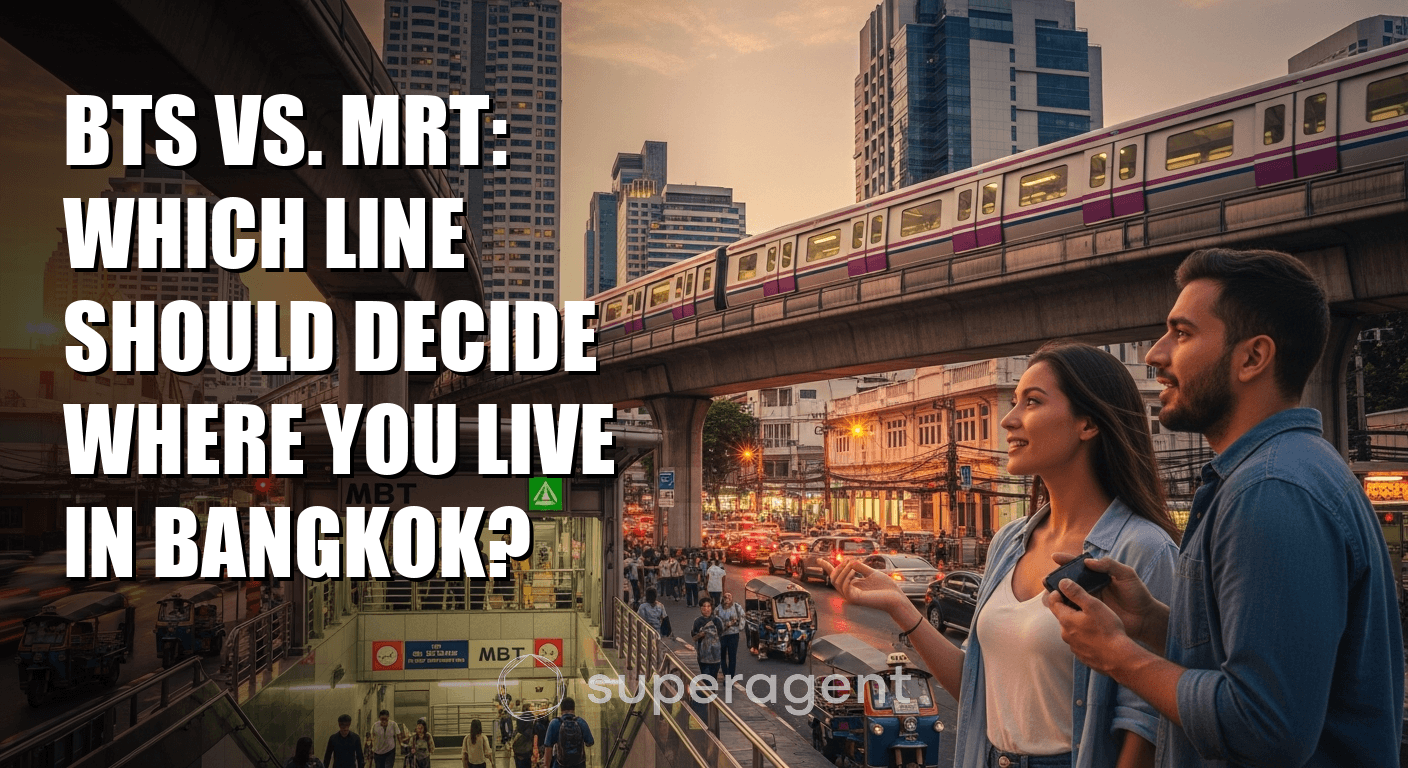
Every renter in Bangkok eventually faces the same question. You've found two condos you like, one near a BTS station and one near an MRT station, and you're staring at a map trying to figure out which transit line will actually make your life easier. It's not just about getting from A to B. The line you choose shapes your commute, your neighborhood vibe, your grocery options, and honestly, how much you'll pay in rent each month.
Let's break down what actually matters when choosing between the BTS Skytrain and the MRT subway, and how each line changes your daily life as a renter in Bangkok.
The BTS Sukhumvit Line: Expat Comfort with a Price Tag
The BTS Sukhumvit Line is the backbone of expat life in Bangkok. Stations like Asok, Phrom Phong, Thong Lo, and Ekkamai sit along one of the most popular rental corridors in the city. If you want international restaurants, rooftop bars, co-working spaces, and English-friendly services within walking distance, this is your line.
But you'll pay for it. A one-bedroom condo at a place like Park Origin Phrom Phong or Noble Recole near Asok will run you 18,000 to 30,000 THB per month depending on the unit and floor. Head further out toward Bearing or Samrong and prices drop to the 8,000 to 14,000 THB range, but you'll trade walkability and nightlife for quieter, more residential surroundings.
Here's a real scenario. Say you work at a company near Chit Lom or Siam. Living near On Nut gives you a 20 minute ride with no transfers, and a modern one-bedroom at The Base Park West or Ideo Mobi Sukhumvit for around 12,000 to 16,000 THB. That's one of the best value plays on the entire Sukhumvit Line right now.
The BTS Silom Line: For Finance Types and Old Bangkok Fans
The Silom Line doesn't get as much love from renters, but it quietly serves some of Bangkok's most interesting neighborhoods. Stations like Chong Nonsi, Surasak, and Saphan Taksin put you close to Sathorn's business district, Silom's street food scene, and the Chao Phraya River.
If you work in finance, law, or at an embassy, the Silom Line probably makes more sense than Sukhumvit. A condo like The Address Sathorn near Chong Nonsi goes for about 20,000 to 28,000 THB for a one-bedroom. Alternatively, something like Aspire Sathorn Ratchaprarop near Surasak can dip closer to 13,000 to 17,000 THB.
Picture this. You're a consultant working on Sathorn Soi 12. Living near Saint Louis BTS station means a five minute commute and a neighborhood with great local food stalls, fewer tourists, and a more genuinely Thai atmosphere than anything along lower Sukhumvit. It's a trade-off that a lot of long-term renters happily make.
The MRT Blue Line: More Space, Lower Rent, Real Bangkok
The MRT Blue Line is where budget-conscious renters and people who actually want to live like locals tend to end up. Stations like Phra Ram 9, Huai Khwang, Sutthisan, and Lat Phrao offer significantly cheaper rent than anything on the BTS, and the neighborhoods feel less curated and more lived-in.
A solid one-bedroom at Life Asoke Hype near Phra Ram 9 goes for around 14,000 to 20,000 THB. Move a couple stops to Huai Khwang and you'll find studios at Chapter One Midtown for 9,000 to 12,000 THB. The night market at Huai Khwang alone is worth the move if you like eating well for 50 to 80 THB a meal.
The Blue Line also now loops through Tha Phra, Bang Phai, and Lak Song, opening up the Thonburi side of the river. These areas are still developing, but renters who don't mind being early adopters can find brand new condos for under 8,000 THB per month. That's almost unheard of near any BTS station.
Transfer Stations: The Best of Both Worlds
If you can't decide between lines, live near a transfer station. Asok and Sukhumvit station connect the BTS Sukhumvit Line to the MRT Blue Line. Mo Chit and Chatuchak Park do the same thing up north. These spots give you maximum flexibility, which matters a lot when your office, gym, and social life are scattered across the city.
Take someone who works near Silom but has friends in the Ratchada and Huai Khwang area. Living near Asok means one transfer gets you almost anywhere. Yes, rent near Asok is higher, typically 16,000 to 28,000 THB for a decent one-bedroom at buildings like Edge Sukhumvit 23 or The Lofts Asoke. But the time you save on commuting and the flexibility you gain can be worth every baht.
What Actually Matters When Choosing Your Line
Forget brand loyalty to the BTS or MRT. Focus on three things. First, where is your office? Count the stations and transfers, not the kilometers. Second, what's your rent budget? The MRT consistently offers lower rents for comparable quality. Third, what kind of neighborhood do you want? BTS Sukhumvit is polished and international. BTS Silom is professional and riverside. MRT Blue Line is local, affordable, and full of street food.
Also consider this. BTS stations are elevated and open-air, which means you'll feel the heat on platforms during April. MRT stations are underground and air-conditioned throughout. It sounds small, but after a year of commuting, the little things add up.
Your transit line isn't just transportation. It's your neighborhood, your lifestyle, and a big chunk of your monthly budget. Pick the line that matches how you actually live, not just where you work. And if you want to compare condos along specific stations without spending weeks on LINE groups and Facebook threads, try searching on superagent.co to find listings matched to your commute, budget, and the vibe you're looking for.
Every renter in Bangkok eventually faces the same question. You've found two condos you like, one near a BTS station and one near an MRT station, and you're staring at a map trying to figure out which transit line will actually make your life easier. It's not just about getting from A to B. The line you choose shapes your commute, your neighborhood vibe, your grocery options, and honestly, how much you'll pay in rent each month.
Let's break down what actually matters when choosing between the BTS Skytrain and the MRT subway, and how each line changes your daily life as a renter in Bangkok.
The BTS Sukhumvit Line: Expat Comfort with a Price Tag
The BTS Sukhumvit Line is the backbone of expat life in Bangkok. Stations like Asok, Phrom Phong, Thong Lo, and Ekkamai sit along one of the most popular rental corridors in the city. If you want international restaurants, rooftop bars, co-working spaces, and English-friendly services within walking distance, this is your line.
But you'll pay for it. A one-bedroom condo at a place like Park Origin Phrom Phong or Noble Recole near Asok will run you 18,000 to 30,000 THB per month depending on the unit and floor. Head further out toward Bearing or Samrong and prices drop to the 8,000 to 14,000 THB range, but you'll trade walkability and nightlife for quieter, more residential surroundings.
Continue reading after that.
Looking for a condo
to rent?
Leave your name and phone. We'll follow up while you keep reading.
100% Secure
Fast Response
Free Consultation
Here's a real scenario. Say you work at a company near Chit Lom or Siam. Living near On Nut gives you a 20 minute ride with no transfers, and a modern one-bedroom at The Base Park West or Ideo Mobi Sukhumvit for around 12,000 to 16,000 THB. That's one of the best value plays on the entire Sukhumvit Line right now.
The BTS Silom Line: For Finance Types and Old Bangkok Fans
The Silom Line doesn't get as much love from renters, but it quietly serves some of Bangkok's most interesting neighborhoods. Stations like Chong Nonsi, Surasak, and Saphan Taksin put you close to Sathorn's business district, Silom's street food scene, and the Chao Phraya River.
If you work in finance, law, or at an embassy, the Silom Line probably makes more sense than Sukhumvit. A condo like The Address Sathorn near Chong Nonsi goes for about 20,000 to 28,000 THB for a one-bedroom. Alternatively, something like Aspire Sathorn Ratchaprarop near Surasak can dip closer to 13,000 to 17,000 THB.
Picture this. You're a consultant working on Sathorn Soi 12. Living near Saint Louis BTS station means a five minute commute and a neighborhood with great local food stalls, fewer tourists, and a more genuinely Thai atmosphere than anything along lower Sukhumvit. It's a trade-off that a lot of long-term renters happily make.
The MRT Blue Line: More Space, Lower Rent, Real Bangkok
The MRT Blue Line is where budget-conscious renters and people who actually want to live like locals tend to end up. Stations like Phra Ram 9, Huai Khwang, Sutthisan, and Lat Phrao offer significantly cheaper rent than anything on the BTS, and the neighborhoods feel less curated and more lived-in.
A solid one-bedroom at Life Asoke Hype near Phra Ram 9 goes for around 14,000 to 20,000 THB. Move a couple stops to Huai Khwang and you'll find studios at Chapter One Midtown for 9,000 to 12,000 THB. The night market at Huai Khwang alone is worth the move if you like eating well for 50 to 80 THB a meal.
The Blue Line also now loops through Tha Phra, Bang Phai, and Lak Song, opening up the Thonburi side of the river. These areas are still developing, but renters who don't mind being early adopters can find brand new condos for under 8,000 THB per month. That's almost unheard of near any BTS station.
Transfer Stations: The Best of Both Worlds
If you can't decide between lines, live near a transfer station. Asok and Sukhumvit station connect the BTS Sukhumvit Line to the MRT Blue Line. Mo Chit and Chatuchak Park do the same thing up north. These spots give you maximum flexibility, which matters a lot when your office, gym, and social life are scattered across the city.
Take someone who works near Silom but has friends in the Ratchada and Huai Khwang area. Living near Asok means one transfer gets you almost anywhere. Yes, rent near Asok is higher, typically 16,000 to 28,000 THB for a decent one-bedroom at buildings like Edge Sukhumvit 23 or The Lofts Asoke. But the time you save on commuting and the flexibility you gain can be worth every baht.
Continue reading after that.
Looking for a condo
to rent?
Leave your name and phone. We'll follow up while you keep reading.
100% Secure
Fast Response
Free Consultation
What Actually Matters When Choosing Your Line
Forget brand loyalty to the BTS or MRT. Focus on three things. First, where is your office? Count the stations and transfers, not the kilometers. Second, what's your rent budget? The MRT consistently offers lower rents for comparable quality. Third, what kind of neighborhood do you want? BTS Sukhumvit is polished and international. BTS Silom is professional and riverside. MRT Blue Line is local, affordable, and full of street food.
Also consider this. BTS stations are elevated and open-air, which means you'll feel the heat on platforms during April. MRT stations are underground and air-conditioned throughout. It sounds small, but after a year of commuting, the little things add up.
Your transit line isn't just transportation. It's your neighborhood, your lifestyle, and a big chunk of your monthly budget. Pick the line that matches how you actually live, not just where you work. And if you want to compare condos along specific stations without spending weeks on LINE groups and Facebook threads, try searching on superagent.co to find listings matched to your commute, budget, and the vibe you're looking for.
Share this article
Properties you may like
More like this
 In Guides · Superagent EditorialHidden Costs of Renting a Condo in Bangkok Nobody Warns You AboutBangkok condo rent looks affordable until month one hits. Here are the real costs beyond the headline figure that catch most renters off guard.25 May 20261 min read
 In Guides · Superagent EditorialWhat a Long-Vacant Bangkok Condo Unit Is Actually Telling YouA Bangkok condo vacant for months signals overpricing, landlord issues, or real problems. Here is how to read the signs.25 May 20261 min read
 In Guides · Superagent EditorialRed Flags in a Bangkok Rental Contract to Watch Out ForBangkok rental contracts often hide risky clauses. Here are the red flags every tenant must catch before signing any lease.25 May 20261 min read
 In Guides · Superagent EditorialWorking Online from a Condo: How to Choose the Perfect Room for ProductivityLearn how to choose the best condo room for working online with tips on lighting, noise, and furniture setup to maximize productivity.9 May 20261 min read