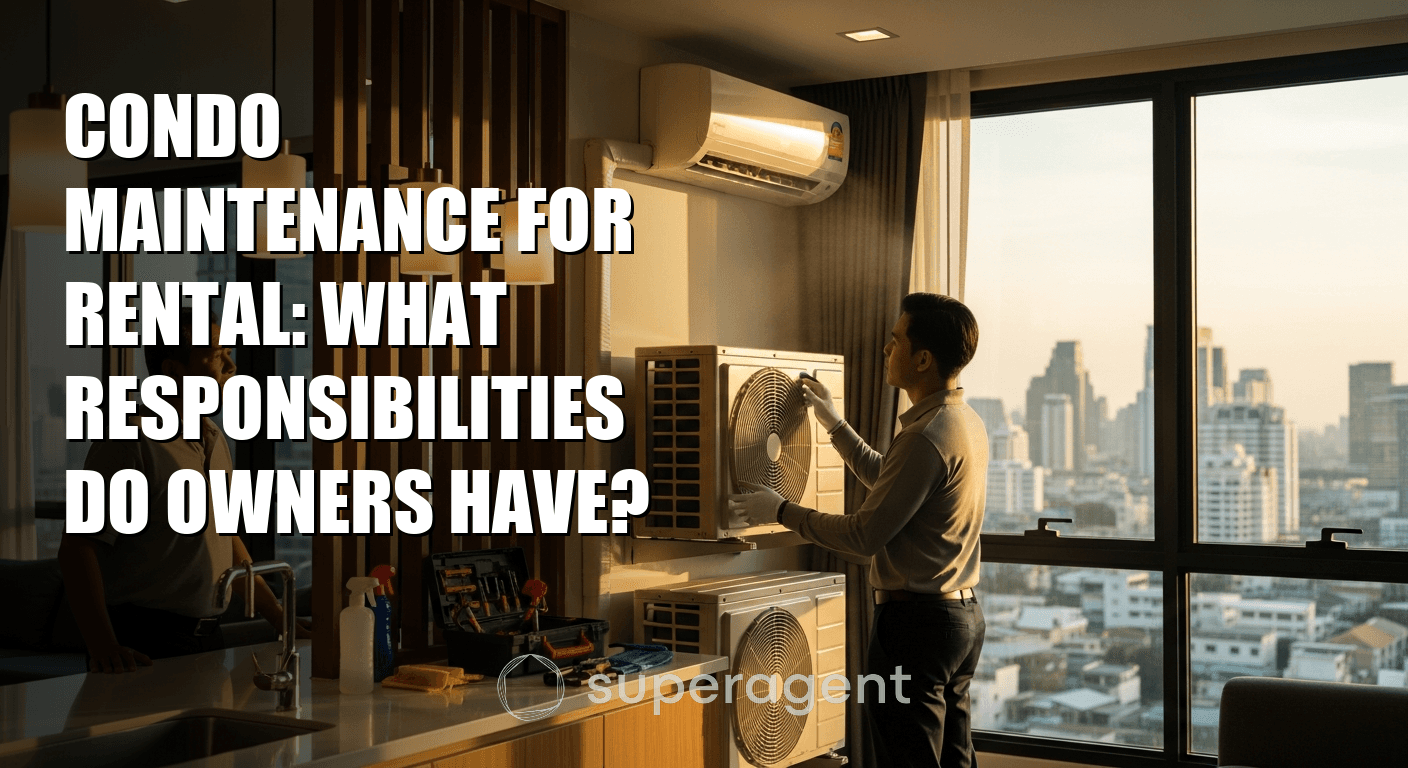
Condo Maintenance for Rental: What Responsibilities Do Owners Have?
Guides
Condo Maintenance for Rental: What Responsibilities Do Owners Have?
Essential maintenance duties that rental condo owners must handle to protect their investment.
Summary
Learn what condo maintenance for rental properties owners are responsible for, including repairs, inspections, and legal obligations to keep tenants satisf
If you own a condo in Bangkok and rent it out, congratulations, you have got a real asset. But here is the thing nobody tells you: that monthly rental income comes with serious responsibility. Tenants expect hot water, working air conditioning, and doors that actually lock. When something breaks, they call you. And if you are not clear about who pays for what, you will end up in a dispute that costs you more than the repair itself.
The rental market in Bangkok is competitive. From Thonglor to Ari, from Chatuchak to On Nut, landlords who keep their units in good shape get better tenants, longer leases, and word-of-mouth referrals. Landlords who ignore maintenance get broken leases, bad reviews on rental platforms, and empty units. In this guide, I walk you through exactly what you are responsible for as a condo owner, what your tenant should handle, and how to set it up so nobody gets surprised.
Your Legal Obligation as a Condo Owner
Under Thai law, you are the owner of the property. That means you are responsible for keeping it in a safe, habitable condition. This is not optional. The Thai Civil and Commercial Code, along with the Condominium Act, makes it clear: the landlord must maintain the structure, major systems, and common areas.
What does that mean in practice? You own the walls, the pipes inside those walls, the electrical wiring, the roof, and everything that is a permanent fixture of the unit. If a pipe bursts in the bathroom, that is yours. If the air conditioner unit that came with the condo fails, you fix it. If the windows leak during the monsoon, your problem.
I met a condo owner in Ploenchit who tried to charge his tenant 15,000 THB for a water heater replacement. The tenant refused, reported him to the property management, and broke the lease early. The owner ended up losing two months of rent, had to replace the heater anyway, and spent weeks finding a new tenant. Save yourself the headache.
What is Built Into the Unit
Think of it this way: if it came with your condo when you bought it, or if you had it installed as part of the original condition, you maintain it. This includes air conditioners (both window units and split systems that are affixed to walls), water heaters, kitchen appliances that are permanently installed, ceiling fans that are hardwired, light fixtures, and bathroom fixtures like faucets and showerheads.
In Bangkok, most mid-range rentals in areas like Ekkamai, Pratunam, or Phrom Phong come with basic furniture and appliances. That air conditioner unit in the bedroom that cost 8,000 THB? Your responsibility. The hot water heater that heated the unit when your tenant moved in? You fix it if it stops working.
The rule is simple: if removing it would damage the unit, you own it. If it was part of the deal when the tenant signed the lease, you maintain it. Document the condition of every fixture in a move-in inspection report. Photograph everything. This protects you both.
What Tenants Are Responsible For
Your tenant is not your maintenance contractor. But they are responsible for day-to-day upkeep and minor damage caused by their misuse or neglect. This is where most disputes happen, so get it in writing from day one.
Tenants handle light bulbs, batteries in remote controls, and keeping the unit clean. If they block the drain by putting hair in it every day, that is on them. If they spill coffee on the carpet and do not clean it, that is their problem. If they hang heavy picture frames without permission and damage the wall, they pay for the hole.
If they break a window by throwing something at it, that is user damage. If a window crack appears on its own, that is wear and tear, and you handle it. If they clog the toilet by flushing something they should not have, they pay. If the toilet stops working for no clear reason, you fix it.
A tenant in a two-bedroom near BTS Nana racked up 40,000 THB in damage claims because she refused to tell the landlord about a slow leak under the sink. By the time the owner found out, mold had spread to the floor below. Make your tenant agree to report issues immediately. The faster you catch problems, the cheaper they are to fix.
Major Building Systems and Common Areas
Your condo building has shared systems: lifts, common corridors, the roof, exterior walls, plumbing and electrical that serve multiple units, and parking areas. The building management and condo juristic person handle most of this, and you pay maintenance fees for it.
But here is where it gets important: if a problem affects your specific unit, who pays? If the main water line breaks and it is in the shared wall between your unit and your neighbor's, the building is responsible. If the water line inside your unit fails, you are responsible. If the roof over your unit leaks because of a defect in the building structure, the condo juristic person or building insurer handles it. If your window frame rusts because you never sealed it, that is on you.
Make sure your condo has insurance that covers the building structure. Check with your building management. Most condos in Bangkok require owners to carry building insurance, and you should understand exactly what it covers. Properties in Lumphini, Thong Lor, and Petchburi commonly use CBRE Thailand or local insurance brokers to manage these policies.
Setting Up a Clear Maintenance Agreement
The best way to avoid conflict is to define everything upfront in your lease agreement. Do not rely on verbal promises. Write it down. Specify what you will fix, what the tenant pays for, and what the process is when something breaks.
Here is what should be in your maintenance section: you will fix air conditioner units, water heaters, kitchen appliances, light fixtures, plumbing issues inside the unit, and door locks within 24 to 48 hours of being notified. The tenant will report issues in writing or via email so there is a record. The tenant pays for damage caused by their negligence, abuse, or misuse.
Include an emergency contact procedure. What happens if the air conditioner breaks on a Saturday night? Can the tenant call a technician and bill you, or do they have to wait? If they suffer unreasonable delays, they may break the lease or withhold rent. In Bangkok, technicians are everywhere. You can get someone to your unit in Ratchadamri or Sukhumvit within hours. Have a list of trusted service providers ready before your tenant moves in.
One owner in Chatuchak who manages 8 rental units keeps a maintenance log in a shared Google Sheet with his tenants. When something breaks, the tenant reports it with a photo. He responds within 24 hours and updates the sheet. Costs are tracked. It sounds formal, but it eliminates he said, she said disputes and shows care for the property.
Repair Costs You Should Budget For
Do not be surprised by maintenance costs. In Bangkok, here is what you should expect annually: air conditioner servicing and repairs (4,000 to 15,000 THB per unit per year), water heater maintenance (2,000 to 8,000 THB), plumbing repairs or replacements (5,000 to 50,000 THB depending on severity), painting and wall touch-ups (10,000 to 40,000 THB every 2 to 3 years), and carpet or flooring repairs (10,000 to 100,000 THB depending on damage and materials).
If you rent out a one-bedroom condo in Ari or Ekkamai for 20,000 to 25,000 THB per month, you should reserve at least 10 to 15 percent of gross rental income for maintenance, repairs, and contingencies. That is 2,000 to 3,750 THB per month set aside. Some months you spend nothing. Some months you spend 50,000 THB because the main compressor on the air conditioner fails.
- Air Conditioner Servicing: 1,500 to 3,000 | 2 to 3 times per year | Yes, built-in unit
- Water Heater Repair or Replacement: 2,000 to 12,000 | Every 3 to 5 years | Yes, if it came with unit
- Plumbing Repair (minor leak): 3,000 to 8,000 | As needed | Yes, if inside unit
- Door Lock Replacement: 2,000 to 5,000 | Every 3 to 5 years or on tenant change | Yes
- Carpet or Floor Repair: 10,000 to 100,000 | Every 5 to 10 years or on damage | Normal wear; tenant for abuse
- Wall Paint and Touch-Up: 5,000 to 40,000 | Every 2 to 3 years | Yes, normal wear
- Appliance Repair (built-in oven, microwave): 2,000 to 10,000 | As needed | Yes, if unit came with it
Data point: according to property managers in Bangkok handling units in Thong Lor, Phrom Phong, and Asok, average annual maintenance costs for a furnished one-bedroom condo run between 18,000 and 45,000 THB per year. This varies by age of the building, quality of construction, and tenant behavior.
How to Protect Yourself Financially
Get a security deposit. In Thailand, a standard deposit is one to two months of rent. This covers accidental damage or unpaid utilities when the tenant moves out. If they break something beyond normal wear, you deduct the cost from the deposit. If they cause no damage, you return it fully.
Take high-quality photos and videos of the unit before the tenant moves in. Show everything: the condition of walls, carpet, appliances, and fixtures. Have the tenant sign a move-in inspection form acknowledging the condition. This protects you if they later claim you owe them their deposit for pre-existing damage.
Make sure your lease clearly states that the tenant pays for utilities (electricity, water, internet), keeps the unit clean, and reports maintenance issues in writing. Some owners in On Nut and Pridi Banomyong include a clause that if the tenant does not report a maintenance issue promptly and it worsens, the tenant covers the increased repair cost.
Consider taking out a landlord insurance policy. This is different from building insurance. It covers liability if someone is injured in your unit, and can cover loss of rent if a major incident makes the unit uninhabitable. Insurance brokers in Bangkok can quote you a policy for a few thousand baht per year.
When Things Go Wrong: Dispute Resolution
Despite your best efforts, disputes happen. The tenant claims you are responsible for a repair you think they caused. You think they owe you for damage. How do you handle it?
First, try to resolve it in writing. Send an email or message explaining your position with photos or repair quotes. Give the tenant a chance to respond. Most disputes settle here if both parties are reasonable.
If that does not work, involve a neutral third party. The building management can sometimes mediate. You can hire an inspector to assess whether damage is wear and tear or user damage. Get a written report. It costs 2,000 to 5,000 THB but can save you from a costly legal dispute.
As a last resort, you can go to the Bangkapi District Court or your local municipal court if the amount is small, or hire a lawyer for larger claims. But lawsuits are expensive and slow. Most owners in Bangkok prefer to accept minor losses and move on rather than spend 50,000 THB on legal fees to recover 10,000 THB in damages.
The best dispute resolution is prevention. A clear lease, good documentation, quick response to maintenance requests, and respect for your tenant go a long way. Renters who feel their landlord cares about the property take better care of it themselves.
Managing maintenance for a rental condo in Bangkok requires balance. You need to be responsive and professional, but also firm about what you are and are not responsible for. Set clear expectations in writing, respond quickly to real problems, and do not let small issues become big ones. Keep a maintenance fund, take good photos, and stay organized. Your tenant will respect you for it, and your property will hold its value and attract quality renters year after year.
If you are looking for a well-maintained rental property in Bangkok or want to connect with vetted property managers who understand these maintenance responsibilities, check out Superagent at superagent.co. We connect owners with tenants who respect the property, and we help both sides understand exactly what everyone is responsible for.
If you own a condo in Bangkok and rent it out, congratulations, you have got a real asset. But here is the thing nobody tells you: that monthly rental income comes with serious responsibility. Tenants expect hot water, working air conditioning, and doors that actually lock. When something breaks, they call you. And if you are not clear about who pays for what, you will end up in a dispute that costs you more than the repair itself.
The rental market in Bangkok is competitive. From Thonglor to Ari, from Chatuchak to On Nut, landlords who keep their units in good shape get better tenants, longer leases, and word-of-mouth referrals. Landlords who ignore maintenance get broken leases, bad reviews on rental platforms, and empty units. In this guide, I walk you through exactly what you are responsible for as a condo owner, what your tenant should handle, and how to set it up so nobody gets surprised.
Your Legal Obligation as a Condo Owner
Under Thai law, you are the owner of the property. That means you are responsible for keeping it in a safe, habitable condition. This is not optional. The Thai Civil and Commercial Code, along with the Condominium Act, makes it clear: the landlord must maintain the structure, major systems, and common areas.
What does that mean in practice? You own the walls, the pipes inside those walls, the electrical wiring, the roof, and everything that is a permanent fixture of the unit. If a pipe bursts in the bathroom, that is yours. If the air conditioner unit that came with the condo fails, you fix it. If the windows leak during the monsoon, your problem.
I met a condo owner in Ploenchit who tried to charge his tenant 15,000 THB for a water heater replacement. The tenant refused, reported him to the property management, and broke the lease early. The owner ended up losing two months of rent, had to replace the heater anyway, and spent weeks finding a new tenant. Save yourself the headache.
What is Built Into the Unit
Think of it this way: if it came with your condo when you bought it, or if you had it installed as part of the original condition, you maintain it. This includes air conditioners (both window units and split systems that are affixed to walls), water heaters, kitchen appliances that are permanently installed, ceiling fans that are hardwired, light fixtures, and bathroom fixtures like faucets and showerheads.
In Bangkok, most mid-range rentals in areas like Ekkamai, Pratunam, or Phrom Phong come with basic furniture and appliances. That air conditioner unit in the bedroom that cost 8,000 THB? Your responsibility. The hot water heater that heated the unit when your tenant moved in? You fix it if it stops working.
Continue reading after that.
Looking for a condo
to rent?
Leave your name and phone. We'll follow up while you keep reading.
100% Secure
Fast Response
Free Consultation
The rule is simple: if removing it would damage the unit, you own it. If it was part of the deal when the tenant signed the lease, you maintain it. Document the condition of every fixture in a move-in inspection report. Photograph everything. This protects you both.
What Tenants Are Responsible For
Your tenant is not your maintenance contractor. But they are responsible for day-to-day upkeep and minor damage caused by their misuse or neglect. This is where most disputes happen, so get it in writing from day one.
Tenants handle light bulbs, batteries in remote controls, and keeping the unit clean. If they block the drain by putting hair in it every day, that is on them. If they spill coffee on the carpet and do not clean it, that is their problem. If they hang heavy picture frames without permission and damage the wall, they pay for the hole.
If they break a window by throwing something at it, that is user damage. If a window crack appears on its own, that is wear and tear, and you handle it. If they clog the toilet by flushing something they should not have, they pay. If the toilet stops working for no clear reason, you fix it.
A tenant in a two-bedroom near BTS Nana racked up 40,000 THB in damage claims because she refused to tell the landlord about a slow leak under the sink. By the time the owner found out, mold had spread to the floor below. Make your tenant agree to report issues immediately. The faster you catch problems, the cheaper they are to fix.
Major Building Systems and Common Areas
Your condo building has shared systems: lifts, common corridors, the roof, exterior walls, plumbing and electrical that serve multiple units, and parking areas. The building management and condo juristic person handle most of this, and you pay maintenance fees for it.
But here is where it gets important: if a problem affects your specific unit, who pays? If the main water line breaks and it is in the shared wall between your unit and your neighbor's, the building is responsible. If the water line inside your unit fails, you are responsible. If the roof over your unit leaks because of a defect in the building structure, the condo juristic person or building insurer handles it. If your window frame rusts because you never sealed it, that is on you.
Make sure your condo has insurance that covers the building structure. Check with your building management. Most condos in Bangkok require owners to carry building insurance, and you should understand exactly what it covers. Properties in Lumphini, Thong Lor, and Petchburi commonly use CBRE Thailand or local insurance brokers to manage these policies.
Setting Up a Clear Maintenance Agreement
The best way to avoid conflict is to define everything upfront in your lease agreement. Do not rely on verbal promises. Write it down. Specify what you will fix, what the tenant pays for, and what the process is when something breaks.
Here is what should be in your maintenance section: you will fix air conditioner units, water heaters, kitchen appliances, light fixtures, plumbing issues inside the unit, and door locks within 24 to 48 hours of being notified. The tenant will report issues in writing or via email so there is a record. The tenant pays for damage caused by their negligence, abuse, or misuse.
Include an emergency contact procedure. What happens if the air conditioner breaks on a Saturday night? Can the tenant call a technician and bill you, or do they have to wait? If they suffer unreasonable delays, they may break the lease or withhold rent. In Bangkok, technicians are everywhere. You can get someone to your unit in Ratchadamri or Sukhumvit within hours. Have a list of trusted service providers ready before your tenant moves in.
One owner in Chatuchak who manages 8 rental units keeps a maintenance log in a shared Google Sheet with his tenants. When something breaks, the tenant reports it with a photo. He responds within 24 hours and updates the sheet. Costs are tracked. It sounds formal, but it eliminates he said, she said disputes and shows care for the property.
Repair Costs You Should Budget For
Do not be surprised by maintenance costs. In Bangkok, here is what you should expect annually: air conditioner servicing and repairs (4,000 to 15,000 THB per unit per year), water heater maintenance (2,000 to 8,000 THB), plumbing repairs or replacements (5,000 to 50,000 THB depending on severity), painting and wall touch-ups (10,000 to 40,000 THB every 2 to 3 years), and carpet or flooring repairs (10,000 to 100,000 THB depending on damage and materials).
If you rent out a one-bedroom condo in Ari or Ekkamai for 20,000 to 25,000 THB per month, you should reserve at least 10 to 15 percent of gross rental income for maintenance, repairs, and contingencies. That is 2,000 to 3,750 THB per month set aside. Some months you spend nothing. Some months you spend 50,000 THB because the main compressor on the air conditioner fails.
- Air Conditioner Servicing: 1,500 to 3,000 | 2 to 3 times per year | Yes, built-in unit
- Water Heater Repair or Replacement: 2,000 to 12,000 | Every 3 to 5 years | Yes, if it came with unit
- Plumbing Repair (minor leak): 3,000 to 8,000 | As needed | Yes, if inside unit
- Door Lock Replacement: 2,000 to 5,000 | Every 3 to 5 years or on tenant change | Yes
- Carpet or Floor Repair: 10,000 to 100,000 | Every 5 to 10 years or on damage | Normal wear; tenant for abuse
- Wall Paint and Touch-Up: 5,000 to 40,000 | Every 2 to 3 years | Yes, normal wear
- Appliance Repair (built-in oven, microwave): 2,000 to 10,000 | As needed | Yes, if unit came with it
Data point: according to property managers in Bangkok handling units in Thong Lor, Phrom Phong, and Asok, average annual maintenance costs for a furnished one-bedroom condo run between 18,000 and 45,000 THB per year. This varies by age of the building, quality of construction, and tenant behavior.
Continue reading after that.
Looking for a condo
to rent?
Leave your name and phone. We'll follow up while you keep reading.
100% Secure
Fast Response
Free Consultation
How to Protect Yourself Financially
Get a security deposit. In Thailand, a standard deposit is one to two months of rent. This covers accidental damage or unpaid utilities when the tenant moves out. If they break something beyond normal wear, you deduct the cost from the deposit. If they cause no damage, you return it fully.
Take high-quality photos and videos of the unit before the tenant moves in. Show everything: the condition of walls, carpet, appliances, and fixtures. Have the tenant sign a move-in inspection form acknowledging the condition. This protects you if they later claim you owe them their deposit for pre-existing damage.
Make sure your lease clearly states that the tenant pays for utilities (electricity, water, internet), keeps the unit clean, and reports maintenance issues in writing. Some owners in On Nut and Pridi Banomyong include a clause that if the tenant does not report a maintenance issue promptly and it worsens, the tenant covers the increased repair cost.
Consider taking out a landlord insurance policy. This is different from building insurance. It covers liability if someone is injured in your unit, and can cover loss of rent if a major incident makes the unit uninhabitable. Insurance brokers in Bangkok can quote you a policy for a few thousand baht per year.
When Things Go Wrong: Dispute Resolution
Despite your best efforts, disputes happen. The tenant claims you are responsible for a repair you think they caused. You think they owe you for damage. How do you handle it?
First, try to resolve it in writing. Send an email or message explaining your position with photos or repair quotes. Give the tenant a chance to respond. Most disputes settle here if both parties are reasonable.
If that does not work, involve a neutral third party. The building management can sometimes mediate. You can hire an inspector to assess whether damage is wear and tear or user damage. Get a written report. It costs 2,000 to 5,000 THB but can save you from a costly legal dispute.
As a last resort, you can go to the Bangkapi District Court or your local municipal court if the amount is small, or hire a lawyer for larger claims. But lawsuits are expensive and slow. Most owners in Bangkok prefer to accept minor losses and move on rather than spend 50,000 THB on legal fees to recover 10,000 THB in damages.
The best dispute resolution is prevention. A clear lease, good documentation, quick response to maintenance requests, and respect for your tenant go a long way. Renters who feel their landlord cares about the property take better care of it themselves.
Managing maintenance for a rental condo in Bangkok requires balance. You need to be responsive and professional, but also firm about what you are and are not responsible for. Set clear expectations in writing, respond quickly to real problems, and do not let small issues become big ones. Keep a maintenance fund, take good photos, and stay organized. Your tenant will respect you for it, and your property will hold its value and attract quality renters year after year.
If you are looking for a well-maintained rental property in Bangkok or want to connect with vetted property managers who understand these maintenance responsibilities, check out Superagent at superagent.co. We connect owners with tenants who respect the property, and we help both sides understand exactly what everyone is responsible for.
Share this article
Properties you may like
![[For Rent] HOUSE I Sampran I 3 Beds I 2 Baths I 20,000THB/mo](/_next/image?url=https%3A%2F%2Fstorage.googleapis.com%2Fsuperagent-web%2Fattachments%2Flistings%2F1763%2F15c03c53-e75f-4140-9b11-b3b4d5cf26cd-line_album_-2-7-80-_260603_7.jpg&w=3840&q=75)
฿20,000
3 Bed280 sqm
[For Rent] HOUSE I Sampran I 3 Beds I 2 Baths I 20,000THB/mo
House![[For Rent] CONDO I The Pano Rama 3 I 2 Beds I 2 Baths I 85,000THB/mo](/_next/image?url=https%3A%2F%2Fstorage.googleapis.com%2Fsuperagent-web%2Fattachments%2Flistings%2F6920%2Fc0dea299-7185-4ce3-98f2-917c8d934a28-1326-2.jpg&w=3840&q=75)
฿85,000
2 Bed2110 sqm
[For Rent] CONDO I The Pano Rama 3 I 2 Beds I 2 Baths I 85,000THB/mo
Rama 3
Condo![[For Rent] Ocean Tower 2 Asoke I Flr. 33 I 130,000THB/mo](/_next/image?url=https%3A%2F%2Fstorage.googleapis.com%2Fsuperagent-web%2Fattachments%2Flistings%2F6919%2F5ccfcc58-254c-4ca8-ab9c-81326b4831a2-1329-1.jpg&w=3840&q=75)
฿130,000
0209 sqm
[For Rent] Ocean Tower 2 Asoke I Flr. 33 I 130,000THB/mo
Asoke
Condo![[For Rent] TOWNHOME I Patio Srinakarin Rama 9 I Corner Unit I 3 Beds I 3 Baths I 47,500THB/mo](/_next/image?url=https%3A%2F%2Fstorage.googleapis.com%2Fsuperagent-web%2Fattachments%2Flistings%2F6918%2Ffb464c17-8c48-494f-b7a7-b5bc97d832b4-1333.jpg&w=3840&q=75)
฿47,500
3 Bed3190 sqm
[For Rent] TOWNHOME I Patio Srinakarin Rama 9 I Corner Unit I 3 Beds I 3 Baths I 47,500THB/mo
Condo![[For Rent] TOWNHOME I Patio Srinakarin Rama 9 I 3 Beds I 3 Baths I 42,000THB/mo](/_next/image?url=https%3A%2F%2Fstorage.googleapis.com%2Fsuperagent-web%2Fattachments%2Flistings%2F6917%2F5cfc4305-beb7-4022-ac1b-1d68075ad6f1-615432836_2162870904521148_7371076413897326067_n.jpg&w=3840&q=75)
฿42,000
3 Bed3141 sqm
[For Rent] TOWNHOME I Patio Srinakarin Rama 9 I 3 Beds I 3 Baths I 42,000THB/mo
Condo![[For Rent] TOWNHOME I Patio Srinakarin Rama 9 I 3 Beds I 3 Baths I 47,500THB/mo](/_next/image?url=https%3A%2F%2Fstorage.googleapis.com%2Fsuperagent-web%2Fattachments%2Flistings%2F6916%2F9f3c6f87-9bc4-487d-a888-ed5efe4ebecf-1331-1.jpg&w=3840&q=75)
฿47,500
3 Bed3141 sqm
[For Rent] TOWNHOME I Patio Srinakarin Rama 9 I 3 Beds I 3 Baths I 47,500THB/mo
Townhouse![[For Rent&Sale] TOWNHOME I Patio Srinakarin Rama 9 I 3 Beds I 3 Baths I Rent 47,500THB/mo - Sale 7.5mb THB](/_next/image?url=https%3A%2F%2Fstorage.googleapis.com%2Fsuperagent-web%2Fattachments%2Flistings%2F6915%2F4590708f-ba0f-4d47-a4ca-ba11ee7d4a87-1330-6.jpg&w=3840&q=75)
฿47,500
3 Bed3141 sqm
[For Rent&Sale] TOWNHOME I Patio Srinakarin Rama 9 I 3 Beds I 3 Baths I Rent 47,500THB/mo - Sale 7.5mb THB
Townhouse![[For Rent] CONDO I Chapter Thonglor 25I 1 Bed I 1 Bath I 24,000THB/mo](/_next/image?url=https%3A%2F%2Fstorage.googleapis.com%2Fsuperagent-web%2Fattachments%2Flistings%2F6914%2Fa958c528-cb08-42d8-a0c6-cb1a992f93b2-1337-2.jpg&w=3840&q=75)
฿24,000
1 Bed130 sqm
[For Rent] CONDO I Chapter Thonglor 25I 1 Bed I 1 Bath I 24,000THB/mo
Condo![[For Rent] CONDO I Park Origin Thonglor I 2 Beds I 1 Baths I 47,000THB/mo](/_next/image?url=https%3A%2F%2Fstorage.googleapis.com%2Fsuperagent-web%2Fattachments%2Flistings%2F6913%2Fb3ba2c36-e4f1-4c83-85b2-b3bcdd3a5bfb-1336-1.jpg&w=3840&q=75)
฿47,000
2 Bed145 sqm
[For Rent] CONDO I Park Origin Thonglor I 2 Beds I 1 Baths I 47,000THB/mo
Thonglor
Condo![[For Rent&Sale] CONDO I Kallista Mansion I 3 Beds I 3 Baths I Rent 130,000THB/mo - Sale 55mb THB](/_next/image?url=https%3A%2F%2Fstorage.googleapis.com%2Fsuperagent-web%2Fattachments%2Flistings%2F6912%2F67751863-0dac-40e5-9078-ad4a8b2ece7b-1328-11.jpg&w=3840&q=75)
฿130,000
3 Bed3—
[For Rent&Sale] CONDO I Kallista Mansion I 3 Beds I 3 Baths I Rent 130,000THB/mo - Sale 55mb THB
CondoMore like this
 In Guides · Superagent EditorialHidden Costs of Renting a Condo in Bangkok Nobody Warns You AboutBangkok condo rent looks affordable until month one hits. Here are the real costs beyond the headline figure that catch most renters off guard.25 May 20261 min read
 In Guides · Superagent EditorialWhat a Long-Vacant Bangkok Condo Unit Is Actually Telling YouA Bangkok condo vacant for months signals overpricing, landlord issues, or real problems. Here is how to read the signs.25 May 20261 min read
 In Guides · Superagent EditorialRed Flags in a Bangkok Rental Contract to Watch Out ForBangkok rental contracts often hide risky clauses. Here are the red flags every tenant must catch before signing any lease.25 May 20261 min read
 In Guides · Superagent EditorialWorking Online from a Condo: How to Choose the Perfect Room for ProductivityLearn how to choose the best condo room for working online with tips on lighting, noise, and furniture setup to maximize productivity.9 May 20261 min read