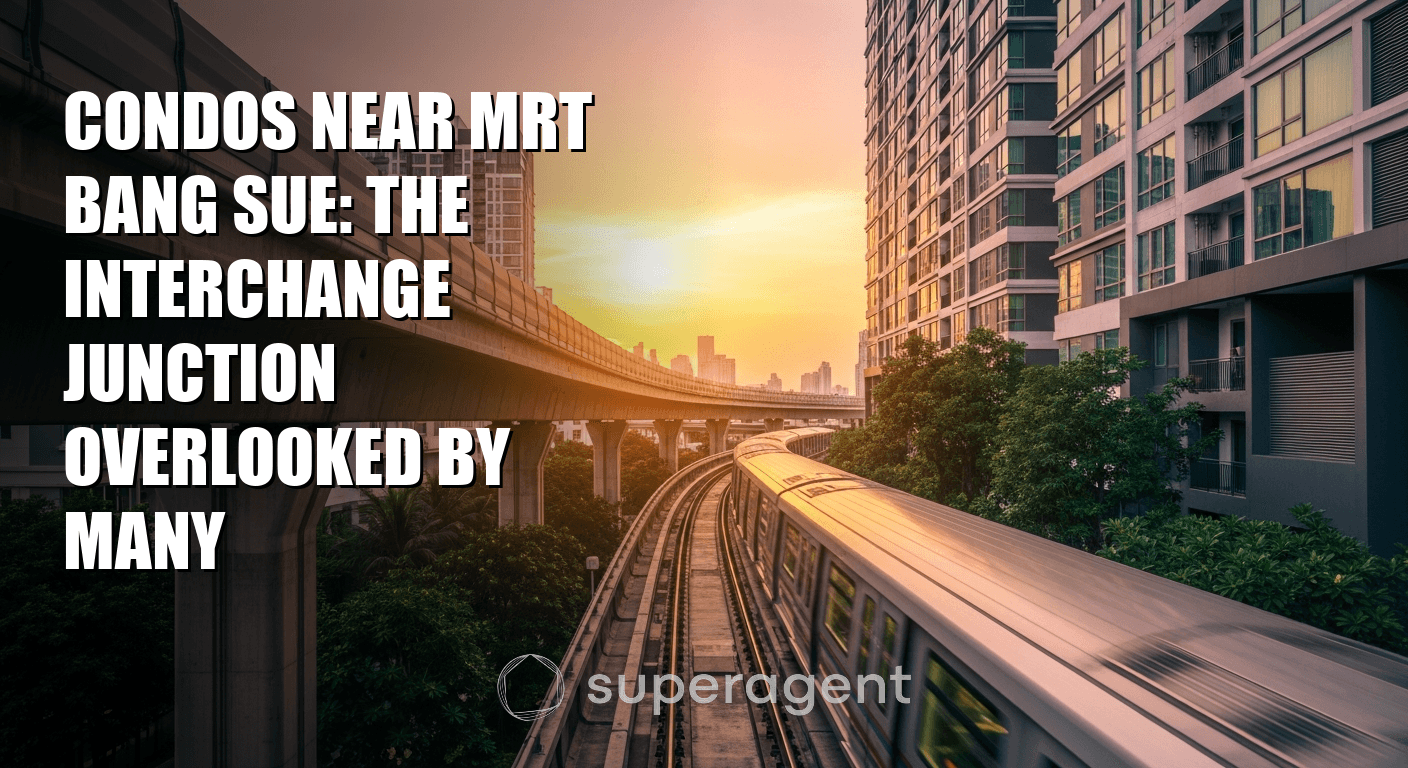
Condos Near MRT Bang Sue: The Interchange Junction Overlooked by Many
Neighborhoods
Condos Near MRT Bang Sue: The Interchange Junction Overlooked by Many
Discover hidden gem condos near MRT Bang Sue interchange with premium locations and smart pricing.
Summary
Explore คอนโดใกล้ MRT บางซื่อ at the interchange junction. Find affordable units with excellent connectivity and amenities many renters overlook.
Most people hunting for condos near MRT stations in Bangkok have the same instinct: head straight for the obvious choices. Asok, Phrom Phong, Nana. Those stations get all the attention, all the listings, all the competition. But here's what I've learned after years of watching Bangkok's rental market, there's a sweet spot that gets criminally overlooked. Bang Sue intersection, the MRT interchange station, sits right in the middle of a rental renaissance that hardly anyone talks about anymore.
Bang Sue isn't sexy on paper. It doesn't have the nightlife of Thonglor or the expat density of Sukhumvit. That's exactly why the condos here make sense if you actually live in Bangkok instead of just passing through.
Why Bang Sue Matters More Than You Think
Let me be straight with you. Bang Sue interchange opens up your entire commute game. You get both the MRT and BTS connectivity here, which means your job could be anywhere from Chatuchak to Samrong and you'd still get there in reasonable time. The MRT itself connects directly to Huay Kwang toward the north and merges into the Rama 9 line going south.
The real magic is that you're not paying central Bangkok prices for something that functions like central Bangkok. A decent 1-bedroom condo within 500 meters of Bang Sue interchange runs between 12,000 to 18,000 baht monthly. Go two kilometers out and you'll find 2-bedroom units for 18,000 to 28,000 baht. Compare that to nearby Ratchayothin or Phetchaburi, and you're looking at meaningful savings while keeping the transit access.
I watched a colleague move to Bang Sue three years ago. She works in Thonglor, which most people assume requires living in the Sukhumvit corridor. Instead, she takes the MRT south from Bang Sue, transfers easily, and saves nearly 200,000 baht yearly on rent.
The Actual Neighborhoods Around the Station
Bang Sue intersection sits at the junction of several distinct sois, and each one has its own personality. Soi Bang Sue 7 heads west toward quieter residential areas where small families live. Soi Bang Sue 1 and the immediate eastward sois are denser with commerce and smaller condos. The north side toward Phahon Yothin Road has bigger developments and more modern buildings.
Sriprat Condominium sits right on Bang Sue 1, about 200 meters from the interchange. It's an older building, built around 2005, but the location is undeniable. I know three people who rented there specifically because they could walk to MRT in under 3 minutes. Rents there hover around 14,000 to 16,000 baht for 1-bedroom, never updated, but the commute mathematics work.
Head toward Soi Bang Sue 24, and you enter a zone that barely registers on most expat rental radars. Thai families, young professionals, small businesses. A newer building like Aree Place on that side runs 16,000 to 20,000 baht for 1-bedroom with actual amenities. Air conditioner, hot water, maybe a small gym. You see Thai people living actual lives here, which means the infrastructure actually works for normal humans.
Getting Around From Bang Sue
Here's what the commute math actually looks like. From Bang Sue to Siam BTS takes about 18 minutes on the MRT plus a quick connection. From Bang Sue to Lad Phrao, about 12 minutes. From Bang Sue straight up the MRT toward Chatuchak, about 20 minutes. None of this is dramatically different from living in Phrom Phong or Ari, except you're paying substantially less.
The BTS connection matters too. You can access the Rama 9 line which feeds into central Bangkok without the usual Sukhumvit congestion. If your work is actually in the north, around Ladprao or even Chatuchak, you're basically living at optimal distance from your office and paying like someone living 5 kilometers further out.
I worked with someone who lived on Soi Bang Sue 3 and commuted daily to an office near Bangkok University. What should have been a 45-minute slog became 25 minutes by combining MRT and a cheap motorcycle taxi for the last kilometer. The neighborhood itself meant he could walk to local cafes, noodle shops, and small markets where nobody charged farang prices.
The Housing Stock You'll Actually Find
Bang Sue isn't flooded with luxury developments, which is the whole point. You get solid mid-range buildings built between 2000 and 2015, maintained reasonably, not trying to be something they're not. The buildings come with basic but functional amenities. Security is taken seriously because these are neighborhoods where people actually live year-round, not investment speculation.
Look at buildings like Nara Grand Residence on the east side, or older projects like Suanluang Park just slightly north. These aren't Instagram properties. They're places where you can lock yourself in a decent unit and actually experience living in Bangkok as opposed to performing for Instagram. 2-bedroom units here run 20,000 to 35,000 baht monthly, which leaves room in your budget for an actual life.
The developer activity here is different too. You see actual owners maintaining buildings because they live in the same neighborhood, not distant investors waiting for value appreciation. That translates to repairs that get done, complaints that get addressed, and rental agreements that are straightforward.
What Actually Matters About Bang Sue
Living near Bang Sue interchange means choosing efficiency over status. You get the transit connectivity, the reasonable costs, and the neighborhoods that function because real people depend on them working. The trade off is that you won't find yourself in the nightlife districts or the expat bubble zones, and honestly, that's a feature for most people actually living in Bangkok.
The rental market here moves slower than Sukhumvit, which means landlords aren't raising prices every six months. Your unit stays reasonably priced, deposits get returned without drama, and your neighbors aren't transient backpackers or transactional expats. You might actually recognize people at the local 7-Eleven after three months.
If you're genuinely trying to afford Bangkok without compromising on transport access or neighborhood functionality, Bang Sue intersection deserves serious consideration. The condos won't impress anyone at drinks in Thonglor. Your money goes further, your commute works, and you're living in an actual neighborhood instead of a foreigner enclave. That's not a compromise. That's just smart Bangkok living.
Start your search for Bang Sue condos on Superagent, where you can filter by distance to the MRT interchange and sort by actual functionality instead of Instagram appeal. You might surprise yourself with what makes sense when you stop looking at where everyone else is looking.
Most people hunting for condos near MRT stations in Bangkok have the same instinct: head straight for the obvious choices. Asok, Phrom Phong, Nana. Those stations get all the attention, all the listings, all the competition. But here's what I've learned after years of watching Bangkok's rental market, there's a sweet spot that gets criminally overlooked. Bang Sue intersection, the MRT interchange station, sits right in the middle of a rental renaissance that hardly anyone talks about anymore.
Bang Sue isn't sexy on paper. It doesn't have the nightlife of Thonglor or the expat density of Sukhumvit. That's exactly why the condos here make sense if you actually live in Bangkok instead of just passing through.
Why Bang Sue Matters More Than You Think
Let me be straight with you. Bang Sue interchange opens up your entire commute game. You get both the MRT and BTS connectivity here, which means your job could be anywhere from Chatuchak to Samrong and you'd still get there in reasonable time. The MRT itself connects directly to Huay Kwang toward the north and merges into the Rama 9 line going south.
The real magic is that you're not paying central Bangkok prices for something that functions like central Bangkok. A decent 1-bedroom condo within 500 meters of Bang Sue interchange runs between 12,000 to 18,000 baht monthly. Go two kilometers out and you'll find 2-bedroom units for 18,000 to 28,000 baht. Compare that to nearby Ratchayothin or Phetchaburi, and you're looking at meaningful savings while keeping the transit access.
I watched a colleague move to Bang Sue three years ago. She works in Thonglor, which most people assume requires living in the Sukhumvit corridor. Instead, she takes the MRT south from Bang Sue, transfers easily, and saves nearly 200,000 baht yearly on rent.
The Actual Neighborhoods Around the Station
Bang Sue intersection sits at the junction of several distinct sois, and each one has its own personality. Soi Bang Sue 7 heads west toward quieter residential areas where small families live. Soi Bang Sue 1 and the immediate eastward sois are denser with commerce and smaller condos. The north side toward Phahon Yothin Road has bigger developments and more modern buildings.
Sriprat Condominium sits right on Bang Sue 1, about 200 meters from the interchange. It's an older building, built around 2005, but the location is undeniable. I know three people who rented there specifically because they could walk to MRT in under 3 minutes. Rents there hover around 14,000 to 16,000 baht for 1-bedroom, never updated, but the commute mathematics work.
Head toward Soi Bang Sue 24, and you enter a zone that barely registers on most expat rental radars. Thai families, young professionals, small businesses. A newer building like Aree Place on that side runs 16,000 to 20,000 baht for 1-bedroom with actual amenities. Air conditioner, hot water, maybe a small gym. You see Thai people living actual lives here, which means the infrastructure actually works for normal humans.
Getting Around From Bang Sue
Here's what the commute math actually looks like. From Bang Sue to Siam BTS takes about 18 minutes on the MRT plus a quick connection. From Bang Sue to Lad Phrao, about 12 minutes. From Bang Sue straight up the MRT toward Chatuchak, about 20 minutes. None of this is dramatically different from living in Phrom Phong or Ari, except you're paying substantially less.
The BTS connection matters too. You can access the Rama 9 line which feeds into central Bangkok without the usual Sukhumvit congestion. If your work is actually in the north, around Ladprao or even Chatuchak, you're basically living at optimal distance from your office and paying like someone living 5 kilometers further out.
I worked with someone who lived on Soi Bang Sue 3 and commuted daily to an office near Bangkok University. What should have been a 45-minute slog became 25 minutes by combining MRT and a cheap motorcycle taxi for the last kilometer. The neighborhood itself meant he could walk to local cafes, noodle shops, and small markets where nobody charged farang prices.
Talk to us about renting
Share your details and keep reading — we’ll get back to you.
The Housing Stock You'll Actually Find
Bang Sue isn't flooded with luxury developments, which is the whole point. You get solid mid-range buildings built between 2000 and 2015, maintained reasonably, not trying to be something they're not. The buildings come with basic but functional amenities. Security is taken seriously because these are neighborhoods where people actually live year-round, not investment speculation.
Look at buildings like Nara Grand Residence on the east side, or older projects like Suanluang Park just slightly north. These aren't Instagram properties. They're places where you can lock yourself in a decent unit and actually experience living in Bangkok as opposed to performing for Instagram. 2-bedroom units here run 20,000 to 35,000 baht monthly, which leaves room in your budget for an actual life.
The developer activity here is different too. You see actual owners maintaining buildings because they live in the same neighborhood, not distant investors waiting for value appreciation. That translates to repairs that get done, complaints that get addressed, and rental agreements that are straightforward.
What Actually Matters About Bang Sue
Living near Bang Sue interchange means choosing efficiency over status. You get the transit connectivity, the reasonable costs, and the neighborhoods that function because real people depend on them working. The trade off is that you won't find yourself in the nightlife districts or the expat bubble zones, and honestly, that's a feature for most people actually living in Bangkok.
The rental market here moves slower than Sukhumvit, which means landlords aren't raising prices every six months. Your unit stays reasonably priced, deposits get returned without drama, and your neighbors aren't transient backpackers or transactional expats. You might actually recognize people at the local 7-Eleven after three months.
If you're genuinely trying to afford Bangkok without compromising on transport access or neighborhood functionality, Bang Sue intersection deserves serious consideration. The condos won't impress anyone at drinks in Thonglor. Your money goes further, your commute works, and you're living in an actual neighborhood instead of a foreigner enclave. That's not a compromise. That's just smart Bangkok living.
Start your search for Bang Sue condos on Superagent, where you can filter by distance to the MRT interchange and sort by actual functionality instead of Instagram appeal. You might surprise yourself with what makes sense when you stop looking at where everyone else is looking.
Share this article
Properties you may like
![[For Rent] CONDO I CLOUD Thonglor-Phetchaburi I 1 Bed I 1 Bath I 22,500THB/mo](/_next/image?url=https%3A%2F%2Fstorage.googleapis.com%2Fsuperagent-web%2Fattachments%2Flistings%2F6742%2F6cef5361-0dac-4dba-98f1-b0d187559c84-1118-1.jpg&w=3840&q=75)
฿22,500
1 Bed132 sqm
[For Rent] CONDO I CLOUD Thonglor-Phetchaburi I 1 Bed I 1 Bath I 22,500THB/mo
Thonglor
Condo![[For Rent] CONDO I City Smart Sukhumvit 18 I 3 Beds I 3 Baths I 65,000mo/THB](/_next/image?url=https%3A%2F%2Fstorage.googleapis.com%2Fsuperagent-web%2Fattachments%2Flistings%2F6741%2Fd371c89d-a913-42c4-a673-e540afae4f46-1116-1.jpg&w=3840&q=75)
฿65,000
3 Bed3125 sqm
[For Rent] CONDO I City Smart Sukhumvit 18 I 3 Beds I 3 Baths I 65,000mo/THB
Condo![[For Rent] CONDO I The Coast Bangkok I 1 Bed I 1 Bath I 20,000mo/THB](/_next/image?url=https%3A%2F%2Fstorage.googleapis.com%2Fsuperagent-web%2Fattachments%2Flistings%2F6740%2F498477ce-4ffa-4e4c-ab08-0e565d9c4bbe-1115-3.jpg&w=3840&q=75)
฿20,000
1 Bed146 sqm
[For Rent] CONDO I The Coast Bangkok I 1 Bed I 1 Bath I 20,000mo/THB
Bang Na
Condo![[For Rent] CONDO I IDEO Sukhumvit-RAMA 4 I 2 Beds I 2 Baths I 55,000mo/THB](/_next/image?url=https%3A%2F%2Fstorage.googleapis.com%2Fsuperagent-web%2Fattachments%2Flistings%2F6739%2F15df221d-5b8e-497c-b7ce-a6b9b6412cab-1113-1.jpg&w=3840&q=75)
฿55,000
2 Bed265 sqm
[For Rent] CONDO I IDEO Sukhumvit-RAMA 4 I 2 Beds I 2 Baths I 55,000mo/THB
Phra Khanong
Condo![[For Rent] CONDO I Downtown 49 I Pet Friendly I 1 Bed I 1 Bath I 23,000mo/THB](/_next/image?url=https%3A%2F%2Fstorage.googleapis.com%2Fsuperagent-web%2Fattachments%2Flistings%2F6738%2F11cf2ffe-1f01-4ccc-991c-2ad608f1ba73-1112-1.jpg&w=3840&q=75)
฿23,000
1 Bed135 sqm
[For Rent] CONDO I Downtown 49 I Pet Friendly I 1 Bed I 1 Bath I 23,000mo/THB
Thonglor
Condo![[For Rent] CONDO I Nusasiri Grand Condominium Ekkamai I 2 Beds I 2 Baths I 55,500mo/THB](/_next/image?url=https%3A%2F%2Fstorage.googleapis.com%2Fsuperagent-web%2Fattachments%2Flistings%2F6737%2Feb4785b4-6fd9-4e48-836c-640cc7999e07-1110-5.jpg&w=3840&q=75)
฿55,500
2 Bed280 sqm
[For Rent] CONDO I Nusasiri Grand Condominium Ekkamai I 2 Beds I 2 Baths I 55,500mo/THB
Condo![[For Rent] CONDO I Topview Tower I 3 Beds I 2 Baths I 65,000mo/THB](/_next/image?url=https%3A%2F%2Fstorage.googleapis.com%2Fsuperagent-web%2Fattachments%2Flistings%2F6736%2F8fa8ed0b-5193-4af0-a243-209ec13aa217-1109-11.jpg&w=3840&q=75)
฿65,000
3 Bed2120 sqm
[For Rent] CONDO I Topview Tower I 3 Beds I 2 Baths I 65,000mo/THB
Condo![[For Rent] CONDO I Urbano Absolute Sathon-Taksin I 1 Bed I 1 Bath I 17,500mo/THB](/_next/image?url=https%3A%2F%2Fstorage.googleapis.com%2Fsuperagent-web%2Fattachments%2Flistings%2F6735%2Fb6aa0f79-33a4-4fd9-9fd5-145b740cced8-1108-1.jpg&w=3840&q=75)
฿17,500
1 Bed138 sqm
[For Rent] CONDO I Urbano Absolute Sathon-Taksin I 1 Bed I 1 Bath I 17,500mo/THB
Condo![[For Rent] CONDO I KnightsBridge Prime Sathon I Duplex I 2 Beds I 1 Bath I 46,000THB/mo](/_next/image?url=https%3A%2F%2Fstorage.googleapis.com%2Fsuperagent-web%2Fattachments%2Flistings%2F6734%2Faf8e7500-c684-4f78-9e62-d792c1590ec6-1117-1.jpg&w=3840&q=75)
฿46,000
2 Bed158 sqm
[For Rent] CONDO I KnightsBridge Prime Sathon I Duplex I 2 Beds I 1 Bath I 46,000THB/mo
Sathorn
Condo![[For Rent] CONDO I Life Rama 4 - Asoke I 2 Beds I 1 Bath I 45,000THB/mo](/_next/image?url=https%3A%2F%2Fstorage.googleapis.com%2Fsuperagent-web%2Fattachments%2Flistings%2F6630%2F45e09ffb-5b86-4dcf-ad76-05c21e8e5fef-1003-4.jpg&w=3840&q=75)
฿45,000
2 Bed148 sqm
[For Rent] CONDO I Life Rama 4 - Asoke I 2 Beds I 1 Bath I 45,000THB/mo
Asoke
CondoMore like this
 In Neighborhoods · Superagent EditorialCondos Near MRT Tha Phra: Why Bangkok's West Side Beats the East Side on RentOne-bedroom condos near MRT Tha Phra rent for 8,000 to 15,000 THB, 40 to 60 percent below Sukhumvit, with BTS and MRT interchange access.13 Dec 20181 min read
 In Neighborhoods · Superagent EditorialCondos Near MRT Bang Sue: The Interchange Neighborhood Most Bangkok Renters OverlookCondos near MRT Bang Sue rent for 8,000 to 15,000 THB, with Blue and Purple Line interchange access and Krung Thep Aphiwat Central Terminal.12 Dec 20181 min read
 In Neighborhoods · Superagent EditorialCondos Near MRT Lat Phrao: Blue Line Rents, Buildings and Neighborhood GuideA practical guide to renting near MRT Lat Phrao, with one-bedroom rents from 10,000 THB, top condo buildings compared and neighborhood tips.6 Dec 20181 min read
 In Neighborhoods · Superagent EditorialCondos Near MRT Ratchadaphisek: Rental Prices, Buildings and Life in Bangkok's Entertainment CorridorRents near MRT Ratchadaphisek run 12,000 to 22,000 THB for a one bedroom, with Blue Line access, Jodd Fairs and building comparisons.5 Dec 20181 min read