English-Thai Condo Rental Agreements: What to Watch Out for in Each Version
Guides
English-Thai Condo Rental Agreements: What to Watch Out for in Each Version
Master bilingual rental contracts and protect yourself from costly mistakes
Summary
Learn what to watch for in English-Thai condo rental agreements in Bangkok. Our guide covers key clauses, legal differences, and protection tips for renter
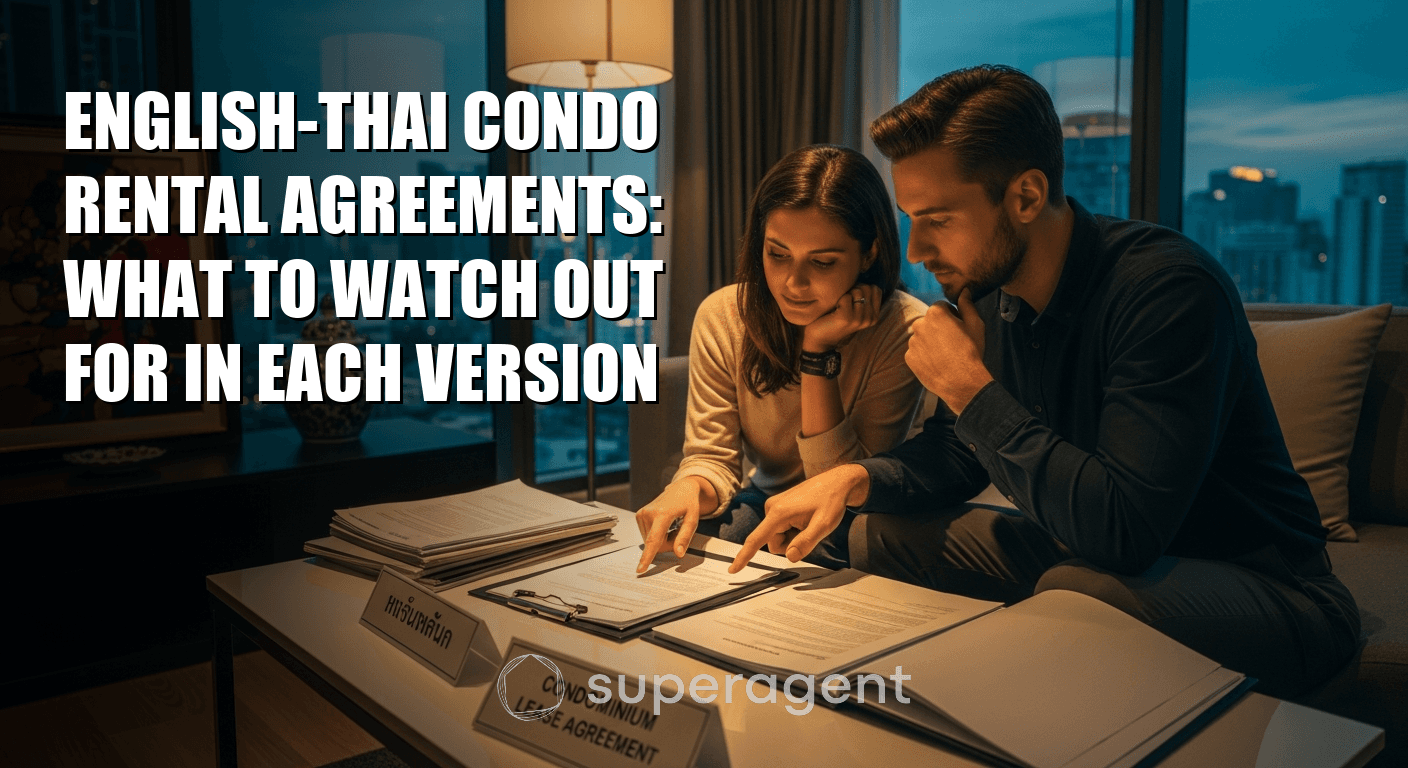
You're scrolling through Superagent listings in Sukhumvit, you find the perfect place, and then the landlord hands you a rental agreement. Half of it is in Thai, half in English, and you're staring at terms you don't quite understand. Sound familiar? This is the reality for hundreds of expats renting condos in Bangkok every month.
The rental contract is your safety net. It spells out what you're paying, what you get, and what happens if things go wrong. But when you're dealing with bilingual documents, things get murky fast. A mistranslation or missing clause can cost you your deposit or lock you into an unfair lease.
Let's break down what you actually need to watch for in Thai-English rental agreements, because getting this right from day one saves you serious headaches later.
The Deposit Trap: What the Contract Actually Says About Getting Your Money Back
Your landlord says you get your deposit back. The contract says something slightly different. This is where bilingual agreements fall apart regularly.
In the Thai version, the deposit clause might state it returns "within 30 days after the unit is inspected." In the English translation, someone casually wrote "upon lease termination." These aren't the same thing. One gives the landlord a full month to return funds. The other is vague enough that they could interpret it however they want.
Real scenario: You're moving from a Thonglor condo to a new job in Rama 9. You give notice, move out, and wait for your 150,000 THB deposit. The landlord says they're inspecting for damage. Thirty days pass. Forty days. You call and they mention "the payment process takes time." Without explicit language about the inspection timeline and the return deadline, you have almost no recourse.
What to check: Make sure both versions specify exactly how many days for inspection and exactly how many days to transfer the money back. Get that number in writing in both languages. Ask specifically what "damage inspection" actually covers. Does a painted wall count? A missing wall mount? Pin holes? Get examples.
The Damage Assessment Clause: Who Decides What Normal Wear Looks Like
This is where Thai and English versions can say completely different things without either side realizing it.
The English version might say "tenant responsible for damage beyond normal wear and tear." Sounds fair, right? But the Thai version sometimes lists specific items you're responsible for even with normal use. We're talking paint scuffs, cabinet handles, door hinges. Things that naturally deteriorate.
Here's what happens: You live in a Ploenchit condo for two years. The paint has minor marks from moving furniture. The bathroom tiles have one cracked grout line. You move out thinking this is normal wear. The landlord photographs everything, creates a list in Thai that itemizes costs for repainting, grout repair, and cabinet maintenance. Your deposit gets hit for 35,000 THB in charges that weren't mentioned during move-in.
What to check: Request a move-in inspection photo session with the landlord before you even unpack. Take pictures of the exact condition of every wall, floor, appliance, and fixture. Have both parties sign off on these photos. This protects you because you now have documented proof of the condition when you started. When the Thai damage list shows up later, you can reference your photos.
The Termination and Early Exit Clause: Can You Actually Leave Before the Contract Ends
The English section says "tenant may terminate with 30 days notice." The Thai section says something about paying a penalty or forfeiting the deposit. These contradict each other constantly.
Many bilingual contracts have different terms in each language because they were translated by different people at different times, or the landlord had different agreements for Thai and foreign tenants and just merged them together.
Example: You're in a 12-month lease at a Wireless Road high-rise. After 8 months, your company transfers you to Chiang Mai. You give 30 days notice expecting to leave clean. But when you read the fine print Thai translation more carefully, there's a penalty clause for breaking the contract early. It's 50,000 THB or forfeiting your deposit. This wasn't mentioned in the English section you read before signing.
What to check: Ask directly and get a written answer in both languages: "Can I terminate early? If yes, what penalty applies?" Don't assume the English section covers everything. Have the landlord clarify what happens if you need to leave at month 10 or month 11. Get the exact penalty amount specified. Then have them sign a document acknowledging this answer in both Thai and English.
The Maintenance and Repair Responsibility: Who Pays When Something Breaks
This clause determines whether a broken air conditioner, failed water heater, or cracked ceiling is your problem or the landlord's problem.
The English version might state "landlord responsible for structural repairs and appliances." The Thai version might say "tenant responsible for anything beyond the structural walls." These aren't even close to the same scope of coverage.
Let's say you're renting a one-bedroom in Nana near the BTS. Month three, the air conditioner stops working. It's 38 degrees outside and humid as a sauna. You call your landlord. They say it's your responsibility according to the contract. You read the English section and it seems like they should handle it. You read the Thai section and it definitely says tenant responsibility for mechanical systems. You're stuck in a hot condo arguing about who gets the 8,000 THB repair bill.
What to check: Create a specific list during move-in of every appliance and system in the unit. Air conditioner, washing machine, water heater, refrigerator, lighting fixtures. For each one, have the landlord initial whether they maintain it or you do. This list should be attached to your contract in both languages. When something breaks, you have a reference document instead of guessing.
The Renewal and Price Increase Clause: What Happens When Your Lease Expires
Your one-year lease is ending. The landlord wants to renew but at 8,000 THB more per month. You check the contract and the English section has no mention of price increases. The Thai section mentions a percentage increase is permitted. Who's right?
You're now in a negotiation where the contract actually supports the landlord's position, even though you weren't expecting it based on the English translation.
What to check: The renewal clause should specify maximum percentage increase allowed per year or state the price stays fixed. It should clarify whether renewal is automatic or requires written agreement from both parties. This needs to be identical in both languages. If there's any difference in wording, ask which version is legally binding. Usually the Thai version takes precedence in Thailand, so if you're an expat, that matters.
Getting It Right Before You Sign
The safest move is having someone who speaks both languages fluently review the contract before you sign. Not a friend who studied Thai in university. A professional translator or a bilingual lawyer. This costs 2,000 to 5,000 THB depending on contract length, and it's genuinely worth it when you're committing to a year of rent payments.
If that's not possible, sit down with the landlord and go through every section. Read both the English and Thai versions aloud. When you see differences, ask them to clarify which one is correct and have them initial the one that applies.
Take photos of your fully executed contract in both languages. Text yourself pictures of every page. This protects you if the landlord later claims you signed something you didn't.
When you're searching for your next place on Superagent, pay attention to landlords who provide clear rental terms upfront and who seem comfortable discussing contract details. The transparent ones tend to have much smoother rental experiences. Take your time with the paperwork. A few hours now prevents weeks of problems later.
You're scrolling through Superagent listings in Sukhumvit, you find the perfect place, and then the landlord hands you a rental agreement. Half of it is in Thai, half in English, and you're staring at terms you don't quite understand. Sound familiar? This is the reality for hundreds of expats renting condos in Bangkok every month.
The rental contract is your safety net. It spells out what you're paying, what you get, and what happens if things go wrong. But when you're dealing with bilingual documents, things get murky fast. A mistranslation or missing clause can cost you your deposit or lock you into an unfair lease.
Let's break down what you actually need to watch for in Thai-English rental agreements, because getting this right from day one saves you serious headaches later.
The Deposit Trap: What the Contract Actually Says About Getting Your Money Back
Your landlord says you get your deposit back. The contract says something slightly different. This is where bilingual agreements fall apart regularly.
In the Thai version, the deposit clause might state it returns "within 30 days after the unit is inspected." In the English translation, someone casually wrote "upon lease termination." These aren't the same thing. One gives the landlord a full month to return funds. The other is vague enough that they could interpret it however they want.
Real scenario: You're moving from a Thonglor condo to a new job in Rama 9. You give notice, move out, and wait for your 150,000 THB deposit. The landlord says they're inspecting for damage. Thirty days pass. Forty days. You call and they mention "the payment process takes time." Without explicit language about the inspection timeline and the return deadline, you have almost no recourse.
Continue reading after that.
Looking for a condo
to rent?
Leave your name and phone. We'll follow up while you keep reading.
100% Secure
Fast Response
Free Consultation
What to check: Make sure both versions specify exactly how many days for inspection and exactly how many days to transfer the money back. Get that number in writing in both languages. Ask specifically what "damage inspection" actually covers. Does a painted wall count? A missing wall mount? Pin holes? Get examples.
The Damage Assessment Clause: Who Decides What Normal Wear Looks Like
This is where Thai and English versions can say completely different things without either side realizing it.
The English version might say "tenant responsible for damage beyond normal wear and tear." Sounds fair, right? But the Thai version sometimes lists specific items you're responsible for even with normal use. We're talking paint scuffs, cabinet handles, door hinges. Things that naturally deteriorate.
Here's what happens: You live in a Ploenchit condo for two years. The paint has minor marks from moving furniture. The bathroom tiles have one cracked grout line. You move out thinking this is normal wear. The landlord photographs everything, creates a list in Thai that itemizes costs for repainting, grout repair, and cabinet maintenance. Your deposit gets hit for 35,000 THB in charges that weren't mentioned during move-in.
What to check: Request a move-in inspection photo session with the landlord before you even unpack. Take pictures of the exact condition of every wall, floor, appliance, and fixture. Have both parties sign off on these photos. This protects you because you now have documented proof of the condition when you started. When the Thai damage list shows up later, you can reference your photos.
The Termination and Early Exit Clause: Can You Actually Leave Before the Contract Ends
The English section says "tenant may terminate with 30 days notice." The Thai section says something about paying a penalty or forfeiting the deposit. These contradict each other constantly.
Many bilingual contracts have different terms in each language because they were translated by different people at different times, or the landlord had different agreements for Thai and foreign tenants and just merged them together.
Example: You're in a 12-month lease at a Wireless Road high-rise. After 8 months, your company transfers you to Chiang Mai. You give 30 days notice expecting to leave clean. But when you read the fine print Thai translation more carefully, there's a penalty clause for breaking the contract early. It's 50,000 THB or forfeiting your deposit. This wasn't mentioned in the English section you read before signing.
What to check: Ask directly and get a written answer in both languages: "Can I terminate early? If yes, what penalty applies?" Don't assume the English section covers everything. Have the landlord clarify what happens if you need to leave at month 10 or month 11. Get the exact penalty amount specified. Then have them sign a document acknowledging this answer in both Thai and English.
The Maintenance and Repair Responsibility: Who Pays When Something Breaks
This clause determines whether a broken air conditioner, failed water heater, or cracked ceiling is your problem or the landlord's problem.
The English version might state "landlord responsible for structural repairs and appliances." The Thai version might say "tenant responsible for anything beyond the structural walls." These aren't even close to the same scope of coverage.
Let's say you're renting a one-bedroom in Nana near the BTS. Month three, the air conditioner stops working. It's 38 degrees outside and humid as a sauna. You call your landlord. They say it's your responsibility according to the contract. You read the English section and it seems like they should handle it. You read the Thai section and it definitely says tenant responsibility for mechanical systems. You're stuck in a hot condo arguing about who gets the 8,000 THB repair bill.
What to check: Create a specific list during move-in of every appliance and system in the unit. Air conditioner, washing machine, water heater, refrigerator, lighting fixtures. For each one, have the landlord initial whether they maintain it or you do. This list should be attached to your contract in both languages. When something breaks, you have a reference document instead of guessing.
Continue reading after that.
Looking for a condo
to rent?
Leave your name and phone. We'll follow up while you keep reading.
100% Secure
Fast Response
Free Consultation
The Renewal and Price Increase Clause: What Happens When Your Lease Expires
Your one-year lease is ending. The landlord wants to renew but at 8,000 THB more per month. You check the contract and the English section has no mention of price increases. The Thai section mentions a percentage increase is permitted. Who's right?
You're now in a negotiation where the contract actually supports the landlord's position, even though you weren't expecting it based on the English translation.
What to check: The renewal clause should specify maximum percentage increase allowed per year or state the price stays fixed. It should clarify whether renewal is automatic or requires written agreement from both parties. This needs to be identical in both languages. If there's any difference in wording, ask which version is legally binding. Usually the Thai version takes precedence in Thailand, so if you're an expat, that matters.
Getting It Right Before You Sign
The safest move is having someone who speaks both languages fluently review the contract before you sign. Not a friend who studied Thai in university. A professional translator or a bilingual lawyer. This costs 2,000 to 5,000 THB depending on contract length, and it's genuinely worth it when you're committing to a year of rent payments.
If that's not possible, sit down with the landlord and go through every section. Read both the English and Thai versions aloud. When you see differences, ask them to clarify which one is correct and have them initial the one that applies.
Take photos of your fully executed contract in both languages. Text yourself pictures of every page. This protects you if the landlord later claims you signed something you didn't.
When you're searching for your next place on Superagent, pay attention to landlords who provide clear rental terms upfront and who seem comfortable discussing contract details. The transparent ones tend to have much smoother rental experiences. Take your time with the paperwork. A few hours now prevents weeks of problems later.
Share this article
Properties you may like
![[For Rent] CONDO I Las Colinas Condominium I 2 Beds I 3 Baths I 85,000THB/mo](/_next/image?url=https%3A%2F%2Fstorage.googleapis.com%2Fsuperagent-web%2Fattachments%2Flistings%2F6828%2F80f345c4-488e-43b2-b017-c9fbb17b520d-99486dd8-4237-4ba2-9207-01ce4f66b21f-media.jpg&w=3840&q=75)
฿85,000
2 Bed3170 sqm
[For Rent] CONDO I Las Colinas Condominium I 2 Beds I 3 Baths I 85,000THB/mo
Asoke
Condo![[For Rent] CONDO I Ashton Asoke I 1 Bed I 1 Bath I 30,000THB/mo](/_next/image?url=https%3A%2F%2Fstorage.googleapis.com%2Fsuperagent-web%2Fattachments%2Flistings%2F6876%2Fb7ce9bbe-f877-4ff5-bb54-8ad0026db940-1272-4.jpg&w=3840&q=75)
฿30,000
1 Bed135 sqm
[For Rent] CONDO I Ashton Asoke I 1 Bed I 1 Bath I 30,000THB/mo
Asoke
Condo![[For Rent] CONDO I Skyrise Avenue Sukhumvit 64 I 2 Beds I 2 Baths I 27,000THB/mo](/_next/image?url=https%3A%2F%2Fstorage.googleapis.com%2Fsuperagent-web%2Fattachments%2Flistings%2F2001%2F670f91de-c251-4e81-971c-8e30ed2158cd-screenshot-2026-07-05-at-11.38.53-pm.png&w=3840&q=75)
฿27,000
2 Bed252 sqm
[For Rent] CONDO I Skyrise Avenue Sukhumvit 64 I 2 Beds I 2 Baths I 27,000THB/mo
Punnawithi
Condo![[For Rent] CONDO I Park Origin Ratchathewi I Duplex I 2 Beds I 1 Bath I 32,000THB/mo](/_next/image?url=https%3A%2F%2Fstorage.googleapis.com%2Fsuperagent-web%2Fattachments%2Flistings%2F6896%2Fb79a7d21-7533-4b0d-bb19-762ebfafab62-1318-6.jpg&w=3840&q=75)
฿32,000
2 Bed135.9 sqm
[For Rent] CONDO I Park Origin Ratchathewi I Duplex I 2 Beds I 1 Bath I 32,000THB/mo
Ratchathewi
Condo![[For Rent] CONDO I Park Origin Phayathai I Studio I 1 Bath I 28,000THB/mo](/_next/image?url=https%3A%2F%2Fstorage.googleapis.com%2Fsuperagent-web%2Fattachments%2Flistings%2F6757%2Fb226df93-94c6-46fa-aeba-ebfadc7f81b8-1000006042.jpg&w=3840&q=75)
฿28,000
Studio129 sqm
[For Rent] CONDO I Park Origin Phayathai I Studio I 1 Bath I 28,000THB/mo
Phaya Thai
Condo![[For Rent] CONDO I Ideo Mobi Sukhumvit 81 I Duplex I 1 Bed I 1 Bath I 28,000THB/mo](/_next/image?url=https%3A%2F%2Fstorage.googleapis.com%2Fsuperagent-web%2Fattachments%2Flistings%2F1849%2Fc8b2c033-3b5f-4615-b2b0-4972f40141f0-705-13.jpg&w=3840&q=75)
฿28,000
1 Bed143 sqm
[For Rent] CONDO I Ideo Mobi Sukhumvit 81 I Duplex I 1 Bed I 1 Bath I 28,000THB/mo
On Nut
Condo![[For Rent] CONDO I Siamese Sukhumvit 48 I 1 Bed I 1 Bath I 28,000THB/mo](/_next/image?url=https%3A%2F%2Fstorage.googleapis.com%2Fsuperagent-web%2Fattachments%2Flistings%2F6841%2Febc2dce2-2e9b-4e6d-a01c-0cfa619dfa13-1231-6.jpg&w=3840&q=75)
฿28,000
1 Bed144 sqm
[For Rent] CONDO I Siamese Sukhumvit 48 I 1 Bed I 1 Bath I 28,000THB/mo
Condo![[For Rent] CONDO I Ashton Asoke I 1 Bed I 1 Bath I 22,000THB/mo](/_next/image?url=https%3A%2F%2Fstorage.googleapis.com%2Fsuperagent-web%2Fattachments%2Flistings%2F6802%2Fe06b9b73-1207-414a-ab04-1685de0c7eaa-20220808_153124_0.jpg&w=3840&q=75)
฿22,000
1 Bed134 sqm
[For Rent] CONDO I Ashton Asoke I 1 Bed I 1 Bath I 22,000THB/mo
Asoke
Condo![[For Rent] CONDO I HQ Thonglor Soi 4 I 1 Bed I 1 Bath I 35,000 THB/mo](/_next/image?url=https%3A%2F%2Fstorage.googleapis.com%2Fsuperagent-web%2Fattachments%2Flistings%2F1445%2F72352585-1bc2-41a8-bd62-ddcbf8189fe9-376-5.jpg&w=3840&q=75)
฿35,000
1 Bed143.6 sqm
[For Rent] CONDO I HQ Thonglor Soi 4 I 1 Bed I 1 Bath I 35,000 THB/mo
Thonglor
Condo![[For Rent] CONDO I The Master Centrium Asoke - Sukhumvit I Duplex I 2 Beds I 3 Baths I 75,000 THB/mo](/_next/image?url=https%3A%2F%2Fstorage.googleapis.com%2Fsuperagent-web%2Fattachments%2Flistings%2F1545%2F97932b6a-c358-45e4-b5f9-995dbf5a3cf0-441-2.jpg&w=3840&q=75)
฿75,000
2 Bed3150 sqm
[For Rent] CONDO I The Master Centrium Asoke - Sukhumvit I Duplex I 2 Beds I 3 Baths I 75,000 THB/mo
Asoke
CondoMore like this
 In Guides · Superagent EditorialHidden Costs of Renting a Condo in Bangkok Nobody Warns You AboutBangkok condo rent looks affordable until month one hits. Here are the real costs beyond the headline figure that catch most renters off guard.25 May 20261 min read
 In Guides · Superagent EditorialWhat a Long-Vacant Bangkok Condo Unit Is Actually Telling YouA Bangkok condo vacant for months signals overpricing, landlord issues, or real problems. Here is how to read the signs.25 May 20261 min read
 In Guides · Superagent EditorialRed Flags in a Bangkok Rental Contract to Watch Out ForBangkok rental contracts often hide risky clauses. Here are the red flags every tenant must catch before signing any lease.25 May 20261 min read
 In Guides · Superagent EditorialWorking Online from a Condo: How to Choose the Perfect Room for ProductivityLearn how to choose the best condo room for working online with tips on lighting, noise, and furniture setup to maximize productivity.9 May 20261 min read