Guides
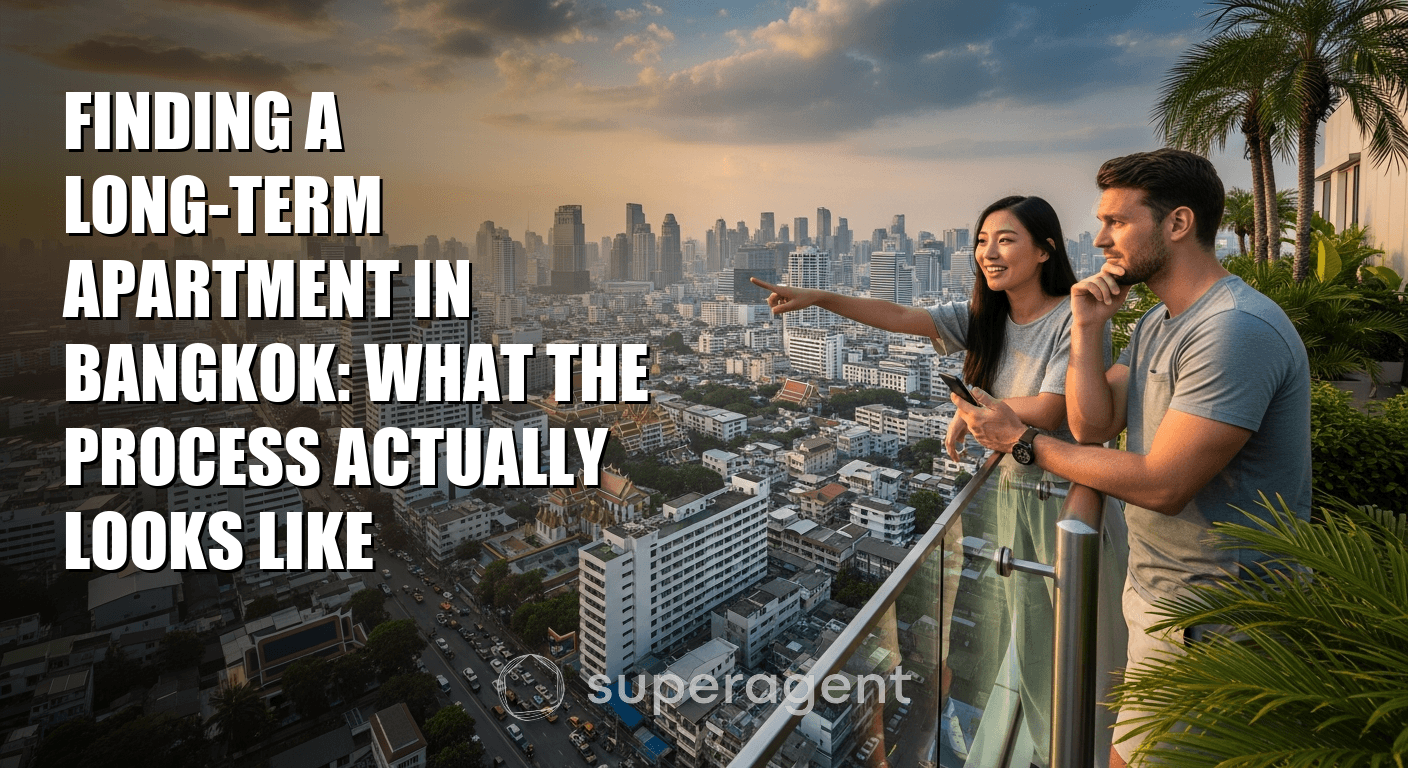
Finding a Long-Term Apartment in Bangkok: What the Process Actually Looks Like
Navigate Bangkok's rental market with insider tips on finding your perfect long-term home.
Summary
Discover the complete process for securing an apartment for rent in Bangkok long term, from search strategies to negotiation tactics and lease agreements.
You have been scrolling through listing sites for three weeks now. You have bookmarked maybe forty condos, messaged a dozen agents, and somehow still feel like you have no idea how renting long term in Bangkok actually works. Sound familiar? You are not alone. The process of finding an apartment for rent in Bangkok long term looks simple from the outside, but the reality involves a lot of moving parts that nobody warns you about. This guide breaks it all down based on how things actually work on the ground, not how they look on a brochure.
Step One: Figure Out Your Real Budget and What It Gets You
Before you even open a listing site, sit down and figure out your all-in monthly budget. Not just rent. You need to factor in electricity (often billed at 7 to 9 THB per unit in condos, versus around 4 THB from the government rate), water, internet, and building common fees if they are not included.
Here is a rough reality check. According to CBRE Thailand's residential market reports, the average rent for a one-bedroom condo in central Bangkok ranges from 15,000 to 35,000 THB per month depending on the neighborhood, age of the building, and proximity to a BTS or MRT station. A two-bedroom unit in a mid-tier building near BTS On Nut might go for 18,000 to 28,000 THB, while the same layout near BTS Thong Lo could easily hit 40,000 to 55,000 THB.
Let me give you a concrete example. Say you work near Silom and your budget is 20,000 THB per month. You could find a well-maintained studio or small one-bed near BTS Bearing or MRT Huai Khwang and commute in about 25 minutes. Or you could stretch for a smaller, older unit closer to work around Surasak or Chong Nonsi. Knowing what trade-offs you are willing to make saves you weeks of aimless browsing.
Step Two: Pick Your Neighborhood Like a Local Would
This is where most newcomers get stuck. Bangkok is massive, and neighborhoods that look close on a map can feel worlds apart in daily life. Your commute, grocery options, social scene, and even air quality can shift dramatically from one area to the next.
If you are a young professional working in the Sathorn or Silom corridor, areas like BTS Surasak, Saint Louis, or even the stretch between MRT Lumphini and Khlong Toei offer solid options. Families with kids in international schools along Sukhumvit tend to cluster around Soi 49 through Soi 63 (Ekkamai), close to schools and family-friendly malls like Gateway Ekkamai.
Consider someone relocating for a job at a company in Chatuchak. They might instinctively search for condos near Siam or Asoke because those names come up everywhere. But living near MRT Phahon Yothin or BTS Ha Yaek Lat Phrao would cut their commute in half and save them 5,000 to 10,000 THB per month on rent. You can check MRT Bangkok's official route map to plan your commute before committing to a neighborhood.
| Neighborhood | Nearest BTS/MRT | 1-Bed Rent Range (THB/month) | Best For |
|---|---|---|---|
| Thong Lo / Ekkamai | BTS Thong Lo, BTS Ekkamai | 25,000 to 55,000 | Expats, nightlife, families |
| On Nut / Bang Chak | BTS On Nut, BTS Bang Chak | 12,000 to 22,000 | Budget-conscious professionals |
| Ari / Saphan Khwai | BTS Ari, BTS Saphan Khwai | 14,000 to 28,000 | Creatives, local food lovers |
| Silom / Sathorn | BTS Surasak, MRT Lumphini | 18,000 to 40,000 | Finance professionals, CBD workers |
| Huai Khwang / Ratchada | MRT Huai Khwang, MRT Sutthisan | 10,000 to 20,000 | Budget renters, night market fans |
| Lat Phrao / Chatuchak | MRT Phahon Yothin, BTS Ha Yaek Lat Phrao | 9,000 to 18,000 | Local lifestyle, green space |
Step Three: Viewing Units and Knowing What to Actually Look For
Online photos lie. Or at least, they tell a very selective version of the truth. That "spacious living area" might be shot with a wide-angle lens that makes 28 square meters look like 50. Always visit in person before signing anything.
When you walk into a unit, check these things that most people forget. Turn on the air conditioning and wait five minutes. Does it actually cool the room or just make noise? Run the hot water in the bathroom. Open the windows and listen. Is there a construction site next door? Check for mold around window frames and in the bathroom ceiling. These details matter a lot more in a long-term rental than the Instagram-worthiness of the kitchen backsplash.
Here is a real scenario. A friend of mine signed a year lease for a unit in a building on Sukhumvit Soi 22, right near the Imperial Queens Park hotel. The photos looked incredible. Two weeks in, she discovered the water pressure dropped to nothing every evening when other residents came home, and the building's elevator broke down twice in her first month. She was stuck for a year. A proper walkthrough at 6 PM instead of 11 AM would have revealed both issues.
Step Four: Understanding the Lease and What You Are Actually Signing
Long-term apartment leases in Bangkok typically run for 12 months. The standard arrangement requires a two-month security deposit plus one month's rent upfront, meaning you need three months of rent in cash before you even move in. Some buildings also charge a one-time key card fee or a move-in deposit.
Read the lease carefully, especially the clauses about early termination. Many landlords will keep your entire deposit if you break the lease early, and this is generally enforceable. Some leases include a diplomatic clause that allows you to break the contract with 30 or 60 days' notice if you are relocated overseas, but this is not standard and you need to ask for it specifically.
The Thai Revenue Department requires that rental income be reported as taxable income by the landlord. This is relevant to you because some landlords will resist providing official receipts or registering the lease, which can complicate things if you need proof of address for visa or work permit purposes. Always insist on a proper contract in both English and Thai.
A common scenario: digital nomads on long-term stays sometimes accept informal month-to-month arrangements to avoid the big upfront deposit. This works fine until there is a dispute about damage, utility bills, or the landlord decides to sell the unit. Without a signed lease, you have very limited recourse.
Step Five: The First Month Reality Check
You signed the lease, moved in, and unpacked your bags. Now comes the part nobody blogs about. The first month in a new Bangkok apartment is when all the small stuff reveals itself.
Your internet might need upgrading. Most condos come with basic building wifi, but if you work from home, you will almost certainly need your own fiber line. AIS and True both offer packages starting around 599 THB per month for speeds that can handle video calls without freezing.
You will also discover your building's quirks. Maybe the pool closes at 7 PM. Maybe the mailroom loses packages. Maybe your neighbor plays music until 2 AM every Friday. Document any issues and communicate them to your landlord or the juristic office early. Problems that seem small in week one become unbearable by month six.
One example that comes up constantly: electricity bills. A renter in a condo at The Base Park West near BTS On Nut discovered her first electricity bill was 4,200 THB for a 30-square-meter studio. The air conditioning unit was old and inefficient, running almost nonstop because the unit faced west and got direct afternoon sun. She negotiated with the landlord to replace the AC unit, which brought her bill down to around 2,200 THB. If she had checked the AC during her viewing, she could have negotiated before signing.
Step Six: Renewing, Renegotiating, or Moving On
As your lease approaches its end, you have three options. Renew at the same rate, negotiate a lower rent, or move out. Many renters do not realize that negotiation is not just acceptable in Bangkok, it is expected.
If you have been a reliable tenant who pays on time and keeps the unit in good condition, you have real leverage. Vacancy costs landlords money. Every month a unit sits empty, they are losing rent plus still paying common fees. A reasonable ask is a 5 to 10 percent discount on renewal, or requesting that the landlord cover a repair or upgrade in exchange for signing another year.
Market conditions matter here too. If new supply has come online in your area, like the dozens of new condos that have launched along the BTS Sukhumvit extension past Bearing, your landlord knows you have options. Use that context in your conversation.
If you do decide to move, start your search at least six to eight weeks before your lease ends. This gives you time to view units, negotiate, and handle the logistics of transferring utilities and getting your deposit back.
Finding an apartment for rent in Bangkok long term does not have to feel like a gamble. The process rewards people who do their homework, ask the right questions, and treat the search like the significant financial commitment it actually is. Whether you are moving to Bangkok for the first time or switching neighborhoods after a few years, approaching each step with clear expectations makes everything smoother. If you want to skip the guesswork and see curated listings matched to your actual needs, try searching on superagent.co, where the AI does the heavy lifting so you can focus on finding a place that actually fits your life.
You have been scrolling through listing sites for three weeks now. You have bookmarked maybe forty condos, messaged a dozen agents, and somehow still feel like you have no idea how renting long term in Bangkok actually works. Sound familiar? You are not alone. The process of finding an apartment for rent in Bangkok long term looks simple from the outside, but the reality involves a lot of moving parts that nobody warns you about. This guide breaks it all down based on how things actually work on the ground, not how they look on a brochure.
Step One: Figure Out Your Real Budget and What It Gets You
Before you even open a listing site, sit down and figure out your all-in monthly budget. Not just rent. You need to factor in electricity (often billed at 7 to 9 THB per unit in condos, versus around 4 THB from the government rate), water, internet, and building common fees if they are not included.
Here is a rough reality check. According to CBRE Thailand's residential market reports, the average rent for a one-bedroom condo in central Bangkok ranges from 15,000 to 35,000 THB per month depending on the neighborhood, age of the building, and proximity to a BTS or MRT station. A two-bedroom unit in a mid-tier building near BTS On Nut might go for 18,000 to 28,000 THB, while the same layout near BTS Thong Lo could easily hit 40,000 to 55,000 THB.
Let me give you a concrete example. Say you work near Silom and your budget is 20,000 THB per month. You could find a well-maintained studio or small one-bed near BTS Bearing or MRT Huai Khwang and commute in about 25 minutes. Or you could stretch for a smaller, older unit closer to work around Surasak or Chong Nonsi. Knowing what trade-offs you are willing to make saves you weeks of aimless browsing.
Step Two: Pick Your Neighborhood Like a Local Would
This is where most newcomers get stuck. Bangkok is massive, and neighborhoods that look close on a map can feel worlds apart in daily life. Your commute, grocery options, social scene, and even air quality can shift dramatically from one area to the next.
If you are a young professional working in the Sathorn or Silom corridor, areas like BTS Surasak, Saint Louis, or even the stretch between MRT Lumphini and Khlong Toei offer solid options. Families with kids in international schools along Sukhumvit tend to cluster around Soi 49 through Soi 63 (Ekkamai), close to schools and family-friendly malls like Gateway Ekkamai.
Consider someone relocating for a job at a company in Chatuchak. They might instinctively search for condos near Siam or Asoke because those names come up everywhere. But living near MRT Phahon Yothin or BTS Ha Yaek Lat Phrao would cut their commute in half and save them 5,000 to 10,000 THB per month on rent. You can check MRT Bangkok's official route map to plan your commute before committing to a neighborhood.
| Neighborhood | Nearest BTS/MRT | 1-Bed Rent Range (THB/month) | Best For |
|---|---|---|---|
| Thong Lo / Ekkamai | BTS Thong Lo, BTS Ekkamai | 25,000 to 55,000 | Expats, nightlife, families |
| On Nut / Bang Chak | BTS On Nut, BTS Bang Chak | 12,000 to 22,000 | Budget-conscious professionals |
| Ari / Saphan Khwai | BTS Ari, BTS Saphan Khwai | 14,000 to 28,000 | Creatives, local food lovers |
| Silom / Sathorn | BTS Surasak, MRT Lumphini | 18,000 to 40,000 | Finance professionals, CBD workers |
| Huai Khwang / Ratchada | MRT Huai Khwang, MRT Sutthisan | 10,000 to 20,000 | Budget renters, night market fans |
| Lat Phrao / Chatuchak | MRT Phahon Yothin, BTS Ha Yaek Lat Phrao | 9,000 to 18,000 | Local lifestyle, green space |
Step Three: Viewing Units and Knowing What to Actually Look For
Online photos lie. Or at least, they tell a very selective version of the truth. That "spacious living area" might be shot with a wide-angle lens that makes 28 square meters look like 50. Always visit in person before signing anything.
When you walk into a unit, check these things that most people forget. Turn on the air conditioning and wait five minutes. Does it actually cool the room or just make noise? Run the hot water in the bathroom. Open the windows and listen. Is there a construction site next door? Check for mold around window frames and in the bathroom ceiling. These details matter a lot more in a long-term rental than the Instagram-worthiness of the kitchen backsplash.
Here is a real scenario. A friend of mine signed a year lease for a unit in a building on Sukhumvit Soi 22, right near the Imperial Queens Park hotel. The photos looked incredible. Two weeks in, she discovered the water pressure dropped to nothing every evening when other residents came home, and the building's elevator broke down twice in her first month. She was stuck for a year. A proper walkthrough at 6 PM instead of 11 AM would have revealed both issues.
Step Four: Understanding the Lease and What You Are Actually Signing
Long-term apartment leases in Bangkok typically run for 12 months. The standard arrangement requires a two-month security deposit plus one month's rent upfront, meaning you need three months of rent in cash before you even move in. Some buildings also charge a one-time key card fee or a move-in deposit.
Read the lease carefully, especially the clauses about early termination. Many landlords will keep your entire deposit if you break the lease early, and this is generally enforceable. Some leases include a diplomatic clause that allows you to break the contract with 30 or 60 days' notice if you are relocated overseas, but this is not standard and you need to ask for it specifically.
The Thai Revenue Department requires that rental income be reported as taxable income by the landlord. This is relevant to you because some landlords will resist providing official receipts or registering the lease, which can complicate things if you need proof of address for visa or work permit purposes. Always insist on a proper contract in both English and Thai.
Talk to us about renting
Share your details and keep reading — we’ll get back to you.
A common scenario: digital nomads on long-term stays sometimes accept informal month-to-month arrangements to avoid the big upfront deposit. This works fine until there is a dispute about damage, utility bills, or the landlord decides to sell the unit. Without a signed lease, you have very limited recourse.
Step Five: The First Month Reality Check
You signed the lease, moved in, and unpacked your bags. Now comes the part nobody blogs about. The first month in a new Bangkok apartment is when all the small stuff reveals itself.
Your internet might need upgrading. Most condos come with basic building wifi, but if you work from home, you will almost certainly need your own fiber line. AIS and True both offer packages starting around 599 THB per month for speeds that can handle video calls without freezing.
You will also discover your building's quirks. Maybe the pool closes at 7 PM. Maybe the mailroom loses packages. Maybe your neighbor plays music until 2 AM every Friday. Document any issues and communicate them to your landlord or the juristic office early. Problems that seem small in week one become unbearable by month six.
One example that comes up constantly: electricity bills. A renter in a condo at The Base Park West near BTS On Nut discovered her first electricity bill was 4,200 THB for a 30-square-meter studio. The air conditioning unit was old and inefficient, running almost nonstop because the unit faced west and got direct afternoon sun. She negotiated with the landlord to replace the AC unit, which brought her bill down to around 2,200 THB. If she had checked the AC during her viewing, she could have negotiated before signing.
Step Six: Renewing, Renegotiating, or Moving On
As your lease approaches its end, you have three options. Renew at the same rate, negotiate a lower rent, or move out. Many renters do not realize that negotiation is not just acceptable in Bangkok, it is expected.
If you have been a reliable tenant who pays on time and keeps the unit in good condition, you have real leverage. Vacancy costs landlords money. Every month a unit sits empty, they are losing rent plus still paying common fees. A reasonable ask is a 5 to 10 percent discount on renewal, or requesting that the landlord cover a repair or upgrade in exchange for signing another year.
Market conditions matter here too. If new supply has come online in your area, like the dozens of new condos that have launched along the BTS Sukhumvit extension past Bearing, your landlord knows you have options. Use that context in your conversation.
If you do decide to move, start your search at least six to eight weeks before your lease ends. This gives you time to view units, negotiate, and handle the logistics of transferring utilities and getting your deposit back.
Finding an apartment for rent in Bangkok long term does not have to feel like a gamble. The process rewards people who do their homework, ask the right questions, and treat the search like the significant financial commitment it actually is. Whether you are moving to Bangkok for the first time or switching neighborhoods after a few years, approaching each step with clear expectations makes everything smoother. If you want to skip the guesswork and see curated listings matched to your actual needs, try searching on superagent.co, where the AI does the heavy lifting so you can focus on finding a place that actually fits your life.
Share this article
Properties you may like
![[For Rent&Sale] HOUSE I Perfect Place Ramindra - Wongwaen I 4 Beds I 3 Baths I Rent 33,000THB/mo - Sale 7.49mb THB](/_next/image?url=https%3A%2F%2Fstorage.googleapis.com%2Fsuperagent-web%2Fattachments%2Flistings%2F1957%2F4c02eda2-14c3-4a1c-8ad1-fea436f93326-p8.5.jpg&w=3840&q=75)
฿33,000
[For Rent&Sale] HOUSE I Perfect Place Ramindra - Wongwaen I 4 Beds I 3 Baths I Rent 33,000THB/mo - Sale 7.49mb THB
House![[For Rent] CONDO I Notting Hill The Exclusive Charoen Krung 93 I 2 Beds I 1 Bath I 25,000THB/mo](/_next/image?url=https%3A%2F%2Fstorage.googleapis.com%2Fsuperagent-web%2Fattachments%2Flistings%2F1928%2F0ab7c14e-8339-4c28-b54a-d8a64920e9af-4.-img_1315.jpg&w=3840&q=75)
฿25,000
[For Rent] CONDO I Notting Hill The Exclusive Charoen Krung 93 I 2 Beds I 1 Bath I 25,000THB/mo
Condo![[For Rent] BUILDING I Quach House Phrom Phong I 1st-6th Floor I 100,000-135,000THB/mo](/_next/image?url=https%3A%2F%2Fstorage.googleapis.com%2Fsuperagent-web%2Fattachments%2Flistings%2F1976%2F333d3ec9-941e-431d-8a0c-68b9d7bdbc41-1000002210.jpg&w=3840&q=75)
฿135,000
[For Rent] BUILDING I Quach House Phrom Phong I 1st-6th Floor I 100,000-135,000THB/mo
Townhouse![[For Rent] CONDO I Waterford Diamond Sukhumvit 30/1 I 3 Beds I 3 Baths I 65,000THB/mo](/_next/image?url=https%3A%2F%2Fstorage.googleapis.com%2Fsuperagent-web%2Fattachments%2Flistings%2F2049%2Fa78ddba5-043d-459a-97eb-4f80a7bf7d1a-8f2dc5c8-f220-47ae-b027-7deab6c6666b-media.jpg&w=3840&q=75)
฿65,000
[For Rent] CONDO I Waterford Diamond Sukhumvit 30/1 I 3 Beds I 3 Baths I 65,000THB/mo
Phrom Phong
Condo![[For Rent] HOUSE I Centro Vibhavadi I 4 Beds I 3 Baths I 80,000THB/mo](/_next/image?url=https%3A%2F%2Fstorage.googleapis.com%2Fsuperagent-web%2Fattachments%2Flistings%2F2048%2F7bcb9b3f-6bca-4615-8451-eb71e0910ecc-26-07-09-15-10-22-747_deco.jpg&w=3840&q=75)
฿80,000
[For Rent] HOUSE I Centro Vibhavadi I 4 Beds I 3 Baths I 80,000THB/mo
House![[For Rent] CONDO I RHYTHM Sathorn I 1 Bed I 1 Bath I 20,000THB/mo](/_next/image?url=https%3A%2F%2Fstorage.googleapis.com%2Fsuperagent-web%2Fattachments%2Flistings%2F2045%2Fcd83dbf6-1fcd-43e1-9788-a9f9ef92106c-img_2861.jpg&w=3840&q=75)
฿20,000
[For Rent] CONDO I RHYTHM Sathorn I 1 Bed I 1 Bath I 20,000THB/mo
Condo![[For Rent] TOWNHOME I Gravitia Rama 2-Thakam I 3 Beds I 3 Baths I 35,000THB/mo](/_next/image?url=https%3A%2F%2Fstorage.googleapis.com%2Fsuperagent-web%2Fattachments%2Flistings%2F2046%2F3a6c0105-9e14-456f-8fde-b8a52d7cec89-line_album_-531_260714_16.jpg&w=3840&q=75)
฿35,000
[For Rent] TOWNHOME I Gravitia Rama 2-Thakam I 3 Beds I 3 Baths I 35,000THB/mo
Townhouse![[For Rent & Sale] CONDO I KHUN by YOO I 2 Beds I 2 Baths I Rent 130,000THB/mo - Sale 37,000,000mb THB](/_next/image?url=https%3A%2F%2Fstorage.googleapis.com%2Fsuperagent-web%2Fattachments%2Flistings%2F2015%2Fac778d88-63d8-418e-8291-ce27e76eb87b-17227fa8597d930453882fcb8eceab768aa7d514.jpg&w=3840&q=75)
฿130,000
[For Rent & Sale] CONDO I KHUN by YOO I 2 Beds I 2 Baths I Rent 130,000THB/mo - Sale 37,000,000mb THB
Thonglor
Condo![[For Rent] CONDO I IDEO Ratchada-Huai Khwang I 2 Beds I 2 Baths I 25,000THB/mo](/_next/image?url=https%3A%2F%2Fstorage.googleapis.com%2Fsuperagent-web%2Fattachments%2Flistings%2F1935%2Fac9ba95a-0ad4-4121-9287-226c06205f6f-1782609678044-61071c89.jpg&w=3840&q=75)
฿25,000
[For Rent] CONDO I IDEO Ratchada-Huai Khwang I 2 Beds I 2 Baths I 25,000THB/mo
Huai Khwang
Condo![[For Rent] HOUSE I Laddarom Rattanathibet I 4 Beds I 3 Baths I Rent 80,000THB/mo](/_next/image?url=https%3A%2F%2Fstorage.googleapis.com%2Fsuperagent-web%2Fattachments%2Flistings%2F2035%2Ff8ee11b5-97d3-475e-b58b-49ebc833161e-ef77c7dc-87f5-4b5e-8a7d-0c4e41b65b6b-a34.jpg&w=3840&q=75)
฿80,000
[For Rent] HOUSE I Laddarom Rattanathibet I 4 Beds I 3 Baths I Rent 80,000THB/mo
HouseMore like this
 In Guides · Superagent EditorialHidden Costs of Renting a Condo in Bangkok Nobody Warns You AboutBangkok condo rent looks affordable until month one hits. Here are the real costs beyond the headline figure that catch most renters off guard.25 May 20261 min read
 In Guides · Superagent EditorialWhat a Long-Vacant Bangkok Condo Unit Is Actually Telling YouA Bangkok condo vacant for months signals overpricing, landlord issues, or real problems. Here is how to read the signs.25 May 20261 min read
 In Guides · Superagent EditorialRed Flags in a Bangkok Rental Contract to Watch Out ForBangkok rental contracts often hide risky clauses. Here are the red flags every tenant must catch before signing any lease.25 May 20261 min read
 In Guides · Superagent EditorialWorking Online from a Condo: How to Choose the Perfect Room for ProductivityLearn how to choose the best condo room for working online with tips on lighting, noise, and furniture setup to maximize productivity.9 May 20261 min read