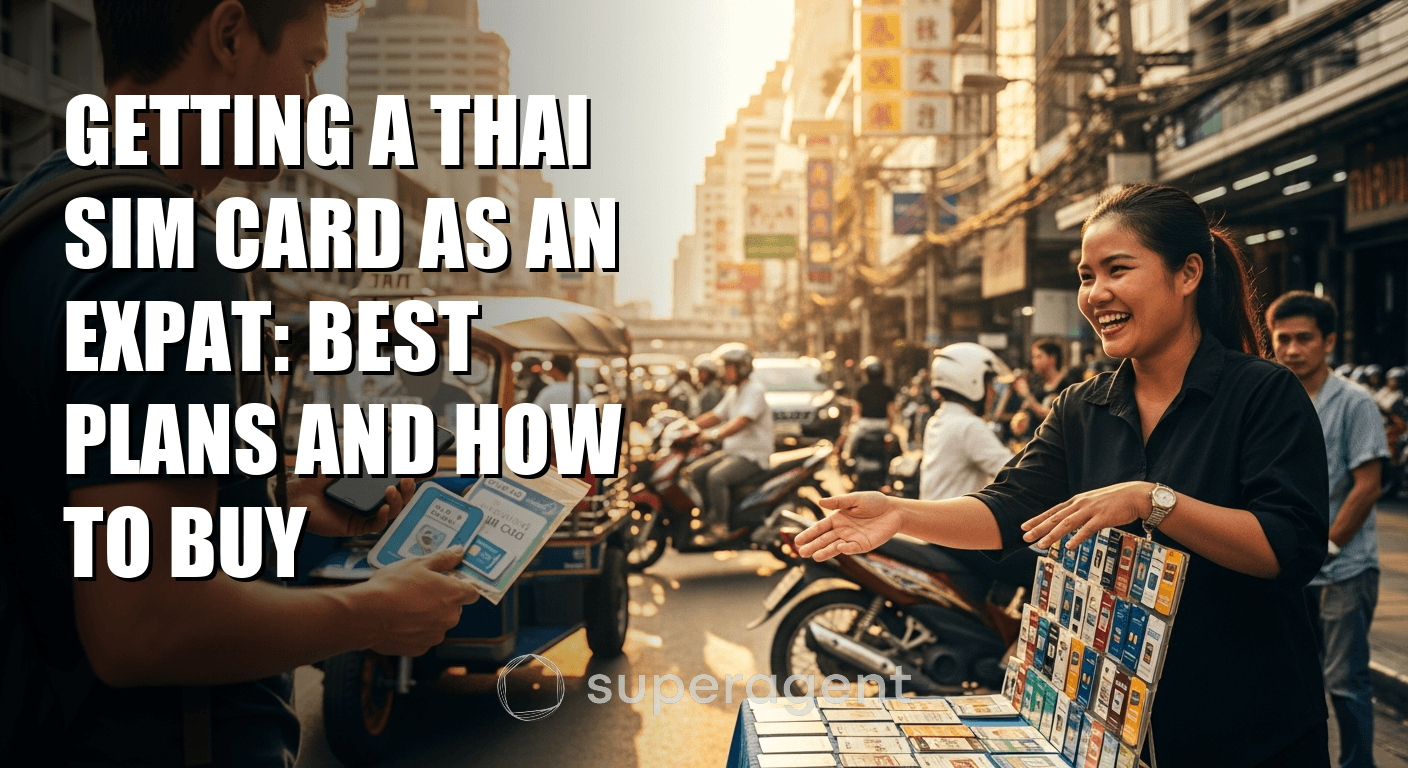
Getting a Thai SIM Card as an Expat: Best Plans and How to Buy
Guides
Getting a Thai SIM Card as an Expat: Best Plans and How to Buy
Stay connected in Thailand with affordable mobile plans designed for foreign residents.
Summary
Learn how to get a Thai SIM card as an expat with our complete guide to the best plans, providers, and step-by-step buying instructions for Bangkok living.
Landing at Suvarnabhumi at midnight, grabbing your bags, and immediately realizing you can't message your new landlord about the lockbox code. That's the moment every expat learns the same lesson: get a Thai SIM card before you do anything else. The good news is Thailand makes it ridiculously easy, and the plans are genuinely cheap compared to what you're used to back home.
Where to Buy a Thai SIM Card in Bangkok
The fastest option is right at the airport. Both Suvarnabhumi and Don Mueang have official carrier kiosks from AIS, TrueMove H, and DTAC just past customs. They're open late, the staff speak English, and they'll pop the SIM in your phone and get everything activated on the spot. Expect to pay around 299 to 599 THB depending on the plan.
If you skip the airport, no stress. Every 7-Eleven in Bangkok sells prepaid SIM cards, and there are carrier shops in basically every mall. The AIS shop on the ground floor of CentralWorld near Chit Lom BTS is massive and always staffed. TrueMove has a big branch inside MBK Center near National Stadium BTS, which is also where you'd go if you need an unlocked phone on the cheap.
One thing to know: you'll need your passport. Thai regulations require ID registration for all SIM cards, so bring your actual passport, not a photocopy. The process takes about five minutes. If you're buying at 7-Eleven, the cashier will scan your passport and hand you the SIM with a basic starter pack already loaded.
The Big Three Carriers and What They Actually Offer
Thailand has three major mobile networks, and honestly, all three are solid in Bangkok. The differences start showing up when you travel upcountry, but for city life, you'll be fine with any of them.
AIS is the largest network with the widest 5G coverage. Their prepaid tourist SIM runs about 599 THB for 15 days with 30GB of data at high speed. For longer stays, their monthly packages start around 200 THB for 10GB and go up to about 700 THB for unlimited high speed data. AIS tends to have the best signal in high rise condos, which matters when you're living on the 30th floor of a building like Ideo Mobi Sukhumvit near On Nut BTS.
TrueMove H is the second largest and partners with TrueOnline, the biggest home internet provider. If your condo already has True fiber installed, bundling your mobile and home internet can save you a couple hundred baht per month. Their prepaid plans are similar in pricing to AIS, with a popular 15 day tourist package at 499 THB for 30GB.
DTAC merged with True in 2023 to form a combined entity, but the DTAC brand still operates separately for now. Their "Happy Tourist SIM" at 299 THB for 8 days with 15GB is probably the best budget option for short stays. Coverage in central Bangkok is comparable to the others.
Prepaid vs Postpaid and When to Switch
Most expats start with prepaid because it requires zero commitment and no Thai bank account. You top up at 7-Eleven, through the carrier's app, or via TrueMoney Wallet. Easy. For the first few months of condo hunting and settling in, prepaid gives you everything you need.
Once you have a work permit or a long term visa, switching to postpaid makes sense. Postpaid plans are cheaper per gigabyte, and you get perks like international calling minutes and priority customer service. You'll typically need your passport, work permit, and a Thai bank account to sign up. Some carriers accept a residence letter from your condo's juristic office as proof of address.
Say you're renting a one bedroom at Life Ladprao near Ladprao MRT for around 15,000 THB per month. Adding a postpaid mobile plan at 599 THB for unlimited data keeps your total connectivity costs well under 1,500 THB when you include the condo's included Wi-Fi. That's a fraction of what you'd pay for similar service in most Western countries.
Tips That Save You Headaches
Make sure your phone is unlocked before you arrive. Phones purchased outright are usually fine, but carrier locked devices from the US or Europe can be a problem. Check with your home carrier before you fly.
Keep your SIM active by topping up at least once every 30 days. If your balance hits zero and you don't reload within the grace period, your number gets recycled. Losing a Thai phone number is annoying because it's often tied to your banking apps, food delivery accounts, and your LINE messenger, which is how most landlords and agents communicate here.
Download the carrier's app right away. AIS has "myAIS," True has "True iService," and they let you check your balance, buy add on data packages, and manage everything without visiting a shop. The apps are in English and actually work well.
Your Phone Number Is Your Bangkok Lifeline
Your Thai number becomes essential faster than you'd expect. From registering on food delivery apps to verifying your identity at the bank, everything runs through SMS verification here. When you're searching for a condo, landlords and property managers almost always want to reach you on LINE, which requires a phone number to set up.
Getting connected is step one. Finding the right condo to call home is step two. If you're starting your Bangkok apartment search, Superagent at superagent.co uses AI to match you with verified listings across the city, so you can spend less time scrolling and more time settling into your new neighborhood.
Landing at Suvarnabhumi at midnight, grabbing your bags, and immediately realizing you can't message your new landlord about the lockbox code. That's the moment every expat learns the same lesson: get a Thai SIM card before you do anything else. The good news is Thailand makes it ridiculously easy, and the plans are genuinely cheap compared to what you're used to back home.
Where to Buy a Thai SIM Card in Bangkok
The fastest option is right at the airport. Both Suvarnabhumi and Don Mueang have official carrier kiosks from AIS, TrueMove H, and DTAC just past customs. They're open late, the staff speak English, and they'll pop the SIM in your phone and get everything activated on the spot. Expect to pay around 299 to 599 THB depending on the plan.
If you skip the airport, no stress. Every 7-Eleven in Bangkok sells prepaid SIM cards, and there are carrier shops in basically every mall. The AIS shop on the ground floor of CentralWorld near Chit Lom BTS is massive and always staffed. TrueMove has a big branch inside MBK Center near National Stadium BTS, which is also where you'd go if you need an unlocked phone on the cheap.
One thing to know: you'll need your passport. Thai regulations require ID registration for all SIM cards, so bring your actual passport, not a photocopy. The process takes about five minutes. If you're buying at 7-Eleven, the cashier will scan your passport and hand you the SIM with a basic starter pack already loaded.
The Big Three Carriers and What They Actually Offer
Thailand has three major mobile networks, and honestly, all three are solid in Bangkok. The differences start showing up when you travel upcountry, but for city life, you'll be fine with any of them.
AIS is the largest network with the widest 5G coverage. Their prepaid tourist SIM runs about 599 THB for 15 days with 30GB of data at high speed. For longer stays, their monthly packages start around 200 THB for 10GB and go up to about 700 THB for unlimited high speed data. AIS tends to have the best signal in high rise condos, which matters when you're living on the 30th floor of a building like Ideo Mobi Sukhumvit near On Nut BTS.
TrueMove H is the second largest and partners with TrueOnline, the biggest home internet provider. If your condo already has True fiber installed, bundling your mobile and home internet can save you a couple hundred baht per month. Their prepaid plans are similar in pricing to AIS, with a popular 15 day tourist package at 499 THB for 30GB.
DTAC merged with True in 2023 to form a combined entity, but the DTAC brand still operates separately for now. Their "Happy Tourist SIM" at 299 THB for 8 days with 15GB is probably the best budget option for short stays. Coverage in central Bangkok is comparable to the others.
Prepaid vs Postpaid and When to Switch
Most expats start with prepaid because it requires zero commitment and no Thai bank account. You top up at 7-Eleven, through the carrier's app, or via TrueMoney Wallet. Easy. For the first few months of condo hunting and settling in, prepaid gives you everything you need.
Once you have a work permit or a long term visa, switching to postpaid makes sense. Postpaid plans are cheaper per gigabyte, and you get perks like international calling minutes and priority customer service. You'll typically need your passport, work permit, and a Thai bank account to sign up. Some carriers accept a residence letter from your condo's juristic office as proof of address.
Talk to us about renting
Share your details and keep reading — we’ll get back to you.
Say you're renting a one bedroom at Life Ladprao near Ladprao MRT for around 15,000 THB per month. Adding a postpaid mobile plan at 599 THB for unlimited data keeps your total connectivity costs well under 1,500 THB when you include the condo's included Wi-Fi. That's a fraction of what you'd pay for similar service in most Western countries.
Tips That Save You Headaches
Make sure your phone is unlocked before you arrive. Phones purchased outright are usually fine, but carrier locked devices from the US or Europe can be a problem. Check with your home carrier before you fly.
Keep your SIM active by topping up at least once every 30 days. If your balance hits zero and you don't reload within the grace period, your number gets recycled. Losing a Thai phone number is annoying because it's often tied to your banking apps, food delivery accounts, and your LINE messenger, which is how most landlords and agents communicate here.
Download the carrier's app right away. AIS has "myAIS," True has "True iService," and they let you check your balance, buy add on data packages, and manage everything without visiting a shop. The apps are in English and actually work well.
Your Phone Number Is Your Bangkok Lifeline
Your Thai number becomes essential faster than you'd expect. From registering on food delivery apps to verifying your identity at the bank, everything runs through SMS verification here. When you're searching for a condo, landlords and property managers almost always want to reach you on LINE, which requires a phone number to set up.
Getting connected is step one. Finding the right condo to call home is step two. If you're starting your Bangkok apartment search, Superagent at superagent.co uses AI to match you with verified listings across the city, so you can spend less time scrolling and more time settling into your new neighborhood.
Share this article
Properties you may like
![[For Rent] CONDO I Quintara Treehaus Sukhumvit 42 I 1 Bed I 1 Bath I 27,000THB/mo](/_next/image?url=https%3A%2F%2Fstorage.googleapis.com%2Fsuperagent-web%2Fattachments%2Flistings%2F6744%2Fae5e2ba7-7c5f-4e6f-a3d7-0f5b7acb36c6-1120-1.jpg&w=3840&q=75)
฿27,000
1 Bed140 sqm
[For Rent] CONDO I Quintara Treehaus Sukhumvit 42 I 1 Bed I 1 Bath I 27,000THB/mo
Phra Khanong
Condo![[For Rent] CONDO I Aguston Sukhumvit 22 I Pet Friendly I 2 Beds I 2 Baths I Rent 55,000THB/mo](/_next/image?url=https%3A%2F%2Fstorage.googleapis.com%2Fsuperagent-web%2Fattachments%2Flistings%2F2266%2Fd3afcd25-6b79-46cb-9f1f-396acdc3dd10-955-3.jpg&w=3840&q=75)
฿55,000
2 Bed295 sqm
[For Rent] CONDO I Aguston Sukhumvit 22 I Pet Friendly I 2 Beds I 2 Baths I Rent 55,000THB/mo
Phrom Phong
Condo![[For Rent] CONDO I SUPALAI PLACE Sukhumvit 39 I 2 Beds I 2 Baths (1 Jacuzzi) I 55,555THB/mo](/_next/image?url=https%3A%2F%2Fstorage.googleapis.com%2Fsuperagent-web%2Fattachments%2Flistings%2F6743%2Fba530743-48b9-4ac6-92d3-c2247e743cf6-01-supalai-place-skv39-2b-link-heaven.jpg&w=3840&q=75)
฿55,555
2 Bed2142 sqm
[For Rent] CONDO I SUPALAI PLACE Sukhumvit 39 I 2 Beds I 2 Baths (1 Jacuzzi) I 55,555THB/mo
Phrom Phong
Condo![[For Rent] CONDO I Maru Ekkamai 2 I Pet friendly I 2 Beds I 2 Baths I 68,000 THB/mo](/_next/image?url=https%3A%2F%2Fstorage.googleapis.com%2Fsuperagent-web%2Fattachments%2Flistings%2F6602%2F9f1d8f71-ee43-435f-9a44-da16c4092c92-968-1.jpg&w=3840&q=75)
฿68,000
2 Bed360 sqm
[For Rent] CONDO I Maru Ekkamai 2 I Pet friendly I 2 Beds I 2 Baths I 68,000 THB/mo
Ekkamai
Condo![[For Rent] CONDO I Noble State 39 I 2 Beds I 2 Baths I 63,000THB/mo](/_next/image?url=https%3A%2F%2Fstorage.googleapis.com%2Fsuperagent-web%2Fattachments%2Flistings%2F2237%2F60eb58f3-eae5-41ed-a80b-406e004f05d8-940-1.jpg&w=3840&q=75)
฿63,000
2 Bed260 sqm
[For Rent] CONDO I Noble State 39 I 2 Beds I 2 Baths I 63,000THB/mo
Phrom Phong
Condo![[For Rent] CONDO I Rhythm Sukhumvit 36-38 I 2 Beds I 2 Baths I 38,999THB/mo](/_next/image?url=https%3A%2F%2Fstorage.googleapis.com%2Fsuperagent-web%2Fattachments%2Flistings%2F1788%2F942a0215-4128-4c2c-a064-f607e84e7aa4-656-2.jpg&w=3840&q=75)
฿38,999
2 Bed256 sqm
[For Rent] CONDO I Rhythm Sukhumvit 36-38 I 2 Beds I 2 Baths I 38,999THB/mo
Thonglor
Condo![[For Rent] CONDO I City Smart Sukhumvit 18 I 3 Beds I 3 Baths I 65,000mo/THB](/_next/image?url=https%3A%2F%2Fstorage.googleapis.com%2Fsuperagent-web%2Fattachments%2Flistings%2F6741%2Fd371c89d-a913-42c4-a673-e540afae4f46-1116-1.jpg&w=3840&q=75)
฿65,000
3 Bed3125 sqm
[For Rent] CONDO I City Smart Sukhumvit 18 I 3 Beds I 3 Baths I 65,000mo/THB
Condo![[For Rent] CONDO I The Coast Bangkok I 1 Bed I 1 Bath I 20,000mo/THB](/_next/image?url=https%3A%2F%2Fstorage.googleapis.com%2Fsuperagent-web%2Fattachments%2Flistings%2F6740%2F498477ce-4ffa-4e4c-ab08-0e565d9c4bbe-1115-3.jpg&w=3840&q=75)
฿20,000
1 Bed146 sqm
[For Rent] CONDO I The Coast Bangkok I 1 Bed I 1 Bath I 20,000mo/THB
Bang Na
Condo![[For Rent] CONDO I IDEO Sukhumvit-RAMA 4 I 2 Beds I 2 Baths I 55,000mo/THB](/_next/image?url=https%3A%2F%2Fstorage.googleapis.com%2Fsuperagent-web%2Fattachments%2Flistings%2F6739%2F15df221d-5b8e-497c-b7ce-a6b9b6412cab-1113-1.jpg&w=3840&q=75)
฿55,000
2 Bed265 sqm
[For Rent] CONDO I IDEO Sukhumvit-RAMA 4 I 2 Beds I 2 Baths I 55,000mo/THB
Phra Khanong
Condo![[For Rent] CONDO I Downtown 49 I Pet Friendly I 1 Bed I 1 Bath I 23,000mo/THB](/_next/image?url=https%3A%2F%2Fstorage.googleapis.com%2Fsuperagent-web%2Fattachments%2Flistings%2F6738%2F11cf2ffe-1f01-4ccc-991c-2ad608f1ba73-1112-1.jpg&w=3840&q=75)
฿23,000
1 Bed135 sqm
[For Rent] CONDO I Downtown 49 I Pet Friendly I 1 Bed I 1 Bath I 23,000mo/THB
Thonglor
CondoMore like this
 In Guides · Superagent EditorialHidden Costs of Renting a Condo in Bangkok Nobody Warns You AboutBangkok condo rent looks affordable until month one hits. Here are the real costs beyond the headline figure that catch most renters off guard.25 May 20261 min read
 In Guides · Superagent EditorialWhat a Long-Vacant Bangkok Condo Unit Is Actually Telling YouA Bangkok condo vacant for months signals overpricing, landlord issues, or real problems. Here is how to read the signs.25 May 20261 min read
 In Guides · Superagent EditorialRed Flags in a Bangkok Rental Contract to Watch Out ForBangkok rental contracts often hide risky clauses. Here are the red flags every tenant must catch before signing any lease.25 May 20261 min read
 In Guides · Superagent EditorialWorking Online from a Condo: How to Choose the Perfect Room for ProductivityLearn how to choose the best condo room for working online with tips on lighting, noise, and furniture setup to maximize productivity.9 May 20261 min read