Getting Around Bangkok on a Budget: BTS, MRT, Bus, and Songthaew Guide
Guides
Getting Around Bangkok on a Budget: BTS, MRT, Bus, and Songthaew Guide
Navigate Bangkok's efficient public transport system without breaking the bank.
Summary
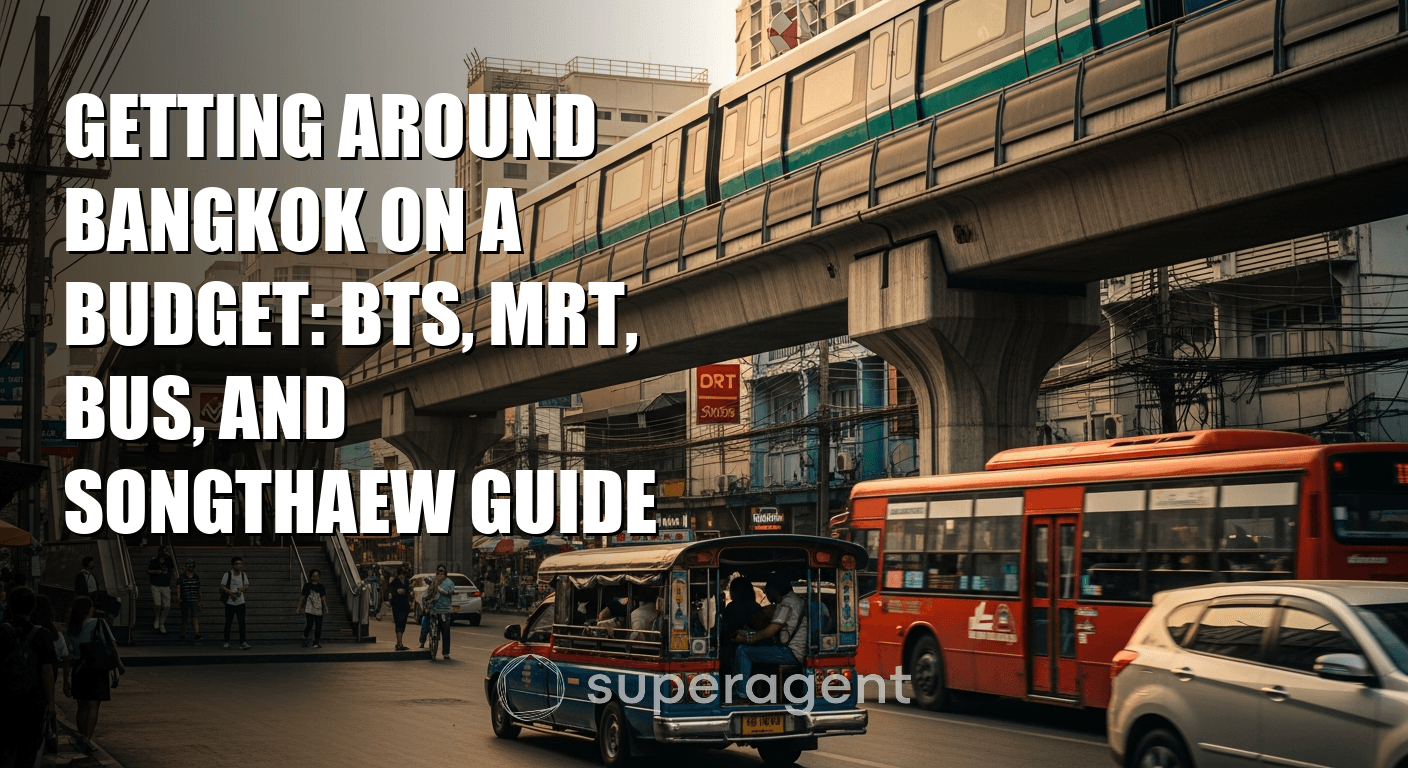
Master budget transport Bangkok expat options with our complete guide to BTS, MRT, buses, and songthaews. Save money while exploring the city.
Bangkok is one of those cities where your transport choices can make or break your monthly budget. I've watched friends blow 15,000 THB a month on Grab rides because they picked a condo in the wrong spot, while others spend less than 2,000 THB getting everywhere they need to go. The difference almost always comes down to understanding how Bangkok's public transport actually works and choosing your rental location accordingly.
The BTS Skytrain: Fast, Air Conditioned, and Surprisingly Affordable
The BTS is the backbone of Bangkok life for most expats. Two lines, the Sukhumvit Line and the Silom Line, cover the most popular living and working areas in the city. A single trip costs between 17 and 62 THB depending on distance, but the real savings come from the Rabbit card stored value system. Load it up and you skip the ticket queue chaos every morning.
Here's a real example. Say you live near On Nut station, where a decent one bedroom at a place like The Base Park West goes for around 12,000 to 15,000 THB per month. Your daily commute to Asok for work is about 37 THB each way. That's roughly 1,480 THB per month for weekday commuting. Compare that to Grab rides covering the same route at 150 to 200 THB each way, and you're saving over 4,500 THB monthly.
The BTS runs from around 5:15 AM to midnight. Peak hours between 7:30 and 9:00 AM on the Sukhumvit Line at stations like Siam, Chit Lom, and Asok can get brutally packed. If your office allows a 10 AM start, your commute experience improves dramatically.
The MRT: Your Underground Alternative
The MRT Blue Line forms a loop through areas the BTS doesn't reach, connecting Hua Lamphong, Silom, Chatuchak, and extending out to spots like Lak Song and Tha Phra. The Purple Line connects Bang Yai to Tao Pun. Fares range from 17 to 70 THB per trip, and you'll need a separate stored value card from the BTS system, which is one of Bangkok's most annoying quirks.
Living near Phra Ram 9 MRT station is a great budget play. Condos like Life Asoke Rama 9 or Aspire Rama 9 offer studios and one bedrooms in the 10,000 to 14,000 THB range. You're connected to the Blue Line, with Sukhumvit MRT station just two stops away for a transfer to the BTS. Monthly MRT costs for a typical commute from here run about 1,200 to 1,600 THB.
The MRT also runs until midnight and recently started accepting contactless bank cards at some stations, which makes topping up stored value cards less of a headache.
Bangkok Buses: The Budget King Nobody Talks About
Bangkok's bus network gets a bad reputation among expats, and honestly some of it is earned. Routes can be confusing, signage is mostly in Thai, and schedules are more of a suggestion than a commitment. But if you take the time to learn even two or three routes near your condo, you can get across the city for 8 to 25 THB per ride.
My friend rents a studio near Soi Thonglor 13 for 9,500 THB and takes Bus 511 from Sukhumvit Road to Silom for work. Air conditioned, 19 THB, and surprisingly reliable during non peak hours. She spends under 800 THB a month on transport. The ViaBus app shows real time bus locations and is a game changer for figuring out which routes pass your area.
Cream and red buses without air conditioning are the cheapest at 8 THB flat fare. Orange and blue air conditioned buses cost between 13 and 25 THB. You pay the conductor who walks through the bus after you board.
Songthaews and Boat Services: Hyperlocal Transport Gems
Songthaews are those converted pickup trucks with two bench seats in the back. They run fixed routes through specific neighborhoods, and a ride typically costs 7 to 10 THB. In areas like Bang Na, Ramkhamhaeng, and parts of Nonthaburi, songthaews connect BTS and MRT stations to residential sois that are too far to walk comfortably.
If you rent at a condo like Lumpini Ville Sukhumvit 76 near Bearing BTS, a songthaew running along Sukhumvit Soi 76 and 77 will drop you right at the station for 8 THB. Monthly cost for daily use? Under 500 THB.
Don't overlook the Saen Saep canal boat either. It runs from Wat Sri Bun Rueang in the east all the way to the Golden Mount near Khao San, with a stop at Pratunam. Fares are 10 to 20 THB, and the boat can be faster than any road transport during rush hour. It's wet, loud, and chaotic, but it works.
Picking a Condo Location That Saves You Transport Money
The smartest budget move in Bangkok is choosing where you live based on your commute first, neighborhood vibes second. A condo that costs 2,000 THB less per month but adds 4,000 THB in Grab rides is not a deal. Look for places within 500 meters of a BTS or MRT station, and check if bus routes or songthaews cover the last mile.
Areas like On Nut, Bearing, Phra Ram 9, Bang Wa, and Wutthakat consistently offer the best combination of affordable rent and solid public transport access. You can find well maintained one bedrooms for 8,000 to 14,000 THB in all of these neighborhoods.
When you're searching for your next rental, think about total monthly living cost, not just the number on the lease. A 12,000 THB condo near On Nut BTS with a 1,500 THB monthly commute beats a 10,000 THB condo in a poorly connected soi where you spend 5,000 THB on rides. Superagent at superagent.co lets you filter condos by BTS and MRT proximity, so you can find that perfect balance between rent price and transport savings without spending weekends visiting random buildings across the city.
Bangkok is one of those cities where your transport choices can make or break your monthly budget. I've watched friends blow 15,000 THB a month on Grab rides because they picked a condo in the wrong spot, while others spend less than 2,000 THB getting everywhere they need to go. The difference almost always comes down to understanding how Bangkok's public transport actually works and choosing your rental location accordingly.
The BTS Skytrain: Fast, Air Conditioned, and Surprisingly Affordable
The BTS is the backbone of Bangkok life for most expats. Two lines, the Sukhumvit Line and the Silom Line, cover the most popular living and working areas in the city. A single trip costs between 17 and 62 THB depending on distance, but the real savings come from the Rabbit card stored value system. Load it up and you skip the ticket queue chaos every morning.
Here's a real example. Say you live near On Nut station, where a decent one bedroom at a place like The Base Park West goes for around 12,000 to 15,000 THB per month. Your daily commute to Asok for work is about 37 THB each way. That's roughly 1,480 THB per month for weekday commuting. Compare that to Grab rides covering the same route at 150 to 200 THB each way, and you're saving over 4,500 THB monthly.
The BTS runs from around 5:15 AM to midnight. Peak hours between 7:30 and 9:00 AM on the Sukhumvit Line at stations like Siam, Chit Lom, and Asok can get brutally packed. If your office allows a 10 AM start, your commute experience improves dramatically.
The MRT: Your Underground Alternative
The MRT Blue Line forms a loop through areas the BTS doesn't reach, connecting Hua Lamphong, Silom, Chatuchak, and extending out to spots like Lak Song and Tha Phra. The Purple Line connects Bang Yai to Tao Pun. Fares range from 17 to 70 THB per trip, and you'll need a separate stored value card from the BTS system, which is one of Bangkok's most annoying quirks.
Living near Phra Ram 9 MRT station is a great budget play. Condos like Life Asoke Rama 9 or Aspire Rama 9 offer studios and one bedrooms in the 10,000 to 14,000 THB range. You're connected to the Blue Line, with Sukhumvit MRT station just two stops away for a transfer to the BTS. Monthly MRT costs for a typical commute from here run about 1,200 to 1,600 THB.
The MRT also runs until midnight and recently started accepting contactless bank cards at some stations, which makes topping up stored value cards less of a headache.
Bangkok Buses: The Budget King Nobody Talks About
Bangkok's bus network gets a bad reputation among expats, and honestly some of it is earned. Routes can be confusing, signage is mostly in Thai, and schedules are more of a suggestion than a commitment. But if you take the time to learn even two or three routes near your condo, you can get across the city for 8 to 25 THB per ride.
My friend rents a studio near Soi Thonglor 13 for 9,500 THB and takes Bus 511 from Sukhumvit Road to Silom for work. Air conditioned, 19 THB, and surprisingly reliable during non peak hours. She spends under 800 THB a month on transport. The ViaBus app shows real time bus locations and is a game changer for figuring out which routes pass your area.
Cream and red buses without air conditioning are the cheapest at 8 THB flat fare. Orange and blue air conditioned buses cost between 13 and 25 THB. You pay the conductor who walks through the bus after you board.
Talk to us about renting
Share your details and keep reading — we’ll get back to you.
Songthaews and Boat Services: Hyperlocal Transport Gems
Songthaews are those converted pickup trucks with two bench seats in the back. They run fixed routes through specific neighborhoods, and a ride typically costs 7 to 10 THB. In areas like Bang Na, Ramkhamhaeng, and parts of Nonthaburi, songthaews connect BTS and MRT stations to residential sois that are too far to walk comfortably.
If you rent at a condo like Lumpini Ville Sukhumvit 76 near Bearing BTS, a songthaew running along Sukhumvit Soi 76 and 77 will drop you right at the station for 8 THB. Monthly cost for daily use? Under 500 THB.
Don't overlook the Saen Saep canal boat either. It runs from Wat Sri Bun Rueang in the east all the way to the Golden Mount near Khao San, with a stop at Pratunam. Fares are 10 to 20 THB, and the boat can be faster than any road transport during rush hour. It's wet, loud, and chaotic, but it works.
Picking a Condo Location That Saves You Transport Money
The smartest budget move in Bangkok is choosing where you live based on your commute first, neighborhood vibes second. A condo that costs 2,000 THB less per month but adds 4,000 THB in Grab rides is not a deal. Look for places within 500 meters of a BTS or MRT station, and check if bus routes or songthaews cover the last mile.
Areas like On Nut, Bearing, Phra Ram 9, Bang Wa, and Wutthakat consistently offer the best combination of affordable rent and solid public transport access. You can find well maintained one bedrooms for 8,000 to 14,000 THB in all of these neighborhoods.
When you're searching for your next rental, think about total monthly living cost, not just the number on the lease. A 12,000 THB condo near On Nut BTS with a 1,500 THB monthly commute beats a 10,000 THB condo in a poorly connected soi where you spend 5,000 THB on rides. Superagent at superagent.co lets you filter condos by BTS and MRT proximity, so you can find that perfect balance between rent price and transport savings without spending weekends visiting random buildings across the city.
Share this article
Properties you may like
![[For Rent] CONDO I Life One Wireless I 2 Beds I 1 Bath I 40,000THB/mo](/_next/image?url=https%3A%2F%2Fstorage.googleapis.com%2Fsuperagent-web%2Fattachments%2Flistings%2F6767%2F03e11a74-9a71-44df-9493-9adc1c934047-1147-6.jpg&w=3840&q=75)
฿40,000
2 Bed145 sqm
[For Rent] CONDO I Life One Wireless I 2 Beds I 1 Bath I 40,000THB/mo
Ploenchit
Condo![[For Rent] CONDO I IDEO Mobi Charan Interchange I 2 Beds I 1 Bath I 22,000THB/mo](/_next/image?url=https%3A%2F%2Fstorage.googleapis.com%2Fsuperagent-web%2Fattachments%2Flistings%2F6766%2F23b6eb3e-caa3-400e-9bcb-c00c2c6f196b-1146-1.jpg&w=3840&q=75)
฿22,000
2 Bed145 sqm
[For Rent] CONDO I IDEO Mobi Charan Interchange I 2 Beds I 1 Bath I 22,000THB/mo
Condo![[For Rent] CONDO I Life Asoke Hype I 1 Bed I 1 Bath I 18,000THB/mo](/_next/image?url=https%3A%2F%2Fstorage.googleapis.com%2Fsuperagent-web%2Fattachments%2Flistings%2F6765%2F80b683ff-1960-428b-bbbc-37b913f8e2c3-1143-3.jpg&w=3840&q=75)
฿18,000
1 Bed126 sqm
[For Rent] CONDO I Life Asoke Hype I 1 Bed I 1 Bath I 18,000THB/mo
Asoke
Condo![[For Rent] CONDO I Witthayu Complex I Pet Friendly I 2 Beds I 1 Bath I 28,000THB/mo](/_next/image?url=https%3A%2F%2Fstorage.googleapis.com%2Fsuperagent-web%2Fattachments%2Flistings%2F6764%2F02d4c7ac-6555-4668-87da-a32133c64277-1145-1.jpg&w=3840&q=75)
฿28,000
2 Bed185 sqm
[For Rent] CONDO I Witthayu Complex I Pet Friendly I 2 Beds I 1 Bath I 28,000THB/mo
Condo![[For Rent] CONDO I Witthayu Complex I Pet Friendly I 2 Beds I 2 Baths I 35,000THB/mo](/_next/image?url=https%3A%2F%2Fstorage.googleapis.com%2Fsuperagent-web%2Fattachments%2Flistings%2F6763%2F2c2d8fb9-5284-4d27-8451-8658173f9bfb-1144-5.jpg&w=3840&q=75)
฿35,000
2 Bed295 sqm
[For Rent] CONDO I Witthayu Complex I Pet Friendly I 2 Beds I 2 Baths I 35,000THB/mo
Condo![[For Rent] CONDO I UP Ekkamai I Pet Friendly I 2 Beds I 2 Baths I 40,000THB/mo](/_next/image?url=https%3A%2F%2Fstorage.googleapis.com%2Fsuperagent-web%2Fattachments%2Flistings%2F6762%2F28ea39dc-4e7d-4dc5-b8bc-fa254e6512c6-1142-1.jpg&w=3840&q=75)
฿40,003
2 Bed260 sqm
[For Rent] CONDO I UP Ekkamai I Pet Friendly I 2 Beds I 2 Baths I 40,000THB/mo
Condo![[For Rent] CONDO I Ideo Q Phayathai I 2 Beds I 2 Baths I 50,000THB/mo](/_next/image?url=https%3A%2F%2Fstorage.googleapis.com%2Fsuperagent-web%2Fattachments%2Flistings%2F6761%2Fd56dc353-7436-451a-b407-76100af6b15f-1141-1.jpg&w=3840&q=75)
฿50,000
2 Bed275 sqm
[For Rent] CONDO I Ideo Q Phayathai I 2 Beds I 2 Baths I 50,000THB/mo
Phaya Thai
Condo![[For Rent] CONDO I Culture Chula I Duplex I 1 Bed I 1 Bath I 35,000THB/mo](/_next/image?url=https%3A%2F%2Fstorage.googleapis.com%2Fsuperagent-web%2Fattachments%2Flistings%2F6760%2F8deaff98-ecb1-4c62-b9be-aecac2f65797-1140-1.jpg&w=3840&q=75)
฿35,000
1 Bed138 sqm
[For Rent] CONDO I Culture Chula I Duplex I 1 Bed I 1 Bath I 35,000THB/mo
Siam
Condo![[For Rent] CONDO I The River Condominium I 2 Beds I 3 Baths I 55,000THB/mo](/_next/image?url=https%3A%2F%2Fstorage.googleapis.com%2Fsuperagent-web%2Fattachments%2Flistings%2F6745%2Fa48d8ae3-8857-408d-81ff-45eb890fbdb9-1000011745.jpg&w=3840&q=75)
฿55,000
2 Bed398 sqm
[For Rent] CONDO I The River Condominium I 2 Beds I 3 Baths I 55,000THB/mo
Wongwian Yai
Condo![[For Rent] CONDO I Park Origin Phayathai I Studio I 1 Bath I 28,000THB/mo](/_next/image?url=https%3A%2F%2Fstorage.googleapis.com%2Fsuperagent-web%2Fattachments%2Flistings%2F6757%2Fb226df93-94c6-46fa-aeba-ebfadc7f81b8-1000006042.jpg&w=3840&q=75)
฿28,000
Studio129 sqm
[For Rent] CONDO I Park Origin Phayathai I Studio I 1 Bath I 28,000THB/mo
Phaya Thai
CondoMore like this
 In Guides · Superagent EditorialHidden Costs of Renting a Condo in Bangkok Nobody Warns You AboutBangkok condo rent looks affordable until month one hits. Here are the real costs beyond the headline figure that catch most renters off guard.25 May 20261 min read
 In Guides · Superagent EditorialWhat a Long-Vacant Bangkok Condo Unit Is Actually Telling YouA Bangkok condo vacant for months signals overpricing, landlord issues, or real problems. Here is how to read the signs.25 May 20261 min read
 In Guides · Superagent EditorialRed Flags in a Bangkok Rental Contract to Watch Out ForBangkok rental contracts often hide risky clauses. Here are the red flags every tenant must catch before signing any lease.25 May 20261 min read
 In Guides · Superagent EditorialWorking Online from a Condo: How to Choose the Perfect Room for ProductivityLearn how to choose the best condo room for working online with tips on lighting, noise, and furniture setup to maximize productivity.9 May 20261 min read