Guides
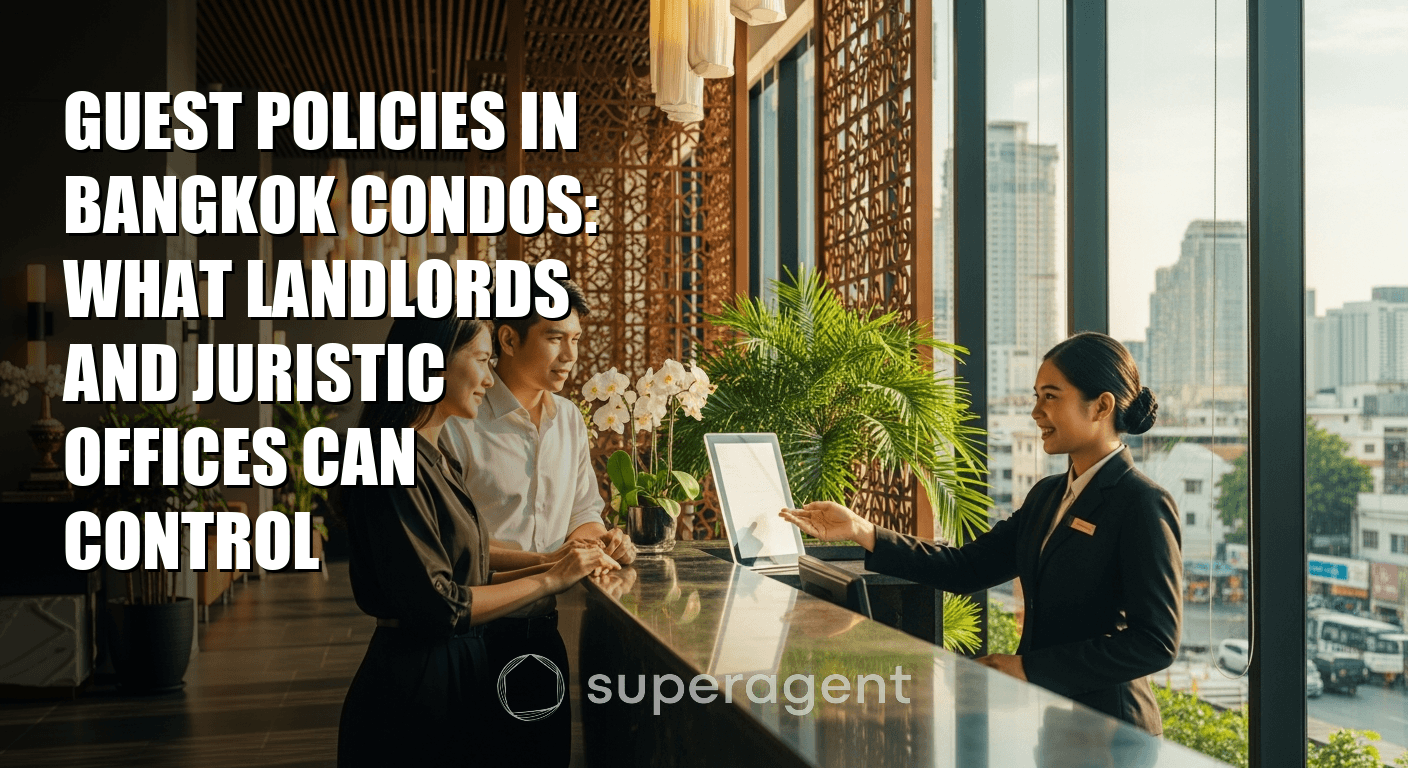
Guest Policies in Bangkok Condos: What Landlords and Juristic Offices Can Control
Learn what guest policies Bangkok condo owners and juristic offices can enforce
Summary
Understand bangkok condo guest policy rules, restrictions, and what landlords can legally control when renting residential units.
You moved into a nice one-bedroom condo near BTS Thong Lo, paying around 22,000 THB per month. Your friend from back home visits Bangkok for two weeks. They crash on your couch, and everything seems fine. Then you get a call from the juristic office saying your guest needs to register, pay a deposit, and follow building rules you never knew existed. Sound familiar? Guest policies in Bangkok condos catch a lot of renters off guard, and the rules vary wildly from building to building. Let's break down what landlords and juristic offices can actually control, what they cannot, and how to avoid awkward confrontations at the lobby desk.
What Exactly Is a Juristic Office and Why Does It Matter?
If you have rented in Bangkok for any length of time, you have probably dealt with a juristic office without fully understanding what it is. Under the Thai Land Department regulations, every registered condominium in Thailand must have a juristic person, essentially a management body that handles common areas, building rules, and co-owner affairs. This is governed by the Condominium Act B.E. 2522 and its amendments.
The juristic office sets building regulations that all residents, owners and tenants alike, must follow. These regulations cover everything from pool hours to pet policies to, yes, guest rules. The key thing to understand is that these are not arbitrary decisions by a power-tripping lobby guard. They are formally adopted rules backed by Thai law.
Take a building like The Lumpini 24 near BTS Phrom Phong. Their juristic office requires all overnight guests to be registered at the front desk with a copy of their passport or Thai ID. Guests staying more than three consecutive nights may need written approval from the unit owner. This is not unusual. It is actually pretty standard across mid-range and high-end condos in the Sukhumvit corridor.
Overnight Guests vs. Long-Term Visitors: Where the Line Gets Blurry
Most Bangkok condos distinguish between a casual visitor who comes for dinner and leaves, and an overnight guest who sleeps in your unit. A friend popping by for a few hours usually just needs to sign in at the lobby and leave an ID. No drama there.
The complications start with overnight stays and especially with guests who stay for extended periods. According to a 2023 survey by DDproperty, approximately 68% of condominium projects in Bangkok require formal guest registration for stays exceeding 3 nights. Many buildings cap continuous guest stays at 7 to 14 days before requiring additional documentation or fees.
Here is a real scenario. A renter in Ideo Q Sukhumvit 36, near BTS Thong Lo, had her boyfriend staying over most nights of the week. The juristic office eventually contacted the unit owner, who then asked the tenant to either add the boyfriend to the lease or have him register as a co-occupant with an additional key card fee of 2,000 to 3,000 THB. The building was within its rights. If someone is essentially living in the unit, they are not a guest anymore. They are an unregistered occupant.
What Landlords Can and Cannot Put in Your Lease
Your lease agreement is a private contract between you and the landlord. Landlords in Bangkok can include guest-related clauses, and many do. Common ones include requiring landlord approval for guests staying longer than a week, prohibiting subletting or short-term rentals through platforms like Airbnb, limiting the number of occupants in a unit, and requiring tenants to ensure guests follow building rules.
What landlords cannot do is override Thai civil and commercial law. For example, a landlord cannot ban you from having any visitors at all. That would be considered an unreasonable restriction on your use of the property. They also cannot impose fines that were not agreed upon in the lease or building regulations.
Consider a common situation in buildings along the Ratchadaphisek corridor near MRT Rama 9, where one-bedroom units rent for 12,000 to 18,000 THB per month. Many landlords in this area rent to young professionals and include a clause stating "no overnight guests of the opposite sex." While culturally motivated, this type of clause is difficult to enforce and sits in a legal gray area. Most legal experts agree it would not hold up if challenged, but it still creates friction.
Building Rules That Catch Renters Off Guard
Beyond your lease, the juristic office has its own set of regulations. These are the ones that tend to surprise people. Here are the most common guest-related building rules you will encounter across Bangkok condos.
| Policy Type | Common Rule | Typical Buildings/Areas | Estimated Extra Cost |
|---|---|---|---|
| Guest Registration | All overnight guests must register at lobby with ID | Most condos citywide | Free |
| Key Card for Guests | Temporary key card issued for stays over 3 nights | Ashton Asoke, Ideo Mobi Sukhumvit | 500 to 2,000 THB deposit |
| Guest Stay Limit | Maximum 7 to 14 consecutive nights per guest | Life Sukhumvit 48, Rhythm Sukhumvit 36-38 | Free, but overstay may incur fees |
| Guest Curfew for Facilities | Guests cannot use pool/gym, or only during set hours | High-end condos in Sathorn, Silom | Free |
| No Unregistered Overnight Guests | Fines for repeated unregistered overnight visitors | Condos near Soi Nana, Soi 11 areas | 1,000 to 5,000 THB fine per incident |
| Co-Occupant Registration | Long-term guests must register as co-occupants | Noble Ploenchit, Park 24 | 2,000 to 5,000 THB for additional card |
A friend of mine renting at Rhythm Ekkamai near BTS Ekkamai had his parents visit from Europe for three weeks. The juristic office allowed the first week without issue but then required a temporary resident registration for the remaining two weeks, including a 3,000 THB refundable deposit for visitor key cards. He was not thrilled, but the policy was clearly posted in the building handbook he received at move-in. Lesson learned: always read the building regulations, not just the lease.
The Airbnb Problem and How It Affects Your Guest Policy
Thailand's Hotel Act makes it illegal to rent out a property for fewer than 30 days unless the property is registered as a hotel. This law has been increasingly enforced since 2018, and juristic offices in Bangkok have become extremely vigilant about short-term guests who look like Airbnb customers.
If your building suspects you are running a short-term rental, the consequences can be serious. According to Knight Frank Thailand, several high-profile condominiums in the Asoke and Nana areas have installed facial recognition systems and tightened guest registration specifically to combat unauthorized short-term rentals. Buildings like The Address Sukhumvit 28 and Edge Sukhumvit 23 have banned all stays under 30 days entirely.
This crackdown affects regular renters too. If you frequently have different guests staying overnight, even if they are genuinely friends or family, your juristic office might flag your unit. One renter at a condo near BTS Ari, paying around 18,000 THB per month for a studio, received a warning letter after three different friends stayed in his unit over the course of a single month. Each stay was only two or three nights, but the pattern triggered the building's monitoring system.
How to Protect Yourself Before You Sign a Lease
The best time to deal with guest policy headaches is before they happen. Here is what smart renters in Bangkok do before signing any lease.
First, ask the landlord directly about guest policies. Not just what the lease says, but what the building actually enforces. There is often a gap between written rules and daily practice. Second, request a copy of the building regulations from the juristic office. Any reputable building will provide this in English, especially in expat-heavy areas like Sukhumvit, Silom, and Sathorn. Third, talk to the lobby staff. They are the ones enforcing these policies daily, and they can tell you how strict the building really is.
If you know you will have frequent visitors, whether a partner who stays over regularly, family coming to visit, or friends passing through Bangkok, factor this into your condo search. Buildings in areas like Phra Khanong or On Nut, where one-bedrooms run 10,000 to 16,000 THB per month, tend to have slightly more relaxed enforcement compared to premium Sukhumvit buildings between Asoke and Thong Lo.
Finally, keep a paper trail. If your landlord says guests are fine, get it in writing, even a LINE message screenshot works. If the juristic office gives you verbal permission for a longer guest stay, follow up with an email to confirm. This protects you if disputes arise later, especially regarding security deposit deductions at move-out.
Guest policies might feel like a minor detail when you are apartment hunting, but they can turn into a real headache if you are caught off guard. Know the rules, ask the right questions, and choose a building that fits how you actually live. If you are searching for a condo in Bangkok and want to compare guest policies, building amenities, and real pricing side by side, try browsing listings on superagent.co to find a place that works for your lifestyle, not just your budget.
You moved into a nice one-bedroom condo near BTS Thong Lo, paying around 22,000 THB per month. Your friend from back home visits Bangkok for two weeks. They crash on your couch, and everything seems fine. Then you get a call from the juristic office saying your guest needs to register, pay a deposit, and follow building rules you never knew existed. Sound familiar? Guest policies in Bangkok condos catch a lot of renters off guard, and the rules vary wildly from building to building. Let's break down what landlords and juristic offices can actually control, what they cannot, and how to avoid awkward confrontations at the lobby desk.
What Exactly Is a Juristic Office and Why Does It Matter?
If you have rented in Bangkok for any length of time, you have probably dealt with a juristic office without fully understanding what it is. Under the Thai Land Department regulations, every registered condominium in Thailand must have a juristic person, essentially a management body that handles common areas, building rules, and co-owner affairs. This is governed by the Condominium Act B.E. 2522 and its amendments.
The juristic office sets building regulations that all residents, owners and tenants alike, must follow. These regulations cover everything from pool hours to pet policies to, yes, guest rules. The key thing to understand is that these are not arbitrary decisions by a power-tripping lobby guard. They are formally adopted rules backed by Thai law.
Take a building like The Lumpini 24 near BTS Phrom Phong. Their juristic office requires all overnight guests to be registered at the front desk with a copy of their passport or Thai ID. Guests staying more than three consecutive nights may need written approval from the unit owner. This is not unusual. It is actually pretty standard across mid-range and high-end condos in the Sukhumvit corridor.
Overnight Guests vs. Long-Term Visitors: Where the Line Gets Blurry
Most Bangkok condos distinguish between a casual visitor who comes for dinner and leaves, and an overnight guest who sleeps in your unit. A friend popping by for a few hours usually just needs to sign in at the lobby and leave an ID. No drama there.
The complications start with overnight stays and especially with guests who stay for extended periods. According to a 2023 survey by DDproperty, approximately 68% of condominium projects in Bangkok require formal guest registration for stays exceeding 3 nights. Many buildings cap continuous guest stays at 7 to 14 days before requiring additional documentation or fees.
Here is a real scenario. A renter in Ideo Q Sukhumvit 36, near BTS Thong Lo, had her boyfriend staying over most nights of the week. The juristic office eventually contacted the unit owner, who then asked the tenant to either add the boyfriend to the lease or have him register as a co-occupant with an additional key card fee of 2,000 to 3,000 THB. The building was within its rights. If someone is essentially living in the unit, they are not a guest anymore. They are an unregistered occupant.
What Landlords Can and Cannot Put in Your Lease
Your lease agreement is a private contract between you and the landlord. Landlords in Bangkok can include guest-related clauses, and many do. Common ones include requiring landlord approval for guests staying longer than a week, prohibiting subletting or short-term rentals through platforms like Airbnb, limiting the number of occupants in a unit, and requiring tenants to ensure guests follow building rules.
What landlords cannot do is override Thai civil and commercial law. For example, a landlord cannot ban you from having any visitors at all. That would be considered an unreasonable restriction on your use of the property. They also cannot impose fines that were not agreed upon in the lease or building regulations.
Consider a common situation in buildings along the Ratchadaphisek corridor near MRT Rama 9, where one-bedroom units rent for 12,000 to 18,000 THB per month. Many landlords in this area rent to young professionals and include a clause stating "no overnight guests of the opposite sex." While culturally motivated, this type of clause is difficult to enforce and sits in a legal gray area. Most legal experts agree it would not hold up if challenged, but it still creates friction.
Building Rules That Catch Renters Off Guard
Beyond your lease, the juristic office has its own set of regulations. These are the ones that tend to surprise people. Here are the most common guest-related building rules you will encounter across Bangkok condos.
| Policy Type | Common Rule | Typical Buildings/Areas | Estimated Extra Cost |
|---|---|---|---|
| Guest Registration | All overnight guests must register at lobby with ID | Most condos citywide | Free |
| Key Card for Guests | Temporary key card issued for stays over 3 nights | Ashton Asoke, Ideo Mobi Sukhumvit | 500 to 2,000 THB deposit |
| Guest Stay Limit | Maximum 7 to 14 consecutive nights per guest | Life Sukhumvit 48, Rhythm Sukhumvit 36-38 | Free, but overstay may incur fees |
| Guest Curfew for Facilities | Guests cannot use pool/gym, or only during set hours | High-end condos in Sathorn, Silom | Free |
| No Unregistered Overnight Guests | Fines for repeated unregistered overnight visitors | Condos near Soi Nana, Soi 11 areas | 1,000 to 5,000 THB fine per incident |
| Co-Occupant Registration | Long-term guests must register as co-occupants | Noble Ploenchit, Park 24 | 2,000 to 5,000 THB for additional card |
A friend of mine renting at Rhythm Ekkamai near BTS Ekkamai had his parents visit from Europe for three weeks. The juristic office allowed the first week without issue but then required a temporary resident registration for the remaining two weeks, including a 3,000 THB refundable deposit for visitor key cards. He was not thrilled, but the policy was clearly posted in the building handbook he received at move-in. Lesson learned: always read the building regulations, not just the lease.
Talk to us about renting
Share your details and keep reading — we’ll get back to you.
The Airbnb Problem and How It Affects Your Guest Policy
Thailand's Hotel Act makes it illegal to rent out a property for fewer than 30 days unless the property is registered as a hotel. This law has been increasingly enforced since 2018, and juristic offices in Bangkok have become extremely vigilant about short-term guests who look like Airbnb customers.
If your building suspects you are running a short-term rental, the consequences can be serious. According to Knight Frank Thailand, several high-profile condominiums in the Asoke and Nana areas have installed facial recognition systems and tightened guest registration specifically to combat unauthorized short-term rentals. Buildings like The Address Sukhumvit 28 and Edge Sukhumvit 23 have banned all stays under 30 days entirely.
This crackdown affects regular renters too. If you frequently have different guests staying overnight, even if they are genuinely friends or family, your juristic office might flag your unit. One renter at a condo near BTS Ari, paying around 18,000 THB per month for a studio, received a warning letter after three different friends stayed in his unit over the course of a single month. Each stay was only two or three nights, but the pattern triggered the building's monitoring system.
How to Protect Yourself Before You Sign a Lease
The best time to deal with guest policy headaches is before they happen. Here is what smart renters in Bangkok do before signing any lease.
First, ask the landlord directly about guest policies. Not just what the lease says, but what the building actually enforces. There is often a gap between written rules and daily practice. Second, request a copy of the building regulations from the juristic office. Any reputable building will provide this in English, especially in expat-heavy areas like Sukhumvit, Silom, and Sathorn. Third, talk to the lobby staff. They are the ones enforcing these policies daily, and they can tell you how strict the building really is.
If you know you will have frequent visitors, whether a partner who stays over regularly, family coming to visit, or friends passing through Bangkok, factor this into your condo search. Buildings in areas like Phra Khanong or On Nut, where one-bedrooms run 10,000 to 16,000 THB per month, tend to have slightly more relaxed enforcement compared to premium Sukhumvit buildings between Asoke and Thong Lo.
Finally, keep a paper trail. If your landlord says guests are fine, get it in writing, even a LINE message screenshot works. If the juristic office gives you verbal permission for a longer guest stay, follow up with an email to confirm. This protects you if disputes arise later, especially regarding security deposit deductions at move-out.
Guest policies might feel like a minor detail when you are apartment hunting, but they can turn into a real headache if you are caught off guard. Know the rules, ask the right questions, and choose a building that fits how you actually live. If you are searching for a condo in Bangkok and want to compare guest policies, building amenities, and real pricing side by side, try browsing listings on superagent.co to find a place that works for your lifestyle, not just your budget.
Share this article
Properties you may like
![[For Rent&Sale] HOUSE I Perfect Place Ramindra - Wongwaen I 4 Beds I 3 Baths I Rent 33,000THB/mo - Sale 7.49mb THB](/_next/image?url=https%3A%2F%2Fstorage.googleapis.com%2Fsuperagent-web%2Fattachments%2Flistings%2F1957%2F4c02eda2-14c3-4a1c-8ad1-fea436f93326-p8.5.jpg&w=3840&q=75)
฿33,000
[For Rent&Sale] HOUSE I Perfect Place Ramindra - Wongwaen I 4 Beds I 3 Baths I Rent 33,000THB/mo - Sale 7.49mb THB
House![[For Rent] CONDO I Notting Hill The Exclusive Charoen Krung 93 I 2 Beds I 1 Bath I 25,000THB/mo](/_next/image?url=https%3A%2F%2Fstorage.googleapis.com%2Fsuperagent-web%2Fattachments%2Flistings%2F1928%2F0ab7c14e-8339-4c28-b54a-d8a64920e9af-4.-img_1315.jpg&w=3840&q=75)
฿25,000
[For Rent] CONDO I Notting Hill The Exclusive Charoen Krung 93 I 2 Beds I 1 Bath I 25,000THB/mo
Condo![[For Rent] BUILDING I Quach House Phrom Phong I 1st-6th Floor I 100,000-135,000THB/mo](/_next/image?url=https%3A%2F%2Fstorage.googleapis.com%2Fsuperagent-web%2Fattachments%2Flistings%2F1976%2F333d3ec9-941e-431d-8a0c-68b9d7bdbc41-1000002210.jpg&w=3840&q=75)
฿135,000
[For Rent] BUILDING I Quach House Phrom Phong I 1st-6th Floor I 100,000-135,000THB/mo
Townhouse![[For Rent] CONDO I Waterford Diamond Sukhumvit 30/1 I 3 Beds I 3 Baths I 65,000THB/mo](/_next/image?url=https%3A%2F%2Fstorage.googleapis.com%2Fsuperagent-web%2Fattachments%2Flistings%2F2049%2Fa78ddba5-043d-459a-97eb-4f80a7bf7d1a-8f2dc5c8-f220-47ae-b027-7deab6c6666b-media.jpg&w=3840&q=75)
฿65,000
[For Rent] CONDO I Waterford Diamond Sukhumvit 30/1 I 3 Beds I 3 Baths I 65,000THB/mo
Phrom Phong
Condo![[For Rent] HOUSE I Centro Vibhavadi I 4 Beds I 3 Baths I 80,000THB/mo](/_next/image?url=https%3A%2F%2Fstorage.googleapis.com%2Fsuperagent-web%2Fattachments%2Flistings%2F2048%2F7bcb9b3f-6bca-4615-8451-eb71e0910ecc-26-07-09-15-10-22-747_deco.jpg&w=3840&q=75)
฿80,000
[For Rent] HOUSE I Centro Vibhavadi I 4 Beds I 3 Baths I 80,000THB/mo
House![[For Rent] CONDO I RHYTHM Sathorn I 1 Bed I 1 Bath I 20,000THB/mo](/_next/image?url=https%3A%2F%2Fstorage.googleapis.com%2Fsuperagent-web%2Fattachments%2Flistings%2F2045%2Fcd83dbf6-1fcd-43e1-9788-a9f9ef92106c-img_2861.jpg&w=3840&q=75)
฿20,000
[For Rent] CONDO I RHYTHM Sathorn I 1 Bed I 1 Bath I 20,000THB/mo
Condo![[For Rent] TOWNHOME I Gravitia Rama 2-Thakam I 3 Beds I 3 Baths I 35,000THB/mo](/_next/image?url=https%3A%2F%2Fstorage.googleapis.com%2Fsuperagent-web%2Fattachments%2Flistings%2F2046%2F3a6c0105-9e14-456f-8fde-b8a52d7cec89-line_album_-531_260714_16.jpg&w=3840&q=75)
฿35,000
[For Rent] TOWNHOME I Gravitia Rama 2-Thakam I 3 Beds I 3 Baths I 35,000THB/mo
Townhouse![[For Rent & Sale] CONDO I KHUN by YOO I 2 Beds I 2 Baths I Rent 130,000THB/mo - Sale 37,000,000mb THB](/_next/image?url=https%3A%2F%2Fstorage.googleapis.com%2Fsuperagent-web%2Fattachments%2Flistings%2F2015%2Fac778d88-63d8-418e-8291-ce27e76eb87b-17227fa8597d930453882fcb8eceab768aa7d514.jpg&w=3840&q=75)
฿130,000
[For Rent & Sale] CONDO I KHUN by YOO I 2 Beds I 2 Baths I Rent 130,000THB/mo - Sale 37,000,000mb THB
Thonglor
Condo![[For Rent] CONDO I IDEO Ratchada-Huai Khwang I 2 Beds I 2 Baths I 25,000THB/mo](/_next/image?url=https%3A%2F%2Fstorage.googleapis.com%2Fsuperagent-web%2Fattachments%2Flistings%2F1935%2Fac9ba95a-0ad4-4121-9287-226c06205f6f-1782609678044-61071c89.jpg&w=3840&q=75)
฿25,000
[For Rent] CONDO I IDEO Ratchada-Huai Khwang I 2 Beds I 2 Baths I 25,000THB/mo
Huai Khwang
Condo![[For Rent] HOUSE I Laddarom Rattanathibet I 4 Beds I 3 Baths I Rent 80,000THB/mo](/_next/image?url=https%3A%2F%2Fstorage.googleapis.com%2Fsuperagent-web%2Fattachments%2Flistings%2F2035%2Ff8ee11b5-97d3-475e-b58b-49ebc833161e-ef77c7dc-87f5-4b5e-8a7d-0c4e41b65b6b-a34.jpg&w=3840&q=75)
฿80,000
[For Rent] HOUSE I Laddarom Rattanathibet I 4 Beds I 3 Baths I Rent 80,000THB/mo
HouseMore like this
 In Guides · Superagent EditorialHidden Costs of Renting a Condo in Bangkok Nobody Warns You AboutBangkok condo rent looks affordable until month one hits. Here are the real costs beyond the headline figure that catch most renters off guard.25 May 20261 min read
 In Guides · Superagent EditorialWhat a Long-Vacant Bangkok Condo Unit Is Actually Telling YouA Bangkok condo vacant for months signals overpricing, landlord issues, or real problems. Here is how to read the signs.25 May 20261 min read
 In Guides · Superagent EditorialRed Flags in a Bangkok Rental Contract to Watch Out ForBangkok rental contracts often hide risky clauses. Here are the red flags every tenant must catch before signing any lease.25 May 20261 min read
 In Guides · Superagent EditorialWorking Online from a Condo: How to Choose the Perfect Room for ProductivityLearn how to choose the best condo room for working online with tips on lighting, noise, and furniture setup to maximize productivity.9 May 20261 min read