Leaving Your Job to Move to Bangkok: What Renters Need to Plan First
Guides
Leaving Your Job to Move to Bangkok: What Renters Need to Plan First
Essential planning steps to make your Bangkok relocation smooth and financially secure.
Summary
Leaving job move Bangkok requires careful planning. Learn housing costs, visa requirements, job prospects, and financial preparation for expat life.
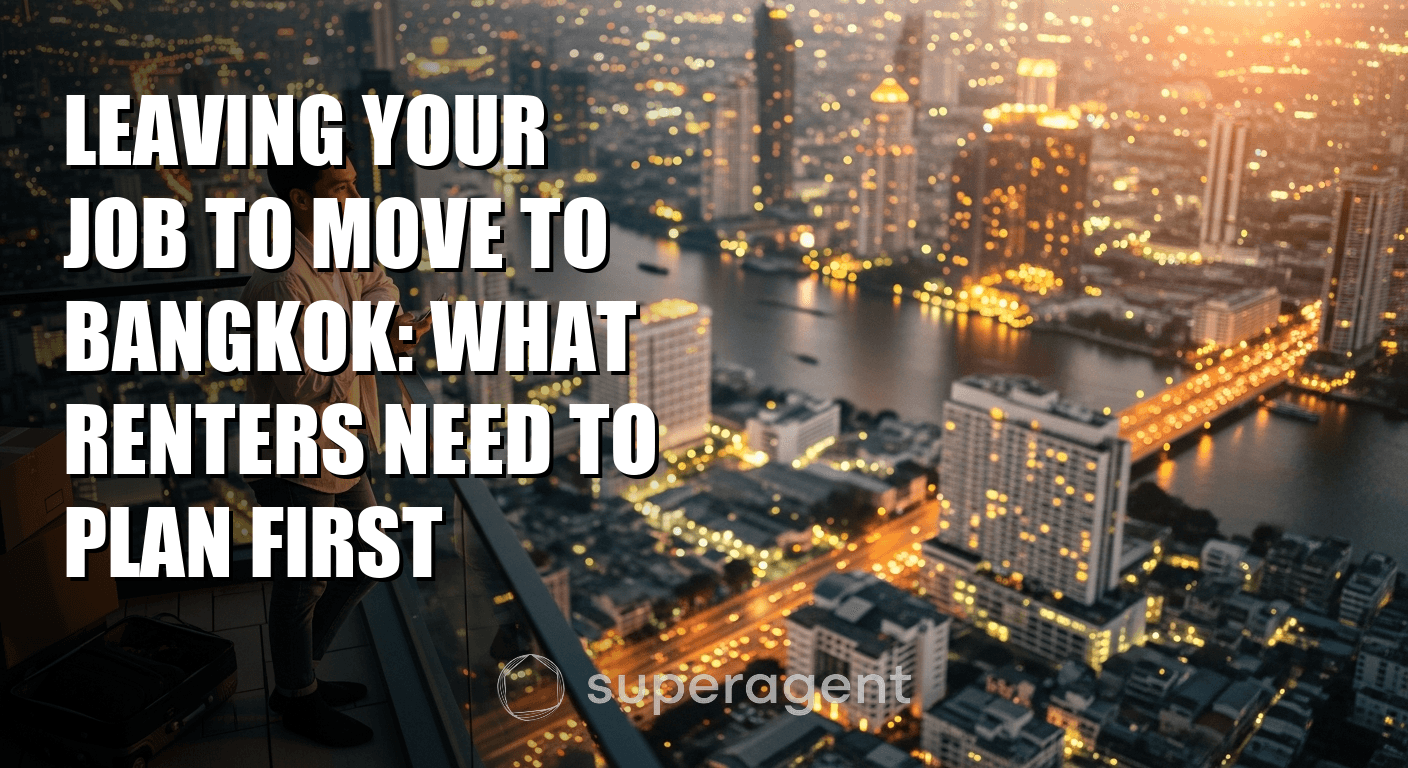
You've been thinking about it for months. Maybe years. The spreadsheets are open, the resignation letter is half drafted, and you keep checking Bangkok condo listings at 2 AM. Leaving your job to move to Bangkok is one of those decisions that feels both thrilling and terrifying, and the rental side of the equation is where most people stumble. Not because Bangkok is hard to rent in, but because they plan the adventure without planning the apartment. Let me walk you through what you actually need to figure out before you hand in that resignation.
Get Real About Your Monthly Budget Before You Book a Flight
Here's the thing nobody tells you: Bangkok can be incredibly cheap or surprisingly expensive depending on where and how you want to live. A studio near BTS Bearing might run you 7,000 to 10,000 THB per month. A one bedroom at Life Asoke Hype near MRT Phetchaburi could be 18,000 to 25,000 THB. And if you want a two bedroom at a place like Muniq Sukhumvit 23, you're looking at 45,000 THB or more.
Before you leave your job, map out at least six months of living expenses. Rent, utilities (figure 2,000 to 4,000 THB for electricity alone if you run the AC), internet, food, visa costs, and health insurance. A comfortable solo budget in a decent area like On Nut or Phra Khanong is roughly 50,000 to 65,000 THB per month all in. If you're planning to live off savings, know exactly how many months that buys you.
One guy I know quit his marketing job in London, moved to Bangkok with 400,000 THB saved, and burned through it in four months because he rented a 30,000 THB condo in Thonglor without accounting for the lifestyle that neighborhood pulls you into. Rooftop bars, brunch spots, and Grab rides add up fast. Pick your neighborhood based on your actual budget, not your fantasy budget.
Sort Out Your Visa Situation Before You Sign a Lease
This is the part that catches people off guard. Thailand does not have a simple "I want to live here" visa. Your options depend on your situation. If you're working remotely, the Thailand DTV (Destination Thailand Visa) launched in 2024 gives you up to 180 days with extensions. If you're over 50, there's the retirement visa. If you're starting a business, that's a different process entirely.
Why does this matter for renting? Because most Bangkok landlords want a lease of at least six months to a year. If your visa only covers 60 or 90 days, some landlords get nervous. Others will work with you, especially in expat heavy buildings like The Lumpini 24 on Sukhumvit Soi 24 or Ideo Mobi Asoke near MRT Sukhumvit.
Talk to a visa agent or do serious research before you commit to a lease length. The last thing you want is to sign a 12 month contract, then discover your visa situation forces you to leave after three months and you lose your deposit.
Pick the Right Neighborhood for Your New Life, Not Your Vacation
Bangkok as a tourist and Bangkok as a resident are completely different experiences. That Airbnb you loved near Khao San Road is not where you want to live long term. Trust me on this.
If you're working remotely and need reliable internet plus good cafes, look at Ari (BTS Ari) or Ekkamai (BTS Ekkamai). Both have strong coworking scenes and walkable streets. If budget is your priority, Bang Sue or Lat Phrao along the MRT line offer modern condos at 8,000 to 14,000 THB for a decent one bedroom.
I met a couple from the States who initially set their hearts on Sathorn because it "felt professional." They ended up in a one bedroom at Whizdom Essence near BTS Punnawithi for 15,000 THB per month and loved it. Quieter, newer building, pool, gym, and a direct BTS line into the city center. Sometimes the best neighborhoods are the ones you've never heard of before arriving.
Have Your Rental Documents Ready Before You Land
Bangkok landlords and agents will typically ask for your passport, a deposit (usually two months rent), and one month's rent upfront. That means if you're renting a place at 20,000 THB per month, you need 60,000 THB ready on day one.
Some buildings also ask for a work permit or proof of income. If you've just left your job, you obviously won't have a local work permit. This is where having bank statements showing savings or proof of remote income helps. A few landlords at buildings like Centric Ratchada on Soi Ratchadaphisek 12 are more flexible with freelancers and remote workers, but you need to come prepared.
Open a Thai bank account as soon as possible after arriving. Bangkok Bank and Kasikorn Bank both work with foreigners, though requirements change frequently. Having a local account makes paying rent, utilities, and daily expenses dramatically easier.
Give Yourself a Landing Pad Before Committing Long Term
Do not sign a year long lease from overseas. I cannot stress this enough. Book a serviced apartment or short term rental for your first two to four weeks. Areas like Phrom Phong (BTS Phrom Phong) and Asok (BTS Asok) have plenty of monthly rental options in the 15,000 to 25,000 THB range that give you time to explore neighborhoods in person.
Use that buffer period to visit condos, walk around different sois, check commute times, and figure out if the area actually fits your daily routine. The condo that looked perfect on a listing might sit next to a construction site or a nightclub you did not notice in photos.
Leaving your job to move to Bangkok is a bold move, and getting the rental piece right makes everything else smoother. Take the time to plan your budget, sort your visa, and see places in person before you commit. When you're ready to start searching, Superagent at superagent.co lets you browse condos across Bangkok with AI powered recommendations that match your actual budget and lifestyle, so you spend less time scrolling and more time settling into your new city.
You've been thinking about it for months. Maybe years. The spreadsheets are open, the resignation letter is half drafted, and you keep checking Bangkok condo listings at 2 AM. Leaving your job to move to Bangkok is one of those decisions that feels both thrilling and terrifying, and the rental side of the equation is where most people stumble. Not because Bangkok is hard to rent in, but because they plan the adventure without planning the apartment. Let me walk you through what you actually need to figure out before you hand in that resignation.
Get Real About Your Monthly Budget Before You Book a Flight
Here's the thing nobody tells you: Bangkok can be incredibly cheap or surprisingly expensive depending on where and how you want to live. A studio near BTS Bearing might run you 7,000 to 10,000 THB per month. A one bedroom at Life Asoke Hype near MRT Phetchaburi could be 18,000 to 25,000 THB. And if you want a two bedroom at a place like Muniq Sukhumvit 23, you're looking at 45,000 THB or more.
Before you leave your job, map out at least six months of living expenses. Rent, utilities (figure 2,000 to 4,000 THB for electricity alone if you run the AC), internet, food, visa costs, and health insurance. A comfortable solo budget in a decent area like On Nut or Phra Khanong is roughly 50,000 to 65,000 THB per month all in. If you're planning to live off savings, know exactly how many months that buys you.
Continue reading after that.
Looking for a condo
to rent?
Leave your name and phone. We'll follow up while you keep reading.
100% Secure
Fast Response
Free Consultation
One guy I know quit his marketing job in London, moved to Bangkok with 400,000 THB saved, and burned through it in four months because he rented a 30,000 THB condo in Thonglor without accounting for the lifestyle that neighborhood pulls you into. Rooftop bars, brunch spots, and Grab rides add up fast. Pick your neighborhood based on your actual budget, not your fantasy budget.
Sort Out Your Visa Situation Before You Sign a Lease
This is the part that catches people off guard. Thailand does not have a simple "I want to live here" visa. Your options depend on your situation. If you're working remotely, the Thailand DTV (Destination Thailand Visa) launched in 2024 gives you up to 180 days with extensions. If you're over 50, there's the retirement visa. If you're starting a business, that's a different process entirely.
Why does this matter for renting? Because most Bangkok landlords want a lease of at least six months to a year. If your visa only covers 60 or 90 days, some landlords get nervous. Others will work with you, especially in expat heavy buildings like The Lumpini 24 on Sukhumvit Soi 24 or Ideo Mobi Asoke near MRT Sukhumvit.
Talk to a visa agent or do serious research before you commit to a lease length. The last thing you want is to sign a 12 month contract, then discover your visa situation forces you to leave after three months and you lose your deposit.
Pick the Right Neighborhood for Your New Life, Not Your Vacation
Bangkok as a tourist and Bangkok as a resident are completely different experiences. That Airbnb you loved near Khao San Road is not where you want to live long term. Trust me on this.
If you're working remotely and need reliable internet plus good cafes, look at Ari (BTS Ari) or Ekkamai (BTS Ekkamai). Both have strong coworking scenes and walkable streets. If budget is your priority, Bang Sue or Lat Phrao along the MRT line offer modern condos at 8,000 to 14,000 THB for a decent one bedroom.
I met a couple from the States who initially set their hearts on Sathorn because it "felt professional." They ended up in a one bedroom at Whizdom Essence near BTS Punnawithi for 15,000 THB per month and loved it. Quieter, newer building, pool, gym, and a direct BTS line into the city center. Sometimes the best neighborhoods are the ones you've never heard of before arriving.
Have Your Rental Documents Ready Before You Land
Bangkok landlords and agents will typically ask for your passport, a deposit (usually two months rent), and one month's rent upfront. That means if you're renting a place at 20,000 THB per month, you need 60,000 THB ready on day one.
Some buildings also ask for a work permit or proof of income. If you've just left your job, you obviously won't have a local work permit. This is where having bank statements showing savings or proof of remote income helps. A few landlords at buildings like Centric Ratchada on Soi Ratchadaphisek 12 are more flexible with freelancers and remote workers, but you need to come prepared.
Continue reading after that.
Looking for a condo
to rent?
Leave your name and phone. We'll follow up while you keep reading.
100% Secure
Fast Response
Free Consultation
Open a Thai bank account as soon as possible after arriving. Bangkok Bank and Kasikorn Bank both work with foreigners, though requirements change frequently. Having a local account makes paying rent, utilities, and daily expenses dramatically easier.
Give Yourself a Landing Pad Before Committing Long Term
Do not sign a year long lease from overseas. I cannot stress this enough. Book a serviced apartment or short term rental for your first two to four weeks. Areas like Phrom Phong (BTS Phrom Phong) and Asok (BTS Asok) have plenty of monthly rental options in the 15,000 to 25,000 THB range that give you time to explore neighborhoods in person.
Use that buffer period to visit condos, walk around different sois, check commute times, and figure out if the area actually fits your daily routine. The condo that looked perfect on a listing might sit next to a construction site or a nightclub you did not notice in photos.
Leaving your job to move to Bangkok is a bold move, and getting the rental piece right makes everything else smoother. Take the time to plan your budget, sort your visa, and see places in person before you commit. When you're ready to start searching, Superagent at superagent.co lets you browse condos across Bangkok with AI powered recommendations that match your actual budget and lifestyle, so you spend less time scrolling and more time settling into your new city.
Share this article
Properties you may like
![[For Rent] CONDO I Ideo Sukhumvit 93 I 1 Bed I 1 Bath I 18,000THB/mo](/_next/image?url=https%3A%2F%2Fstorage.googleapis.com%2Fsuperagent-web%2Fattachments%2Flistings%2F6907%2Fb41f8377-3447-4526-87ab-a26a1c299e5d-1325-1.jpg&w=3840&q=75)
฿18,000
1 Bed130 sqm
[For Rent] CONDO I Ideo Sukhumvit 93 I 1 Bed I 1 Bath I 18,000THB/mo
Condo![[For Rent] CONDO I Ideo Sukhumvit 93 I 1 Bed I 1 Bath I 20,000THB/mo](/_next/image?url=https%3A%2F%2Fstorage.googleapis.com%2Fsuperagent-web%2Fattachments%2Flistings%2F6848%2F604285ae-9826-4938-a370-50ec872df06f-1238-1.jpg&w=3840&q=75)
฿20,000
1 Bed134 sqm
[For Rent] CONDO I Ideo Sukhumvit 93 I 1 Bed I 1 Bath I 20,000THB/mo
Condo![[For Rent] HOUSE I Sampran I 3 Beds I 2 Baths I 20,000THB/mo](/_next/image?url=https%3A%2F%2Fstorage.googleapis.com%2Fsuperagent-web%2Fattachments%2Flistings%2F1763%2F15c03c53-e75f-4140-9b11-b3b4d5cf26cd-line_album_-2-7-80-_260603_7.jpg&w=3840&q=75)
฿20,000
3 Bed280 sqm
[For Rent] HOUSE I Sampran I 3 Beds I 2 Baths I 20,000THB/mo
House![[For Rent] CONDO I The Pano Rama 3 I 2 Beds I 2 Baths I 85,000THB/mo](/_next/image?url=https%3A%2F%2Fstorage.googleapis.com%2Fsuperagent-web%2Fattachments%2Flistings%2F6920%2Fc0dea299-7185-4ce3-98f2-917c8d934a28-1326-2.jpg&w=3840&q=75)
฿85,000
2 Bed2110 sqm
[For Rent] CONDO I The Pano Rama 3 I 2 Beds I 2 Baths I 85,000THB/mo
Rama 3
Condo![[For Rent] Ocean Tower 2 Asoke I Flr. 33 I 130,000THB/mo](/_next/image?url=https%3A%2F%2Fstorage.googleapis.com%2Fsuperagent-web%2Fattachments%2Flistings%2F6919%2F5ccfcc58-254c-4ca8-ab9c-81326b4831a2-1329-1.jpg&w=3840&q=75)
฿130,000
0209 sqm
[For Rent] Ocean Tower 2 Asoke I Flr. 33 I 130,000THB/mo
Asoke
Condo![[For Rent] TOWNHOME I Patio Srinakarin Rama 9 I Corner Unit I 3 Beds I 3 Baths I 47,500THB/mo](/_next/image?url=https%3A%2F%2Fstorage.googleapis.com%2Fsuperagent-web%2Fattachments%2Flistings%2F6918%2Ffb464c17-8c48-494f-b7a7-b5bc97d832b4-1333.jpg&w=3840&q=75)
฿47,500
3 Bed3190 sqm
[For Rent] TOWNHOME I Patio Srinakarin Rama 9 I Corner Unit I 3 Beds I 3 Baths I 47,500THB/mo
Condo![[For Rent] TOWNHOME I Patio Srinakarin Rama 9 I 3 Beds I 3 Baths I 42,000THB/mo](/_next/image?url=https%3A%2F%2Fstorage.googleapis.com%2Fsuperagent-web%2Fattachments%2Flistings%2F6917%2F5cfc4305-beb7-4022-ac1b-1d68075ad6f1-615432836_2162870904521148_7371076413897326067_n.jpg&w=3840&q=75)
฿42,000
3 Bed3141 sqm
[For Rent] TOWNHOME I Patio Srinakarin Rama 9 I 3 Beds I 3 Baths I 42,000THB/mo
Condo![[For Rent] TOWNHOME I Patio Srinakarin Rama 9 I 3 Beds I 3 Baths I 47,500THB/mo](/_next/image?url=https%3A%2F%2Fstorage.googleapis.com%2Fsuperagent-web%2Fattachments%2Flistings%2F6916%2F9f3c6f87-9bc4-487d-a888-ed5efe4ebecf-1331-1.jpg&w=3840&q=75)
฿47,500
3 Bed3141 sqm
[For Rent] TOWNHOME I Patio Srinakarin Rama 9 I 3 Beds I 3 Baths I 47,500THB/mo
Townhouse![[For Rent&Sale] TOWNHOME I Patio Srinakarin Rama 9 I 3 Beds I 3 Baths I Rent 47,500THB/mo - Sale 7.5mb THB](/_next/image?url=https%3A%2F%2Fstorage.googleapis.com%2Fsuperagent-web%2Fattachments%2Flistings%2F6915%2F4590708f-ba0f-4d47-a4ca-ba11ee7d4a87-1330-6.jpg&w=3840&q=75)
฿47,500
3 Bed3141 sqm
[For Rent&Sale] TOWNHOME I Patio Srinakarin Rama 9 I 3 Beds I 3 Baths I Rent 47,500THB/mo - Sale 7.5mb THB
Townhouse![[For Rent] CONDO I Chapter Thonglor 25I 1 Bed I 1 Bath I 24,000THB/mo](/_next/image?url=https%3A%2F%2Fstorage.googleapis.com%2Fsuperagent-web%2Fattachments%2Flistings%2F6914%2Fa958c528-cb08-42d8-a0c6-cb1a992f93b2-1337-2.jpg&w=3840&q=75)
฿24,000
1 Bed130 sqm
[For Rent] CONDO I Chapter Thonglor 25I 1 Bed I 1 Bath I 24,000THB/mo
CondoMore like this
 In Guides · Superagent EditorialHidden Costs of Renting a Condo in Bangkok Nobody Warns You AboutBangkok condo rent looks affordable until month one hits. Here are the real costs beyond the headline figure that catch most renters off guard.25 May 20261 min read
 In Guides · Superagent EditorialWhat a Long-Vacant Bangkok Condo Unit Is Actually Telling YouA Bangkok condo vacant for months signals overpricing, landlord issues, or real problems. Here is how to read the signs.25 May 20261 min read
 In Guides · Superagent EditorialRed Flags in a Bangkok Rental Contract to Watch Out ForBangkok rental contracts often hide risky clauses. Here are the red flags every tenant must catch before signing any lease.25 May 20261 min read
 In Guides · Superagent EditorialWorking Online from a Condo: How to Choose the Perfect Room for ProductivityLearn how to choose the best condo room for working online with tips on lighting, noise, and furniture setup to maximize productivity.9 May 20261 min read