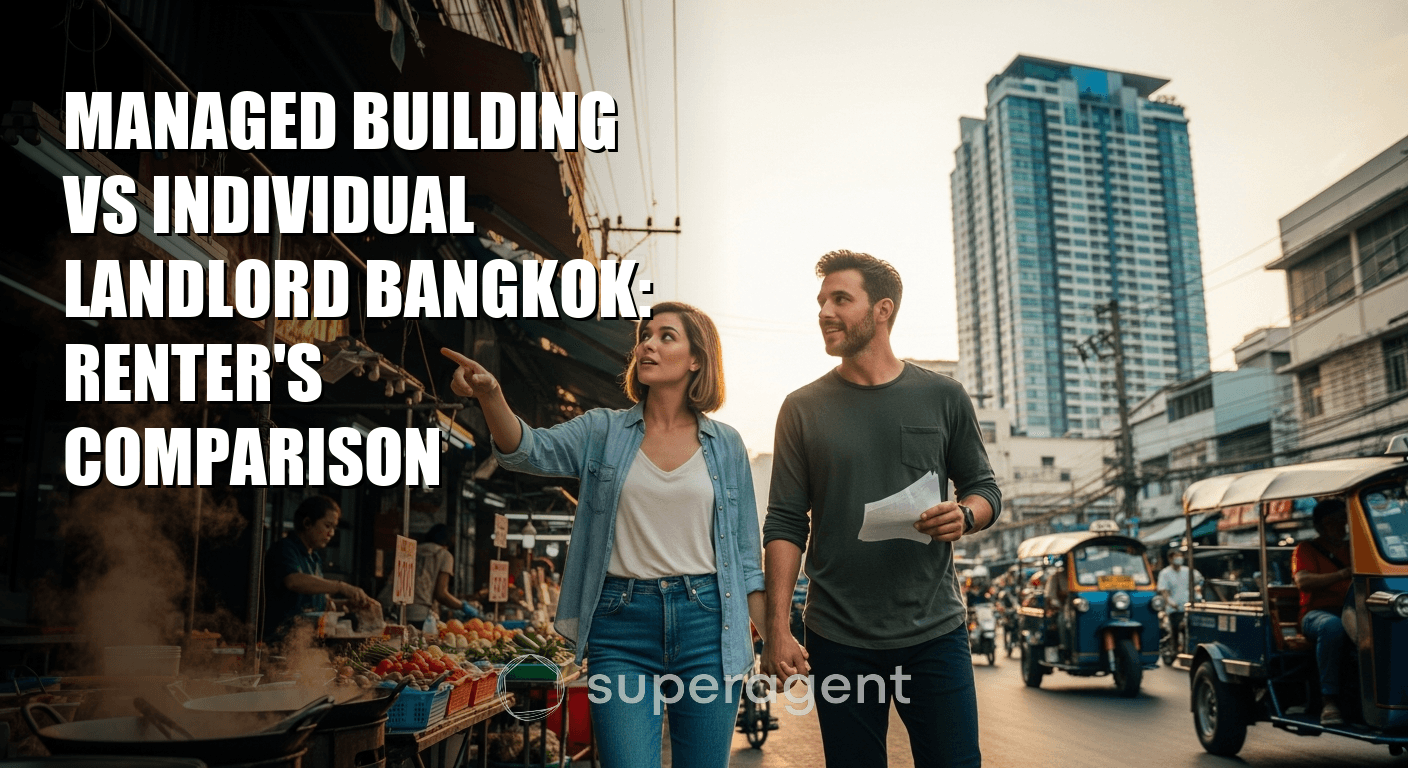
Managed Building vs Individual Landlord Bangkok: Renter's Comparison
Guides
Managed Building vs Individual Landlord Bangkok: Renter's Comparison
Discover which rental option offers better value, flexibility, and peace of mind for expats in Bangkok.
Summary
Compare managed condos versus individual landlords in Bangkok to find the rental solution that best fits your needs and budget.
You've narrowed your search to two condos near BTS Thong Lo. One is in a managed building with a leasing office, uniformed staff, and a corporate feel. The other is owned by a Thai couple who bought it as an investment and handle everything themselves. The units look similar. The rent is close. But your experience as a tenant could be wildly different depending on which route you pick. If you're weighing a managed condo vs individual Bangkok landlord, here's what actually matters when you're living here day to day.
What "Managed Building" Actually Means in Bangkok
When people say managed building in Bangkok, they usually mean a condo where a professional property management company or the developer's own team handles leasing, maintenance, and tenant services. Think places like The Lofts Asoke, Ideo Q Siam, or anything by Sansiri's rental arm. You deal with a front desk, a maintenance team, and often a dedicated leasing manager rather than a single owner.
Individual landlords, on the other hand, are exactly what they sound like. A person or family owns the unit and rents it out directly, sometimes through an agent. They might own one condo or five, but you're dealing with them personally for repairs, deposits, and move in logistics.
Say you're looking at a one bedroom in Aspire Sukhumvit 48 near BTS Phra Khanong. One unit at 18,000 THB per month is run through the building's rental program. Another unit two floors up at 16,500 THB is listed by the owner on Facebook. Same pool, same gym, same lobby. But everything behind the scenes is different.
Lease Terms, Deposits, and the Paperwork Side
Managed buildings tend to have standardized lease agreements. You'll see clear clauses about deposit returns, notice periods, and what happens if something breaks. The contract is usually bilingual, and the process feels more like renting from a company because, well, you are.
With individual landlords, contracts vary wildly. Some use a proper Thai lease template. Others hand you a two page document that barely covers the basics. I once saw a landlord near MRT Phra Ram 9 try to use a one page "agreement" that didn't even mention the deposit return timeline. That's a red flag, and it happens more than you'd think.
Deposits in managed buildings are typically two months rent plus one month advance, returned within 30 to 45 days after move out with a clear inspection process. Individual landlords follow the same general structure, but getting your deposit back can sometimes turn into a negotiation. Some are great about it. Others will find reasons to deduct for normal wear and tear.
Maintenance, Repairs, and Who Picks Up the Phone
This is where the gap becomes really obvious. In a managed building like The Line Sukhumvit 101 near BTS Punnawithi, you submit a maintenance request through an app or at the front desk. A technician shows up, usually within 24 hours. The aircon breaks at midnight? There's a process for that.
With an individual landlord, your experience depends entirely on who that person is. I've had landlords who responded to LINE messages within minutes and sent a repair crew the same afternoon. I've also had one near Soi Ari who took nine days to fix a broken water heater in January. You just don't know until you're in it.
If you're someone who values reliability and doesn't want to chase anyone down for a leaking faucet, managed buildings win this category almost every time. If you're handy, easygoing, and okay with a bit of back and forth, an individual landlord might not bother you at all.
Flexibility, Rent Negotiation, and the Human Factor
Here's where individual landlords actually shine. Because you're dealing with a real person, there's often room to negotiate. A managed building listing a studio in Ideo Mobi Rama 9 at 15,000 THB per month probably won't budge on price. That's the rate, take it or leave it.
But an individual landlord listing a similar unit in the same building at 14,500 THB? You might talk them down to 13,500 THB for a 12 month lease, especially if the unit has been vacant for a while. They might throw in furniture upgrades, waive the last month's rent, or agree to a shorter lease term. Corporate management teams rarely have that kind of flexibility.
There's also the relationship angle. A good individual landlord becomes someone who looks out for you. I know expats in Ekkamai whose landlord brings them homemade Thai food during Songkran. That kind of connection doesn't happen with a leasing office.
Which One Is Right for Your Situation
If you're new to Bangkok, here for work on a corporate package, or just want zero hassle, a managed building is the safer bet. You pay a slight premium for professionalism, consistency, and systems that work without you having to push.
If you've been here a while, speak some Thai, and enjoy the more personal side of renting, an individual landlord can save you money and give you a more flexible arrangement. Just do your homework. Ask to see the lease before committing. Check reviews. Talk to current tenants if you can.
The honest truth is that both options can be great or terrible depending on the specific building and the specific person. The key is knowing what questions to ask before you sign anything.
Whether you're leaning toward a managed setup or a direct landlord deal, Superagent at superagent.co can help you compare verified listings across both types, so you see real prices, real photos, and real terms before you ever visit a unit. It takes the guesswork out of one of the biggest decisions you'll make in Bangkok.
You've narrowed your search to two condos near BTS Thong Lo. One is in a managed building with a leasing office, uniformed staff, and a corporate feel. The other is owned by a Thai couple who bought it as an investment and handle everything themselves. The units look similar. The rent is close. But your experience as a tenant could be wildly different depending on which route you pick. If you're weighing a managed condo vs individual Bangkok landlord, here's what actually matters when you're living here day to day.
What "Managed Building" Actually Means in Bangkok
When people say managed building in Bangkok, they usually mean a condo where a professional property management company or the developer's own team handles leasing, maintenance, and tenant services. Think places like The Lofts Asoke, Ideo Q Siam, or anything by Sansiri's rental arm. You deal with a front desk, a maintenance team, and often a dedicated leasing manager rather than a single owner.
Individual landlords, on the other hand, are exactly what they sound like. A person or family owns the unit and rents it out directly, sometimes through an agent. They might own one condo or five, but you're dealing with them personally for repairs, deposits, and move in logistics.
Continue reading after that.
Looking for a condo
to rent?
Leave your name and phone. We'll follow up while you keep reading.
100% Secure
Fast Response
Free Consultation
Say you're looking at a one bedroom in Aspire Sukhumvit 48 near BTS Phra Khanong. One unit at 18,000 THB per month is run through the building's rental program. Another unit two floors up at 16,500 THB is listed by the owner on Facebook. Same pool, same gym, same lobby. But everything behind the scenes is different.
Lease Terms, Deposits, and the Paperwork Side
Managed buildings tend to have standardized lease agreements. You'll see clear clauses about deposit returns, notice periods, and what happens if something breaks. The contract is usually bilingual, and the process feels more like renting from a company because, well, you are.
With individual landlords, contracts vary wildly. Some use a proper Thai lease template. Others hand you a two page document that barely covers the basics. I once saw a landlord near MRT Phra Ram 9 try to use a one page "agreement" that didn't even mention the deposit return timeline. That's a red flag, and it happens more than you'd think.
Deposits in managed buildings are typically two months rent plus one month advance, returned within 30 to 45 days after move out with a clear inspection process. Individual landlords follow the same general structure, but getting your deposit back can sometimes turn into a negotiation. Some are great about it. Others will find reasons to deduct for normal wear and tear.
Maintenance, Repairs, and Who Picks Up the Phone
This is where the gap becomes really obvious. In a managed building like The Line Sukhumvit 101 near BTS Punnawithi, you submit a maintenance request through an app or at the front desk. A technician shows up, usually within 24 hours. The aircon breaks at midnight? There's a process for that.
With an individual landlord, your experience depends entirely on who that person is. I've had landlords who responded to LINE messages within minutes and sent a repair crew the same afternoon. I've also had one near Soi Ari who took nine days to fix a broken water heater in January. You just don't know until you're in it.
If you're someone who values reliability and doesn't want to chase anyone down for a leaking faucet, managed buildings win this category almost every time. If you're handy, easygoing, and okay with a bit of back and forth, an individual landlord might not bother you at all.
Flexibility, Rent Negotiation, and the Human Factor
Here's where individual landlords actually shine. Because you're dealing with a real person, there's often room to negotiate. A managed building listing a studio in Ideo Mobi Rama 9 at 15,000 THB per month probably won't budge on price. That's the rate, take it or leave it.
But an individual landlord listing a similar unit in the same building at 14,500 THB? You might talk them down to 13,500 THB for a 12 month lease, especially if the unit has been vacant for a while. They might throw in furniture upgrades, waive the last month's rent, or agree to a shorter lease term. Corporate management teams rarely have that kind of flexibility.
Continue reading after that.
Looking for a condo
to rent?
Leave your name and phone. We'll follow up while you keep reading.
100% Secure
Fast Response
Free Consultation
There's also the relationship angle. A good individual landlord becomes someone who looks out for you. I know expats in Ekkamai whose landlord brings them homemade Thai food during Songkran. That kind of connection doesn't happen with a leasing office.
Which One Is Right for Your Situation
If you're new to Bangkok, here for work on a corporate package, or just want zero hassle, a managed building is the safer bet. You pay a slight premium for professionalism, consistency, and systems that work without you having to push.
If you've been here a while, speak some Thai, and enjoy the more personal side of renting, an individual landlord can save you money and give you a more flexible arrangement. Just do your homework. Ask to see the lease before committing. Check reviews. Talk to current tenants if you can.
The honest truth is that both options can be great or terrible depending on the specific building and the specific person. The key is knowing what questions to ask before you sign anything.
Whether you're leaning toward a managed setup or a direct landlord deal, Superagent at superagent.co can help you compare verified listings across both types, so you see real prices, real photos, and real terms before you ever visit a unit. It takes the guesswork out of one of the biggest decisions you'll make in Bangkok.
Share this article
Properties you may like
![[For Rent] CONDO I Maestro 14 Siam-Ratchathewi Pet Friendly I 1 Bed I 1 Bath I 22,000THB/mo](/_next/image?url=https%3A%2F%2Fstorage.googleapis.com%2Fsuperagent-web%2Fattachments%2Flistings%2F6686%2F5ae8a77f-b6fb-4578-a765-e56f493cd25f-1058.png&w=3840&q=75)
฿25,000
1 Bed130 sqm
[For Rent] CONDO I Maestro 14 Siam-Ratchathewi Pet Friendly I 1 Bed I 1 Bath I 22,000THB/mo
Siam
Condo![[For Rent] CONDO I Las Colinas Condominium I 2 Beds I 3 Baths I 85,000THB/mo](/_next/image?url=https%3A%2F%2Fstorage.googleapis.com%2Fsuperagent-web%2Fattachments%2Flistings%2F6828%2F80f345c4-488e-43b2-b017-c9fbb17b520d-99486dd8-4237-4ba2-9207-01ce4f66b21f-media.jpg&w=3840&q=75)
฿85,000
2 Bed3170 sqm
[For Rent] CONDO I Las Colinas Condominium I 2 Beds I 3 Baths I 85,000THB/mo
Asoke
Condo![[For Rent] CONDO I The Diplomat 39 I 2 Beds I 2 Baths I 89,000THB/mo](/_next/image?url=https%3A%2F%2Fstorage.googleapis.com%2Fsuperagent-web%2Fattachments%2Flistings%2F6784%2Ff92c62cc-d3be-42df-adca-b8f96fb02cfb-1163-1.jpg&w=3840&q=75)
฿89,000
2 Bed286 sqm
[For Rent] CONDO I The Diplomat 39 I 2 Beds I 2 Baths I 89,000THB/mo
Phrom Phong
Condo![[For Rent] CONDO I KEN Attitude Rattanathibet I Duplex I 2 Beds I 2 Baths I 40,000THB/mo](/_next/image?url=https%3A%2F%2Fstorage.googleapis.com%2Fsuperagent-web%2Fattachments%2Flistings%2F6852%2F17c1715e-4458-4008-bb0b-072a4c081166-img_0557.jpeg&w=3840&q=75)
฿40,000
2 Bed277 sqm
[For Rent] CONDO I KEN Attitude Rattanathibet I Duplex I 2 Beds I 2 Baths I 40,000THB/mo
Condo![[For Rent] CONDO I H Sukhumvit 43 I 1 Bed I 1 Bath I 28,000THB/mo](/_next/image?url=https%3A%2F%2Fstorage.googleapis.com%2Fsuperagent-web%2Fattachments%2Flistings%2F6851%2Ff355c21a-a282-4338-86c6-dc5bb3368321-1244-1.jpg&w=3840&q=75)
฿28,000
1 Bed143 sqm
[For Rent] CONDO I H Sukhumvit 43 I 1 Bed I 1 Bath I 28,000THB/mo
Phrom Phong
Condo![[For Rent] CONDO I The Base Park West T77 I 2 Beds I 2 Baths I 24,000THB/mo](/_next/image?url=https%3A%2F%2Fstorage.googleapis.com%2Fsuperagent-web%2Fattachments%2Flistings%2F6723%2Fabc06b19-f7fa-4950-98f6-8bdd841b26a6-1098-3.jpg&w=3840&q=75)
฿24,000
2 Bed253 sqm
[For Rent] CONDO I The Base Park West T77 I 2 Beds I 2 Baths I 24,000THB/mo
On Nut
Condo![[For Rent] CONDO I The Room Phaya Thai I 1 Bed I 1 Bath I 20,000THB/mo](/_next/image?url=https%3A%2F%2Fstorage.googleapis.com%2Fsuperagent-web%2Fattachments%2Flistings%2F2042%2F47afcf0d-8998-4283-abfe-8451d5c47178-1000029204.jpg&w=3840&q=75)
฿20,000
1 Bed128 sqm
[For Rent] CONDO I The Room Phaya Thai I 1 Bed I 1 Bath I 20,000THB/mo
Condo![[For Rent] CONDO I IDEO Rama 9-Asoke I Duplex I 1 Bed I 1 Bath I 36,000THB/mo](/_next/image?url=https%3A%2F%2Fstorage.googleapis.com%2Fsuperagent-web%2Fattachments%2Flistings%2F6795%2Fa7e5e587-f4be-4b3e-a635-839870c16713-1174-4.jpg&w=3840&q=75)
฿36,000
1 Bed138 sqm
[For Rent] CONDO I IDEO Rama 9-Asoke I Duplex I 1 Bed I 1 Bath I 36,000THB/mo
Condo![[For Rent/Sale] CONDO I Park Origin Thonglor I 3 Beds I 2 Baths I Rent 95,000 THB/mo - Sale 26mb THB](/_next/image?url=https%3A%2F%2Fstorage.googleapis.com%2Fsuperagent-web%2Fattachments%2Flistings%2F1508%2F725e6df5-039f-428c-a0c8-2f5d596e7833-420-1.jpg&w=3840&q=75)
฿95,000
3 Bed272 sqm
[For Rent/Sale] CONDO I Park Origin Thonglor I 3 Beds I 2 Baths I Rent 95,000 THB/mo - Sale 26mb THB
Thonglor
Condo![[For Rent] CONDO I Maru Ekkamai 2 I Pet friendly I 2 Beds I 2 Baths I 68,000 THB/mo](/_next/image?url=https%3A%2F%2Fstorage.googleapis.com%2Fsuperagent-web%2Fattachments%2Flistings%2F6602%2F9f1d8f71-ee43-435f-9a44-da16c4092c92-968-1.jpg&w=3840&q=75)
฿68,000
2 Bed360 sqm
[For Rent] CONDO I Maru Ekkamai 2 I Pet friendly I 2 Beds I 2 Baths I 68,000 THB/mo
Ekkamai
CondoMore like this
 In Guides · Superagent EditorialHidden Costs of Renting a Condo in Bangkok Nobody Warns You AboutBangkok condo rent looks affordable until month one hits. Here are the real costs beyond the headline figure that catch most renters off guard.25 May 20261 min read
 In Guides · Superagent EditorialWhat a Long-Vacant Bangkok Condo Unit Is Actually Telling YouA Bangkok condo vacant for months signals overpricing, landlord issues, or real problems. Here is how to read the signs.25 May 20261 min read
 In Guides · Superagent EditorialRed Flags in a Bangkok Rental Contract to Watch Out ForBangkok rental contracts often hide risky clauses. Here are the red flags every tenant must catch before signing any lease.25 May 20261 min read
 In Guides · Superagent EditorialWorking Online from a Condo: How to Choose the Perfect Room for ProductivityLearn how to choose the best condo room for working online with tips on lighting, noise, and furniture setup to maximize productivity.9 May 20261 min read