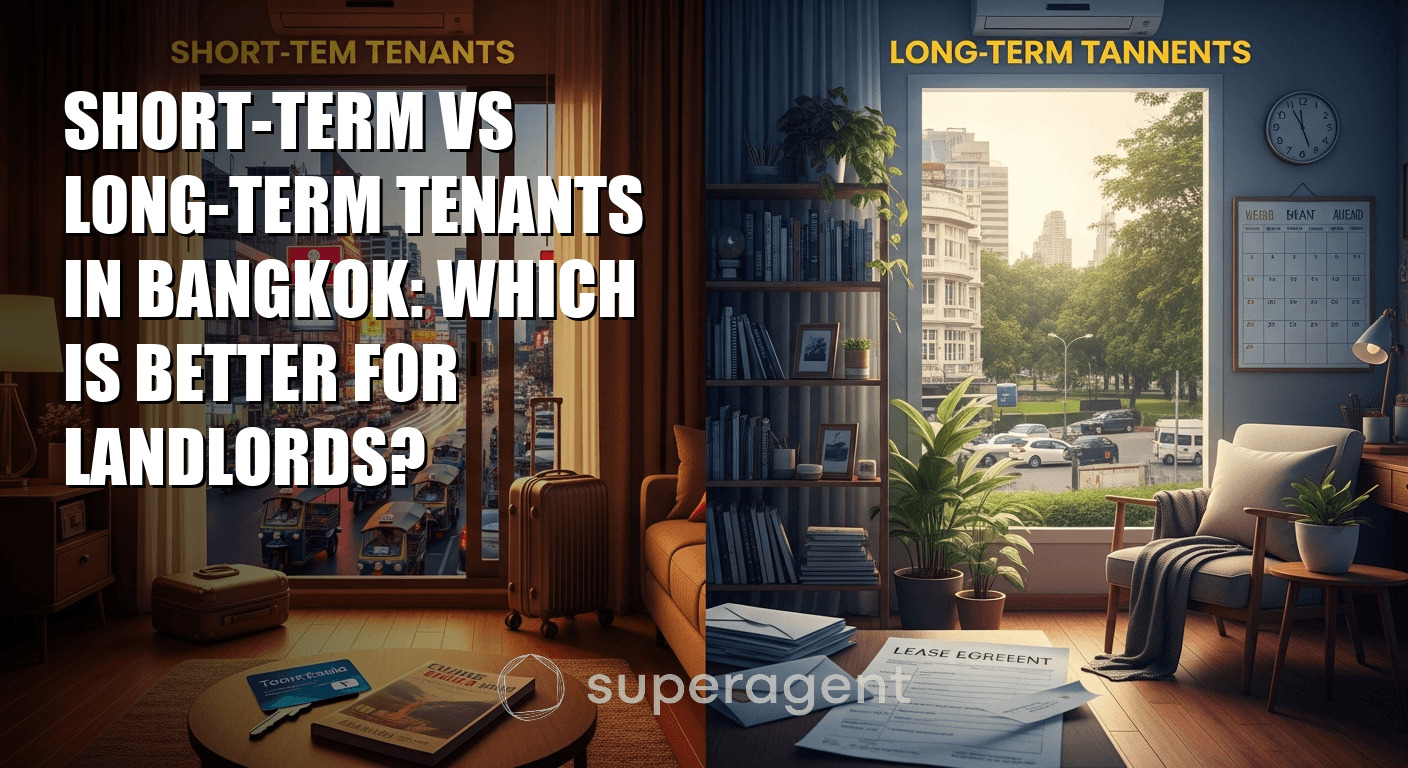
Short-Term vs Long-Term Tenants in Bangkok: Which Is Better for Landlords?
Guides
Short-Term vs Long-Term Tenants in Bangkok: Which Is Better for Landlords?
Discover which rental strategy maximizes your Bangkok property income and minimizes headaches.
Summary
Compare short-term and long-term tenant options for Bangkok rentals. Learn profit potential, vacancy rates, management demands and risks to choose wisely.
If you own a condo in Bangkok and you're renting it out, you've probably asked yourself this question at least once. Should you go after short-term tenants who pay more per night but come and go? Or lock in a long-term renter who stays for a year and pays like clockwork? The answer isn't as simple as most landlord blogs make it seem. It depends on your building, your location, your tolerance for hassle, and honestly, how much time you want to spend thinking about your property.
Let's break down both sides so you can figure out what actually works for your situation here in Bangkok.
The Short-Term Rental Appeal: Higher Rates, Higher Effort
Short-term rentals in Bangkok can be wildly profitable on paper. A one-bedroom condo near BTS Nana that might rent for 20,000 THB per month on a yearly lease could pull in 1,500 to 2,500 THB per night on platforms like Airbnb. If you keep it booked even 20 nights a month, you're looking at 30,000 to 50,000 THB. That's a significant bump.
But here's the reality check. Most juristic offices in popular Bangkok condos have cracked down hard on short-term rentals. Buildings like The Base Sukhumvit 77 and Ideo Mobi Asoke have rules that require minimum stays of 30 days. Some buildings fine owners who get caught running nightly rentals. You also need to deal with the Thai Hotel Act, which technically requires a hotel license for stays under 30 days.
Then there's the operational side. Cleaning between guests, coordinating check-ins at 11 PM because someone's flight was delayed, replacing towels, restocking toiletries. You either do it all yourself or hire a management company that takes 20 to 30 percent of your revenue. That margin starts shrinking fast.
Consider a real scenario. A landlord with a studio at Lumpini Suite Sukhumvit 41 tried short-term rentals for six months. Revenue was great during high season from November to February. But during the rainy months, occupancy dropped to around 40 percent. After management fees, utilities, and a fine from the building's juristic office, the net income barely beat what a long-term tenant would have paid with zero headaches.
The Long-Term Tenant Advantage: Stability and Simplicity
Long-term tenants, meaning those who sign leases of 6 to 12 months, are the bread and butter of Bangkok's rental market. You find a good tenant, sign the contract, collect a two-month security deposit, and your monthly income is predictable. No vacancy gaps to stress about. No daily coordination.
A two-bedroom condo at Life Asoke Hype near MRT Phetchaburi might rent for 28,000 to 35,000 THB per month on a one-year lease. That's 336,000 to 420,000 THB annually, deposited into your account every month. You know exactly what's coming in, and you can plan around it.
The expat market in Bangkok is strong for long-term rentals. Japanese families in the Phrom Phong area, European professionals near Silom, digital workers settling into Ari or On Nut. These tenants tend to take care of the unit because it's their home, not a hotel room. Wear and tear is generally lower compared to a revolving door of short-stay guests.
The downside? You're locked into a rate. If the market goes up, you can't adjust until the lease renews. And if you get a problematic tenant, dealing with that situation for 12 months is no fun. Proper screening upfront is essential.
Location Matters More Than You Think
Your condo's location in Bangkok should heavily influence your decision. Properties near tourist hotspots like Soi Cowboy, Khao San Road, or along the Chao Phraya River near ICONSIAM tend to attract short-term visitors. If your building allows it and you're in one of these zones, short-term can make sense.
But if your unit sits in a residential neighborhood popular with working professionals, think Ekkamai, Thonglor, or Bearing, you're better off targeting long-term renters. These areas have strong demand from expats relocating for work. A condo at Rhythm Ekkamai, for example, consistently attracts tenants on one-year leases at 22,000 to 30,000 THB for a one-bedroom. That demand stays steady year-round, no seasonal dips.
Condos near international schools like NIST near BTS Ploenchit or Bangkok Patana near BTS On Nut are goldmines for long-term family tenants. These renters often stay two to three years. That kind of stability is hard to beat.
The Middle Ground: Monthly Rentals
There's a sweet spot that more Bangkok landlords are discovering. Monthly rentals, sometimes called medium-term stays, let you charge a premium over yearly leases while staying compliant with building rules and the Hotel Act. Think 30 to 90 day stays.
A landlord renting a furnished one-bedroom at Siamese Exclusive Ratchada near MRT Huai Khwang charges 18,000 THB on a yearly lease. But for a fully serviced monthly rental, the same unit goes for 25,000 THB per month. The tenant is a project consultant from Singapore on a three-month assignment. Less turnover than nightly rentals, better income than a yearly contract.
This approach works especially well for furnished condos in the CBD and along the Sukhumvit corridor. Business travelers, relocating professionals waiting for permanent housing, and medical tourists staying near Bumrungrad Hospital all fit this category perfectly.
So Which One Should You Choose?
There's no universal answer, but here's a practical framework. If your building actively prohibits short stays, don't risk it. The fines and potential legal trouble aren't worth the extra income. If your condo is in a tourist zone and your juristic office is lenient, short-term or monthly rentals can boost your returns significantly, as long as you're prepared for the workload.
For most Bangkok landlords, especially those who own one or two units and have full-time jobs, long-term tenants offer the best balance of income and peace of mind. The rental income might be lower per night, but it's consistent, and your time is worth something too.
Whatever you decide, the key is matching the right tenant to your property. If you want to take the guesswork out of that process, Superagent at superagent.co uses AI to connect Bangkok landlords with qualified tenants quickly, whether you're listing for a month or a year. It's a smarter way to fill your unit without the usual runaround.
If you own a condo in Bangkok and you're renting it out, you've probably asked yourself this question at least once. Should you go after short-term tenants who pay more per night but come and go? Or lock in a long-term renter who stays for a year and pays like clockwork? The answer isn't as simple as most landlord blogs make it seem. It depends on your building, your location, your tolerance for hassle, and honestly, how much time you want to spend thinking about your property.
Let's break down both sides so you can figure out what actually works for your situation here in Bangkok.
The Short-Term Rental Appeal: Higher Rates, Higher Effort
Short-term rentals in Bangkok can be wildly profitable on paper. A one-bedroom condo near BTS Nana that might rent for 20,000 THB per month on a yearly lease could pull in 1,500 to 2,500 THB per night on platforms like Airbnb. If you keep it booked even 20 nights a month, you're looking at 30,000 to 50,000 THB. That's a significant bump.
But here's the reality check. Most juristic offices in popular Bangkok condos have cracked down hard on short-term rentals. Buildings like The Base Sukhumvit 77 and Ideo Mobi Asoke have rules that require minimum stays of 30 days. Some buildings fine owners who get caught running nightly rentals. You also need to deal with the Thai Hotel Act, which technically requires a hotel license for stays under 30 days.
Continue reading after that.
Looking for a condo
to rent?
Leave your name and phone. We'll follow up while you keep reading.
100% Secure
Fast Response
Free Consultation
Then there's the operational side. Cleaning between guests, coordinating check-ins at 11 PM because someone's flight was delayed, replacing towels, restocking toiletries. You either do it all yourself or hire a management company that takes 20 to 30 percent of your revenue. That margin starts shrinking fast.
Consider a real scenario. A landlord with a studio at Lumpini Suite Sukhumvit 41 tried short-term rentals for six months. Revenue was great during high season from November to February. But during the rainy months, occupancy dropped to around 40 percent. After management fees, utilities, and a fine from the building's juristic office, the net income barely beat what a long-term tenant would have paid with zero headaches.
The Long-Term Tenant Advantage: Stability and Simplicity
Long-term tenants, meaning those who sign leases of 6 to 12 months, are the bread and butter of Bangkok's rental market. You find a good tenant, sign the contract, collect a two-month security deposit, and your monthly income is predictable. No vacancy gaps to stress about. No daily coordination.
A two-bedroom condo at Life Asoke Hype near MRT Phetchaburi might rent for 28,000 to 35,000 THB per month on a one-year lease. That's 336,000 to 420,000 THB annually, deposited into your account every month. You know exactly what's coming in, and you can plan around it.
The expat market in Bangkok is strong for long-term rentals. Japanese families in the Phrom Phong area, European professionals near Silom, digital workers settling into Ari or On Nut. These tenants tend to take care of the unit because it's their home, not a hotel room. Wear and tear is generally lower compared to a revolving door of short-stay guests.
The downside? You're locked into a rate. If the market goes up, you can't adjust until the lease renews. And if you get a problematic tenant, dealing with that situation for 12 months is no fun. Proper screening upfront is essential.
Location Matters More Than You Think
Your condo's location in Bangkok should heavily influence your decision. Properties near tourist hotspots like Soi Cowboy, Khao San Road, or along the Chao Phraya River near ICONSIAM tend to attract short-term visitors. If your building allows it and you're in one of these zones, short-term can make sense.
But if your unit sits in a residential neighborhood popular with working professionals, think Ekkamai, Thonglor, or Bearing, you're better off targeting long-term renters. These areas have strong demand from expats relocating for work. A condo at Rhythm Ekkamai, for example, consistently attracts tenants on one-year leases at 22,000 to 30,000 THB for a one-bedroom. That demand stays steady year-round, no seasonal dips.
Condos near international schools like NIST near BTS Ploenchit or Bangkok Patana near BTS On Nut are goldmines for long-term family tenants. These renters often stay two to three years. That kind of stability is hard to beat.
The Middle Ground: Monthly Rentals
There's a sweet spot that more Bangkok landlords are discovering. Monthly rentals, sometimes called medium-term stays, let you charge a premium over yearly leases while staying compliant with building rules and the Hotel Act. Think 30 to 90 day stays.
Continue reading after that.
Looking for a condo
to rent?
Leave your name and phone. We'll follow up while you keep reading.
100% Secure
Fast Response
Free Consultation
A landlord renting a furnished one-bedroom at Siamese Exclusive Ratchada near MRT Huai Khwang charges 18,000 THB on a yearly lease. But for a fully serviced monthly rental, the same unit goes for 25,000 THB per month. The tenant is a project consultant from Singapore on a three-month assignment. Less turnover than nightly rentals, better income than a yearly contract.
This approach works especially well for furnished condos in the CBD and along the Sukhumvit corridor. Business travelers, relocating professionals waiting for permanent housing, and medical tourists staying near Bumrungrad Hospital all fit this category perfectly.
So Which One Should You Choose?
There's no universal answer, but here's a practical framework. If your building actively prohibits short stays, don't risk it. The fines and potential legal trouble aren't worth the extra income. If your condo is in a tourist zone and your juristic office is lenient, short-term or monthly rentals can boost your returns significantly, as long as you're prepared for the workload.
For most Bangkok landlords, especially those who own one or two units and have full-time jobs, long-term tenants offer the best balance of income and peace of mind. The rental income might be lower per night, but it's consistent, and your time is worth something too.
Whatever you decide, the key is matching the right tenant to your property. If you want to take the guesswork out of that process, Superagent at superagent.co uses AI to connect Bangkok landlords with qualified tenants quickly, whether you're listing for a month or a year. It's a smarter way to fill your unit without the usual runaround.
Share this article
Properties you may like
![[For Rent] CONDO I Maestro 14 Siam-Ratchathewi Pet Friendly I 1 Bed I 1 Bath I 22,000THB/mo](/_next/image?url=https%3A%2F%2Fstorage.googleapis.com%2Fsuperagent-web%2Fattachments%2Flistings%2F6686%2F5ae8a77f-b6fb-4578-a765-e56f493cd25f-1058.png&w=3840&q=75)
฿25,000
1 Bed130 sqm
[For Rent] CONDO I Maestro 14 Siam-Ratchathewi Pet Friendly I 1 Bed I 1 Bath I 22,000THB/mo
Siam
Condo![[For Rent] CONDO I Las Colinas Condominium I 2 Beds I 3 Baths I 85,000THB/mo](/_next/image?url=https%3A%2F%2Fstorage.googleapis.com%2Fsuperagent-web%2Fattachments%2Flistings%2F6828%2F80f345c4-488e-43b2-b017-c9fbb17b520d-99486dd8-4237-4ba2-9207-01ce4f66b21f-media.jpg&w=3840&q=75)
฿85,000
2 Bed3170 sqm
[For Rent] CONDO I Las Colinas Condominium I 2 Beds I 3 Baths I 85,000THB/mo
Asoke
Condo![[For Rent] CONDO I The Diplomat 39 I 2 Beds I 2 Baths I 89,000THB/mo](/_next/image?url=https%3A%2F%2Fstorage.googleapis.com%2Fsuperagent-web%2Fattachments%2Flistings%2F6784%2Ff92c62cc-d3be-42df-adca-b8f96fb02cfb-1163-1.jpg&w=3840&q=75)
฿89,000
2 Bed286 sqm
[For Rent] CONDO I The Diplomat 39 I 2 Beds I 2 Baths I 89,000THB/mo
Phrom Phong
Condo![[For Rent] CONDO I KEN Attitude Rattanathibet I Duplex I 2 Beds I 2 Baths I 40,000THB/mo](/_next/image?url=https%3A%2F%2Fstorage.googleapis.com%2Fsuperagent-web%2Fattachments%2Flistings%2F6852%2F17c1715e-4458-4008-bb0b-072a4c081166-img_0557.jpeg&w=3840&q=75)
฿40,000
2 Bed277 sqm
[For Rent] CONDO I KEN Attitude Rattanathibet I Duplex I 2 Beds I 2 Baths I 40,000THB/mo
Condo![[For Rent] CONDO I H Sukhumvit 43 I 1 Bed I 1 Bath I 28,000THB/mo](/_next/image?url=https%3A%2F%2Fstorage.googleapis.com%2Fsuperagent-web%2Fattachments%2Flistings%2F6851%2Ff355c21a-a282-4338-86c6-dc5bb3368321-1244-1.jpg&w=3840&q=75)
฿28,000
1 Bed143 sqm
[For Rent] CONDO I H Sukhumvit 43 I 1 Bed I 1 Bath I 28,000THB/mo
Phrom Phong
Condo![[For Rent] CONDO I The Base Park West T77 I 2 Beds I 2 Baths I 24,000THB/mo](/_next/image?url=https%3A%2F%2Fstorage.googleapis.com%2Fsuperagent-web%2Fattachments%2Flistings%2F6723%2Fabc06b19-f7fa-4950-98f6-8bdd841b26a6-1098-3.jpg&w=3840&q=75)
฿24,000
2 Bed253 sqm
[For Rent] CONDO I The Base Park West T77 I 2 Beds I 2 Baths I 24,000THB/mo
On Nut
Condo![[For Rent] CONDO I The Room Phaya Thai I 1 Bed I 1 Bath I 20,000THB/mo](/_next/image?url=https%3A%2F%2Fstorage.googleapis.com%2Fsuperagent-web%2Fattachments%2Flistings%2F2042%2F47afcf0d-8998-4283-abfe-8451d5c47178-1000029204.jpg&w=3840&q=75)
฿20,000
1 Bed128 sqm
[For Rent] CONDO I The Room Phaya Thai I 1 Bed I 1 Bath I 20,000THB/mo
Condo![[For Rent] CONDO I IDEO Rama 9-Asoke I Duplex I 1 Bed I 1 Bath I 36,000THB/mo](/_next/image?url=https%3A%2F%2Fstorage.googleapis.com%2Fsuperagent-web%2Fattachments%2Flistings%2F6795%2Fa7e5e587-f4be-4b3e-a635-839870c16713-1174-4.jpg&w=3840&q=75)
฿36,000
1 Bed138 sqm
[For Rent] CONDO I IDEO Rama 9-Asoke I Duplex I 1 Bed I 1 Bath I 36,000THB/mo
Condo![[For Rent/Sale] CONDO I Park Origin Thonglor I 3 Beds I 2 Baths I Rent 95,000 THB/mo - Sale 26mb THB](/_next/image?url=https%3A%2F%2Fstorage.googleapis.com%2Fsuperagent-web%2Fattachments%2Flistings%2F1508%2F725e6df5-039f-428c-a0c8-2f5d596e7833-420-1.jpg&w=3840&q=75)
฿95,000
3 Bed272 sqm
[For Rent/Sale] CONDO I Park Origin Thonglor I 3 Beds I 2 Baths I Rent 95,000 THB/mo - Sale 26mb THB
Thonglor
Condo![[For Rent] CONDO I Maru Ekkamai 2 I Pet friendly I 2 Beds I 2 Baths I 68,000 THB/mo](/_next/image?url=https%3A%2F%2Fstorage.googleapis.com%2Fsuperagent-web%2Fattachments%2Flistings%2F6602%2F9f1d8f71-ee43-435f-9a44-da16c4092c92-968-1.jpg&w=3840&q=75)
฿68,000
2 Bed360 sqm
[For Rent] CONDO I Maru Ekkamai 2 I Pet friendly I 2 Beds I 2 Baths I 68,000 THB/mo
Ekkamai
CondoMore like this
 In Guides · Superagent EditorialHidden Costs of Renting a Condo in Bangkok Nobody Warns You AboutBangkok condo rent looks affordable until month one hits. Here are the real costs beyond the headline figure that catch most renters off guard.25 May 20261 min read
 In Guides · Superagent EditorialWhat a Long-Vacant Bangkok Condo Unit Is Actually Telling YouA Bangkok condo vacant for months signals overpricing, landlord issues, or real problems. Here is how to read the signs.25 May 20261 min read
 In Guides · Superagent EditorialRed Flags in a Bangkok Rental Contract to Watch Out ForBangkok rental contracts often hide risky clauses. Here are the red flags every tenant must catch before signing any lease.25 May 20261 min read
 In Guides · Superagent EditorialWorking Online from a Condo: How to Choose the Perfect Room for ProductivityLearn how to choose the best condo room for working online with tips on lighting, noise, and furniture setup to maximize productivity.9 May 20261 min read