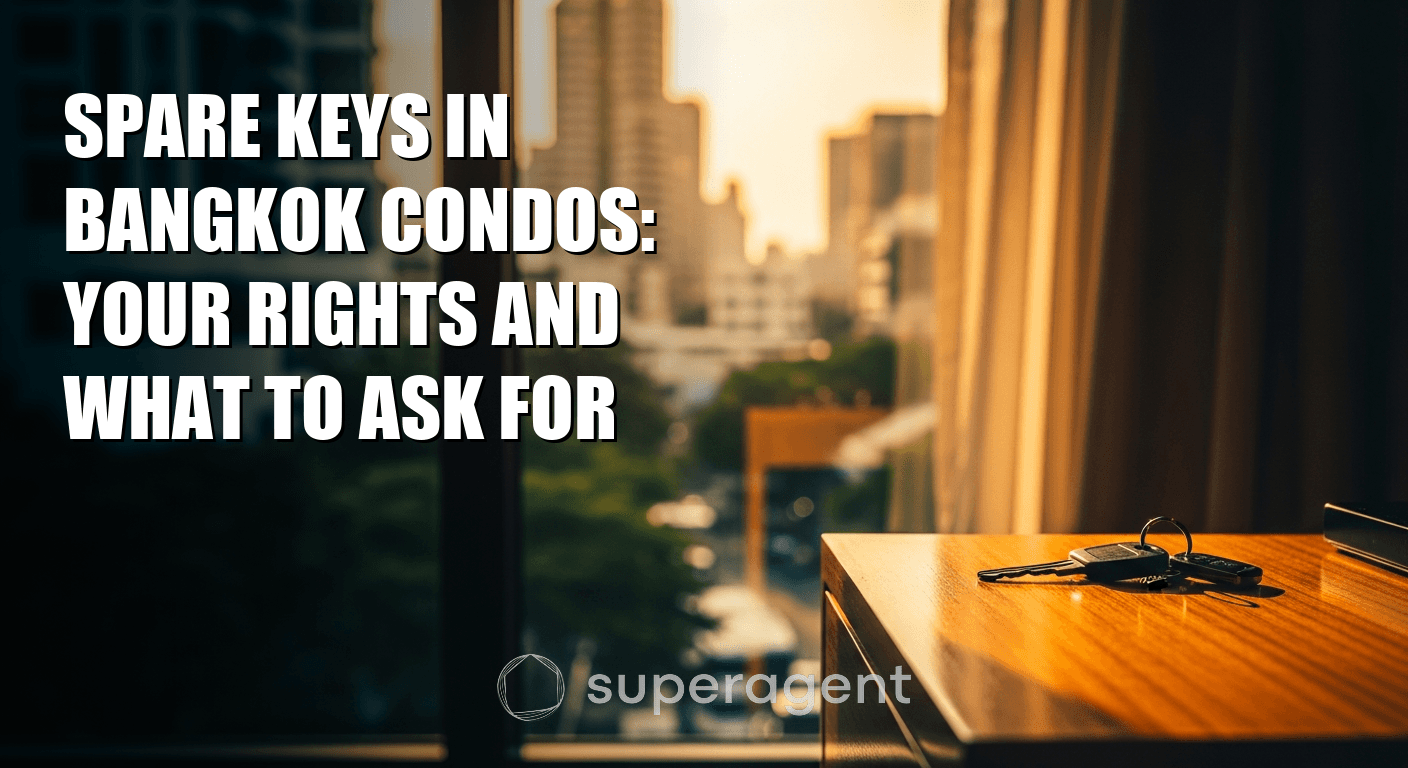
Spare Keys in Bangkok Condos: Your Rights and What to Ask For
Guides
Spare Keys in Bangkok Condos: Your Rights and What to Ask For
Learn what you're entitled to and how to negotiate spare key policies with your Bangkok condo.
Summary
Understand your rights regarding bangkok condo keys spare policies. Discover negotiation tips and security considerations for renters in Thailand's capital
You move into a nice one bedroom condo near On Nut BTS, sign the lease, pay two months deposit, and get handed a single key card. One card. That's it. You ask about a spare and the landlord gives you a vague smile and says something about the juristic office. Sound familiar? You're not alone. The spare key situation in Bangkok condos trips up renters all the time, and it's one of those small details that can turn into a real headache if you don't sort it out before signing.
How Keys and Key Cards Actually Work in Bangkok Condos
Most newer condos in Bangkok have moved away from traditional metal keys. Buildings like Lumpini, Ideo, The Base, and Life series condos almost all use key cards or key fobs now. These cards are programmed by the juristic office and usually tied to your specific unit and floor access in the elevator.
Older buildings, especially walk ups in areas like Ari or around Soi Thonglor, might still use physical keys. But even those often have a separate card for the lobby door, pool gate, or gym. The point is, you're rarely dealing with just one type of access. There could be a room key, an elevator card, a mailbox key, and a gym fob all in the mix.
Here's a real example. A friend rented a studio at Ideo Mobi Sukhumvit for around 15,000 THB per month. She got one key card on move in day. When she asked for a second one, the landlord said she'd have to go to the juristic office herself and pay 500 THB. The landlord didn't mention this at all during the lease discussion. That's a pretty common story across Bangkok.
What Are Your Rights as a Tenant?
Thai rental law doesn't specifically spell out how many keys or cards a landlord must provide. There's no rule that says you're entitled to two key cards or three copies of a physical key. This means everything comes down to what's in your lease agreement.
However, you do have a reasonable expectation that you can access your own home without obstacles. If a landlord only gives you one key card and that card malfunctions, which happens more often than you'd think, you could be locked out of your own apartment. Most juristic offices are only open during business hours, so if it dies at 10 PM on a Friday, good luck.
The 2018 Ministerial Regulation on residential leases in Thailand does protect tenants from unfair charges. So if a landlord tries to charge you 3,000 THB for a spare card that the juristic office programs for 300 THB, you have grounds to push back. Always ask what the juristic office actually charges. In most Bangkok condos, a replacement key card runs between 200 and 500 THB. Some buildings like those in the Ashton series charge up to 1,000 THB because the cards are more advanced.
What to Ask Before You Sign the Lease
This is where five minutes of conversation can save you from weeks of frustration. Before you put your name on anything, ask these questions directly.
How many key cards or keys come with the unit? Two is standard, but some landlords keep the second one for themselves for "emergency access." Clarify who holds what. Ask if the cost of additional cards is covered by the landlord or if you'll be paying out of pocket. Get it in writing.
A tenant I know rented a two bedroom at Life Ladprao near Ladprao MRT for 25,000 THB per month. He lived with his girlfriend, so they needed two working cards. The landlord initially wanted to charge him 1,000 THB for the second card. After a quick phone call to the juristic office, they confirmed the actual cost was 300 THB. He negotiated and the landlord agreed to cover it. Ten minutes of effort, problem solved.
Also ask what happens if a card is lost or damaged. Some leases include a clause that deducts card replacement costs from your security deposit at move out. You want to know this upfront, not when you're trying to get your 50,000 THB deposit back.
The Landlord's Spare Key: A Sensitive Topic
This one makes a lot of renters uncomfortable, and rightfully so. Many Bangkok landlords keep a spare key or card to the unit. They'll say it's for emergencies, maintenance, or letting the cleaning lady in. But tenants deserve to know about this and agree to it.
Thai law does require landlords to give reasonable notice before entering a rented property. They can't just show up whenever they want. If your landlord insists on keeping a key, make sure your lease includes a clause about advance notice, ideally 24 hours minimum.
A woman renting a condo at Rhythm Sukhumvit 36, paying around 20,000 THB per month near Thong Lo BTS, came home one day to find her furniture rearranged. The landlord had sent in a handyman without telling her. She had no idea the landlord even had a key. That's exactly the kind of situation you want to prevent with clear terms in the lease.
Lost Your Key Card? Here's What to Do
It happens to everyone eventually. You're out in Khao San or Sathorn and realize the card is gone. First step is to contact your building's juristic office as soon as possible. They can deactivate the lost card so nobody else uses it to access your floor or unit.
Then request a new one. Bring your lease agreement or a copy of it, plus your passport or Thai ID. Most juristic offices will issue a new card within one to three business days. Some do it on the spot. The fee is usually between 200 and 500 THB, paid directly to the building.
Let your landlord know too, mainly so they don't get confused if the building contacts them. And if it's late at night and you're locked out, most condo security guards can verify your identity and let you in. Just be patient and polite. It works way better than getting frustrated.
Spare keys seem like a tiny detail until you're standing outside your own front door at midnight with no way in. Take a few minutes before signing your lease to sort out key cards, access rights, and who holds what. It's one of the easiest things to overlook and one of the simplest to fix when you handle it early. If you're currently searching for a condo in Bangkok and want to compare options with full transparency on lease terms, check out superagent.co to find listings that make the small details easy to spot before you commit.
You move into a nice one bedroom condo near On Nut BTS, sign the lease, pay two months deposit, and get handed a single key card. One card. That's it. You ask about a spare and the landlord gives you a vague smile and says something about the juristic office. Sound familiar? You're not alone. The spare key situation in Bangkok condos trips up renters all the time, and it's one of those small details that can turn into a real headache if you don't sort it out before signing.
How Keys and Key Cards Actually Work in Bangkok Condos
Most newer condos in Bangkok have moved away from traditional metal keys. Buildings like Lumpini, Ideo, The Base, and Life series condos almost all use key cards or key fobs now. These cards are programmed by the juristic office and usually tied to your specific unit and floor access in the elevator.
Older buildings, especially walk ups in areas like Ari or around Soi Thonglor, might still use physical keys. But even those often have a separate card for the lobby door, pool gate, or gym. The point is, you're rarely dealing with just one type of access. There could be a room key, an elevator card, a mailbox key, and a gym fob all in the mix.
Here's a real example. A friend rented a studio at Ideo Mobi Sukhumvit for around 15,000 THB per month. She got one key card on move in day. When she asked for a second one, the landlord said she'd have to go to the juristic office herself and pay 500 THB. The landlord didn't mention this at all during the lease discussion. That's a pretty common story across Bangkok.
What Are Your Rights as a Tenant?
Thai rental law doesn't specifically spell out how many keys or cards a landlord must provide. There's no rule that says you're entitled to two key cards or three copies of a physical key. This means everything comes down to what's in your lease agreement.
However, you do have a reasonable expectation that you can access your own home without obstacles. If a landlord only gives you one key card and that card malfunctions, which happens more often than you'd think, you could be locked out of your own apartment. Most juristic offices are only open during business hours, so if it dies at 10 PM on a Friday, good luck.
The 2018 Ministerial Regulation on residential leases in Thailand does protect tenants from unfair charges. So if a landlord tries to charge you 3,000 THB for a spare card that the juristic office programs for 300 THB, you have grounds to push back. Always ask what the juristic office actually charges. In most Bangkok condos, a replacement key card runs between 200 and 500 THB. Some buildings like those in the Ashton series charge up to 1,000 THB because the cards are more advanced.
What to Ask Before You Sign the Lease
This is where five minutes of conversation can save you from weeks of frustration. Before you put your name on anything, ask these questions directly.
How many key cards or keys come with the unit? Two is standard, but some landlords keep the second one for themselves for "emergency access." Clarify who holds what. Ask if the cost of additional cards is covered by the landlord or if you'll be paying out of pocket. Get it in writing.
A tenant I know rented a two bedroom at Life Ladprao near Ladprao MRT for 25,000 THB per month. He lived with his girlfriend, so they needed two working cards. The landlord initially wanted to charge him 1,000 THB for the second card. After a quick phone call to the juristic office, they confirmed the actual cost was 300 THB. He negotiated and the landlord agreed to cover it. Ten minutes of effort, problem solved.
Also ask what happens if a card is lost or damaged. Some leases include a clause that deducts card replacement costs from your security deposit at move out. You want to know this upfront, not when you're trying to get your 50,000 THB deposit back.
Talk to us about renting
Share your details and keep reading — we’ll get back to you.
The Landlord's Spare Key: A Sensitive Topic
This one makes a lot of renters uncomfortable, and rightfully so. Many Bangkok landlords keep a spare key or card to the unit. They'll say it's for emergencies, maintenance, or letting the cleaning lady in. But tenants deserve to know about this and agree to it.
Thai law does require landlords to give reasonable notice before entering a rented property. They can't just show up whenever they want. If your landlord insists on keeping a key, make sure your lease includes a clause about advance notice, ideally 24 hours minimum.
A woman renting a condo at Rhythm Sukhumvit 36, paying around 20,000 THB per month near Thong Lo BTS, came home one day to find her furniture rearranged. The landlord had sent in a handyman without telling her. She had no idea the landlord even had a key. That's exactly the kind of situation you want to prevent with clear terms in the lease.
Lost Your Key Card? Here's What to Do
It happens to everyone eventually. You're out in Khao San or Sathorn and realize the card is gone. First step is to contact your building's juristic office as soon as possible. They can deactivate the lost card so nobody else uses it to access your floor or unit.
Then request a new one. Bring your lease agreement or a copy of it, plus your passport or Thai ID. Most juristic offices will issue a new card within one to three business days. Some do it on the spot. The fee is usually between 200 and 500 THB, paid directly to the building.
Let your landlord know too, mainly so they don't get confused if the building contacts them. And if it's late at night and you're locked out, most condo security guards can verify your identity and let you in. Just be patient and polite. It works way better than getting frustrated.
Spare keys seem like a tiny detail until you're standing outside your own front door at midnight with no way in. Take a few minutes before signing your lease to sort out key cards, access rights, and who holds what. It's one of the easiest things to overlook and one of the simplest to fix when you handle it early. If you're currently searching for a condo in Bangkok and want to compare options with full transparency on lease terms, check out superagent.co to find listings that make the small details easy to spot before you commit.
Share this article
Properties you may like
![[For Rent] CONDO I Aguston Sukhumvit 22 I Pet Friendly I 2 Beds I 2 Baths I Rent 55,000THB/mo](/_next/image?url=https%3A%2F%2Fstorage.googleapis.com%2Fsuperagent-web%2Fattachments%2Flistings%2F2266%2Fd3afcd25-6b79-46cb-9f1f-396acdc3dd10-955-3.jpg&w=3840&q=75)
฿55,000
2 Bed295 sqm
[For Rent] CONDO I Aguston Sukhumvit 22 I Pet Friendly I 2 Beds I 2 Baths I Rent 55,000THB/mo
Phrom Phong
Condo![[For Rent] CONDO I SUPALAI PLACE Sukhumvit 39 I 2 Beds I 2 Baths (1 Jacuzzi) I 55,555THB/mo](/_next/image?url=https%3A%2F%2Fstorage.googleapis.com%2Fsuperagent-web%2Fattachments%2Flistings%2F6743%2Fba530743-48b9-4ac6-92d3-c2247e743cf6-01-supalai-place-skv39-2b-link-heaven.jpg&w=3840&q=75)
฿55,555
2 Bed2142 sqm
[For Rent] CONDO I SUPALAI PLACE Sukhumvit 39 I 2 Beds I 2 Baths (1 Jacuzzi) I 55,555THB/mo
Phrom Phong
Condo![[For Rent] CONDO I Maru Ekkamai 2 I Pet friendly I 2 Beds I 2 Baths I 68,000 THB/mo](/_next/image?url=https%3A%2F%2Fstorage.googleapis.com%2Fsuperagent-web%2Fattachments%2Flistings%2F6602%2F9f1d8f71-ee43-435f-9a44-da16c4092c92-968-1.jpg&w=3840&q=75)
฿68,000
2 Bed360 sqm
[For Rent] CONDO I Maru Ekkamai 2 I Pet friendly I 2 Beds I 2 Baths I 68,000 THB/mo
Ekkamai
Condo![[For Rent] CONDO I Noble State 39 I 2 Beds I 2 Baths I 63,000THB/mo](/_next/image?url=https%3A%2F%2Fstorage.googleapis.com%2Fsuperagent-web%2Fattachments%2Flistings%2F2237%2F60eb58f3-eae5-41ed-a80b-406e004f05d8-940-1.jpg&w=3840&q=75)
฿63,000
2 Bed260 sqm
[For Rent] CONDO I Noble State 39 I 2 Beds I 2 Baths I 63,000THB/mo
Phrom Phong
Condo![[For Rent] CONDO I Rhythm Sukhumvit 36-38 I 2 Beds I 2 Baths I 38,999THB/mo](/_next/image?url=https%3A%2F%2Fstorage.googleapis.com%2Fsuperagent-web%2Fattachments%2Flistings%2F1788%2F942a0215-4128-4c2c-a064-f607e84e7aa4-656-2.jpg&w=3840&q=75)
฿38,999
2 Bed256 sqm
[For Rent] CONDO I Rhythm Sukhumvit 36-38 I 2 Beds I 2 Baths I 38,999THB/mo
Thonglor
Condo![[For Rent] CONDO I CLOUD Thonglor-Phetchaburi I 1 Bed I 1 Bath I 22,500THB/mo](/_next/image?url=https%3A%2F%2Fstorage.googleapis.com%2Fsuperagent-web%2Fattachments%2Flistings%2F6742%2F6cef5361-0dac-4dba-98f1-b0d187559c84-1118-1.jpg&w=3840&q=75)
฿22,500
1 Bed132 sqm
[For Rent] CONDO I CLOUD Thonglor-Phetchaburi I 1 Bed I 1 Bath I 22,500THB/mo
Thonglor
Condo![[For Rent] CONDO I City Smart Sukhumvit 18 I 3 Beds I 3 Baths I 65,000mo/THB](/_next/image?url=https%3A%2F%2Fstorage.googleapis.com%2Fsuperagent-web%2Fattachments%2Flistings%2F6741%2Fd371c89d-a913-42c4-a673-e540afae4f46-1116-1.jpg&w=3840&q=75)
฿65,000
3 Bed3125 sqm
[For Rent] CONDO I City Smart Sukhumvit 18 I 3 Beds I 3 Baths I 65,000mo/THB
Condo![[For Rent] CONDO I The Coast Bangkok I 1 Bed I 1 Bath I 20,000mo/THB](/_next/image?url=https%3A%2F%2Fstorage.googleapis.com%2Fsuperagent-web%2Fattachments%2Flistings%2F6740%2F498477ce-4ffa-4e4c-ab08-0e565d9c4bbe-1115-3.jpg&w=3840&q=75)
฿20,000
1 Bed146 sqm
[For Rent] CONDO I The Coast Bangkok I 1 Bed I 1 Bath I 20,000mo/THB
Bang Na
Condo![[For Rent] CONDO I IDEO Sukhumvit-RAMA 4 I 2 Beds I 2 Baths I 55,000mo/THB](/_next/image?url=https%3A%2F%2Fstorage.googleapis.com%2Fsuperagent-web%2Fattachments%2Flistings%2F6739%2F15df221d-5b8e-497c-b7ce-a6b9b6412cab-1113-1.jpg&w=3840&q=75)
฿55,000
2 Bed265 sqm
[For Rent] CONDO I IDEO Sukhumvit-RAMA 4 I 2 Beds I 2 Baths I 55,000mo/THB
Phra Khanong
Condo![[For Rent] CONDO I Downtown 49 I Pet Friendly I 1 Bed I 1 Bath I 23,000mo/THB](/_next/image?url=https%3A%2F%2Fstorage.googleapis.com%2Fsuperagent-web%2Fattachments%2Flistings%2F6738%2F11cf2ffe-1f01-4ccc-991c-2ad608f1ba73-1112-1.jpg&w=3840&q=75)
฿23,000
1 Bed135 sqm
[For Rent] CONDO I Downtown 49 I Pet Friendly I 1 Bed I 1 Bath I 23,000mo/THB
Thonglor
CondoMore like this
 In Guides · Superagent EditorialHidden Costs of Renting a Condo in Bangkok Nobody Warns You AboutBangkok condo rent looks affordable until month one hits. Here are the real costs beyond the headline figure that catch most renters off guard.25 May 20261 min read
 In Guides · Superagent EditorialWhat a Long-Vacant Bangkok Condo Unit Is Actually Telling YouA Bangkok condo vacant for months signals overpricing, landlord issues, or real problems. Here is how to read the signs.25 May 20261 min read
 In Guides · Superagent EditorialRed Flags in a Bangkok Rental Contract to Watch Out ForBangkok rental contracts often hide risky clauses. Here are the red flags every tenant must catch before signing any lease.25 May 20261 min read
 In Guides · Superagent EditorialWorking Online from a Condo: How to Choose the Perfect Room for ProductivityLearn how to choose the best condo room for working online with tips on lighting, noise, and furniture setup to maximize productivity.9 May 20261 min read