Raising Kids in a Bangkok Condo: Space, Noise, and How to Pick the Right Building
Guides
Raising Kids in a Bangkok Condo: Space, Noise, and How to Pick the Right Building
Navigate parenthood in compact spaces with practical strategies and design tips
Summary
A practical guide to raising children in a Bangkok condo, covering unit size, noise control, family-friendly buildings, schools and hospitals.
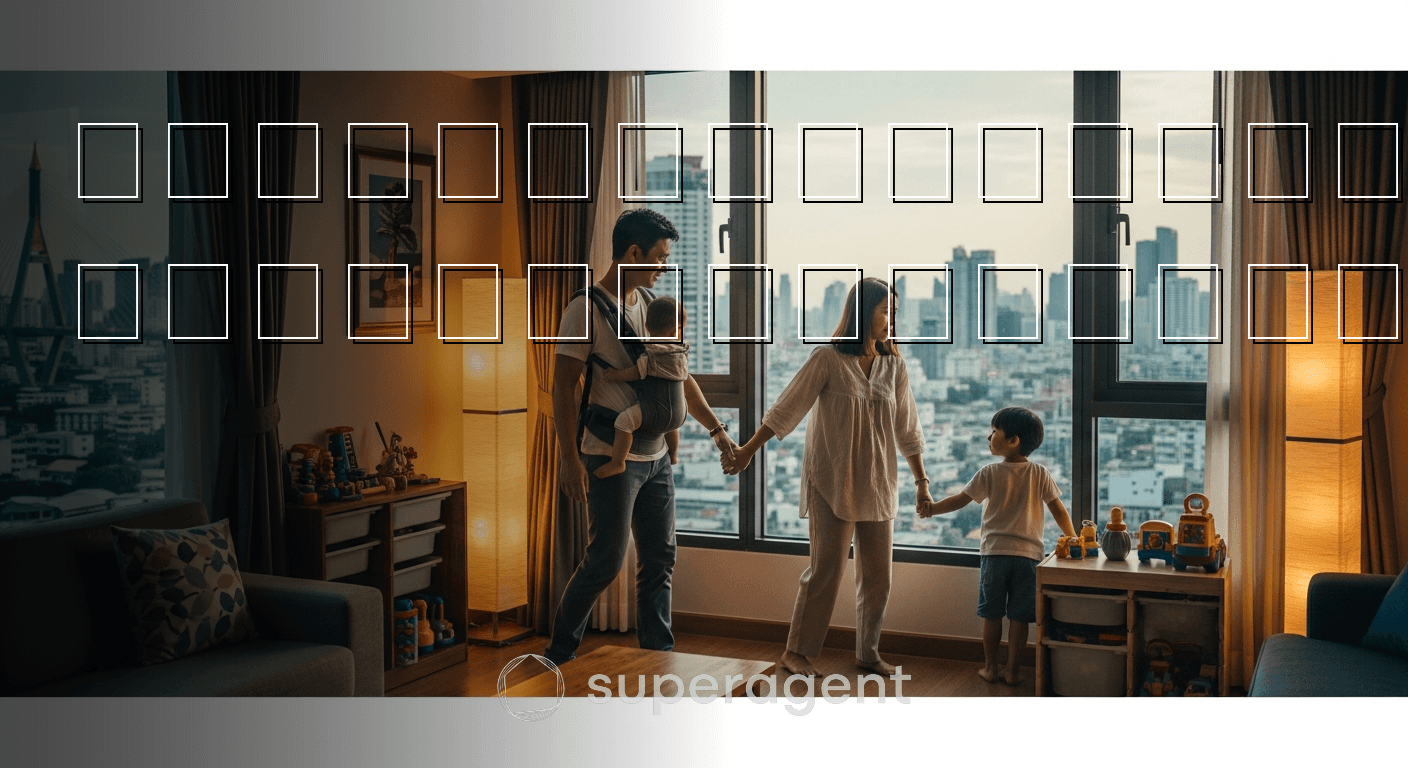
Your toddler just knocked over a glass of water, the baby is crying, and your neighbor downstairs is banging on the ceiling with a broomstick. Welcome to raising kids in a Bangkok condo. It sounds chaotic, and honestly, sometimes it is. But thousands of families across the city do it every day, and many of them genuinely love it. The trick is knowing what challenges to expect and having a real plan for each one. Whether you are an expat family arriving for a new posting or a Thai couple upgrading from a studio, raising children in a condo is completely doable if you pick the right building, the right neighborhood, and the right mindset.
The Space Problem: How Much Room Do You Actually Need?
This is the number one concern for every parent considering condo life in Bangkok. Most one-bedroom condos in the city center range from 30 to 45 square meters, which is fine for a couple but feels impossibly tight once you add a crib, a highchair, and a mountain of baby gear. The reality is that families raising kids in a Bangkok condo typically need at least a two-bedroom unit, ideally 55 square meters or more.
Take a family living at Life Asoke Hype near MRT Phetchaburi, for example. A two-bedroom unit there runs roughly 28,000 to 38,000 THB per month depending on floor and furnishing. That gives you around 60 square meters, enough for a proper kids' room, a living area where toys can spread out, and a kitchen that does not double as a changing station.
According to DDproperty, the average rent for a two-bedroom condo in central Bangkok ranges from 25,000 to 45,000 THB per month, though family-friendly buildings in suburban BTS corridors like Bearing or Bang Na can go as low as 18,000 to 22,000 THB for similar square footage. If budget is tight, moving a few stations outward makes a massive difference in livable space per baht.
Vertical storage, foldable furniture, and creative room dividers become your best friends. Many parents install wall-mounted shelves and use under-bed bins to reclaim floor space. It is not glamorous, but it works.
Noise, Neighbors, and the Unwritten Rules of Condo Living with Kids
Bangkok condos were not designed with screaming toddlers in mind. Thin walls, shared corridors, and strict juristic office rules mean that noise is a genuine issue. Most buildings have quiet hours from 10 PM to 7 AM, and some go further by restricting loud activities in common areas during certain windows.
A friend of mine living at Lumpini Park Rama 9 near MRT Rama 9 learned this the hard way. Her three-year-old loved running laps around the living room at 6 AM. After two complaints from the unit below, she invested in thick foam play mats that covered the entire floor of the kids' room. Problem mostly solved. Rubber interlocking mats, the kind you see in preschools, cost about 300 to 600 THB for a pack of six tiles on Lazada and genuinely absorb impact noise.
Building selection matters here too. Older buildings with thicker concrete walls tend to handle noise better than newer, budget-focused towers where developers cut costs on soundproofing. When touring a unit, stomp on the floor and listen. If you can hear your own footsteps echo, your downstairs neighbor definitely can too.
Being proactive with neighbors also helps. Introduce yourself, acknowledge that you have small kids, and maybe drop off a small gift during holidays. Thai culture values considerate relationships, and a little effort goes a long way in preventing friction.
Choosing a Family-Friendly Building and Neighborhood
Not every condo in Bangkok is suitable for families. Some buildings are essentially party towers filled with short-term renters and nightlife crowds. Others cater to retirees who want absolute silence. The sweet spot for families is a mid-rise or high-rise building with a good mix of long-term tenants, solid facilities, and proximity to schools and parks.
Look for buildings with a dedicated kids' play area, a swimming pool with a children's section, and ideally a garden or open green space. Projects like Supalai Oriental Sukhumvit 39 near BTS Phrom Phong check many of these boxes and sit within walking distance of Emquartier, which has an excellent rooftop playground.
Neighborhoods matter as much as buildings. Sukhumvit between Asoke and Ekkamai is the classic expat family corridor, packed with international schools, pediatric clinics, and kid-friendly restaurants. But it is also expensive. For families watching their budget, areas like On Nut, Udom Suk, and even Taling Chan offer newer buildings with larger units at significantly lower rents.
The BTS Sukhumvit line extension has made stations like BTS Bearing and Samrong increasingly popular with young families. You get bigger condos, quieter streets, and direct train access into the city center in under 30 minutes.
Schools, Healthcare, and the Practical Infrastructure Around Your Condo
Raising kids in a Bangkok condo means your daily logistics revolve around school pickup, pediatrician visits, and weekend activities. The closer these essentials are to your building, the less time you spend stuck in traffic and the more time you spend actually being a parent.
For healthcare, having a reputable hospital nearby is non-negotiable. Bumrungrad International Hospital near BTS Nana is a go-to for expat families, with a dedicated pediatric center and English-speaking staff. Samitivej Sukhumvit near BTS Thong Lo is another excellent option with a strong children's wing.
For schooling, international schools cluster in specific zones. If your kids attend Bangkok Patana School in Bang Na, it makes sense to rent in the Bearing or Bang Na corridor rather than commuting from Ari. If they go to NIST International School near Asoke, you want to be somewhere on the Sukhumvit line between Phrom Phong and Ekkamai.
A practical example: a family with two kids at St. Andrews International School Sukhumvit 107 chose a three-bedroom unit at Ideo Mobi Sukhumvit East near BTS Bang Na for about 32,000 THB per month. The school commute is under 10 minutes by car, and they have direct BTS access for weekend trips into the city. That kind of alignment between home and school saves hours every week.
Comparing Family-Friendly Condo Areas in Bangkok
To help you weigh your options, here is a comparison of popular areas where families rent condos in Bangkok. Prices reflect typical two-bedroom units as of 2024.
| Neighborhood | Nearest BTS/MRT | 2-Bed Rent Range (THB/month) | Nearby Schools | Family-Friendly Score |
|---|---|---|---|---|
| Phrom Phong / Thong Lo | BTS Phrom Phong, BTS Thong Lo | 35,000 to 65,000 | NIST, Samitivej Nursery, First Steps | 9/10 |
| On Nut / Phra Khanong | BTS On Nut, BTS Phra Khanong | 20,000 to 35,000 | Wells International, Brighton College | 8/10 |
| Bang Na / Bearing | BTS Bang Na, BTS Bearing | 15,000 to 28,000 | Bangkok Patana, St. Andrews 107 | 8/10 |
| Ari / Saphan Khwai | BTS Ari, BTS Saphan Khwai | 22,000 to 40,000 | Lycee Francais, Panyarat High School | 7/10 |
| Rama 9 / Ratchada | MRT Rama 9, MRT Ratchadaphisek | 18,000 to 32,000 | Ruamrudee International, Aksorn | 7/10 |
Making the Most of Limited Space and Shared Amenities
One of the biggest advantages of raising kids in a Bangkok condo is the shared amenities. A family in a standalone house needs to buy, maintain, and clean their own pool, gym, and play area. In a condo, it is all included in your common area fees, which typically run 40 to 60 THB per square meter per month.
Smart condo parents treat the building's facilities as an extension of their unit. The pool becomes the backyard. The lobby becomes the playdate spot. The rooftop garden becomes the after-dinner wind-down zone. At a building like The Base Park West Sukhumvit 77 near BTS On Nut, families regularly gather at the ground-floor garden area in the evenings while kids ride scooters and tricycles along the paths.
Public parks also fill a critical gap. Benchasiri Park at BTS Phrom Phong and Benjakitti Park near MRT Queen Sirikit Centre are lifesavers for families who need open green space. Weekend mornings at these parks are basically a parents' networking event, with kids running around and adults swapping school recommendations over iced coffee from the nearby vendors.
For rainy season, and in Bangkok that means roughly May through October, indoor play spaces become essential. Funarium in Sukhumvit 26, Imaginia at Emquartier, and Harbor Pattanakarn are all popular options that give kids a place to burn energy when the condo playroom feels too small.
One more practical tip: negotiate with your landlord for kid-friendly modifications. Many landlords will allow you to install safety gates, cabinet locks, corner protectors, and window guards if you ask. Most of these are non-permanent and can be removed at move-out without affecting your deposit.
Raising kids in a Bangkok condo is not always easy, but it comes with real advantages: community, convenience, security, and access to the city's best schools and hospitals without needing a car. The families who thrive are the ones who choose their building carefully, build relationships with neighbors, and treat the entire neighborhood as their extended living room. If you are starting your search for a family-friendly condo in Bangkok, Superagent at superagent.co can help you filter by unit size, kid-friendly amenities, and proximity to schools so you find the right fit without the usual rental headaches.
Your toddler just knocked over a glass of water, the baby is crying, and your neighbor downstairs is banging on the ceiling with a broomstick. Welcome to raising kids in a Bangkok condo. It sounds chaotic, and honestly, sometimes it is. But thousands of families across the city do it every day, and many of them genuinely love it. The trick is knowing what challenges to expect and having a real plan for each one. Whether you are an expat family arriving for a new posting or a Thai couple upgrading from a studio, raising children in a condo is completely doable if you pick the right building, the right neighborhood, and the right mindset.
The Space Problem: How Much Room Do You Actually Need?
This is the number one concern for every parent considering condo life in Bangkok. Most one-bedroom condos in the city center range from 30 to 45 square meters, which is fine for a couple but feels impossibly tight once you add a crib, a highchair, and a mountain of baby gear. The reality is that families raising kids in a Bangkok condo typically need at least a two-bedroom unit, ideally 55 square meters or more.
Take a family living at Life Asoke Hype near MRT Phetchaburi, for example. A two-bedroom unit there runs roughly 28,000 to 38,000 THB per month depending on floor and furnishing. That gives you around 60 square meters, enough for a proper kids' room, a living area where toys can spread out, and a kitchen that does not double as a changing station.
According to DDproperty, the average rent for a two-bedroom condo in central Bangkok ranges from 25,000 to 45,000 THB per month, though family-friendly buildings in suburban BTS corridors like Bearing or Bang Na can go as low as 18,000 to 22,000 THB for similar square footage. If budget is tight, moving a few stations outward makes a massive difference in livable space per baht.
Vertical storage, foldable furniture, and creative room dividers become your best friends. Many parents install wall-mounted shelves and use under-bed bins to reclaim floor space. It is not glamorous, but it works.
Noise, Neighbors, and the Unwritten Rules of Condo Living with Kids
Bangkok condos were not designed with screaming toddlers in mind. Thin walls, shared corridors, and strict juristic office rules mean that noise is a genuine issue. Most buildings have quiet hours from 10 PM to 7 AM, and some go further by restricting loud activities in common areas during certain windows.
A friend of mine living at Lumpini Park Rama 9 near MRT Rama 9 learned this the hard way. Her three-year-old loved running laps around the living room at 6 AM. After two complaints from the unit below, she invested in thick foam play mats that covered the entire floor of the kids' room. Problem mostly solved. Rubber interlocking mats, the kind you see in preschools, cost about 300 to 600 THB for a pack of six tiles on Lazada and genuinely absorb impact noise.
Building selection matters here too. Older buildings with thicker concrete walls tend to handle noise better than newer, budget-focused towers where developers cut costs on soundproofing. When touring a unit, stomp on the floor and listen. If you can hear your own footsteps echo, your downstairs neighbor definitely can too.
Being proactive with neighbors also helps. Introduce yourself, acknowledge that you have small kids, and maybe drop off a small gift during holidays. Thai culture values considerate relationships, and a little effort goes a long way in preventing friction.
Choosing a Family-Friendly Building and Neighborhood
Not every condo in Bangkok is suitable for families. Some buildings are essentially party towers filled with short-term renters and nightlife crowds. Others cater to retirees who want absolute silence. The sweet spot for families is a mid-rise or high-rise building with a good mix of long-term tenants, solid facilities, and proximity to schools and parks.
Look for buildings with a dedicated kids' play area, a swimming pool with a children's section, and ideally a garden or open green space. Projects like Supalai Oriental Sukhumvit 39 near BTS Phrom Phong check many of these boxes and sit within walking distance of Emquartier, which has an excellent rooftop playground.
Neighborhoods matter as much as buildings. Sukhumvit between Asoke and Ekkamai is the classic expat family corridor, packed with international schools, pediatric clinics, and kid-friendly restaurants. But it is also expensive. For families watching their budget, areas like On Nut, Udom Suk, and even Taling Chan offer newer buildings with larger units at significantly lower rents.
The BTS Sukhumvit line extension has made stations like BTS Bearing and Samrong increasingly popular with young families. You get bigger condos, quieter streets, and direct train access into the city center in under 30 minutes.
Schools, Healthcare, and the Practical Infrastructure Around Your Condo
Raising kids in a Bangkok condo means your daily logistics revolve around school pickup, pediatrician visits, and weekend activities. The closer these essentials are to your building, the less time you spend stuck in traffic and the more time you spend actually being a parent.
For healthcare, having a reputable hospital nearby is non-negotiable. Bumrungrad International Hospital near BTS Nana is a go-to for expat families, with a dedicated pediatric center and English-speaking staff. Samitivej Sukhumvit near BTS Thong Lo is another excellent option with a strong children's wing.
For schooling, international schools cluster in specific zones. If your kids attend Bangkok Patana School in Bang Na, it makes sense to rent in the Bearing or Bang Na corridor rather than commuting from Ari. If they go to NIST International School near Asoke, you want to be somewhere on the Sukhumvit line between Phrom Phong and Ekkamai.
Talk to us about renting
Share your details and keep reading — we’ll get back to you.
A practical example: a family with two kids at St. Andrews International School Sukhumvit 107 chose a three-bedroom unit at Ideo Mobi Sukhumvit East near BTS Bang Na for about 32,000 THB per month. The school commute is under 10 minutes by car, and they have direct BTS access for weekend trips into the city. That kind of alignment between home and school saves hours every week.
Comparing Family-Friendly Condo Areas in Bangkok
To help you weigh your options, here is a comparison of popular areas where families rent condos in Bangkok. Prices reflect typical two-bedroom units as of 2024.
| Neighborhood | Nearest BTS/MRT | 2-Bed Rent Range (THB/month) | Nearby Schools | Family-Friendly Score |
|---|---|---|---|---|
| Phrom Phong / Thong Lo | BTS Phrom Phong, BTS Thong Lo | 35,000 to 65,000 | NIST, Samitivej Nursery, First Steps | 9/10 |
| On Nut / Phra Khanong | BTS On Nut, BTS Phra Khanong | 20,000 to 35,000 | Wells International, Brighton College | 8/10 |
| Bang Na / Bearing | BTS Bang Na, BTS Bearing | 15,000 to 28,000 | Bangkok Patana, St. Andrews 107 | 8/10 |
| Ari / Saphan Khwai | BTS Ari, BTS Saphan Khwai | 22,000 to 40,000 | Lycee Francais, Panyarat High School | 7/10 |
| Rama 9 / Ratchada | MRT Rama 9, MRT Ratchadaphisek | 18,000 to 32,000 | Ruamrudee International, Aksorn | 7/10 |
Making the Most of Limited Space and Shared Amenities
One of the biggest advantages of raising kids in a Bangkok condo is the shared amenities. A family in a standalone house needs to buy, maintain, and clean their own pool, gym, and play area. In a condo, it is all included in your common area fees, which typically run 40 to 60 THB per square meter per month.
Smart condo parents treat the building's facilities as an extension of their unit. The pool becomes the backyard. The lobby becomes the playdate spot. The rooftop garden becomes the after-dinner wind-down zone. At a building like The Base Park West Sukhumvit 77 near BTS On Nut, families regularly gather at the ground-floor garden area in the evenings while kids ride scooters and tricycles along the paths.
Public parks also fill a critical gap. Benchasiri Park at BTS Phrom Phong and Benjakitti Park near MRT Queen Sirikit Centre are lifesavers for families who need open green space. Weekend mornings at these parks are basically a parents' networking event, with kids running around and adults swapping school recommendations over iced coffee from the nearby vendors.
For rainy season, and in Bangkok that means roughly May through October, indoor play spaces become essential. Funarium in Sukhumvit 26, Imaginia at Emquartier, and Harbor Pattanakarn are all popular options that give kids a place to burn energy when the condo playroom feels too small.
One more practical tip: negotiate with your landlord for kid-friendly modifications. Many landlords will allow you to install safety gates, cabinet locks, corner protectors, and window guards if you ask. Most of these are non-permanent and can be removed at move-out without affecting your deposit.
Raising kids in a Bangkok condo is not always easy, but it comes with real advantages: community, convenience, security, and access to the city's best schools and hospitals without needing a car. The families who thrive are the ones who choose their building carefully, build relationships with neighbors, and treat the entire neighborhood as their extended living room. If you are starting your search for a family-friendly condo in Bangkok, Superagent at superagent.co can help you filter by unit size, kid-friendly amenities, and proximity to schools so you find the right fit without the usual rental headaches.
Share this article
Properties you may like
![[For Rent] CONDO I CLOUD Thonglor-Phetchaburi I 1 Bed I 1 Bath I 22,500THB/mo](/_next/image?url=https%3A%2F%2Fstorage.googleapis.com%2Fsuperagent-web%2Fattachments%2Flistings%2F6742%2F6cef5361-0dac-4dba-98f1-b0d187559c84-1118-1.jpg&w=3840&q=75)
฿22,500
1 Bed132 sqm
[For Rent] CONDO I CLOUD Thonglor-Phetchaburi I 1 Bed I 1 Bath I 22,500THB/mo
Thonglor
Condo![[For Rent] CONDO I City Smart Sukhumvit 18 I 3 Beds I 3 Baths I 65,000mo/THB](/_next/image?url=https%3A%2F%2Fstorage.googleapis.com%2Fsuperagent-web%2Fattachments%2Flistings%2F6741%2Fd371c89d-a913-42c4-a673-e540afae4f46-1116-1.jpg&w=3840&q=75)
฿65,000
3 Bed3125 sqm
[For Rent] CONDO I City Smart Sukhumvit 18 I 3 Beds I 3 Baths I 65,000mo/THB
Condo![[For Rent] CONDO I The Coast Bangkok I 1 Bed I 1 Bath I 20,000mo/THB](/_next/image?url=https%3A%2F%2Fstorage.googleapis.com%2Fsuperagent-web%2Fattachments%2Flistings%2F6740%2F498477ce-4ffa-4e4c-ab08-0e565d9c4bbe-1115-3.jpg&w=3840&q=75)
฿20,000
1 Bed146 sqm
[For Rent] CONDO I The Coast Bangkok I 1 Bed I 1 Bath I 20,000mo/THB
Bang Na
Condo![[For Rent] CONDO I IDEO Sukhumvit-RAMA 4 I 2 Beds I 2 Baths I 55,000mo/THB](/_next/image?url=https%3A%2F%2Fstorage.googleapis.com%2Fsuperagent-web%2Fattachments%2Flistings%2F6739%2F15df221d-5b8e-497c-b7ce-a6b9b6412cab-1113-1.jpg&w=3840&q=75)
฿55,000
2 Bed265 sqm
[For Rent] CONDO I IDEO Sukhumvit-RAMA 4 I 2 Beds I 2 Baths I 55,000mo/THB
Phra Khanong
Condo![[For Rent] CONDO I Downtown 49 I Pet Friendly I 1 Bed I 1 Bath I 23,000mo/THB](/_next/image?url=https%3A%2F%2Fstorage.googleapis.com%2Fsuperagent-web%2Fattachments%2Flistings%2F6738%2F11cf2ffe-1f01-4ccc-991c-2ad608f1ba73-1112-1.jpg&w=3840&q=75)
฿23,000
1 Bed135 sqm
[For Rent] CONDO I Downtown 49 I Pet Friendly I 1 Bed I 1 Bath I 23,000mo/THB
Thonglor
Condo![[For Rent] CONDO I Nusasiri Grand Condominium Ekkamai I 2 Beds I 2 Baths I 55,500mo/THB](/_next/image?url=https%3A%2F%2Fstorage.googleapis.com%2Fsuperagent-web%2Fattachments%2Flistings%2F6737%2Feb4785b4-6fd9-4e48-836c-640cc7999e07-1110-5.jpg&w=3840&q=75)
฿55,500
2 Bed280 sqm
[For Rent] CONDO I Nusasiri Grand Condominium Ekkamai I 2 Beds I 2 Baths I 55,500mo/THB
Condo![[For Rent] CONDO I Topview Tower I 3 Beds I 2 Baths I 65,000mo/THB](/_next/image?url=https%3A%2F%2Fstorage.googleapis.com%2Fsuperagent-web%2Fattachments%2Flistings%2F6736%2F8fa8ed0b-5193-4af0-a243-209ec13aa217-1109-11.jpg&w=3840&q=75)
฿65,000
3 Bed2120 sqm
[For Rent] CONDO I Topview Tower I 3 Beds I 2 Baths I 65,000mo/THB
Condo![[For Rent] CONDO I Urbano Absolute Sathon-Taksin I 1 Bed I 1 Bath I 17,500mo/THB](/_next/image?url=https%3A%2F%2Fstorage.googleapis.com%2Fsuperagent-web%2Fattachments%2Flistings%2F6735%2Fb6aa0f79-33a4-4fd9-9fd5-145b740cced8-1108-1.jpg&w=3840&q=75)
฿17,500
1 Bed138 sqm
[For Rent] CONDO I Urbano Absolute Sathon-Taksin I 1 Bed I 1 Bath I 17,500mo/THB
Condo![[For Rent] CONDO I KnightsBridge Prime Sathon I Duplex I 2 Beds I 1 Bath I 46,000THB/mo](/_next/image?url=https%3A%2F%2Fstorage.googleapis.com%2Fsuperagent-web%2Fattachments%2Flistings%2F6734%2Faf8e7500-c684-4f78-9e62-d792c1590ec6-1117-1.jpg&w=3840&q=75)
฿46,000
2 Bed158 sqm
[For Rent] CONDO I KnightsBridge Prime Sathon I Duplex I 2 Beds I 1 Bath I 46,000THB/mo
Sathorn
Condo![[For Rent] CONDO I Life Rama 4 - Asoke I 2 Beds I 1 Bath I 45,000THB/mo](/_next/image?url=https%3A%2F%2Fstorage.googleapis.com%2Fsuperagent-web%2Fattachments%2Flistings%2F6630%2F45e09ffb-5b86-4dcf-ad76-05c21e8e5fef-1003-4.jpg&w=3840&q=75)
฿45,000
2 Bed148 sqm
[For Rent] CONDO I Life Rama 4 - Asoke I 2 Beds I 1 Bath I 45,000THB/mo
Asoke
CondoMore like this
 In Guides · Superagent EditorialHidden Costs of Renting a Condo in Bangkok Nobody Warns You AboutBangkok condo rent looks affordable until month one hits. Here are the real costs beyond the headline figure that catch most renters off guard.25 May 20261 min read
 In Guides · Superagent EditorialWhat a Long-Vacant Bangkok Condo Unit Is Actually Telling YouA Bangkok condo vacant for months signals overpricing, landlord issues, or real problems. Here is how to read the signs.25 May 20261 min read
 In Guides · Superagent EditorialRed Flags in a Bangkok Rental Contract to Watch Out ForBangkok rental contracts often hide risky clauses. Here are the red flags every tenant must catch before signing any lease.25 May 20261 min read
 In Guides · Superagent EditorialWorking Online from a Condo: How to Choose the Perfect Room for ProductivityLearn how to choose the best condo room for working online with tips on lighting, noise, and furniture setup to maximize productivity.9 May 20261 min read