New Condo or Older Building? How to Choose Your Bangkok Rental
Guides
New Condo or Older Building? How to Choose Your Bangkok Rental
Comparing the pros and cons to find your perfect Bangkok rental home
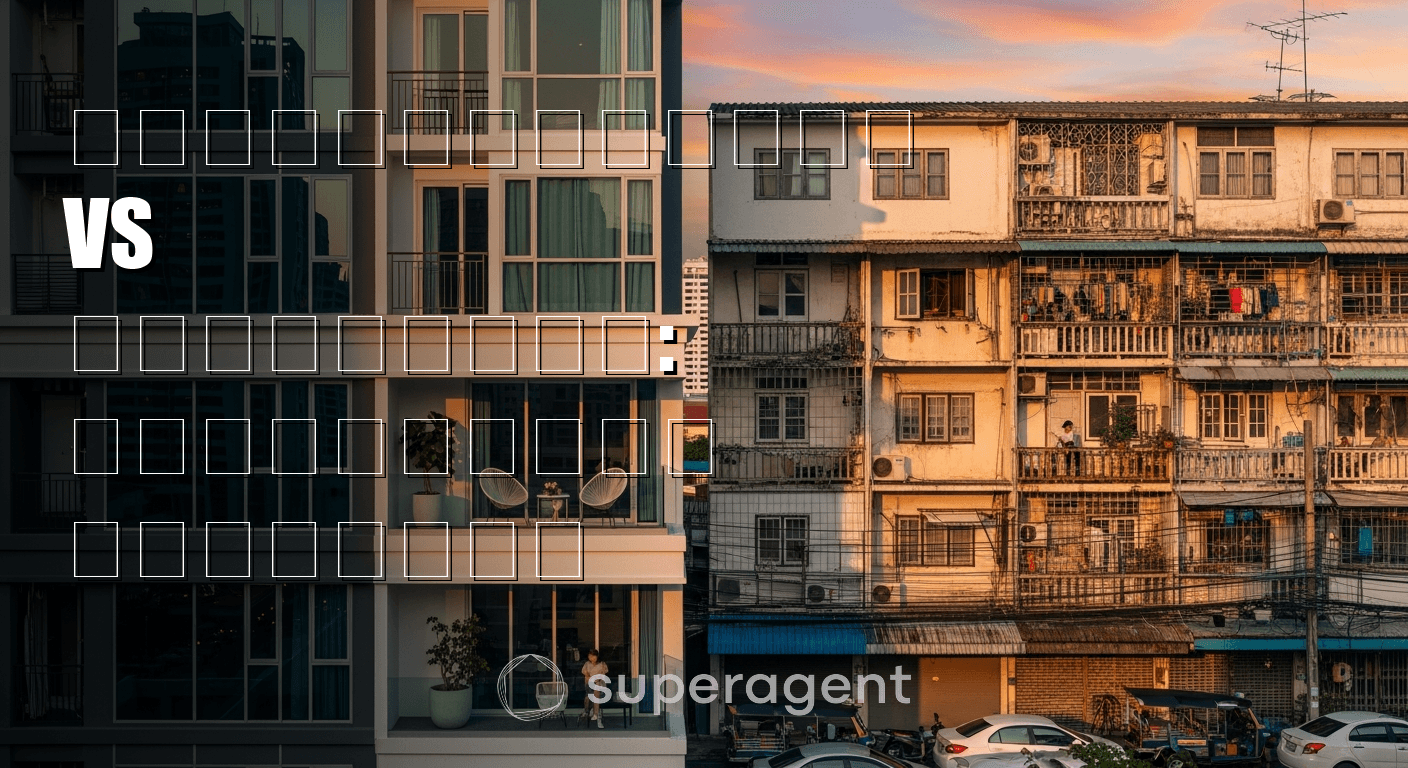
Summary
Compare new and older Bangkok condos on rent, unit size, facilities and location, with real examples from Asoke, Thong Lo and Sukhumvit.
You have been scrolling through condo listings for the past three hours. One building looks brand new with a rooftop infinity pool and co-working space. The next one is older, a bit worn around the edges, but the rent is 40% cheaper and it sits right on top of a BTS station. Sound familiar? This is the classic dilemma every renter in Bangkok faces at some point. New build or older building? Shiny amenities or unbeatable location at a lower price? The answer is not as straightforward as you might think, because both options come with real tradeoffs that affect your daily life, your wallet, and your sanity. Let me break it all down based on what actually matters when you are renting in Bangkok.
What Counts as "New" and "Old" in Bangkok's Condo Market
Before we get into the details, let's set some definitions. In Bangkok, a "new" condo typically means a building completed within the last five years, roughly 2020 onward. These are projects by developers like Origin, Ananda, AP Thai, and Sansiri that have been aggressively building along new MRT extensions and in areas like Rama 9, Phra Ram 3, and along Sukhumvit past On Nut.
An "older" condo is anything built before 2015, and some of the most popular rentals in Bangkok are buildings from the early 2000s or even the late 1990s. Think Waterford Diamond on Sukhumvit Soi 30/1, Baan Siri on Sukhumvit Soi 13, or Lumpini Place Narathiwas on Rama 3. These are well-known names that still attract tenants year after year.
According to CBRE Thailand's residential market reports, Bangkok saw over 60,000 new condo units launched in 2023 alone, adding to an already massive supply. That oversupply is exactly why renters today have more bargaining power than ever, especially when choosing between newer and older stock.
Rent Prices: Where Your Money Actually Goes
This is where the rubber meets the road. New condos in Bangkok charge a premium, and that premium can be significant. A one-bedroom unit at a newer project like Life Asoke Hype near MRT Phetchaburi will set you back around 18,000 to 25,000 THB per month. Walk a few minutes to a slightly older building like Supalai Premier at Asoke, and a similar-sized unit might go for 13,000 to 17,000 THB per month.
The gap gets even wider in prime areas. A one-bedroom in a new luxury project along Sukhumvit Soi 24 to Soi 39, the Phrom Phong to Thong Lo corridor, can easily cost 35,000 to 55,000 THB per month. Meanwhile, an older but well-maintained building like Las Colinas on Sukhumvit Soi 21 offers comparable space for 20,000 to 30,000 THB per month. That is a significant monthly saving that adds up to hundreds of thousands of baht over a year-long lease.
Data from DDproperty shows that average asking rents for condos built after 2020 in central Bangkok are approximately 30% to 45% higher per square meter than buildings completed before 2015. That gap alone should make you think carefully about what you are really paying for.
Build Quality, Unit Size, and the Shrinking Square Meter Problem
Here is something that catches a lot of first-time renters off guard. Newer condos in Bangkok are significantly smaller than older ones. A one-bedroom in a building from 2005 might be 45 to 55 square meters. A one-bedroom in a building completed in 2022? You are looking at 26 to 35 square meters in many cases. Developers have been shrinking unit sizes to keep headline prices affordable while maintaining their margins.
Let me give you a concrete example. At The Line Sukhumvit 101, a relatively new project near BTS Punnawithi, one-bedroom units start at about 28 square meters. Compare that to Lumpini Suite Sukhumvit 41, built in 2009, where one-bedrooms are around 50 square meters. You are getting nearly double the living space in the older building, often at a similar or lower monthly rent.
On the flip side, newer buildings tend to use better materials for fixtures and fittings. Kitchens come with built-in appliances, bathrooms have rain showers, and windows are double-glazed for noise reduction. Older buildings might have dated kitchens, aging plumbing, and single-pane windows that let in every decibel of Bangkok traffic. It is a real tradeoff between space and finish quality.
Facilities and Lifestyle: The Amenity Arms Race
New condo developers in Bangkok are in an all-out war to offer the flashiest facilities. Co-working spaces, rooftop pools, sky lounges, pet parks, EV charging stations, Amazon lockers, and even onsen-style baths. Projects like Whizdom Essence on Sukhumvit Soi 101 and IDEO Mobi Rama 9 have genuinely impressive common areas that feel more like boutique hotels than residential buildings.
Older buildings usually have the basics: a pool, a gym, maybe a small garden. The equipment might be showing its age. The pool might be smaller. But here is the thing, how often do you actually use all those fancy facilities? If you are someone who works from a co-working space or goes to a proper gym anyway, you are paying a premium for amenities you will barely touch.
That said, if you work from home and love the idea of popping down to a residents-only co-working space with fast Wi-Fi and free coffee, a newer building can genuinely improve your quality of life. A friend of mine moved from an older place on Sukhumvit Soi 49 to Oka Haus near BTS Saphan Khwai specifically for the co-working space, and he says it completely changed his daily routine.
Location vs. Newness: The Bangkok Tradeoff
This is the factor that often tips the scales. Older condos in Bangkok tend to sit in the most established, most convenient neighborhoods. The best spots along the BTS Sukhumvit line, from Nana through Asoke, Phrom Phong, Thong Lo, and Ekkamai, are dominated by buildings from the 2000s and early 2010s. These locations are walkable, full of restaurants, close to international schools, and connected to everything.
Newer affordable projects, by contrast, are often built further out. Developers buy cheaper land near newer MRT stations like Huai Khwang, Sutthisan, or along the Yellow Line and Pink Line extensions. A brand-new condo near MRT Lat Phrao might be gorgeous inside, but your commute to Silom could be 45 minutes each way. An older unit at Silom Suite on Soi Sala Daeng puts you five minutes from your office.
For families especially, location often wins. Being close to schools like NIST on Sukhumvit Soi 15 or Bangkok Patana on Soi La Salle matters more than having a yoga studio in your building. For younger professionals who work remotely and do not mind living in emerging neighborhoods, a newer building further out can be a smart play.
The Side-by-Side Comparison
| Factor | New Condo (Built After 2020) | Older Condo (Built Before 2015) |
|---|---|---|
| Average 1-Bed Rent (Central Bangkok) | 22,000 to 45,000 THB/month | 13,000 to 28,000 THB/month |
| Typical Unit Size (1-Bed) | 26 to 35 sqm | 40 to 55 sqm |
| Common Facilities | Extensive: co-working, rooftop pool, smart lockers, EV charging | Basic: pool, gym, garden, lobby |
| Build Quality and Finishes | Modern materials, built-in appliances, good insulation | Varies widely, may need updates |
| Location | Often along newer transit lines or further from city center | Usually in established prime neighborhoods |
| Maintenance and Common Fees | Higher, often 60 to 90 THB per sqm | Lower, often 35 to 55 THB per sqm |
| Noise and Insulation | Better soundproofing, double-glazed windows | Thinner walls, more street noise |
| Negotiation Room on Rent | Moderate, high supply helps | Higher, landlords more flexible |
Practical Things to Check Before You Sign
Regardless of whether you go new or old, there are a few things you should always do before committing to a lease in Bangkok. First, visit the building in person at different times of day. That quiet soi at 10 AM might be a gridlocked nightmare at 6 PM. Check water pressure in the bathroom. Open every closet. Turn on the air conditioning and listen for rattling.
For older buildings specifically, ask about recent renovations. Has the lobby been updated? When were the elevators last serviced? A well-managed juristic office makes all the difference. Buildings like Baan Siri Sukhumvit 13 have been maintained so well that they still feel fresh despite being nearly two decades old.
For newer buildings, ask how many units are owner-occupied versus rented out. Buildings with very high investor ownership can feel empty and transient. Also check if the building is truly completed and fully operational. Some "new" projects still have construction happening on adjacent phases, which means dust, noise, and blocked access roads for months.
One more practical point: common area fees in newer buildings are significantly higher because of all those fancy amenities. These fees are typically passed on to tenants or built into the rent. Make sure you understand what is included in your quoted rent and what is extra.
At the end of the day, the "right" choice depends entirely on your priorities. If you want maximum space, a prime location, and lower rent, an older well-maintained condo is hard to beat. If you want modern finishes, smart home features, and Instagram-worthy facilities, a newer building delivers. There is no universally better option, only the one that fits your life in Bangkok right now. If you want to compare options side by side and filter by build year, location, and budget all at once, head over to superagent.co and let the AI do the heavy lifting for you.
You have been scrolling through condo listings for the past three hours. One building looks brand new with a rooftop infinity pool and co-working space. The next one is older, a bit worn around the edges, but the rent is 40% cheaper and it sits right on top of a BTS station. Sound familiar? This is the classic dilemma every renter in Bangkok faces at some point. New build or older building? Shiny amenities or unbeatable location at a lower price? The answer is not as straightforward as you might think, because both options come with real tradeoffs that affect your daily life, your wallet, and your sanity. Let me break it all down based on what actually matters when you are renting in Bangkok.
What Counts as "New" and "Old" in Bangkok's Condo Market
Before we get into the details, let's set some definitions. In Bangkok, a "new" condo typically means a building completed within the last five years, roughly 2020 onward. These are projects by developers like Origin, Ananda, AP Thai, and Sansiri that have been aggressively building along new MRT extensions and in areas like Rama 9, Phra Ram 3, and along Sukhumvit past On Nut.
An "older" condo is anything built before 2015, and some of the most popular rentals in Bangkok are buildings from the early 2000s or even the late 1990s. Think Waterford Diamond on Sukhumvit Soi 30/1, Baan Siri on Sukhumvit Soi 13, or Lumpini Place Narathiwas on Rama 3. These are well-known names that still attract tenants year after year.
According to CBRE Thailand's residential market reports, Bangkok saw over 60,000 new condo units launched in 2023 alone, adding to an already massive supply. That oversupply is exactly why renters today have more bargaining power than ever, especially when choosing between newer and older stock.
Rent Prices: Where Your Money Actually Goes
This is where the rubber meets the road. New condos in Bangkok charge a premium, and that premium can be significant. A one-bedroom unit at a newer project like Life Asoke Hype near MRT Phetchaburi will set you back around 18,000 to 25,000 THB per month. Walk a few minutes to a slightly older building like Supalai Premier at Asoke, and a similar-sized unit might go for 13,000 to 17,000 THB per month.
The gap gets even wider in prime areas. A one-bedroom in a new luxury project along Sukhumvit Soi 24 to Soi 39, the Phrom Phong to Thong Lo corridor, can easily cost 35,000 to 55,000 THB per month. Meanwhile, an older but well-maintained building like Las Colinas on Sukhumvit Soi 21 offers comparable space for 20,000 to 30,000 THB per month. That is a significant monthly saving that adds up to hundreds of thousands of baht over a year-long lease.
Data from DDproperty shows that average asking rents for condos built after 2020 in central Bangkok are approximately 30% to 45% higher per square meter than buildings completed before 2015. That gap alone should make you think carefully about what you are really paying for.
Build Quality, Unit Size, and the Shrinking Square Meter Problem
Here is something that catches a lot of first-time renters off guard. Newer condos in Bangkok are significantly smaller than older ones. A one-bedroom in a building from 2005 might be 45 to 55 square meters. A one-bedroom in a building completed in 2022? You are looking at 26 to 35 square meters in many cases. Developers have been shrinking unit sizes to keep headline prices affordable while maintaining their margins.
Let me give you a concrete example. At The Line Sukhumvit 101, a relatively new project near BTS Punnawithi, one-bedroom units start at about 28 square meters. Compare that to Lumpini Suite Sukhumvit 41, built in 2009, where one-bedrooms are around 50 square meters. You are getting nearly double the living space in the older building, often at a similar or lower monthly rent.
On the flip side, newer buildings tend to use better materials for fixtures and fittings. Kitchens come with built-in appliances, bathrooms have rain showers, and windows are double-glazed for noise reduction. Older buildings might have dated kitchens, aging plumbing, and single-pane windows that let in every decibel of Bangkok traffic. It is a real tradeoff between space and finish quality.
Facilities and Lifestyle: The Amenity Arms Race
New condo developers in Bangkok are in an all-out war to offer the flashiest facilities. Co-working spaces, rooftop pools, sky lounges, pet parks, EV charging stations, Amazon lockers, and even onsen-style baths. Projects like Whizdom Essence on Sukhumvit Soi 101 and IDEO Mobi Rama 9 have genuinely impressive common areas that feel more like boutique hotels than residential buildings.
Older buildings usually have the basics: a pool, a gym, maybe a small garden. The equipment might be showing its age. The pool might be smaller. But here is the thing, how often do you actually use all those fancy facilities? If you are someone who works from a co-working space or goes to a proper gym anyway, you are paying a premium for amenities you will barely touch.
That said, if you work from home and love the idea of popping down to a residents-only co-working space with fast Wi-Fi and free coffee, a newer building can genuinely improve your quality of life. A friend of mine moved from an older place on Sukhumvit Soi 49 to Oka Haus near BTS Saphan Khwai specifically for the co-working space, and he says it completely changed his daily routine.
Location vs. Newness: The Bangkok Tradeoff
This is the factor that often tips the scales. Older condos in Bangkok tend to sit in the most established, most convenient neighborhoods. The best spots along the BTS Sukhumvit line, from Nana through Asoke, Phrom Phong, Thong Lo, and Ekkamai, are dominated by buildings from the 2000s and early 2010s. These locations are walkable, full of restaurants, close to international schools, and connected to everything.
Talk to us about renting
Share your details and keep reading — we’ll get back to you.
Newer affordable projects, by contrast, are often built further out. Developers buy cheaper land near newer MRT stations like Huai Khwang, Sutthisan, or along the Yellow Line and Pink Line extensions. A brand-new condo near MRT Lat Phrao might be gorgeous inside, but your commute to Silom could be 45 minutes each way. An older unit at Silom Suite on Soi Sala Daeng puts you five minutes from your office.
For families especially, location often wins. Being close to schools like NIST on Sukhumvit Soi 15 or Bangkok Patana on Soi La Salle matters more than having a yoga studio in your building. For younger professionals who work remotely and do not mind living in emerging neighborhoods, a newer building further out can be a smart play.
The Side-by-Side Comparison
| Factor | New Condo (Built After 2020) | Older Condo (Built Before 2015) |
|---|---|---|
| Average 1-Bed Rent (Central Bangkok) | 22,000 to 45,000 THB/month | 13,000 to 28,000 THB/month |
| Typical Unit Size (1-Bed) | 26 to 35 sqm | 40 to 55 sqm |
| Common Facilities | Extensive: co-working, rooftop pool, smart lockers, EV charging | Basic: pool, gym, garden, lobby |
| Build Quality and Finishes | Modern materials, built-in appliances, good insulation | Varies widely, may need updates |
| Location | Often along newer transit lines or further from city center | Usually in established prime neighborhoods |
| Maintenance and Common Fees | Higher, often 60 to 90 THB per sqm | Lower, often 35 to 55 THB per sqm |
| Noise and Insulation | Better soundproofing, double-glazed windows | Thinner walls, more street noise |
| Negotiation Room on Rent | Moderate, high supply helps | Higher, landlords more flexible |
Practical Things to Check Before You Sign
Regardless of whether you go new or old, there are a few things you should always do before committing to a lease in Bangkok. First, visit the building in person at different times of day. That quiet soi at 10 AM might be a gridlocked nightmare at 6 PM. Check water pressure in the bathroom. Open every closet. Turn on the air conditioning and listen for rattling.
For older buildings specifically, ask about recent renovations. Has the lobby been updated? When were the elevators last serviced? A well-managed juristic office makes all the difference. Buildings like Baan Siri Sukhumvit 13 have been maintained so well that they still feel fresh despite being nearly two decades old.
For newer buildings, ask how many units are owner-occupied versus rented out. Buildings with very high investor ownership can feel empty and transient. Also check if the building is truly completed and fully operational. Some "new" projects still have construction happening on adjacent phases, which means dust, noise, and blocked access roads for months.
One more practical point: common area fees in newer buildings are significantly higher because of all those fancy amenities. These fees are typically passed on to tenants or built into the rent. Make sure you understand what is included in your quoted rent and what is extra.
At the end of the day, the "right" choice depends entirely on your priorities. If you want maximum space, a prime location, and lower rent, an older well-maintained condo is hard to beat. If you want modern finishes, smart home features, and Instagram-worthy facilities, a newer building delivers. There is no universally better option, only the one that fits your life in Bangkok right now. If you want to compare options side by side and filter by build year, location, and budget all at once, head over to superagent.co and let the AI do the heavy lifting for you.
Share this article
Properties you may like
![[For Rent] CONDO I Aguston Sukhumvit 22 I Pet Friendly I 2 Beds I 2 Baths I Rent 55,000THB/mo](/_next/image?url=https%3A%2F%2Fstorage.googleapis.com%2Fsuperagent-web%2Fattachments%2Flistings%2F2266%2Fd3afcd25-6b79-46cb-9f1f-396acdc3dd10-955-3.jpg&w=3840&q=75)
฿55,000
2 Bed295 sqm
[For Rent] CONDO I Aguston Sukhumvit 22 I Pet Friendly I 2 Beds I 2 Baths I Rent 55,000THB/mo
Phrom Phong
Condo![[For Rent] CONDO I SUPALAI PLACE Sukhumvit 39 I 2 Beds I 2 Baths (1 Jacuzzi) I 55,555THB/mo](/_next/image?url=https%3A%2F%2Fstorage.googleapis.com%2Fsuperagent-web%2Fattachments%2Flistings%2F6743%2Fba530743-48b9-4ac6-92d3-c2247e743cf6-01-supalai-place-skv39-2b-link-heaven.jpg&w=3840&q=75)
฿55,555
2 Bed2142 sqm
[For Rent] CONDO I SUPALAI PLACE Sukhumvit 39 I 2 Beds I 2 Baths (1 Jacuzzi) I 55,555THB/mo
Phrom Phong
Condo![[For Rent] CONDO I Maru Ekkamai 2 I Pet friendly I 2 Beds I 2 Baths I 68,000 THB/mo](/_next/image?url=https%3A%2F%2Fstorage.googleapis.com%2Fsuperagent-web%2Fattachments%2Flistings%2F6602%2F9f1d8f71-ee43-435f-9a44-da16c4092c92-968-1.jpg&w=3840&q=75)
฿68,000
2 Bed360 sqm
[For Rent] CONDO I Maru Ekkamai 2 I Pet friendly I 2 Beds I 2 Baths I 68,000 THB/mo
Ekkamai
Condo![[For Rent] CONDO I Noble State 39 I 2 Beds I 2 Baths I 63,000THB/mo](/_next/image?url=https%3A%2F%2Fstorage.googleapis.com%2Fsuperagent-web%2Fattachments%2Flistings%2F2237%2F60eb58f3-eae5-41ed-a80b-406e004f05d8-940-1.jpg&w=3840&q=75)
฿63,000
2 Bed260 sqm
[For Rent] CONDO I Noble State 39 I 2 Beds I 2 Baths I 63,000THB/mo
Phrom Phong
Condo![[For Rent] CONDO I Rhythm Sukhumvit 36-38 I 2 Beds I 2 Baths I 38,999THB/mo](/_next/image?url=https%3A%2F%2Fstorage.googleapis.com%2Fsuperagent-web%2Fattachments%2Flistings%2F1788%2F942a0215-4128-4c2c-a064-f607e84e7aa4-656-2.jpg&w=3840&q=75)
฿38,999
2 Bed256 sqm
[For Rent] CONDO I Rhythm Sukhumvit 36-38 I 2 Beds I 2 Baths I 38,999THB/mo
Thonglor
Condo![[For Rent] CONDO I CLOUD Thonglor-Phetchaburi I 1 Bed I 1 Bath I 22,500THB/mo](/_next/image?url=https%3A%2F%2Fstorage.googleapis.com%2Fsuperagent-web%2Fattachments%2Flistings%2F6742%2F6cef5361-0dac-4dba-98f1-b0d187559c84-1118-1.jpg&w=3840&q=75)
฿22,500
1 Bed132 sqm
[For Rent] CONDO I CLOUD Thonglor-Phetchaburi I 1 Bed I 1 Bath I 22,500THB/mo
Thonglor
Condo![[For Rent] CONDO I City Smart Sukhumvit 18 I 3 Beds I 3 Baths I 65,000mo/THB](/_next/image?url=https%3A%2F%2Fstorage.googleapis.com%2Fsuperagent-web%2Fattachments%2Flistings%2F6741%2Fd371c89d-a913-42c4-a673-e540afae4f46-1116-1.jpg&w=3840&q=75)
฿65,000
3 Bed3125 sqm
[For Rent] CONDO I City Smart Sukhumvit 18 I 3 Beds I 3 Baths I 65,000mo/THB
Condo![[For Rent] CONDO I The Coast Bangkok I 1 Bed I 1 Bath I 20,000mo/THB](/_next/image?url=https%3A%2F%2Fstorage.googleapis.com%2Fsuperagent-web%2Fattachments%2Flistings%2F6740%2F498477ce-4ffa-4e4c-ab08-0e565d9c4bbe-1115-3.jpg&w=3840&q=75)
฿20,000
1 Bed146 sqm
[For Rent] CONDO I The Coast Bangkok I 1 Bed I 1 Bath I 20,000mo/THB
Bang Na
Condo![[For Rent] CONDO I IDEO Sukhumvit-RAMA 4 I 2 Beds I 2 Baths I 55,000mo/THB](/_next/image?url=https%3A%2F%2Fstorage.googleapis.com%2Fsuperagent-web%2Fattachments%2Flistings%2F6739%2F15df221d-5b8e-497c-b7ce-a6b9b6412cab-1113-1.jpg&w=3840&q=75)
฿55,000
2 Bed265 sqm
[For Rent] CONDO I IDEO Sukhumvit-RAMA 4 I 2 Beds I 2 Baths I 55,000mo/THB
Phra Khanong
Condo![[For Rent] CONDO I Downtown 49 I Pet Friendly I 1 Bed I 1 Bath I 23,000mo/THB](/_next/image?url=https%3A%2F%2Fstorage.googleapis.com%2Fsuperagent-web%2Fattachments%2Flistings%2F6738%2F11cf2ffe-1f01-4ccc-991c-2ad608f1ba73-1112-1.jpg&w=3840&q=75)
฿23,000
1 Bed135 sqm
[For Rent] CONDO I Downtown 49 I Pet Friendly I 1 Bed I 1 Bath I 23,000mo/THB
Thonglor
CondoMore like this
 In Guides · Superagent EditorialHidden Costs of Renting a Condo in Bangkok Nobody Warns You AboutBangkok condo rent looks affordable until month one hits. Here are the real costs beyond the headline figure that catch most renters off guard.25 May 20261 min read
 In Guides · Superagent EditorialWhat a Long-Vacant Bangkok Condo Unit Is Actually Telling YouA Bangkok condo vacant for months signals overpricing, landlord issues, or real problems. Here is how to read the signs.25 May 20261 min read
 In Guides · Superagent EditorialRed Flags in a Bangkok Rental Contract to Watch Out ForBangkok rental contracts often hide risky clauses. Here are the red flags every tenant must catch before signing any lease.25 May 20261 min read
 In Guides · Superagent EditorialWorking Online from a Condo: How to Choose the Perfect Room for ProductivityLearn how to choose the best condo room for working online with tips on lighting, noise, and furniture setup to maximize productivity.9 May 20261 min read