Why Are Condo Water and Electricity Bills Unusually High? How to Check and Dispute Them
Guides
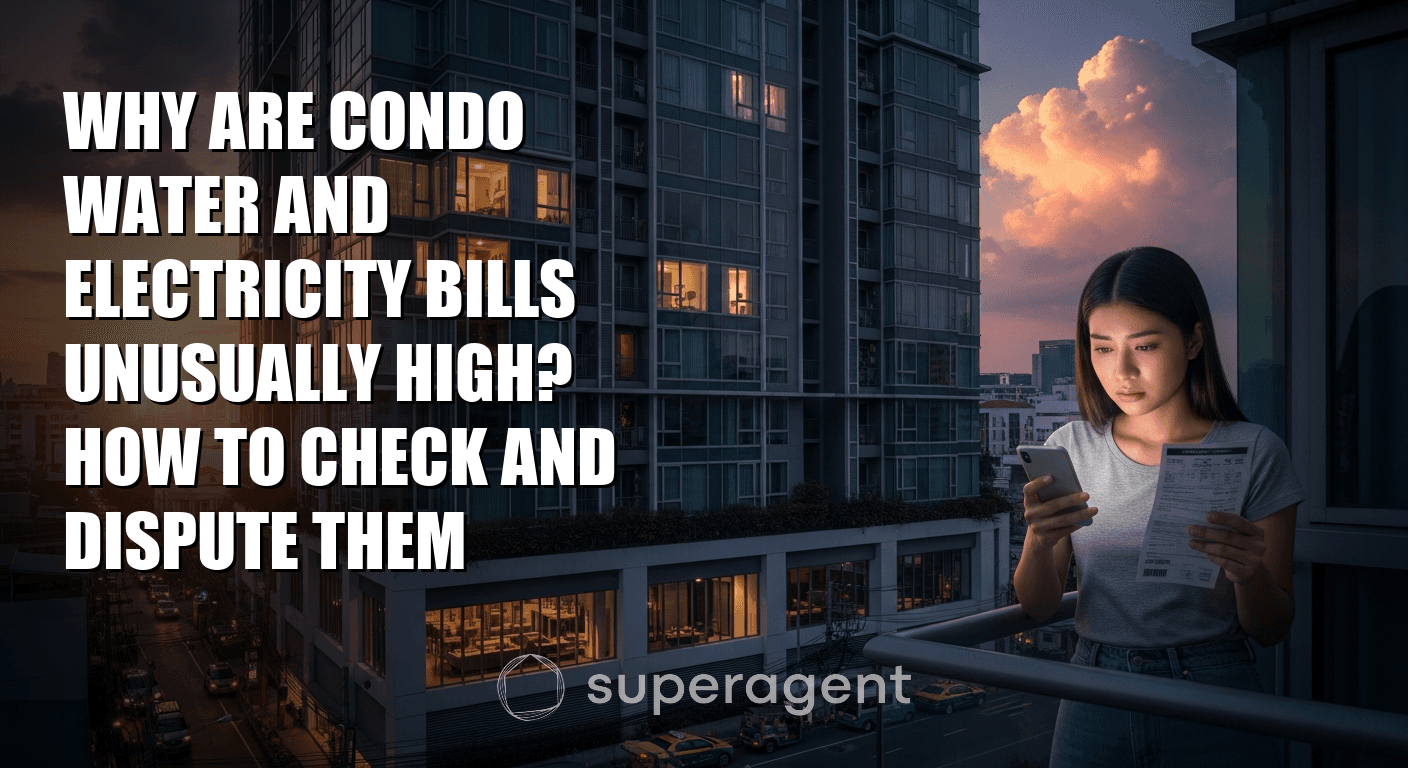
Why Are Condo Water and Electricity Bills Unusually High? How to Check and Dispute Them
Learn how to verify inflated utility bills and dispute overcharges with your condo management.
Summary
Discover why condo water and electricity bills spike unexpectedly and get practical steps to challenge inflated charges with management.
You just opened your condo utility bill and nearly fell off your chair. The water and electricity charges are double what you expected, and you have no idea why. Welcome to one of Bangkok's most frustrating rental experiences. Whether you're living in a 30,000 baht one-bedroom near BTS Thonglor or a 50,000 baht two-bedroom in Sukhumvit Soi 39, unexpectedly high utility bills hit everyone sooner or later.
The thing is, you're not crazy. And you're probably not paying more just because you left the air conditioner running. There are real reasons why condo utility bills spike, some legitimate and some definitely not. Let's walk through exactly what to check and how to push back when the numbers don't add up.
Why Are Your Water and Electricity Bills So High?
First, understand that condo utilities in Bangkok work differently from standalone houses. Most condos add a management fee to your actual usage, plus communal charges for hallway lighting, water pumps, and security systems. Your personal meter shows what you use, but the building's system adds extra costs on top.
A friend renting in Ploenchit recently got a bill for 4,500 baht when his average was 2,800 baht. Turns out the building had upgraded the water filtration system and buried the extra charge in the utility bill without clear notification. That's not uncommon. Other common culprits include failed door sensors on individual units that cause the air conditioning to work harder, or leaking pipes in shared walls that the building charges back to residents.
Sometimes the spike is actually your fault. Did you have guests visiting for a week? Did you run the washing machine more often? Did the AC run nonstop because you forgot to close the balcony door? Those things genuinely cost more money. But if nothing changed in your habits, the problem is elsewhere.
Check Your Meter Reading First
Before you complain to anyone, walk to your apartment and look at your actual meter. Take a photo with today's date. Then compare it to what's on your bill. In Bangkok condos, meters are usually located in a utility room on your floor or in a common area near the main electrical panel.
Many buildings still use manual meter reading, which means someone walks around with a clipboard and writes down numbers. These people are human. They make mistakes. They sometimes estimate. They sometimes read the wrong unit. I've seen someone in a Wireless-area condo get charged for another unit's meter reading for three months straight because the numbers got flipped around.
If your meter shows 5,234 units but your bill says 5,634, that's a 400-unit difference that shouldn't exist. Document this immediately with a photo. This is your strongest argument later.
Request a Meter Check from Building Management
Go to the building office with your photos and your last three bills. Ask them to send a technician to verify your meter is working correctly. Don't demand anything yet. Just ask. Buildings are required to provide this service, though some move slowly.
A digital meter that's malfunctioning can register phantom usage that doesn't match your actual consumption. A condo near Emporium found that residents on the 15th floor were being charged for phantom water usage because the building's meter had a faulty calibration. Once they replaced it, everyone's bills dropped 30 percent.
Most professional buildings will do this check within five to seven working days. Some will charge a small fee, around 500 to 1,000 baht. Pay it if asked. It's better than overpaying for months.
Understand the Building's Charge Breakdown
Your bill should show three separate charges: your personal meter usage, maintenance fees, and common area charges. Read each line carefully. Common area charges might be labeled as "building water," "pump fee," "waste water," or "common electricity."
These shared charges can legitimately go up when the building makes improvements. New LED lighting in hallways costs money. Water treatment system upgrades cost money. But buildings should notify residents in advance or at minimum explain the increase on the bill itself.
One resident in a Sathorn condo got a 2,000 baht increase with zero explanation. When she called the office, they said the building had installed a new backup generator and the monthly cost was split among all 150 units. This is fair, but it should have been communicated. If your building charges you without explaining why, ask for a detailed breakdown in writing.
Dispute and Negotiate the Bill
If your meter reading is correct but the charges still seem high, submit a formal written complaint to the building management. Email is best because you have a record. Keep it simple. State the dates, the amount you're disputing, and ask them to explain it within seven days.
Most buildings will respond. Some will issue a credit if they find an error. Some won't. If you get no response or a non-answer, that's when things get harder. Thai law technically protects renters from being overcharged, but enforcement is weak unless you're willing to escalate it through the Thailand Consumer Protection Board or take it to small claims court.
For most people, it's not worth that hassle. Instead, use the disputed bill as leverage in your next rent negotiation. If you've been in your place for a year and you suddenly got an unfair charge, mention it when discussing renewal. Good landlords will push back against their building's accounting on your behalf.
Practical Ways to Reduce Future Bills
Beyond fighting high bills, prevent them from happening. Use a power strip for your TV and cable box. Turn off the AC when you're not home. Take shorter showers. These matter, but they only control about 30 percent of your charge. The other 70 percent comes from building systems and communal usage that you can't control.
Keep copies of all your bills. Over time, you'll spot patterns. If every August is 40 percent higher, it's probably the AC season. If every April spikes, maybe the building is doing maintenance. Knowing the pattern helps you spot actual anomalies.
If you're looking for a new place and concerned about utilities, ask the current tenants what they typically pay. A building in Petchburi should have similar bills to another in Petchburi. If one is significantly higher without explanation, that's a red flag about management or meter accuracy.
High utility bills in Bangkok condos happen to almost everyone at some point. The key is staying calm, checking your facts first, and then pushing back with documentation. You have more power than you think, especially if you can prove the building made an error. Keep records, ask questions, and don't accept vague explanations. When you're searching for your next condo on Superagent.co, you'll have better information to spot which buildings manage their utilities fairly and which ones don't.
You just opened your condo utility bill and nearly fell off your chair. The water and electricity charges are double what you expected, and you have no idea why. Welcome to one of Bangkok's most frustrating rental experiences. Whether you're living in a 30,000 baht one-bedroom near BTS Thonglor or a 50,000 baht two-bedroom in Sukhumvit Soi 39, unexpectedly high utility bills hit everyone sooner or later.
The thing is, you're not crazy. And you're probably not paying more just because you left the air conditioner running. There are real reasons why condo utility bills spike, some legitimate and some definitely not. Let's walk through exactly what to check and how to push back when the numbers don't add up.
Why Are Your Water and Electricity Bills So High?
First, understand that condo utilities in Bangkok work differently from standalone houses. Most condos add a management fee to your actual usage, plus communal charges for hallway lighting, water pumps, and security systems. Your personal meter shows what you use, but the building's system adds extra costs on top.
A friend renting in Ploenchit recently got a bill for 4,500 baht when his average was 2,800 baht. Turns out the building had upgraded the water filtration system and buried the extra charge in the utility bill without clear notification. That's not uncommon. Other common culprits include failed door sensors on individual units that cause the air conditioning to work harder, or leaking pipes in shared walls that the building charges back to residents.
Continue reading after that.
Looking for a condo
to rent?
Leave your name and phone. We'll follow up while you keep reading.
100% Secure
Fast Response
Free Consultation
Sometimes the spike is actually your fault. Did you have guests visiting for a week? Did you run the washing machine more often? Did the AC run nonstop because you forgot to close the balcony door? Those things genuinely cost more money. But if nothing changed in your habits, the problem is elsewhere.
Check Your Meter Reading First
Before you complain to anyone, walk to your apartment and look at your actual meter. Take a photo with today's date. Then compare it to what's on your bill. In Bangkok condos, meters are usually located in a utility room on your floor or in a common area near the main electrical panel.
Many buildings still use manual meter reading, which means someone walks around with a clipboard and writes down numbers. These people are human. They make mistakes. They sometimes estimate. They sometimes read the wrong unit. I've seen someone in a Wireless-area condo get charged for another unit's meter reading for three months straight because the numbers got flipped around.
If your meter shows 5,234 units but your bill says 5,634, that's a 400-unit difference that shouldn't exist. Document this immediately with a photo. This is your strongest argument later.
Request a Meter Check from Building Management
Go to the building office with your photos and your last three bills. Ask them to send a technician to verify your meter is working correctly. Don't demand anything yet. Just ask. Buildings are required to provide this service, though some move slowly.
A digital meter that's malfunctioning can register phantom usage that doesn't match your actual consumption. A condo near Emporium found that residents on the 15th floor were being charged for phantom water usage because the building's meter had a faulty calibration. Once they replaced it, everyone's bills dropped 30 percent.
Most professional buildings will do this check within five to seven working days. Some will charge a small fee, around 500 to 1,000 baht. Pay it if asked. It's better than overpaying for months.
Understand the Building's Charge Breakdown
Your bill should show three separate charges: your personal meter usage, maintenance fees, and common area charges. Read each line carefully. Common area charges might be labeled as "building water," "pump fee," "waste water," or "common electricity."
These shared charges can legitimately go up when the building makes improvements. New LED lighting in hallways costs money. Water treatment system upgrades cost money. But buildings should notify residents in advance or at minimum explain the increase on the bill itself.
One resident in a Sathorn condo got a 2,000 baht increase with zero explanation. When she called the office, they said the building had installed a new backup generator and the monthly cost was split among all 150 units. This is fair, but it should have been communicated. If your building charges you without explaining why, ask for a detailed breakdown in writing.
Dispute and Negotiate the Bill
If your meter reading is correct but the charges still seem high, submit a formal written complaint to the building management. Email is best because you have a record. Keep it simple. State the dates, the amount you're disputing, and ask them to explain it within seven days.
Most buildings will respond. Some will issue a credit if they find an error. Some won't. If you get no response or a non-answer, that's when things get harder. Thai law technically protects renters from being overcharged, but enforcement is weak unless you're willing to escalate it through the Thailand Consumer Protection Board or take it to small claims court.
Continue reading after that.
Looking for a condo
to rent?
Leave your name and phone. We'll follow up while you keep reading.
100% Secure
Fast Response
Free Consultation
For most people, it's not worth that hassle. Instead, use the disputed bill as leverage in your next rent negotiation. If you've been in your place for a year and you suddenly got an unfair charge, mention it when discussing renewal. Good landlords will push back against their building's accounting on your behalf.
Practical Ways to Reduce Future Bills
Beyond fighting high bills, prevent them from happening. Use a power strip for your TV and cable box. Turn off the AC when you're not home. Take shorter showers. These matter, but they only control about 30 percent of your charge. The other 70 percent comes from building systems and communal usage that you can't control.
Keep copies of all your bills. Over time, you'll spot patterns. If every August is 40 percent higher, it's probably the AC season. If every April spikes, maybe the building is doing maintenance. Knowing the pattern helps you spot actual anomalies.
If you're looking for a new place and concerned about utilities, ask the current tenants what they typically pay. A building in Petchburi should have similar bills to another in Petchburi. If one is significantly higher without explanation, that's a red flag about management or meter accuracy.
High utility bills in Bangkok condos happen to almost everyone at some point. The key is staying calm, checking your facts first, and then pushing back with documentation. You have more power than you think, especially if you can prove the building made an error. Keep records, ask questions, and don't accept vague explanations. When you're searching for your next condo on Superagent.co, you'll have better information to spot which buildings manage their utilities fairly and which ones don't.
Share this article
Properties you may like
![[For Rent] CONDO I Las Colinas Condominium I 2 Beds I 3 Baths I 85,000THB/mo](/_next/image?url=https%3A%2F%2Fstorage.googleapis.com%2Fsuperagent-web%2Fattachments%2Flistings%2F6828%2F80f345c4-488e-43b2-b017-c9fbb17b520d-99486dd8-4237-4ba2-9207-01ce4f66b21f-media.jpg&w=3840&q=75)
฿85,000
2 Bed3170 sqm
[For Rent] CONDO I Las Colinas Condominium I 2 Beds I 3 Baths I 85,000THB/mo
Asoke
Condo![[For Rent] CONDO I Ashton Asoke I 1 Bed I 1 Bath I 30,000THB/mo](/_next/image?url=https%3A%2F%2Fstorage.googleapis.com%2Fsuperagent-web%2Fattachments%2Flistings%2F6876%2Fb7ce9bbe-f877-4ff5-bb54-8ad0026db940-1272-4.jpg&w=3840&q=75)
฿30,000
1 Bed135 sqm
[For Rent] CONDO I Ashton Asoke I 1 Bed I 1 Bath I 30,000THB/mo
Asoke
Condo![[For Rent] CONDO I Skyrise Avenue Sukhumvit 64 I 2 Beds I 2 Baths I 27,000THB/mo](/_next/image?url=https%3A%2F%2Fstorage.googleapis.com%2Fsuperagent-web%2Fattachments%2Flistings%2F2001%2F670f91de-c251-4e81-971c-8e30ed2158cd-screenshot-2026-07-05-at-11.38.53-pm.png&w=3840&q=75)
฿27,000
2 Bed252 sqm
[For Rent] CONDO I Skyrise Avenue Sukhumvit 64 I 2 Beds I 2 Baths I 27,000THB/mo
Punnawithi
Condo![[For Rent] CONDO I Park Origin Ratchathewi I Duplex I 2 Beds I 1 Bath I 32,000THB/mo](/_next/image?url=https%3A%2F%2Fstorage.googleapis.com%2Fsuperagent-web%2Fattachments%2Flistings%2F6896%2Fb79a7d21-7533-4b0d-bb19-762ebfafab62-1318-6.jpg&w=3840&q=75)
฿32,000
2 Bed135.9 sqm
[For Rent] CONDO I Park Origin Ratchathewi I Duplex I 2 Beds I 1 Bath I 32,000THB/mo
Ratchathewi
Condo![[For Rent] CONDO I Park Origin Phayathai I Studio I 1 Bath I 28,000THB/mo](/_next/image?url=https%3A%2F%2Fstorage.googleapis.com%2Fsuperagent-web%2Fattachments%2Flistings%2F6757%2Fb226df93-94c6-46fa-aeba-ebfadc7f81b8-1000006042.jpg&w=3840&q=75)
฿28,000
Studio129 sqm
[For Rent] CONDO I Park Origin Phayathai I Studio I 1 Bath I 28,000THB/mo
Phaya Thai
Condo![[For Rent] CONDO I Ideo Mobi Sukhumvit 81 I Duplex I 1 Bed I 1 Bath I 28,000THB/mo](/_next/image?url=https%3A%2F%2Fstorage.googleapis.com%2Fsuperagent-web%2Fattachments%2Flistings%2F1849%2Fc8b2c033-3b5f-4615-b2b0-4972f40141f0-705-13.jpg&w=3840&q=75)
฿28,000
1 Bed143 sqm
[For Rent] CONDO I Ideo Mobi Sukhumvit 81 I Duplex I 1 Bed I 1 Bath I 28,000THB/mo
On Nut
Condo![[For Rent] CONDO I Siamese Sukhumvit 48 I 1 Bed I 1 Bath I 28,000THB/mo](/_next/image?url=https%3A%2F%2Fstorage.googleapis.com%2Fsuperagent-web%2Fattachments%2Flistings%2F6841%2Febc2dce2-2e9b-4e6d-a01c-0cfa619dfa13-1231-6.jpg&w=3840&q=75)
฿28,000
1 Bed144 sqm
[For Rent] CONDO I Siamese Sukhumvit 48 I 1 Bed I 1 Bath I 28,000THB/mo
Condo![[For Rent] CONDO I Ashton Asoke I 1 Bed I 1 Bath I 22,000THB/mo](/_next/image?url=https%3A%2F%2Fstorage.googleapis.com%2Fsuperagent-web%2Fattachments%2Flistings%2F6802%2Fe06b9b73-1207-414a-ab04-1685de0c7eaa-20220808_153124_0.jpg&w=3840&q=75)
฿22,000
1 Bed134 sqm
[For Rent] CONDO I Ashton Asoke I 1 Bed I 1 Bath I 22,000THB/mo
Asoke
Condo![[For Rent] CONDO I HQ Thonglor Soi 4 I 1 Bed I 1 Bath I 35,000 THB/mo](/_next/image?url=https%3A%2F%2Fstorage.googleapis.com%2Fsuperagent-web%2Fattachments%2Flistings%2F1445%2F72352585-1bc2-41a8-bd62-ddcbf8189fe9-376-5.jpg&w=3840&q=75)
฿35,000
1 Bed143.6 sqm
[For Rent] CONDO I HQ Thonglor Soi 4 I 1 Bed I 1 Bath I 35,000 THB/mo
Thonglor
Condo![[For Rent] CONDO I The Master Centrium Asoke - Sukhumvit I Duplex I 2 Beds I 3 Baths I 75,000 THB/mo](/_next/image?url=https%3A%2F%2Fstorage.googleapis.com%2Fsuperagent-web%2Fattachments%2Flistings%2F1545%2F97932b6a-c358-45e4-b5f9-995dbf5a3cf0-441-2.jpg&w=3840&q=75)
฿75,000
2 Bed3150 sqm
[For Rent] CONDO I The Master Centrium Asoke - Sukhumvit I Duplex I 2 Beds I 3 Baths I 75,000 THB/mo
Asoke
CondoMore like this
 In Guides · Superagent EditorialHidden Costs of Renting a Condo in Bangkok Nobody Warns You AboutBangkok condo rent looks affordable until month one hits. Here are the real costs beyond the headline figure that catch most renters off guard.25 May 20261 min read
 In Guides · Superagent EditorialWhat a Long-Vacant Bangkok Condo Unit Is Actually Telling YouA Bangkok condo vacant for months signals overpricing, landlord issues, or real problems. Here is how to read the signs.25 May 20261 min read
 In Guides · Superagent EditorialRed Flags in a Bangkok Rental Contract to Watch Out ForBangkok rental contracts often hide risky clauses. Here are the red flags every tenant must catch before signing any lease.25 May 20261 min read
 In Guides · Superagent EditorialWorking Online from a Condo: How to Choose the Perfect Room for ProductivityLearn how to choose the best condo room for working online with tips on lighting, noise, and furniture setup to maximize productivity.9 May 20261 min read