Why Renting Near a BTS Station in Bangkok Is Worth the Extra Cost
Guides
Why Renting Near a BTS Station in Bangkok Is Worth the Extra Cost
Living steps from Bangkok's Skytrain pays off in time, money, and quality of life.
Summary
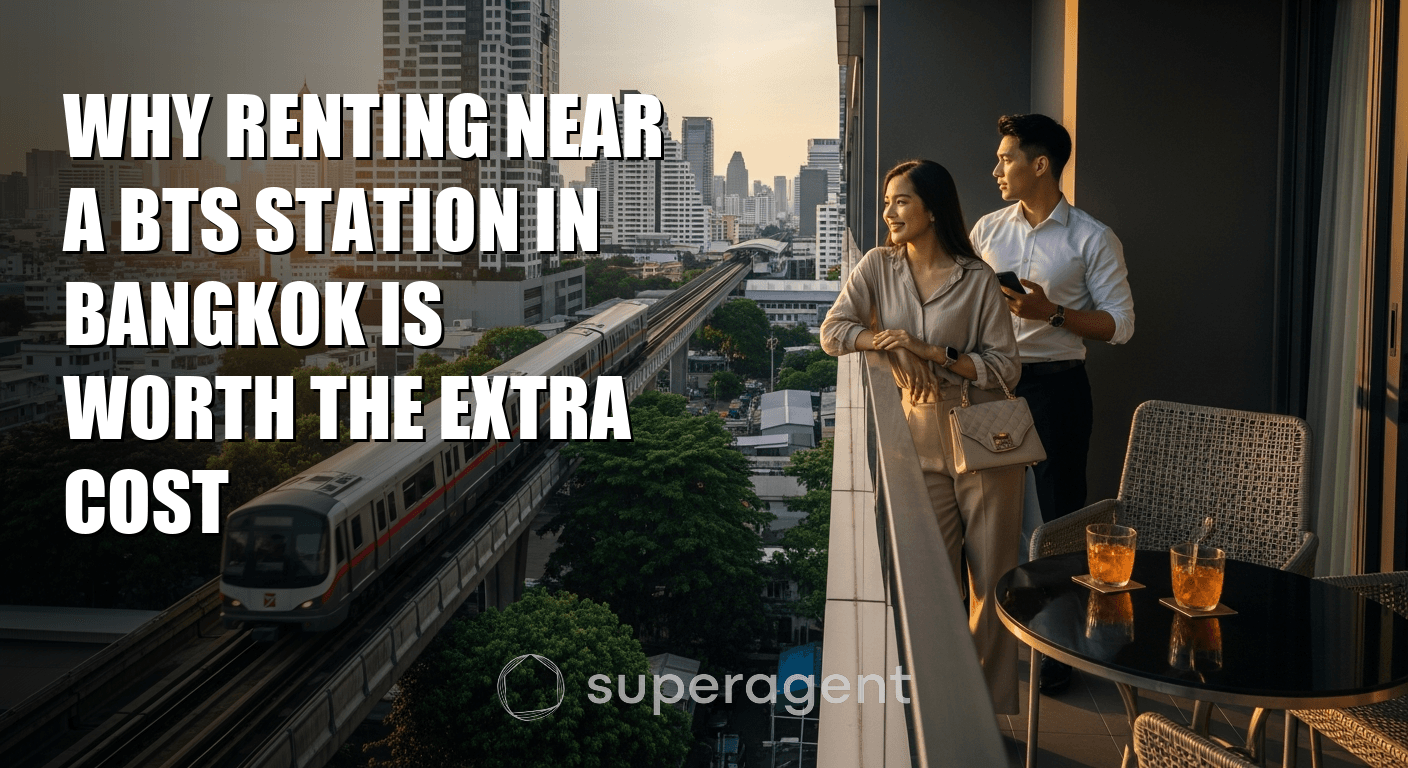
Renting near a BTS station in Bangkok means lower commute costs, less traffic stress, and higher resale appeal, here's why it's worth it.
Renting near a BTS or MRT station is not just a convenience. For most people working in central Bangkok, it is one of the most financially smart decisions you can make, even if the monthly rent runs 3,000 to 5,000 baht higher.
Here is why.
The True Cost of a Long Commute
Bangkok traffic is not a minor inconvenience. It is a daily tax on your time, money, and sanity. The average commute for someone living off the main transit lines, say in parts of Lat Phrao or Ratchada without direct BTS access, can easily run 90 minutes each way during peak hours.
Add up the Grab rides, the occasional taxi, the fuel if you drive, and the tolls. A resident taking two BTS trips daily spends around 2,400 to 3,000 baht per month in fares. Someone driving from a cheaper apartment near Srinakarin Road might spend 5,000 to 8,000 baht on fuel and tolls alone, and still arrive late.
Take Aspire Sukhumvit 48, right beside Phra Khanong BTS. A one-bedroom starts around 18,000 baht a month. A comparable unit three kilometers away in a non-connected building might be 14,000. Once you factor commute costs across 12 months, the cheaper unit is actually the more expensive one.
BTS Proximity Protects Your Time, and That Has Real Value
Bangkok moves fast. If you work in marketing, tech, finance, or hospitality, being 10 minutes from Asok or Chit Lom versus 45 minutes away from the same stations changes your whole day.
You sleep longer, eat breakfast at home, and actually make evening plans without arriving exhausted. The mental overhead of a long Bangkok commute, especially during the June-to-October wet season when flooding on Rama IV or Sukhumvit Soi 39 adds 30 unpredictable minutes, is genuinely underrated.
Someone renting at Ivy Ampio near Ratchadaphisek MRT can reach Asok in under 15 minutes and Chatuchak Park station in 12. No transfers, no traffic. That person has effectively reclaimed one to one-and-a-half hours per day compared to someone commuting in from a remote part of Bang Na.
Flexibility When Your Plans Change
Longer leases and subleasing are increasingly common in Bangkok, and BTS-adjacent units hold their demand through all of it. Landlords know this, so they maintain properties better and are less likely to suddenly push you out when the building sells or changes hands.
If you ever need to find a replacement tenant because of a job change or extended travel, a unit like Chapter One Midtown Asok or The Line Asok-Ratchada is far easier to relist than something ten minutes from the nearest main road. Demand is constant, and turnaround is fast.
Landlords near transit stations also tend to be more experienced. Higher tenant demand means they have managed more situations, negotiate more reasonably, and are often flexible on lease terms because they know the unit will not sit vacant.
What "BTS Walkable" Actually Means in Bangkok
In Bangkok, "BTS walkable" can mean very different things. Five minutes from Ekkamai BTS is genuinely a comfortable walk. Five minutes from On Nut BTS might mean a 500-meter path that floods in heavy rain and disappears into a car park halfway through.
Always check the actual walking route, not just the map distance. Some buildings on Sukhumvit Soi 71 claim Phra Khanong BTS proximity, but the walk involves a busy unsheltered intersection and a footpath that soaks through in a 20-minute downpour. Meanwhile, Lumpini Suite Dindaeng-Ratchaprarop near Ratchaprarop ARL station has covered access and is genuinely quick on a rainy Tuesday morning.
Asking "how many meters from the station" is less useful than asking "how many minutes door-to-platform in bad weather." That is the real number that should drive your decision.
Areas That Offer the Best Value Right Now
The sweet spot in Bangkok for price-to-transit value right now is not the obvious places. Silom, Phrom Phong, and Thong Lo are expensive, and you are paying for prestige as much as access.
Look instead at stations on the outer Sukhumvit Line extension, particularly Udom Suk and Bearing. A one-bedroom near Udom Suk BTS in a building like IDEO Mobi Sukhumvit Eastpoint can be found in the 16,000 to 20,000 baht range, with a direct BTS connection to Asok in under 20 minutes. No expressway, no drama.
On the extended BTS Silom Line, Talat Phlu and Bang Wa stations are genuinely worth a look. The area stays affordable, often 13,000 to 17,000 baht for a decent one-bedroom, with direct BTS access into Silom in 20 to 25 minutes. Five years ago this corridor felt remote. Today it is connected, served by good street food and markets on Ratchaphruek Road, and growing steadily.
The key is knowing which new connections actually changed the math. Bangkok's transit network has expanded a lot, and some stations that felt distant two years ago are now legitimately central.
Choosing where to rent in Bangkok is one of the bigger financial decisions you will make while living here. The sticker price on a listing tells you less than you think. What matters is total cost: rent, commute, time, and stress. Near a good BTS or MRT station, all of those numbers tend to work out better, even when the rent itself looks higher.
If you want to compare condos near specific stations with real pricing and transit times, Superagent lets you search Bangkok rentals by BTS and MRT proximity, with filters built for the way people actually choose where to live.
Written by the Superagent editorial team. Superagent is Bangkok's AI-powered condo rental platform, helping expats and locals find the right rental faster. superagent.co
Related articles
Renting near a BTS or MRT station is not just a convenience. For most people working in central Bangkok, it is one of the most financially smart decisions you can make, even if the monthly rent runs 3,000 to 5,000 baht higher.
Here is why.
The True Cost of a Long Commute
Bangkok traffic is not a minor inconvenience. It is a daily tax on your time, money, and sanity. The average commute for someone living off the main transit lines, say in parts of Lat Phrao or Ratchada without direct BTS access, can easily run 90 minutes each way during peak hours.
Add up the Grab rides, the occasional taxi, the fuel if you drive, and the tolls. A resident taking two BTS trips daily spends around 2,400 to 3,000 baht per month in fares. Someone driving from a cheaper apartment near Srinakarin Road might spend 5,000 to 8,000 baht on fuel and tolls alone, and still arrive late.
Take Aspire Sukhumvit 48, right beside Phra Khanong BTS. A one-bedroom starts around 18,000 baht a month. A comparable unit three kilometers away in a non-connected building might be 14,000. Once you factor commute costs across 12 months, the cheaper unit is actually the more expensive one.
BTS Proximity Protects Your Time, and That Has Real Value
Bangkok moves fast. If you work in marketing, tech, finance, or hospitality, being 10 minutes from Asok or Chit Lom versus 45 minutes away from the same stations changes your whole day.
Continue reading after that.
Looking for a condo
to rent?
Leave your name and phone. We'll follow up while you keep reading.
100% Secure
Fast Response
Free Consultation
You sleep longer, eat breakfast at home, and actually make evening plans without arriving exhausted. The mental overhead of a long Bangkok commute, especially during the June-to-October wet season when flooding on Rama IV or Sukhumvit Soi 39 adds 30 unpredictable minutes, is genuinely underrated.
Someone renting at Ivy Ampio near Ratchadaphisek MRT can reach Asok in under 15 minutes and Chatuchak Park station in 12. No transfers, no traffic. That person has effectively reclaimed one to one-and-a-half hours per day compared to someone commuting in from a remote part of Bang Na.
Flexibility When Your Plans Change
Longer leases and subleasing are increasingly common in Bangkok, and BTS-adjacent units hold their demand through all of it. Landlords know this, so they maintain properties better and are less likely to suddenly push you out when the building sells or changes hands.
If you ever need to find a replacement tenant because of a job change or extended travel, a unit like Chapter One Midtown Asok or The Line Asok-Ratchada is far easier to relist than something ten minutes from the nearest main road. Demand is constant, and turnaround is fast.
Landlords near transit stations also tend to be more experienced. Higher tenant demand means they have managed more situations, negotiate more reasonably, and are often flexible on lease terms because they know the unit will not sit vacant.
What "BTS Walkable" Actually Means in Bangkok
In Bangkok, "BTS walkable" can mean very different things. Five minutes from Ekkamai BTS is genuinely a comfortable walk. Five minutes from On Nut BTS might mean a 500-meter path that floods in heavy rain and disappears into a car park halfway through.
Always check the actual walking route, not just the map distance. Some buildings on Sukhumvit Soi 71 claim Phra Khanong BTS proximity, but the walk involves a busy unsheltered intersection and a footpath that soaks through in a 20-minute downpour. Meanwhile, Lumpini Suite Dindaeng-Ratchaprarop near Ratchaprarop ARL station has covered access and is genuinely quick on a rainy Tuesday morning.
Asking "how many meters from the station" is less useful than asking "how many minutes door-to-platform in bad weather." That is the real number that should drive your decision.
Areas That Offer the Best Value Right Now
The sweet spot in Bangkok for price-to-transit value right now is not the obvious places. Silom, Phrom Phong, and Thong Lo are expensive, and you are paying for prestige as much as access.
Look instead at stations on the outer Sukhumvit Line extension, particularly Udom Suk and Bearing. A one-bedroom near Udom Suk BTS in a building like IDEO Mobi Sukhumvit Eastpoint can be found in the 16,000 to 20,000 baht range, with a direct BTS connection to Asok in under 20 minutes. No expressway, no drama.
Continue reading after that.
Looking for a condo
to rent?
Leave your name and phone. We'll follow up while you keep reading.
100% Secure
Fast Response
Free Consultation
On the extended BTS Silom Line, Talat Phlu and Bang Wa stations are genuinely worth a look. The area stays affordable, often 13,000 to 17,000 baht for a decent one-bedroom, with direct BTS access into Silom in 20 to 25 minutes. Five years ago this corridor felt remote. Today it is connected, served by good street food and markets on Ratchaphruek Road, and growing steadily.
The key is knowing which new connections actually changed the math. Bangkok's transit network has expanded a lot, and some stations that felt distant two years ago are now legitimately central.
Choosing where to rent in Bangkok is one of the bigger financial decisions you will make while living here. The sticker price on a listing tells you less than you think. What matters is total cost: rent, commute, time, and stress. Near a good BTS or MRT station, all of those numbers tend to work out better, even when the rent itself looks higher.
If you want to compare condos near specific stations with real pricing and transit times, Superagent lets you search Bangkok rentals by BTS and MRT proximity, with filters built for the way people actually choose where to live.
Written by the Superagent editorial team. Superagent is Bangkok's AI-powered condo rental platform, helping expats and locals find the right rental faster. superagent.co
Related articles
Share this article
Properties you may like
More like this
 In Guides · Superagent EditorialHidden Costs of Renting a Condo in Bangkok Nobody Warns You AboutBangkok condo rent looks affordable until month one hits. Here are the real costs beyond the headline figure that catch most renters off guard.25 May 20261 min read
 In Guides · Superagent EditorialWhat a Long-Vacant Bangkok Condo Unit Is Actually Telling YouA Bangkok condo vacant for months signals overpricing, landlord issues, or real problems. Here is how to read the signs.25 May 20261 min read
 In Guides · Superagent EditorialRed Flags in a Bangkok Rental Contract to Watch Out ForBangkok rental contracts often hide risky clauses. Here are the red flags every tenant must catch before signing any lease.25 May 20261 min read
 In Guides · Superagent EditorialWorking Online from a Condo: How to Choose the Perfect Room for ProductivityLearn how to choose the best condo room for working online with tips on lighting, noise, and furniture setup to maximize productivity.9 May 20261 min read