Air Purifiers for Bangkok Condos: Do You Need One and Which to Buy?
Lifestyle
Air Purifiers for Bangkok Condos: Do You Need One and Which to Buy?
Protect your health with the right Bangkok condo air filter for clean indoor air year-round.
Summary
Learn whether Bangkok condo air filters are essential for your home and discover the best models to combat pollution and allergens effectively.
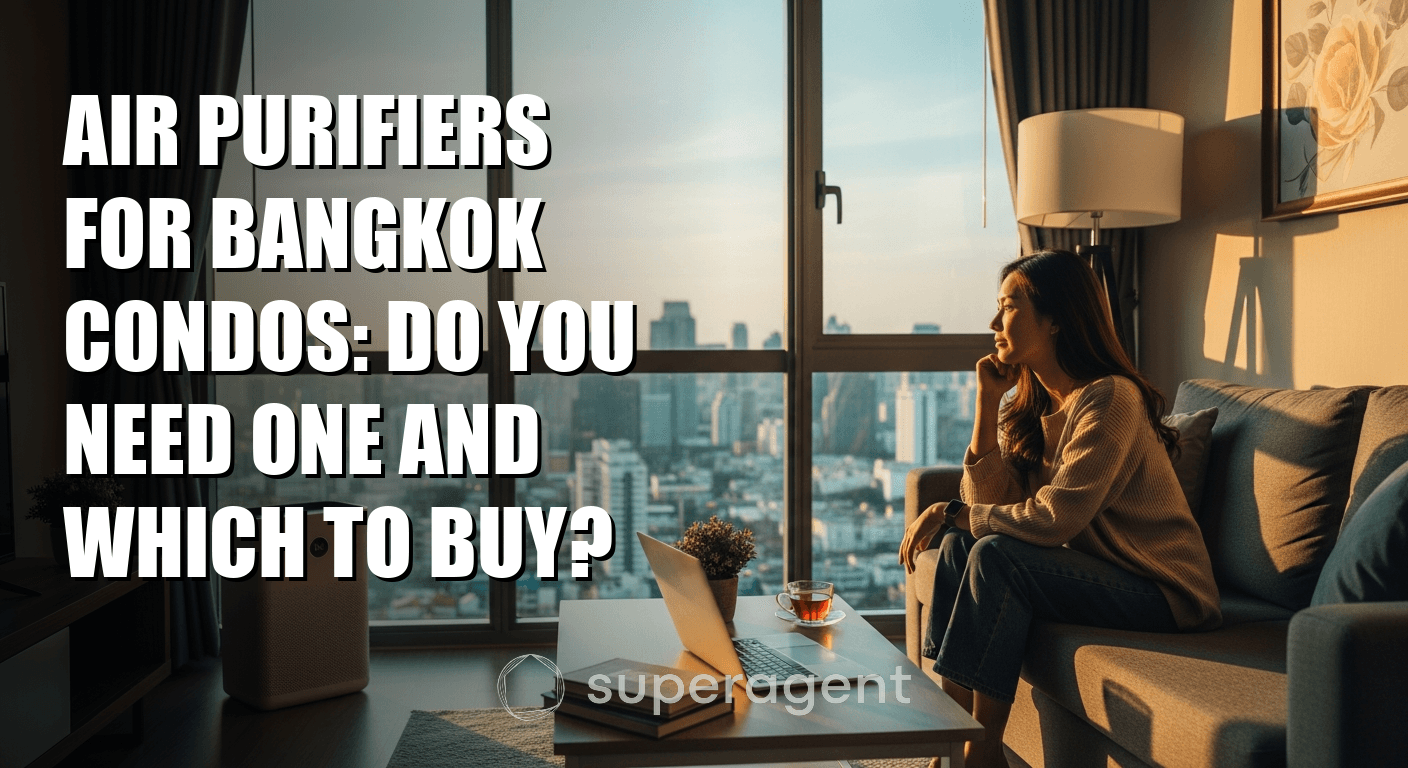
If you've ever woken up in Bangkok during burning season, looked out your condo window, and seen nothing but a gray wall of haze where the skyline should be, you already know the answer to this question. Yes, you probably need an air purifier. Between January and April, Bangkok's PM2.5 readings regularly blow past WHO safe limits, sometimes hitting five or six times the recommended level. And even outside burning season, traffic exhaust, construction dust, and the general hum of a megacity keep the air quality far from pristine.
Living in a condo doesn't automatically protect you either. Older buildings along Sukhumvit or near busy intersections like Asok or Victory Monument have gaps around windows, aging seals, and ventilation systems that pull in outside air without filtering it. So let's talk about what actually works, what's worth your money, and how to pick the right purifier for your Bangkok rental.
Why Bangkok's Air Quality Is a Real Problem for Condo Renters
Bangkok consistently ranks among the most polluted cities in Southeast Asia during the first quarter of the year. The main culprit is PM2.5, tiny particulate matter that can pass through your lungs and into your bloodstream. During peak pollution weeks, areas near major roads like Ratchadaphisek, Rama IV, and Silom regularly exceed 100 on the AQI scale. That's "unhealthy for sensitive groups" territory, and sometimes it pushes well into "unhealthy for everyone."
A friend of mine rents a 35 sqm studio at Life Asoke Hype near MRT Phetchaburi for about 18,000 THB per month. Great location, solid building. But her unit faces the expressway ramp, and during February she noticed a fine layer of dark dust on her white desk every single morning. She bought a cheap ionizer from Lazada. It did almost nothing. That's because not all purifiers are built the same, and Bangkok's pollution demands a specific type of filtration.
HEPA Filters: The Only Type That Actually Matters Here
When shopping for a bangkok condo air filter, the single most important spec to look for is a True HEPA filter, sometimes labeled H13 or H14. These capture 99.97% of particles down to 0.3 microns, which includes the PM2.5 particles that cause the most health damage. Anything labeled "HEPA type" or "HEPA style" is marketing fluff and won't give you the same protection.
Activated carbon filters are a nice bonus. They handle odors, VOCs from new furniture, and the cooking smells that drift through condo hallways. If you've ever lived in a building near a street food strip, say along Soi Rangnam near BTS Victory Monument, you know exactly what that means. But carbon alone won't save your lungs. HEPA is non negotiable.
Skip the ionizers and ozone generators entirely. Ionizers make particles stick to your walls and furniture instead of truly removing them. Ozone generators can actually irritate your respiratory system, which defeats the whole purpose.
Best Air Purifiers for Bangkok Condos by Room Size
For a typical studio or one bedroom condo between 25 and 45 sqm, these are the models that expats and locals in Bangkok actually buy and recommend.
The Xiaomi Smart Air Purifier 4 is the most popular budget option, usually around 4,500 to 5,500 THB at Power Buy or on Lazada. It covers up to 48 sqm, has app control, and replacement filters cost about 800 THB every six months. It's not the quietest on its highest setting, but for the price, it's hard to beat.
The Blueair Blue 3210 is a step up at around 6,500 to 8,000 THB. It's whisper quiet, looks great in a modern condo, and handles rooms up to 26 sqm efficiently. Perfect for a studio at a place like Ideo Mobi Sukhumvit near BTS On Nut where units tend to run 28 to 32 sqm.
For larger two bedroom condos, say 60 to 80 sqm units at places like The Base Park West near BTS On Nut renting for 25,000 to 35,000 THB per month, consider the Coway Airmega 200M or the Xiaomi 4 Pro. Both handle bigger spaces and run around 8,000 to 12,000 THB.
Placement Tips and Rental Friendly Tricks
Where you put your purifier matters almost as much as which one you buy. Place it in the room where you spend the most time, usually the bedroom. Keep it at least 30 cm from walls so air can circulate properly. And keep your windows closed when the AQI is above 50, which you can check in real time with the IQAir app or AirVisual.
One practical trick for renters: buy weather stripping tape from HomePro or MR.DIY for about 50 to 100 THB per roll. Apply it around your window frames and sliding door seals. This stops polluted air from leaking in and makes your purifier dramatically more effective. It peels off cleanly when you move out, so your landlord won't mind.
A couple I know renting a two bedroom at Lumpini Suite Phetchaburi near MRT Makkasan did this plus ran their Xiaomi purifier on auto mode. Their indoor PM2.5 readings dropped from 80 to under 10 within an hour. That's the difference between breathing highway air and breathing mountain air.
Do You Really Need One Year Round?
Honestly, from May through November, Bangkok's air quality improves a lot. Monsoon rains wash the particulates out of the sky and AQI readings often sit in the 20 to 40 range, which is perfectly fine. During those months you can run your purifier on low or turn it off entirely.
But from December through April, it's a different story. This is when crop burning in northern Thailand and neighboring countries sends smoke drifting south, and Bangkok's own traffic and construction pollution gets trapped under still, dry air. During these months, running a purifier in your bedroom while you sleep is one of the smartest investments you can make for your health.
If you're renting and plan to stay in Bangkok for at least a year, a solid air purifier pays for itself in peace of mind alone. Budget 5,000 to 10,000 THB for the unit and another 1,500 to 2,000 THB per year for replacement filters. That's less than one month's electricity bill in most condos.
Looking for a condo with good ventilation, modern window seals, and a layout that works well with a purifier? Superagent at superagent.co helps you search Bangkok rentals with AI powered matching, so you can find the right place and breathe a little easier once you move in.
If you've ever woken up in Bangkok during burning season, looked out your condo window, and seen nothing but a gray wall of haze where the skyline should be, you already know the answer to this question. Yes, you probably need an air purifier. Between January and April, Bangkok's PM2.5 readings regularly blow past WHO safe limits, sometimes hitting five or six times the recommended level. And even outside burning season, traffic exhaust, construction dust, and the general hum of a megacity keep the air quality far from pristine.
Living in a condo doesn't automatically protect you either. Older buildings along Sukhumvit or near busy intersections like Asok or Victory Monument have gaps around windows, aging seals, and ventilation systems that pull in outside air without filtering it. So let's talk about what actually works, what's worth your money, and how to pick the right purifier for your Bangkok rental.
Why Bangkok's Air Quality Is a Real Problem for Condo Renters
Bangkok consistently ranks among the most polluted cities in Southeast Asia during the first quarter of the year. The main culprit is PM2.5, tiny particulate matter that can pass through your lungs and into your bloodstream. During peak pollution weeks, areas near major roads like Ratchadaphisek, Rama IV, and Silom regularly exceed 100 on the AQI scale. That's "unhealthy for sensitive groups" territory, and sometimes it pushes well into "unhealthy for everyone."
A friend of mine rents a 35 sqm studio at Life Asoke Hype near MRT Phetchaburi for about 18,000 THB per month. Great location, solid building. But her unit faces the expressway ramp, and during February she noticed a fine layer of dark dust on her white desk every single morning. She bought a cheap ionizer from Lazada. It did almost nothing. That's because not all purifiers are built the same, and Bangkok's pollution demands a specific type of filtration.
HEPA Filters: The Only Type That Actually Matters Here
When shopping for a bangkok condo air filter, the single most important spec to look for is a True HEPA filter, sometimes labeled H13 or H14. These capture 99.97% of particles down to 0.3 microns, which includes the PM2.5 particles that cause the most health damage. Anything labeled "HEPA type" or "HEPA style" is marketing fluff and won't give you the same protection.
Activated carbon filters are a nice bonus. They handle odors, VOCs from new furniture, and the cooking smells that drift through condo hallways. If you've ever lived in a building near a street food strip, say along Soi Rangnam near BTS Victory Monument, you know exactly what that means. But carbon alone won't save your lungs. HEPA is non negotiable.
Skip the ionizers and ozone generators entirely. Ionizers make particles stick to your walls and furniture instead of truly removing them. Ozone generators can actually irritate your respiratory system, which defeats the whole purpose.
Best Air Purifiers for Bangkok Condos by Room Size
For a typical studio or one bedroom condo between 25 and 45 sqm, these are the models that expats and locals in Bangkok actually buy and recommend.
The Xiaomi Smart Air Purifier 4 is the most popular budget option, usually around 4,500 to 5,500 THB at Power Buy or on Lazada. It covers up to 48 sqm, has app control, and replacement filters cost about 800 THB every six months. It's not the quietest on its highest setting, but for the price, it's hard to beat.
The Blueair Blue 3210 is a step up at around 6,500 to 8,000 THB. It's whisper quiet, looks great in a modern condo, and handles rooms up to 26 sqm efficiently. Perfect for a studio at a place like Ideo Mobi Sukhumvit near BTS On Nut where units tend to run 28 to 32 sqm.
For larger two bedroom condos, say 60 to 80 sqm units at places like The Base Park West near BTS On Nut renting for 25,000 to 35,000 THB per month, consider the Coway Airmega 200M or the Xiaomi 4 Pro. Both handle bigger spaces and run around 8,000 to 12,000 THB.
Talk to us about renting
Share your details and keep reading — we’ll get back to you.
Placement Tips and Rental Friendly Tricks
Where you put your purifier matters almost as much as which one you buy. Place it in the room where you spend the most time, usually the bedroom. Keep it at least 30 cm from walls so air can circulate properly. And keep your windows closed when the AQI is above 50, which you can check in real time with the IQAir app or AirVisual.
One practical trick for renters: buy weather stripping tape from HomePro or MR.DIY for about 50 to 100 THB per roll. Apply it around your window frames and sliding door seals. This stops polluted air from leaking in and makes your purifier dramatically more effective. It peels off cleanly when you move out, so your landlord won't mind.
A couple I know renting a two bedroom at Lumpini Suite Phetchaburi near MRT Makkasan did this plus ran their Xiaomi purifier on auto mode. Their indoor PM2.5 readings dropped from 80 to under 10 within an hour. That's the difference between breathing highway air and breathing mountain air.
Do You Really Need One Year Round?
Honestly, from May through November, Bangkok's air quality improves a lot. Monsoon rains wash the particulates out of the sky and AQI readings often sit in the 20 to 40 range, which is perfectly fine. During those months you can run your purifier on low or turn it off entirely.
But from December through April, it's a different story. This is when crop burning in northern Thailand and neighboring countries sends smoke drifting south, and Bangkok's own traffic and construction pollution gets trapped under still, dry air. During these months, running a purifier in your bedroom while you sleep is one of the smartest investments you can make for your health.
If you're renting and plan to stay in Bangkok for at least a year, a solid air purifier pays for itself in peace of mind alone. Budget 5,000 to 10,000 THB for the unit and another 1,500 to 2,000 THB per year for replacement filters. That's less than one month's electricity bill in most condos.
Looking for a condo with good ventilation, modern window seals, and a layout that works well with a purifier? Superagent at superagent.co helps you search Bangkok rentals with AI powered matching, so you can find the right place and breathe a little easier once you move in.
Share this article
Properties you may like
![[For Rent] CONDO I Life One Wireless I 2 Beds I 1 Bath I 40,000THB/mo](/_next/image?url=https%3A%2F%2Fstorage.googleapis.com%2Fsuperagent-web%2Fattachments%2Flistings%2F6767%2F03e11a74-9a71-44df-9493-9adc1c934047-1147-6.jpg&w=3840&q=75)
฿40,000
2 Bed145 sqm
[For Rent] CONDO I Life One Wireless I 2 Beds I 1 Bath I 40,000THB/mo
Ploenchit
Condo![[For Rent] CONDO I IDEO Mobi Charan Interchange I 2 Beds I 1 Bath I 22,000THB/mo](/_next/image?url=https%3A%2F%2Fstorage.googleapis.com%2Fsuperagent-web%2Fattachments%2Flistings%2F6766%2F23b6eb3e-caa3-400e-9bcb-c00c2c6f196b-1146-1.jpg&w=3840&q=75)
฿22,000
2 Bed145 sqm
[For Rent] CONDO I IDEO Mobi Charan Interchange I 2 Beds I 1 Bath I 22,000THB/mo
Condo![[For Rent] CONDO I Life Asoke Hype I 1 Bed I 1 Bath I 18,000THB/mo](/_next/image?url=https%3A%2F%2Fstorage.googleapis.com%2Fsuperagent-web%2Fattachments%2Flistings%2F6765%2F80b683ff-1960-428b-bbbc-37b913f8e2c3-1143-3.jpg&w=3840&q=75)
฿18,000
1 Bed126 sqm
[For Rent] CONDO I Life Asoke Hype I 1 Bed I 1 Bath I 18,000THB/mo
Asoke
Condo![[For Rent] CONDO I Witthayu Complex I Pet Friendly I 2 Beds I 1 Bath I 28,000THB/mo](/_next/image?url=https%3A%2F%2Fstorage.googleapis.com%2Fsuperagent-web%2Fattachments%2Flistings%2F6764%2F02d4c7ac-6555-4668-87da-a32133c64277-1145-1.jpg&w=3840&q=75)
฿28,000
2 Bed185 sqm
[For Rent] CONDO I Witthayu Complex I Pet Friendly I 2 Beds I 1 Bath I 28,000THB/mo
Condo![[For Rent] CONDO I Witthayu Complex I Pet Friendly I 2 Beds I 2 Baths I 35,000THB/mo](/_next/image?url=https%3A%2F%2Fstorage.googleapis.com%2Fsuperagent-web%2Fattachments%2Flistings%2F6763%2F2c2d8fb9-5284-4d27-8451-8658173f9bfb-1144-5.jpg&w=3840&q=75)
฿35,000
2 Bed295 sqm
[For Rent] CONDO I Witthayu Complex I Pet Friendly I 2 Beds I 2 Baths I 35,000THB/mo
Condo![[For Rent] CONDO I UP Ekkamai I Pet Friendly I 2 Beds I 2 Baths I 40,000THB/mo](/_next/image?url=https%3A%2F%2Fstorage.googleapis.com%2Fsuperagent-web%2Fattachments%2Flistings%2F6762%2F28ea39dc-4e7d-4dc5-b8bc-fa254e6512c6-1142-1.jpg&w=3840&q=75)
฿40,003
2 Bed260 sqm
[For Rent] CONDO I UP Ekkamai I Pet Friendly I 2 Beds I 2 Baths I 40,000THB/mo
Condo![[For Rent] CONDO I Ideo Q Phayathai I 2 Beds I 2 Baths I 50,000THB/mo](/_next/image?url=https%3A%2F%2Fstorage.googleapis.com%2Fsuperagent-web%2Fattachments%2Flistings%2F6761%2Fd56dc353-7436-451a-b407-76100af6b15f-1141-1.jpg&w=3840&q=75)
฿50,000
2 Bed275 sqm
[For Rent] CONDO I Ideo Q Phayathai I 2 Beds I 2 Baths I 50,000THB/mo
Phaya Thai
Condo![[For Rent] CONDO I Culture Chula I Duplex I 1 Bed I 1 Bath I 35,000THB/mo](/_next/image?url=https%3A%2F%2Fstorage.googleapis.com%2Fsuperagent-web%2Fattachments%2Flistings%2F6760%2F8deaff98-ecb1-4c62-b9be-aecac2f65797-1140-1.jpg&w=3840&q=75)
฿35,000
1 Bed138 sqm
[For Rent] CONDO I Culture Chula I Duplex I 1 Bed I 1 Bath I 35,000THB/mo
Siam
Condo![[For Rent] CONDO I The River Condominium I 2 Beds I 3 Baths I 55,000THB/mo](/_next/image?url=https%3A%2F%2Fstorage.googleapis.com%2Fsuperagent-web%2Fattachments%2Flistings%2F6745%2Fa48d8ae3-8857-408d-81ff-45eb890fbdb9-1000011745.jpg&w=3840&q=75)
฿55,000
2 Bed398 sqm
[For Rent] CONDO I The River Condominium I 2 Beds I 3 Baths I 55,000THB/mo
Wongwian Yai
Condo![[For Rent] CONDO I Park Origin Phayathai I Studio I 1 Bath I 28,000THB/mo](/_next/image?url=https%3A%2F%2Fstorage.googleapis.com%2Fsuperagent-web%2Fattachments%2Flistings%2F6757%2Fb226df93-94c6-46fa-aeba-ebfadc7f81b8-1000006042.jpg&w=3840&q=75)
฿28,000
Studio129 sqm
[For Rent] CONDO I Park Origin Phayathai I Studio I 1 Bath I 28,000THB/mo
Phaya Thai
CondoMore like this
 In Lifestyle · Superagent EditorialWhere Bangkok's Expat Communities Are Concentrated: Rental Guide by NationalityDiscover where Bangkok's expat community areas are located. Our rental guide maps out neighborhoods by nationality to help you find your ideal home.12 Apr 20241 min read
 In Lifestyle · Superagent EditorialThe AI Rental Revolution in Bangkok: How Technology Is Changing How Expats Find HomesBangkok rental revolution ai is reshaping how expats find homes. Explore smart technology, virtual tours, and AI-powered matching tools transforming the ma16 Apr 20211 min read
 In Lifestyle · Superagent EditorialMonthly Condo Rentals in Bangkok: Why They Beat Daily Rates Once Your Stay Passes Two WeeksCompare Bangkok daily and monthly condo rates near BTS Thong Lo, Asoke, Ari and On Nut, and see why monthly leases save tens of thousands of baht.19 Jul 20191 min read
 In Lifestyle · Superagent EditorialHow to Negotiate Rent With Thai Condo Landlords: Techniques That Actually Work in BangkokProven tactics for negotiating condo rent with Bangkok landlords, from market research and counter offers to lease length, timing and low season.18 Jul 20191 min read