Electricity Voltage in Bangkok Condos: Expat Guide to Plugs and Adapters
Lifestyle
Electricity Voltage in Bangkok Condos: Expat Guide to Plugs and Adapters
Navigate Bangkok's power standards safely with our essential adapter and outlet guide.
Summary
Learn about electricity voltage Bangkok condo standards, plug types, and adapter solutions for expats moving to Thailand's capital city.
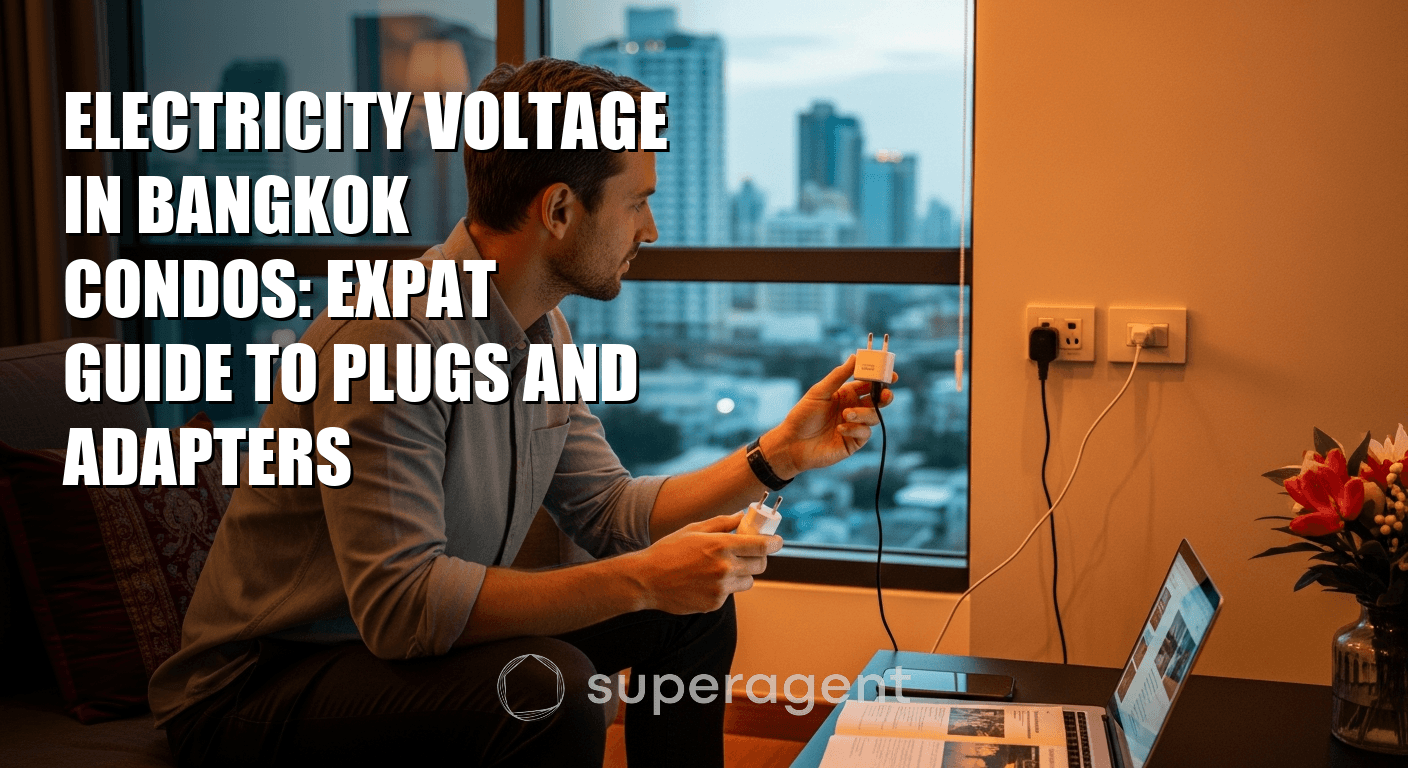
You land in Bangkok, move into your new condo near Thong Lo BTS, plug in your laptop charger, and everything works perfectly. Then you grab your hair dryer from back home in the US, switch it on, and within seconds it smells like burning plastic. Welcome to the wonderful world of electricity voltage in Bangkok condos. It catches more expats off guard than you'd think, and a five minute read now could save you from frying your favorite appliances later.
What Voltage and Frequency Does Bangkok Actually Use?
Thailand runs on 220 volts at 50 Hz. If you're coming from the US, Canada, or Japan, your home country likely uses 110 volts at 60 Hz. That difference matters a lot. Plugging a 110V appliance directly into a 220V Thai outlet can destroy it instantly, and in some cases it can even start a small fire.
If you're arriving from the UK, most of Europe, Australia, or Singapore, you're already on 220 to 240 volts. Your appliances will work fine here voltage wise. You just need to sort out the plug shape, which we'll get to in a moment.
Here's a real example. A friend moved into a one bedroom at Ideo Mobi Sukhumvit 81, paying around 18,000 THB per month near On Nut BTS. He brought his American Vitamix blender without checking the voltage label. One press of the button and it was toast. That blender cost more than two months of his rent. Don't be that person.
Plug Types You'll Find in Bangkok Condos
Bangkok condos typically have outlets that accept both Type A (two flat prongs, US style) and Type C (two round prongs, European style). Many newer buildings also have hybrid outlets that can handle Type B plugs with a grounding pin. So if you're coming from the US, your plug will physically fit into most Thai sockets without any adapter at all.
This is actually where the danger lies. Because the plug fits, people assume everything is compatible. But fitting into the socket only means the shape works. It says nothing about whether your appliance can handle 220 volts.
If you're moving into a newer condo like Life Asoke Hype near Rama 9 MRT, you'll likely find universal outlets in the bathroom for shavers and a few grounded three prong outlets near the kitchen counter. Older buildings along Soi Nana or in the Ari BTS area sometimes still have loose, ungrounded two prong outlets. If your condo has older wiring, consider picking up a quality surge protector from HomePro or Power Buy. They're cheap insurance.
UK residents will need a plug adapter since the Type G three pin rectangular plug doesn't fit Thai outlets. You can grab one at any 7 Eleven near your condo for about 50 to 100 THB, or buy a better one at the electronics floor of MBK Center near National Stadium BTS.
Dual Voltage Appliances: Check Before You Pack
Here's the good news. Most modern electronics are already dual voltage. Flip over your laptop charger, phone charger, or camera charger and look for the fine print. If it says "Input: 100 to 240V, 50/60 Hz," you're golden. It will work anywhere in the world. All you might need is a simple plug adapter, not a voltage converter.
Items that are almost always dual voltage include laptop chargers, phone chargers, tablet chargers, electric shavers, and most camera battery chargers. These are safe to bring and use directly in your Bangkok condo.
Items that are almost never dual voltage include hair dryers, curling irons, flat irons, American coffee makers, and heated blankets. These tend to be built for one voltage only. A colleague renting a studio at The Line Jatujak Mochit for about 15,000 THB per month near Mo Chit BTS learned this the hard way with a straightening iron. Just buy these appliances locally. A solid hair dryer at Tesco Lotus or Big C costs 500 to 1,500 THB.
Do You Need a Voltage Converter or Transformer?
If you absolutely must use a 110V appliance in your Bangkok condo, you'll need a step down voltage converter or transformer. These convert 220V power down to 110V. But be warned. Converters that handle high wattage appliances like hair dryers or kitchen gadgets are heavy, bulky, and not cheap. A decent one runs 1,500 to 4,000 THB at Pantip Plaza near Ratchathewi BTS.
For most expats, the smarter move is simple. Use your dual voltage electronics as they are, buy a cheap plug adapter if needed, and purchase any heat based appliances locally. You'll find everything at stores near any major BTS station, and the prices are very reasonable compared to lugging a transformer halfway across the world.
Quick Tips for Your First Week in a Bangkok Condo
Before plugging anything in, check the voltage label on every appliance you brought. Buy a surge protector with USB ports from HomePro or Lazada for around 300 to 800 THB. Ask your landlord or building juristic office whether the outlets in your unit are grounded, especially if you have expensive equipment. And pick up two or three plug adapters from 7 Eleven during your first convenience store run. Keep a spare in your bag.
If you're renting a condo in buildings like Ashton Asoke near Asoke BTS or Noble Ploenchit near Phloen Chit BTS, the electrical systems will be modern and well maintained. But even in premium condos, the responsibility for your own appliances falls on you.
Getting your electricity situation sorted is one of those small things that makes settling into Bangkok feel effortless. When you're ready to find a condo that fits your life here, Superagent at superagent.co can match you with listings across Bangkok using AI powered search, so you can focus on the fun parts of moving to this city instead of worrying about blown fuses.
You land in Bangkok, move into your new condo near Thong Lo BTS, plug in your laptop charger, and everything works perfectly. Then you grab your hair dryer from back home in the US, switch it on, and within seconds it smells like burning plastic. Welcome to the wonderful world of electricity voltage in Bangkok condos. It catches more expats off guard than you'd think, and a five minute read now could save you from frying your favorite appliances later.
What Voltage and Frequency Does Bangkok Actually Use?
Thailand runs on 220 volts at 50 Hz. If you're coming from the US, Canada, or Japan, your home country likely uses 110 volts at 60 Hz. That difference matters a lot. Plugging a 110V appliance directly into a 220V Thai outlet can destroy it instantly, and in some cases it can even start a small fire.
If you're arriving from the UK, most of Europe, Australia, or Singapore, you're already on 220 to 240 volts. Your appliances will work fine here voltage wise. You just need to sort out the plug shape, which we'll get to in a moment.
Here's a real example. A friend moved into a one bedroom at Ideo Mobi Sukhumvit 81, paying around 18,000 THB per month near On Nut BTS. He brought his American Vitamix blender without checking the voltage label. One press of the button and it was toast. That blender cost more than two months of his rent. Don't be that person.
Continue reading after that.
Looking for a condo
to rent?
Leave your name and phone. We'll follow up while you keep reading.
100% Secure
Fast Response
Free Consultation
Plug Types You'll Find in Bangkok Condos
Bangkok condos typically have outlets that accept both Type A (two flat prongs, US style) and Type C (two round prongs, European style). Many newer buildings also have hybrid outlets that can handle Type B plugs with a grounding pin. So if you're coming from the US, your plug will physically fit into most Thai sockets without any adapter at all.
This is actually where the danger lies. Because the plug fits, people assume everything is compatible. But fitting into the socket only means the shape works. It says nothing about whether your appliance can handle 220 volts.
If you're moving into a newer condo like Life Asoke Hype near Rama 9 MRT, you'll likely find universal outlets in the bathroom for shavers and a few grounded three prong outlets near the kitchen counter. Older buildings along Soi Nana or in the Ari BTS area sometimes still have loose, ungrounded two prong outlets. If your condo has older wiring, consider picking up a quality surge protector from HomePro or Power Buy. They're cheap insurance.
UK residents will need a plug adapter since the Type G three pin rectangular plug doesn't fit Thai outlets. You can grab one at any 7 Eleven near your condo for about 50 to 100 THB, or buy a better one at the electronics floor of MBK Center near National Stadium BTS.
Dual Voltage Appliances: Check Before You Pack
Here's the good news. Most modern electronics are already dual voltage. Flip over your laptop charger, phone charger, or camera charger and look for the fine print. If it says "Input: 100 to 240V, 50/60 Hz," you're golden. It will work anywhere in the world. All you might need is a simple plug adapter, not a voltage converter.
Items that are almost always dual voltage include laptop chargers, phone chargers, tablet chargers, electric shavers, and most camera battery chargers. These are safe to bring and use directly in your Bangkok condo.
Items that are almost never dual voltage include hair dryers, curling irons, flat irons, American coffee makers, and heated blankets. These tend to be built for one voltage only. A colleague renting a studio at The Line Jatujak Mochit for about 15,000 THB per month near Mo Chit BTS learned this the hard way with a straightening iron. Just buy these appliances locally. A solid hair dryer at Tesco Lotus or Big C costs 500 to 1,500 THB.
Do You Need a Voltage Converter or Transformer?
If you absolutely must use a 110V appliance in your Bangkok condo, you'll need a step down voltage converter or transformer. These convert 220V power down to 110V. But be warned. Converters that handle high wattage appliances like hair dryers or kitchen gadgets are heavy, bulky, and not cheap. A decent one runs 1,500 to 4,000 THB at Pantip Plaza near Ratchathewi BTS.
Continue reading after that.
Looking for a condo
to rent?
Leave your name and phone. We'll follow up while you keep reading.
100% Secure
Fast Response
Free Consultation
For most expats, the smarter move is simple. Use your dual voltage electronics as they are, buy a cheap plug adapter if needed, and purchase any heat based appliances locally. You'll find everything at stores near any major BTS station, and the prices are very reasonable compared to lugging a transformer halfway across the world.
Quick Tips for Your First Week in a Bangkok Condo
Before plugging anything in, check the voltage label on every appliance you brought. Buy a surge protector with USB ports from HomePro or Lazada for around 300 to 800 THB. Ask your landlord or building juristic office whether the outlets in your unit are grounded, especially if you have expensive equipment. And pick up two or three plug adapters from 7 Eleven during your first convenience store run. Keep a spare in your bag.
If you're renting a condo in buildings like Ashton Asoke near Asoke BTS or Noble Ploenchit near Phloen Chit BTS, the electrical systems will be modern and well maintained. But even in premium condos, the responsibility for your own appliances falls on you.
Getting your electricity situation sorted is one of those small things that makes settling into Bangkok feel effortless. When you're ready to find a condo that fits your life here, Superagent at superagent.co can match you with listings across Bangkok using AI powered search, so you can focus on the fun parts of moving to this city instead of worrying about blown fuses.
Share this article
Properties you may like
![[For Rent] CONDO I Maestro 14 Siam-Ratchathewi Pet Friendly I 1 Bed I 1 Bath I 22,000THB/mo](/_next/image?url=https%3A%2F%2Fstorage.googleapis.com%2Fsuperagent-web%2Fattachments%2Flistings%2F6686%2F5ae8a77f-b6fb-4578-a765-e56f493cd25f-1058.png&w=3840&q=75)
฿25,000
1 Bed130 sqm
[For Rent] CONDO I Maestro 14 Siam-Ratchathewi Pet Friendly I 1 Bed I 1 Bath I 22,000THB/mo
Siam
Condo![[For Rent] CONDO I Las Colinas Condominium I 2 Beds I 3 Baths I 85,000THB/mo](/_next/image?url=https%3A%2F%2Fstorage.googleapis.com%2Fsuperagent-web%2Fattachments%2Flistings%2F6828%2F80f345c4-488e-43b2-b017-c9fbb17b520d-99486dd8-4237-4ba2-9207-01ce4f66b21f-media.jpg&w=3840&q=75)
฿85,000
2 Bed3170 sqm
[For Rent] CONDO I Las Colinas Condominium I 2 Beds I 3 Baths I 85,000THB/mo
Asoke
Condo![[For Rent] CONDO I The Diplomat 39 I 2 Beds I 2 Baths I 89,000THB/mo](/_next/image?url=https%3A%2F%2Fstorage.googleapis.com%2Fsuperagent-web%2Fattachments%2Flistings%2F6784%2Ff92c62cc-d3be-42df-adca-b8f96fb02cfb-1163-1.jpg&w=3840&q=75)
฿89,000
2 Bed286 sqm
[For Rent] CONDO I The Diplomat 39 I 2 Beds I 2 Baths I 89,000THB/mo
Phrom Phong
Condo![[For Rent] CONDO I KEN Attitude Rattanathibet I Duplex I 2 Beds I 2 Baths I 40,000THB/mo](/_next/image?url=https%3A%2F%2Fstorage.googleapis.com%2Fsuperagent-web%2Fattachments%2Flistings%2F6852%2F17c1715e-4458-4008-bb0b-072a4c081166-img_0557.jpeg&w=3840&q=75)
฿40,000
2 Bed277 sqm
[For Rent] CONDO I KEN Attitude Rattanathibet I Duplex I 2 Beds I 2 Baths I 40,000THB/mo
Condo![[For Rent] CONDO I H Sukhumvit 43 I 1 Bed I 1 Bath I 28,000THB/mo](/_next/image?url=https%3A%2F%2Fstorage.googleapis.com%2Fsuperagent-web%2Fattachments%2Flistings%2F6851%2Ff355c21a-a282-4338-86c6-dc5bb3368321-1244-1.jpg&w=3840&q=75)
฿28,000
1 Bed143 sqm
[For Rent] CONDO I H Sukhumvit 43 I 1 Bed I 1 Bath I 28,000THB/mo
Phrom Phong
Condo![[For Rent] CONDO I The Base Park West T77 I 2 Beds I 2 Baths I 24,000THB/mo](/_next/image?url=https%3A%2F%2Fstorage.googleapis.com%2Fsuperagent-web%2Fattachments%2Flistings%2F6723%2Fabc06b19-f7fa-4950-98f6-8bdd841b26a6-1098-3.jpg&w=3840&q=75)
฿24,000
2 Bed253 sqm
[For Rent] CONDO I The Base Park West T77 I 2 Beds I 2 Baths I 24,000THB/mo
On Nut
Condo![[For Rent] CONDO I The Room Phaya Thai I 1 Bed I 1 Bath I 20,000THB/mo](/_next/image?url=https%3A%2F%2Fstorage.googleapis.com%2Fsuperagent-web%2Fattachments%2Flistings%2F2042%2F47afcf0d-8998-4283-abfe-8451d5c47178-1000029204.jpg&w=3840&q=75)
฿20,000
1 Bed128 sqm
[For Rent] CONDO I The Room Phaya Thai I 1 Bed I 1 Bath I 20,000THB/mo
Condo![[For Rent] CONDO I IDEO Rama 9-Asoke I Duplex I 1 Bed I 1 Bath I 36,000THB/mo](/_next/image?url=https%3A%2F%2Fstorage.googleapis.com%2Fsuperagent-web%2Fattachments%2Flistings%2F6795%2Fa7e5e587-f4be-4b3e-a635-839870c16713-1174-4.jpg&w=3840&q=75)
฿36,000
1 Bed138 sqm
[For Rent] CONDO I IDEO Rama 9-Asoke I Duplex I 1 Bed I 1 Bath I 36,000THB/mo
Condo![[For Rent/Sale] CONDO I Park Origin Thonglor I 3 Beds I 2 Baths I Rent 95,000 THB/mo - Sale 26mb THB](/_next/image?url=https%3A%2F%2Fstorage.googleapis.com%2Fsuperagent-web%2Fattachments%2Flistings%2F1508%2F725e6df5-039f-428c-a0c8-2f5d596e7833-420-1.jpg&w=3840&q=75)
฿95,000
3 Bed272 sqm
[For Rent/Sale] CONDO I Park Origin Thonglor I 3 Beds I 2 Baths I Rent 95,000 THB/mo - Sale 26mb THB
Thonglor
Condo![[For Rent] CONDO I Maru Ekkamai 2 I Pet friendly I 2 Beds I 2 Baths I 68,000 THB/mo](/_next/image?url=https%3A%2F%2Fstorage.googleapis.com%2Fsuperagent-web%2Fattachments%2Flistings%2F6602%2F9f1d8f71-ee43-435f-9a44-da16c4092c92-968-1.jpg&w=3840&q=75)
฿68,000
2 Bed360 sqm
[For Rent] CONDO I Maru Ekkamai 2 I Pet friendly I 2 Beds I 2 Baths I 68,000 THB/mo
Ekkamai
CondoMore like this
 In Lifestyle · Superagent EditorialWhere Bangkok's Expat Communities Are Concentrated: Rental Guide by NationalityDiscover where Bangkok's expat community areas are located. Our rental guide maps out neighborhoods by nationality to help you find your ideal home.12 Apr 20241 min read
 In Lifestyle · Superagent EditorialThe AI Rental Revolution in Bangkok: How Technology Is Changing How Expats Find HomesBangkok rental revolution ai is reshaping how expats find homes. Explore smart technology, virtual tours, and AI-powered matching tools transforming the ma16 Apr 20211 min read
 In Lifestyle · Superagent EditorialMonthly Condo Rentals in Bangkok: Why They Beat Daily Rates Once Your Stay Passes Two WeeksCompare Bangkok daily and monthly condo rates near BTS Thong Lo, Asoke, Ari and On Nut, and see why monthly leases save tens of thousands of baht.19 Jul 20191 min read
 In Lifestyle · Superagent EditorialHow to Negotiate Rent With Thai Condo Landlords: Techniques That Actually Work in BangkokProven tactics for negotiating condo rent with Bangkok landlords, from market research and counter offers to lease length, timing and low season.18 Jul 20191 min read