Parking Rights When Renting a Bangkok Condo: What Your Lease Says
Guides
Parking Rights When Renting a Bangkok Condo: What Your Lease Says
Understanding your parking entitlements protects your rental investment in Bangkok.
Summary
Learn what Bangkok condo parking rights mean for renters and how lease agreements protect your vehicle space and access to facilities.
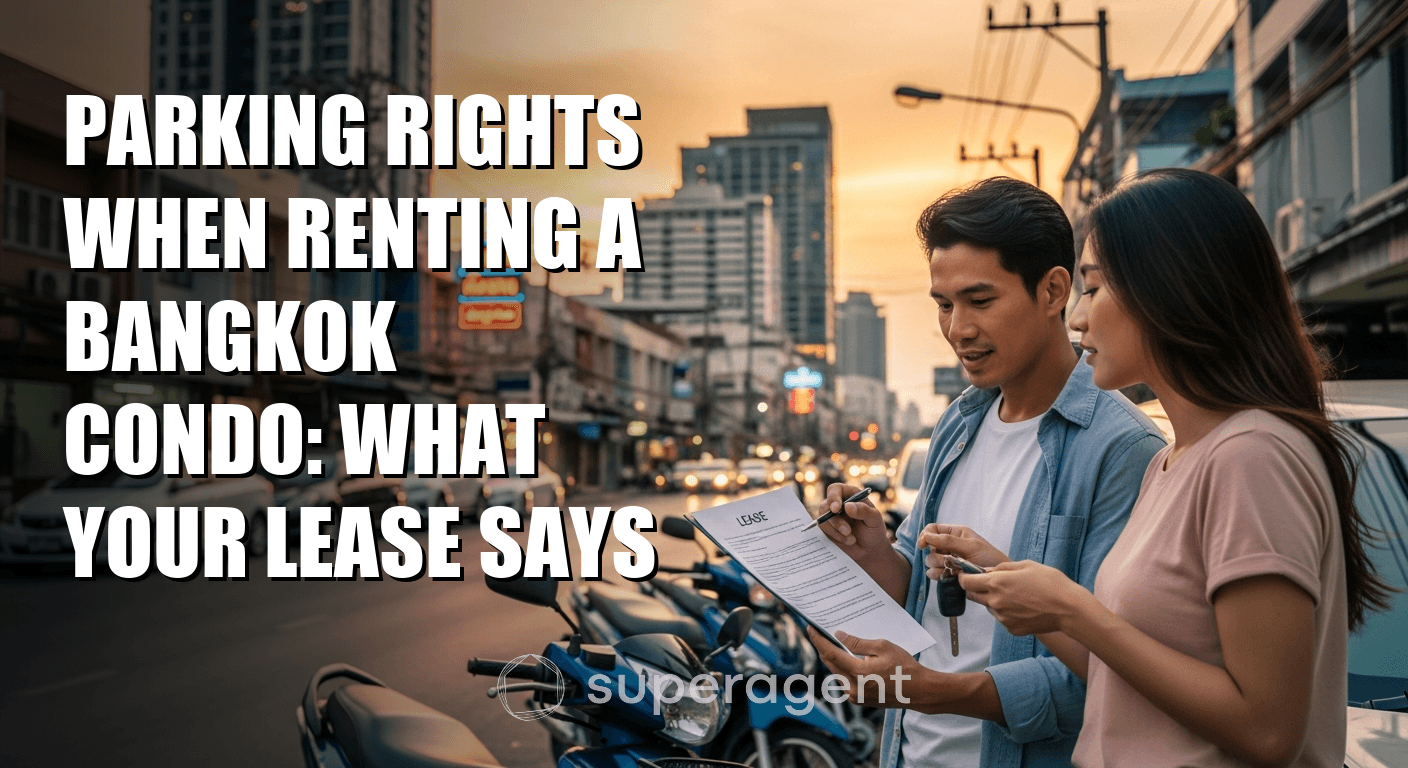
You found a great condo near BTS Thong Lo, signed the lease, moved in, and then realized your car has nowhere to go. The building has parking, sure, but your landlord never transferred a parking card to you. Now you're circling the soi every night at 9 PM looking for a spot on the street. This is one of the most common and most frustrating surprises for condo renters in Bangkok, and it's almost always preventable.
Bangkok condo parking rights are rarely discussed before signing a lease. Most tenants assume parking just comes with the unit. Sometimes it does. Sometimes it absolutely does not. And the difference usually comes down to a few lines in your contract that you probably skimmed past.
How Parking Actually Works in Bangkok Condos
Here's what a lot of renters don't realize. In most Bangkok condominiums, parking spaces are not automatically tied to a unit. They're allocated by the juristic person, which is essentially the building's management body. Each unit owner gets a certain number of parking stickers or access cards based on the building's ratio, which is typically one spot per unit but sometimes fewer in older or more crowded projects.
When an owner rents out their unit, they can choose to pass along the parking access to the tenant or keep it for themselves. In buildings like The Lumpini 24 near BTS Phrom Phong or Ideo Mobi Sukhumvit 81 near BTS On Nut, parking demand is intense. Some owners with multiple units hoard their parking cards and use them for their own vehicles, leaving tenants with nothing.
At a building like Life Asoke Hype near MRT Phetchaburi, where monthly rents run from about 15,000 to 25,000 THB for a one bedroom, you might assume parking is included at that price. But unless your lease explicitly says so, the building has no obligation to give you a card. The owner does.
What Your Lease Should Say About Parking
Most standard Thai rental agreements are surprisingly thin on parking details. A typical lease for a condo in the Ratchada or Rama 9 area might run two or three pages and mention nothing about vehicle access. That's a problem, because verbal promises from landlords tend to evaporate once you've paid your deposit.
What you want to see in your lease is a clear statement that the landlord will provide one parking card or sticker for the duration of the tenancy. It should also specify whether the parking is in a designated spot or on a first come, first served basis. Some buildings like Ashton Asoke near BTS Asoke assign fixed spots. Others, especially older projects along Sukhumvit Soi 39 or Soi 49, operate on a rotation system where you park wherever you can find space.
If the lease doesn't mention parking at all, bring it up before you sign. Ask the landlord to add a clause. Even a single sentence like "Landlord agrees to provide one parking access card for Tenant's use" is enough to protect you. Get it in writing. Always.
When Things Go Wrong with Parking Access
Let me give you a real scenario that plays out constantly. A tenant renting a studio at Aspire Sukhumvit 48 near BTS Phra Khanong for around 12,000 THB per month asks the landlord about parking during the viewing. The landlord says "no problem, the building has parking." The tenant signs the lease, moves in, and then discovers the owner never registered a car for that unit. The juristic office says they can't issue a card without the owner's request. The owner stops replying to LINE messages.
Now the tenant is stuck. Without a parking clause in the lease, there's very little legal ground to stand on. The tenant can park on the street, pay for monthly parking at a nearby commercial building (often 3,000 to 5,000 THB per month), or try to negotiate with the juristic person directly. None of these options are great.
Another issue comes up during lease renewals. Some landlords provide parking for the first year and then quietly reclaim the card when the lease renews, especially if they've bought a new car themselves. If your renewal contract doesn't re-confirm parking access, you could lose it.
Buildings Where Parking Is Especially Tight
Not all condos are created equal when it comes to parking ratios. High density projects along the Sukhumvit corridor tend to have the worst parking situations. Buildings near BTS Ekkamai and BTS Thong Lo, where land prices pushed developers to maximize unit counts, often have fewer parking spaces than total units.
Projects like Park 24 near BTS Phrom Phong or Rhythm Sukhumvit 36 near BTS Thong Lo are popular with renters paying 20,000 to 35,000 THB monthly, but parking competition in these buildings is fierce. If you're renting in this area and you own a car, parking should be one of your first questions, not an afterthought.
On the other hand, condos further out along the BTS line, like projects near BTS Bearing or BTS Samrong, tend to have more generous parking. Rent is lower, density is lower, and you're far less likely to run into problems.
Motorcycles, Second Cars, and Visitor Parking
Parking rules aren't just about your primary car. If you have a motorcycle, many buildings require a separate registration and sticker. Some buildings charge a small monthly fee for motorbike parking, typically 200 to 500 THB. Others include it but limit you to one bike per unit.
If you have a second vehicle or a partner who also drives, you'll likely need a second parking card. Most buildings charge extra for this, and some simply don't allow it when spaces are full. At a condo like The Base Sukhumvit 77 near BTS On Nut, where the tenant mix includes a lot of young professionals with cars, second spots can be almost impossible to get.
Visitor parking is usually available but time limited. Most buildings allow guests to park for a few hours with registration at the lobby. Overnight guest parking is hit or miss and usually requires advance approval from the juristic office.
Parking might feel like a small detail compared to rent price, location, and unit condition. But when you're paying good money every month and can't park your own car at your own building, it stops feeling small very quickly. Before you sign any lease in Bangkok, read the parking clause. If there isn't one, ask for one. And if you're searching for a condo that fits your actual daily life, including your car, try browsing listings on superagent.co where you can filter for the details that matter and get clear information before you commit.
You found a great condo near BTS Thong Lo, signed the lease, moved in, and then realized your car has nowhere to go. The building has parking, sure, but your landlord never transferred a parking card to you. Now you're circling the soi every night at 9 PM looking for a spot on the street. This is one of the most common and most frustrating surprises for condo renters in Bangkok, and it's almost always preventable.
Bangkok condo parking rights are rarely discussed before signing a lease. Most tenants assume parking just comes with the unit. Sometimes it does. Sometimes it absolutely does not. And the difference usually comes down to a few lines in your contract that you probably skimmed past.
How Parking Actually Works in Bangkok Condos
Here's what a lot of renters don't realize. In most Bangkok condominiums, parking spaces are not automatically tied to a unit. They're allocated by the juristic person, which is essentially the building's management body. Each unit owner gets a certain number of parking stickers or access cards based on the building's ratio, which is typically one spot per unit but sometimes fewer in older or more crowded projects.
When an owner rents out their unit, they can choose to pass along the parking access to the tenant or keep it for themselves. In buildings like The Lumpini 24 near BTS Phrom Phong or Ideo Mobi Sukhumvit 81 near BTS On Nut, parking demand is intense. Some owners with multiple units hoard their parking cards and use them for their own vehicles, leaving tenants with nothing.
Continue reading after that.
Looking for a condo
to rent?
Leave your name and phone. We'll follow up while you keep reading.
100% Secure
Fast Response
Free Consultation
At a building like Life Asoke Hype near MRT Phetchaburi, where monthly rents run from about 15,000 to 25,000 THB for a one bedroom, you might assume parking is included at that price. But unless your lease explicitly says so, the building has no obligation to give you a card. The owner does.
What Your Lease Should Say About Parking
Most standard Thai rental agreements are surprisingly thin on parking details. A typical lease for a condo in the Ratchada or Rama 9 area might run two or three pages and mention nothing about vehicle access. That's a problem, because verbal promises from landlords tend to evaporate once you've paid your deposit.
What you want to see in your lease is a clear statement that the landlord will provide one parking card or sticker for the duration of the tenancy. It should also specify whether the parking is in a designated spot or on a first come, first served basis. Some buildings like Ashton Asoke near BTS Asoke assign fixed spots. Others, especially older projects along Sukhumvit Soi 39 or Soi 49, operate on a rotation system where you park wherever you can find space.
If the lease doesn't mention parking at all, bring it up before you sign. Ask the landlord to add a clause. Even a single sentence like "Landlord agrees to provide one parking access card for Tenant's use" is enough to protect you. Get it in writing. Always.
When Things Go Wrong with Parking Access
Let me give you a real scenario that plays out constantly. A tenant renting a studio at Aspire Sukhumvit 48 near BTS Phra Khanong for around 12,000 THB per month asks the landlord about parking during the viewing. The landlord says "no problem, the building has parking." The tenant signs the lease, moves in, and then discovers the owner never registered a car for that unit. The juristic office says they can't issue a card without the owner's request. The owner stops replying to LINE messages.
Now the tenant is stuck. Without a parking clause in the lease, there's very little legal ground to stand on. The tenant can park on the street, pay for monthly parking at a nearby commercial building (often 3,000 to 5,000 THB per month), or try to negotiate with the juristic person directly. None of these options are great.
Another issue comes up during lease renewals. Some landlords provide parking for the first year and then quietly reclaim the card when the lease renews, especially if they've bought a new car themselves. If your renewal contract doesn't re-confirm parking access, you could lose it.
Buildings Where Parking Is Especially Tight
Not all condos are created equal when it comes to parking ratios. High density projects along the Sukhumvit corridor tend to have the worst parking situations. Buildings near BTS Ekkamai and BTS Thong Lo, where land prices pushed developers to maximize unit counts, often have fewer parking spaces than total units.
Projects like Park 24 near BTS Phrom Phong or Rhythm Sukhumvit 36 near BTS Thong Lo are popular with renters paying 20,000 to 35,000 THB monthly, but parking competition in these buildings is fierce. If you're renting in this area and you own a car, parking should be one of your first questions, not an afterthought.
Continue reading after that.
Looking for a condo
to rent?
Leave your name and phone. We'll follow up while you keep reading.
100% Secure
Fast Response
Free Consultation
On the other hand, condos further out along the BTS line, like projects near BTS Bearing or BTS Samrong, tend to have more generous parking. Rent is lower, density is lower, and you're far less likely to run into problems.
Motorcycles, Second Cars, and Visitor Parking
Parking rules aren't just about your primary car. If you have a motorcycle, many buildings require a separate registration and sticker. Some buildings charge a small monthly fee for motorbike parking, typically 200 to 500 THB. Others include it but limit you to one bike per unit.
If you have a second vehicle or a partner who also drives, you'll likely need a second parking card. Most buildings charge extra for this, and some simply don't allow it when spaces are full. At a condo like The Base Sukhumvit 77 near BTS On Nut, where the tenant mix includes a lot of young professionals with cars, second spots can be almost impossible to get.
Visitor parking is usually available but time limited. Most buildings allow guests to park for a few hours with registration at the lobby. Overnight guest parking is hit or miss and usually requires advance approval from the juristic office.
Parking might feel like a small detail compared to rent price, location, and unit condition. But when you're paying good money every month and can't park your own car at your own building, it stops feeling small very quickly. Before you sign any lease in Bangkok, read the parking clause. If there isn't one, ask for one. And if you're searching for a condo that fits your actual daily life, including your car, try browsing listings on superagent.co where you can filter for the details that matter and get clear information before you commit.
Share this article
Properties you may like
![[For Rent] CONDO I Las Colinas Condominium I 2 Beds I 3 Baths I 85,000THB/mo](/_next/image?url=https%3A%2F%2Fstorage.googleapis.com%2Fsuperagent-web%2Fattachments%2Flistings%2F6828%2F80f345c4-488e-43b2-b017-c9fbb17b520d-99486dd8-4237-4ba2-9207-01ce4f66b21f-media.jpg&w=3840&q=75)
฿85,000
2 Bed3170 sqm
[For Rent] CONDO I Las Colinas Condominium I 2 Beds I 3 Baths I 85,000THB/mo
Asoke
Condo![[For Rent] CONDO I Ashton Asoke I 1 Bed I 1 Bath I 30,000THB/mo](/_next/image?url=https%3A%2F%2Fstorage.googleapis.com%2Fsuperagent-web%2Fattachments%2Flistings%2F6876%2Fb7ce9bbe-f877-4ff5-bb54-8ad0026db940-1272-4.jpg&w=3840&q=75)
฿30,000
1 Bed135 sqm
[For Rent] CONDO I Ashton Asoke I 1 Bed I 1 Bath I 30,000THB/mo
Asoke
Condo![[For Rent] CONDO I Skyrise Avenue Sukhumvit 64 I 2 Beds I 2 Baths I 27,000THB/mo](/_next/image?url=https%3A%2F%2Fstorage.googleapis.com%2Fsuperagent-web%2Fattachments%2Flistings%2F2001%2F670f91de-c251-4e81-971c-8e30ed2158cd-screenshot-2026-07-05-at-11.38.53-pm.png&w=3840&q=75)
฿27,000
2 Bed252 sqm
[For Rent] CONDO I Skyrise Avenue Sukhumvit 64 I 2 Beds I 2 Baths I 27,000THB/mo
Punnawithi
Condo![[For Rent] CONDO I Park Origin Ratchathewi I Duplex I 2 Beds I 1 Bath I 32,000THB/mo](/_next/image?url=https%3A%2F%2Fstorage.googleapis.com%2Fsuperagent-web%2Fattachments%2Flistings%2F6896%2Fb79a7d21-7533-4b0d-bb19-762ebfafab62-1318-6.jpg&w=3840&q=75)
฿32,000
2 Bed135.9 sqm
[For Rent] CONDO I Park Origin Ratchathewi I Duplex I 2 Beds I 1 Bath I 32,000THB/mo
Ratchathewi
Condo![[For Rent] CONDO I Park Origin Phayathai I Studio I 1 Bath I 28,000THB/mo](/_next/image?url=https%3A%2F%2Fstorage.googleapis.com%2Fsuperagent-web%2Fattachments%2Flistings%2F6757%2Fb226df93-94c6-46fa-aeba-ebfadc7f81b8-1000006042.jpg&w=3840&q=75)
฿28,000
Studio129 sqm
[For Rent] CONDO I Park Origin Phayathai I Studio I 1 Bath I 28,000THB/mo
Phaya Thai
Condo![[For Rent] CONDO I Ideo Mobi Sukhumvit 81 I Duplex I 1 Bed I 1 Bath I 28,000THB/mo](/_next/image?url=https%3A%2F%2Fstorage.googleapis.com%2Fsuperagent-web%2Fattachments%2Flistings%2F1849%2Fc8b2c033-3b5f-4615-b2b0-4972f40141f0-705-13.jpg&w=3840&q=75)
฿28,000
1 Bed143 sqm
[For Rent] CONDO I Ideo Mobi Sukhumvit 81 I Duplex I 1 Bed I 1 Bath I 28,000THB/mo
On Nut
Condo![[For Rent] CONDO I Siamese Sukhumvit 48 I 1 Bed I 1 Bath I 28,000THB/mo](/_next/image?url=https%3A%2F%2Fstorage.googleapis.com%2Fsuperagent-web%2Fattachments%2Flistings%2F6841%2Febc2dce2-2e9b-4e6d-a01c-0cfa619dfa13-1231-6.jpg&w=3840&q=75)
฿28,000
1 Bed144 sqm
[For Rent] CONDO I Siamese Sukhumvit 48 I 1 Bed I 1 Bath I 28,000THB/mo
Condo![[For Rent] CONDO I Ashton Asoke I 1 Bed I 1 Bath I 22,000THB/mo](/_next/image?url=https%3A%2F%2Fstorage.googleapis.com%2Fsuperagent-web%2Fattachments%2Flistings%2F6802%2Fe06b9b73-1207-414a-ab04-1685de0c7eaa-20220808_153124_0.jpg&w=3840&q=75)
฿22,000
1 Bed134 sqm
[For Rent] CONDO I Ashton Asoke I 1 Bed I 1 Bath I 22,000THB/mo
Asoke
Condo![[For Rent] CONDO I HQ Thonglor Soi 4 I 1 Bed I 1 Bath I 35,000 THB/mo](/_next/image?url=https%3A%2F%2Fstorage.googleapis.com%2Fsuperagent-web%2Fattachments%2Flistings%2F1445%2F72352585-1bc2-41a8-bd62-ddcbf8189fe9-376-5.jpg&w=3840&q=75)
฿35,000
1 Bed143.6 sqm
[For Rent] CONDO I HQ Thonglor Soi 4 I 1 Bed I 1 Bath I 35,000 THB/mo
Thonglor
Condo![[For Rent] CONDO I The Master Centrium Asoke - Sukhumvit I Duplex I 2 Beds I 3 Baths I 75,000 THB/mo](/_next/image?url=https%3A%2F%2Fstorage.googleapis.com%2Fsuperagent-web%2Fattachments%2Flistings%2F1545%2F97932b6a-c358-45e4-b5f9-995dbf5a3cf0-441-2.jpg&w=3840&q=75)
฿75,000
2 Bed3150 sqm
[For Rent] CONDO I The Master Centrium Asoke - Sukhumvit I Duplex I 2 Beds I 3 Baths I 75,000 THB/mo
Asoke
CondoMore like this
 In Guides · Superagent EditorialHidden Costs of Renting a Condo in Bangkok Nobody Warns You AboutBangkok condo rent looks affordable until month one hits. Here are the real costs beyond the headline figure that catch most renters off guard.25 May 20261 min read
 In Guides · Superagent EditorialWhat a Long-Vacant Bangkok Condo Unit Is Actually Telling YouA Bangkok condo vacant for months signals overpricing, landlord issues, or real problems. Here is how to read the signs.25 May 20261 min read
 In Guides · Superagent EditorialRed Flags in a Bangkok Rental Contract to Watch Out ForBangkok rental contracts often hide risky clauses. Here are the red flags every tenant must catch before signing any lease.25 May 20261 min read
 In Guides · Superagent EditorialWorking Online from a Condo: How to Choose the Perfect Room for ProductivityLearn how to choose the best condo room for working online with tips on lighting, noise, and furniture setup to maximize productivity.9 May 20261 min read