Setting Up Utilities in Your Bangkok Condo: Internet, Electric, Water Guide
Guides
Setting Up Utilities in Your Bangkok Condo: Internet, Electric, Water Guide
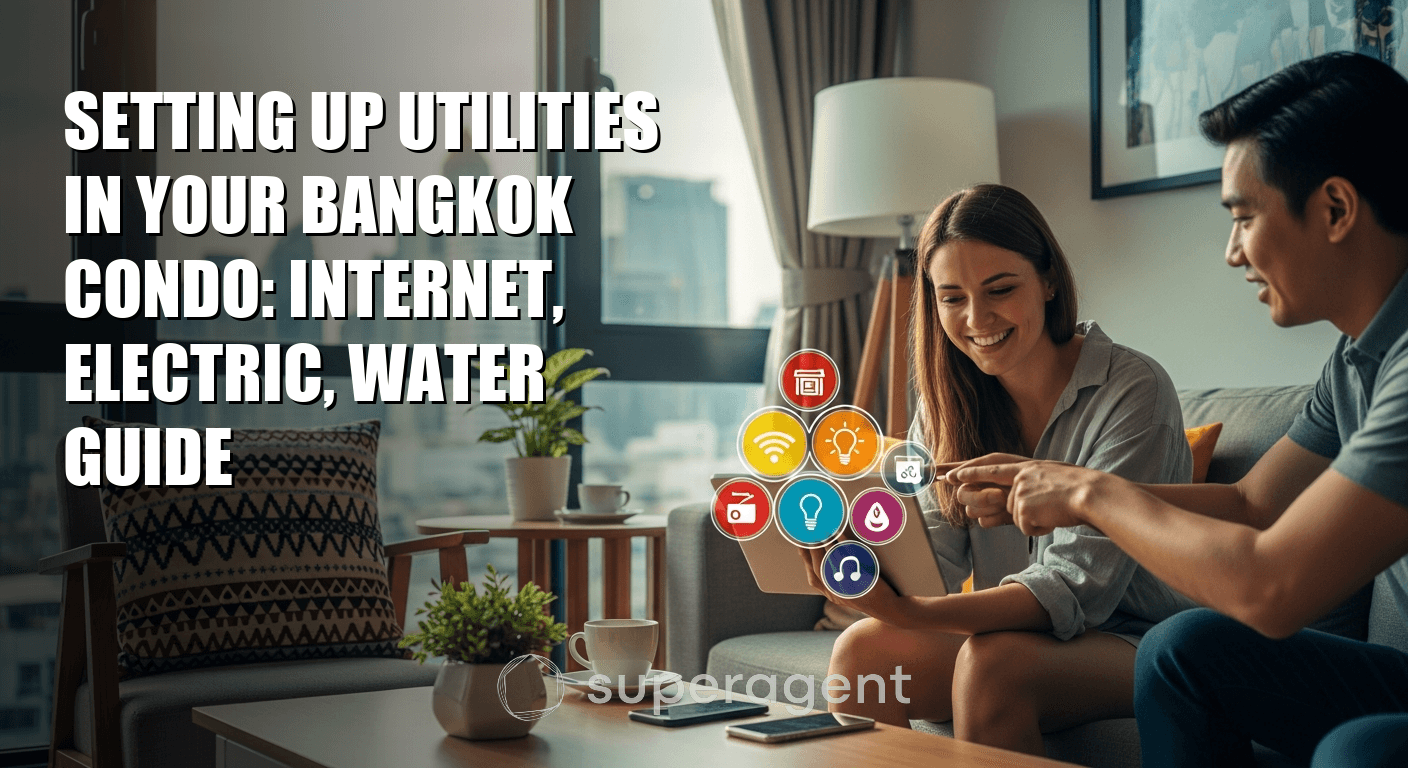
Learn how to quickly connect internet, electricity, and water when moving into your Bangkok condo.
Summary
Complete guide to utility setup Bangkok condo with step-by-step instructions for internet, electric, and water connections made simple.
You signed the lease, got the keys, and walked into your new condo on Sukhumvit Soi 39. Everything looks great. Then you flip a light switch and wonder: wait, is the electricity even on? Setting up utilities in a Bangkok condo can feel confusing the first time, especially if you are coming from a country where everything is bundled or automated. But honestly, once you know the process, it takes a day or two at most. Here is your no nonsense guide to getting internet, electricity, and water sorted in your new place.
Electricity: MEA, Building Meters, and Why Your Bill Varies
Most condos in Bangkok get their electricity through the Metropolitan Electricity Authority, also known as MEA. But here is the thing. You rarely deal with MEA directly. Your condo building acts as the middleman, and they typically charge you per unit of electricity at a markup.
The MEA residential rate is around 3.2 to 4.2 THB per unit depending on usage tiers. However, many condo buildings, especially popular ones like Lumpini Suite Sukhumvit 41 or The Base Park West near BTS Phra Khanong, charge a flat rate of 6 to 9 THB per unit. That markup is legal and extremely common. Always ask your landlord or building juristic office what the per unit rate is before you sign anything.
If you are renting directly from an owner in a building that has individual MEA meters, you can register the meter under your name at the local MEA office. Bring your passport, lease agreement, and a copy of the owner's ID. The MEA branch near BTS On Nut on Sukhumvit Soi 77 handles a lot of these registrations for the lower Sukhumvit area. Expect to spend about an hour there.
One real example: a friend renting a one bedroom at Ideo Mobi Sukhumvit 66 was paying 7 THB per unit through the building. After switching to a direct MEA meter, her monthly bill dropped from about 3,500 THB to around 2,100 THB. That is real money over a year.
Water: Usually Simple, Occasionally Annoying
Water in Bangkok condos is handled by the Metropolitan Waterworks Authority, or MWA. Similar to electricity, most condo buildings buy water wholesale from MWA and bill you at a higher rate. You will typically pay 18 to 35 THB per unit of water, compared to the MWA base rate of about 10 to 17 THB per unit.
The good news is that water bills in Bangkok condos are almost always low. For a single person or couple, expect to pay 100 to 400 THB per month. It is rarely a budget concern. The bill usually comes bundled with your common area fees or is collected separately by the juristic office each month.
If you are in a condo like Aspire Sukhumvit 48, right near BTS Phra Khanong, the building management handles everything. You just pay the monthly invoice they slip under your door or post in the app. Some newer buildings like Life Asoke Hype near MRT Phetchaburi even have apps where you can check usage and pay digitally. Ask your building if they offer that.
One thing that catches people off guard is hot water. Many Bangkok condos use electric water heaters, not gas. So your hot water usage actually shows up on your electric bill, not your water bill. Keep that in mind if your electricity seems higher than expected.
Internet: The One You Actually Care About Most
Let's be honest. For most renters, especially remote workers and expats near Thong Lo or Ari, internet is the utility that matters most. Bangkok has excellent fiber optic coverage, and you have several solid providers to choose from.
The big three are AIS Fibre, True Online, and 3BB. AIS Fibre and True are generally the most reliable in condo buildings along the BTS Sukhumvit line. Plans start at around 599 THB per month for 100 Mbps and go up to 1,200 to 1,500 THB for gigabit speeds.
Here is the catch. Not every provider is available in every building. Before you commit, ask the juristic office which ISPs have infrastructure installed in the building. For example, The Lofts Ekkamai on Sukhumvit Soi 63 supports both True and AIS, but some older buildings near Victory Monument might only have 3BB available.
Setup usually takes three to five business days after you apply. You can walk into any AIS or True shop, like the ones at Terminal 21 near BTS Asok, and sign up with your passport. A technician will come to your unit to install the router. Most plans require a 12 month contract, but some buildings have pre installed connections where you just activate the service with no commitment.
Pro tip: if you are only staying three to six months, ask your landlord if the condo already has an active internet line you can take over. Many landlords keep a basic plan running between tenants, and they will just add the cost to your rent.
Common Area Fees and What They Actually Cover
Every condo in Bangkok charges a common area fee, sometimes called a CAM fee. This is paid by the unit owner, not the renter, in most cases. But some landlords pass this cost along, so check your lease.
CAM fees typically run 40 to 80 THB per square meter per month. For a 35 sqm unit at a mid range building like Centric Ari Station near BTS Ari, that is roughly 1,750 to 2,800 THB monthly. This fee covers building maintenance, security, pool upkeep, lobby cleaning, and sometimes the shared water and garbage costs.
Make sure you know whether CAM fees are included in your quoted rent or added on top. At 15,000 to 25,000 THB per month rentals, an extra 2,000 THB matters to your budget.
Getting Everything Set Up on Day One
The smartest move is to handle utility questions before you sign your lease. Ask about electricity rates, water billing, available internet providers, and who pays the CAM fee. Get it all in writing or at least confirmed in a message. Then on move in day, head to the juristic office, introduce yourself, and register as the occupant. They will walk you through how bills are delivered and paid.
If you are still searching for a condo and want to skip the guesswork, Superagent at superagent.co gives you utility details and building specifics so you know what to expect before you even visit. It saves you from those awkward surprises that turn a great condo into a frustrating one.
You signed the lease, got the keys, and walked into your new condo on Sukhumvit Soi 39. Everything looks great. Then you flip a light switch and wonder: wait, is the electricity even on? Setting up utilities in a Bangkok condo can feel confusing the first time, especially if you are coming from a country where everything is bundled or automated. But honestly, once you know the process, it takes a day or two at most. Here is your no nonsense guide to getting internet, electricity, and water sorted in your new place.
Electricity: MEA, Building Meters, and Why Your Bill Varies
Most condos in Bangkok get their electricity through the Metropolitan Electricity Authority, also known as MEA. But here is the thing. You rarely deal with MEA directly. Your condo building acts as the middleman, and they typically charge you per unit of electricity at a markup.
The MEA residential rate is around 3.2 to 4.2 THB per unit depending on usage tiers. However, many condo buildings, especially popular ones like Lumpini Suite Sukhumvit 41 or The Base Park West near BTS Phra Khanong, charge a flat rate of 6 to 9 THB per unit. That markup is legal and extremely common. Always ask your landlord or building juristic office what the per unit rate is before you sign anything.
If you are renting directly from an owner in a building that has individual MEA meters, you can register the meter under your name at the local MEA office. Bring your passport, lease agreement, and a copy of the owner's ID. The MEA branch near BTS On Nut on Sukhumvit Soi 77 handles a lot of these registrations for the lower Sukhumvit area. Expect to spend about an hour there.
One real example: a friend renting a one bedroom at Ideo Mobi Sukhumvit 66 was paying 7 THB per unit through the building. After switching to a direct MEA meter, her monthly bill dropped from about 3,500 THB to around 2,100 THB. That is real money over a year.
Water: Usually Simple, Occasionally Annoying
Water in Bangkok condos is handled by the Metropolitan Waterworks Authority, or MWA. Similar to electricity, most condo buildings buy water wholesale from MWA and bill you at a higher rate. You will typically pay 18 to 35 THB per unit of water, compared to the MWA base rate of about 10 to 17 THB per unit.
The good news is that water bills in Bangkok condos are almost always low. For a single person or couple, expect to pay 100 to 400 THB per month. It is rarely a budget concern. The bill usually comes bundled with your common area fees or is collected separately by the juristic office each month.
If you are in a condo like Aspire Sukhumvit 48, right near BTS Phra Khanong, the building management handles everything. You just pay the monthly invoice they slip under your door or post in the app. Some newer buildings like Life Asoke Hype near MRT Phetchaburi even have apps where you can check usage and pay digitally. Ask your building if they offer that.
One thing that catches people off guard is hot water. Many Bangkok condos use electric water heaters, not gas. So your hot water usage actually shows up on your electric bill, not your water bill. Keep that in mind if your electricity seems higher than expected.
Internet: The One You Actually Care About Most
Let's be honest. For most renters, especially remote workers and expats near Thong Lo or Ari, internet is the utility that matters most. Bangkok has excellent fiber optic coverage, and you have several solid providers to choose from.
The big three are AIS Fibre, True Online, and 3BB. AIS Fibre and True are generally the most reliable in condo buildings along the BTS Sukhumvit line. Plans start at around 599 THB per month for 100 Mbps and go up to 1,200 to 1,500 THB for gigabit speeds.
Here is the catch. Not every provider is available in every building. Before you commit, ask the juristic office which ISPs have infrastructure installed in the building. For example, The Lofts Ekkamai on Sukhumvit Soi 63 supports both True and AIS, but some older buildings near Victory Monument might only have 3BB available.
Talk to us about renting
Share your details and keep reading — we’ll get back to you.
Setup usually takes three to five business days after you apply. You can walk into any AIS or True shop, like the ones at Terminal 21 near BTS Asok, and sign up with your passport. A technician will come to your unit to install the router. Most plans require a 12 month contract, but some buildings have pre installed connections where you just activate the service with no commitment.
Pro tip: if you are only staying three to six months, ask your landlord if the condo already has an active internet line you can take over. Many landlords keep a basic plan running between tenants, and they will just add the cost to your rent.
Common Area Fees and What They Actually Cover
Every condo in Bangkok charges a common area fee, sometimes called a CAM fee. This is paid by the unit owner, not the renter, in most cases. But some landlords pass this cost along, so check your lease.
CAM fees typically run 40 to 80 THB per square meter per month. For a 35 sqm unit at a mid range building like Centric Ari Station near BTS Ari, that is roughly 1,750 to 2,800 THB monthly. This fee covers building maintenance, security, pool upkeep, lobby cleaning, and sometimes the shared water and garbage costs.
Make sure you know whether CAM fees are included in your quoted rent or added on top. At 15,000 to 25,000 THB per month rentals, an extra 2,000 THB matters to your budget.
Getting Everything Set Up on Day One
The smartest move is to handle utility questions before you sign your lease. Ask about electricity rates, water billing, available internet providers, and who pays the CAM fee. Get it all in writing or at least confirmed in a message. Then on move in day, head to the juristic office, introduce yourself, and register as the occupant. They will walk you through how bills are delivered and paid.
If you are still searching for a condo and want to skip the guesswork, Superagent at superagent.co gives you utility details and building specifics so you know what to expect before you even visit. It saves you from those awkward surprises that turn a great condo into a frustrating one.
Share this article
Properties you may like
![[For Rent] CONDO I Aguston Sukhumvit 22 I Pet Friendly I 2 Beds I 2 Baths I Rent 55,000THB/mo](/_next/image?url=https%3A%2F%2Fstorage.googleapis.com%2Fsuperagent-web%2Fattachments%2Flistings%2F2266%2Fd3afcd25-6b79-46cb-9f1f-396acdc3dd10-955-3.jpg&w=3840&q=75)
฿55,000
2 Bed295 sqm
[For Rent] CONDO I Aguston Sukhumvit 22 I Pet Friendly I 2 Beds I 2 Baths I Rent 55,000THB/mo
Phrom Phong
Condo![[For Rent] CONDO I SUPALAI PLACE Sukhumvit 39 I 2 Beds I 2 Baths (1 Jacuzzi) I 55,555THB/mo](/_next/image?url=https%3A%2F%2Fstorage.googleapis.com%2Fsuperagent-web%2Fattachments%2Flistings%2F6743%2Fba530743-48b9-4ac6-92d3-c2247e743cf6-01-supalai-place-skv39-2b-link-heaven.jpg&w=3840&q=75)
฿55,555
2 Bed2142 sqm
[For Rent] CONDO I SUPALAI PLACE Sukhumvit 39 I 2 Beds I 2 Baths (1 Jacuzzi) I 55,555THB/mo
Phrom Phong
Condo![[For Rent] CONDO I Maru Ekkamai 2 I Pet friendly I 2 Beds I 2 Baths I 68,000 THB/mo](/_next/image?url=https%3A%2F%2Fstorage.googleapis.com%2Fsuperagent-web%2Fattachments%2Flistings%2F6602%2F9f1d8f71-ee43-435f-9a44-da16c4092c92-968-1.jpg&w=3840&q=75)
฿68,000
2 Bed360 sqm
[For Rent] CONDO I Maru Ekkamai 2 I Pet friendly I 2 Beds I 2 Baths I 68,000 THB/mo
Ekkamai
Condo![[For Rent] CONDO I Noble State 39 I 2 Beds I 2 Baths I 63,000THB/mo](/_next/image?url=https%3A%2F%2Fstorage.googleapis.com%2Fsuperagent-web%2Fattachments%2Flistings%2F2237%2F60eb58f3-eae5-41ed-a80b-406e004f05d8-940-1.jpg&w=3840&q=75)
฿63,000
2 Bed260 sqm
[For Rent] CONDO I Noble State 39 I 2 Beds I 2 Baths I 63,000THB/mo
Phrom Phong
Condo![[For Rent] CONDO I Rhythm Sukhumvit 36-38 I 2 Beds I 2 Baths I 38,999THB/mo](/_next/image?url=https%3A%2F%2Fstorage.googleapis.com%2Fsuperagent-web%2Fattachments%2Flistings%2F1788%2F942a0215-4128-4c2c-a064-f607e84e7aa4-656-2.jpg&w=3840&q=75)
฿38,999
2 Bed256 sqm
[For Rent] CONDO I Rhythm Sukhumvit 36-38 I 2 Beds I 2 Baths I 38,999THB/mo
Thonglor
Condo![[For Rent] CONDO I CLOUD Thonglor-Phetchaburi I 1 Bed I 1 Bath I 22,500THB/mo](/_next/image?url=https%3A%2F%2Fstorage.googleapis.com%2Fsuperagent-web%2Fattachments%2Flistings%2F6742%2F6cef5361-0dac-4dba-98f1-b0d187559c84-1118-1.jpg&w=3840&q=75)
฿22,500
1 Bed132 sqm
[For Rent] CONDO I CLOUD Thonglor-Phetchaburi I 1 Bed I 1 Bath I 22,500THB/mo
Thonglor
Condo![[For Rent] CONDO I City Smart Sukhumvit 18 I 3 Beds I 3 Baths I 65,000mo/THB](/_next/image?url=https%3A%2F%2Fstorage.googleapis.com%2Fsuperagent-web%2Fattachments%2Flistings%2F6741%2Fd371c89d-a913-42c4-a673-e540afae4f46-1116-1.jpg&w=3840&q=75)
฿65,000
3 Bed3125 sqm
[For Rent] CONDO I City Smart Sukhumvit 18 I 3 Beds I 3 Baths I 65,000mo/THB
Condo![[For Rent] CONDO I The Coast Bangkok I 1 Bed I 1 Bath I 20,000mo/THB](/_next/image?url=https%3A%2F%2Fstorage.googleapis.com%2Fsuperagent-web%2Fattachments%2Flistings%2F6740%2F498477ce-4ffa-4e4c-ab08-0e565d9c4bbe-1115-3.jpg&w=3840&q=75)
฿20,000
1 Bed146 sqm
[For Rent] CONDO I The Coast Bangkok I 1 Bed I 1 Bath I 20,000mo/THB
Bang Na
Condo![[For Rent] CONDO I IDEO Sukhumvit-RAMA 4 I 2 Beds I 2 Baths I 55,000mo/THB](/_next/image?url=https%3A%2F%2Fstorage.googleapis.com%2Fsuperagent-web%2Fattachments%2Flistings%2F6739%2F15df221d-5b8e-497c-b7ce-a6b9b6412cab-1113-1.jpg&w=3840&q=75)
฿55,000
2 Bed265 sqm
[For Rent] CONDO I IDEO Sukhumvit-RAMA 4 I 2 Beds I 2 Baths I 55,000mo/THB
Phra Khanong
Condo![[For Rent] CONDO I Downtown 49 I Pet Friendly I 1 Bed I 1 Bath I 23,000mo/THB](/_next/image?url=https%3A%2F%2Fstorage.googleapis.com%2Fsuperagent-web%2Fattachments%2Flistings%2F6738%2F11cf2ffe-1f01-4ccc-991c-2ad608f1ba73-1112-1.jpg&w=3840&q=75)
฿23,000
1 Bed135 sqm
[For Rent] CONDO I Downtown 49 I Pet Friendly I 1 Bed I 1 Bath I 23,000mo/THB
Thonglor
CondoMore like this
 In Guides · Superagent EditorialHidden Costs of Renting a Condo in Bangkok Nobody Warns You AboutBangkok condo rent looks affordable until month one hits. Here are the real costs beyond the headline figure that catch most renters off guard.25 May 20261 min read
 In Guides · Superagent EditorialWhat a Long-Vacant Bangkok Condo Unit Is Actually Telling YouA Bangkok condo vacant for months signals overpricing, landlord issues, or real problems. Here is how to read the signs.25 May 20261 min read
 In Guides · Superagent EditorialRed Flags in a Bangkok Rental Contract to Watch Out ForBangkok rental contracts often hide risky clauses. Here are the red flags every tenant must catch before signing any lease.25 May 20261 min read
 In Guides · Superagent EditorialWorking Online from a Condo: How to Choose the Perfect Room for ProductivityLearn how to choose the best condo room for working online with tips on lighting, noise, and furniture setup to maximize productivity.9 May 20261 min read