Access to Pool and Gym When Renting a Bangkok Condo: Your Rights
Guides
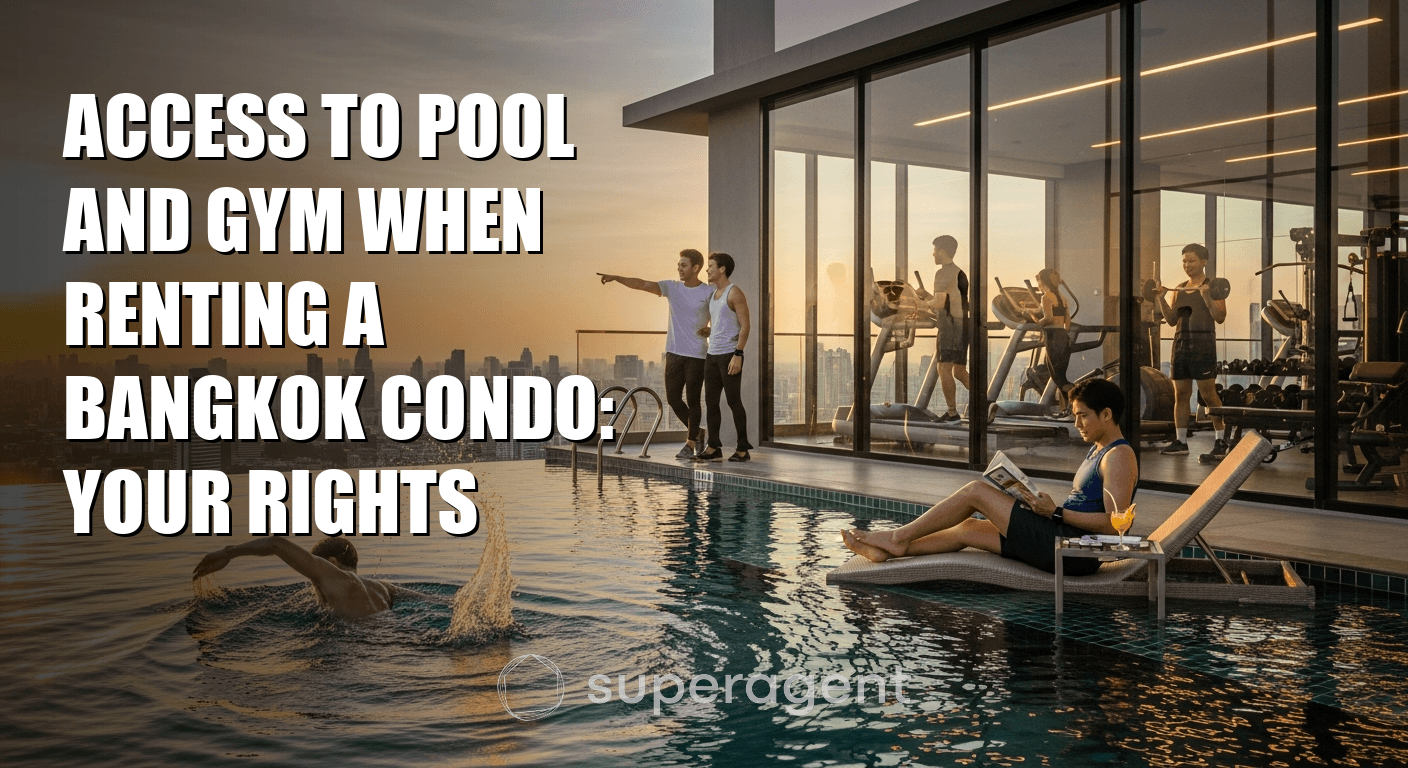
Access to Pool and Gym When Renting a Bangkok Condo: Your Rights
Know your legal entitlements to amenities in your Bangkok rental agreement.
Summary
Understand your bangkok condo pool gym rights as a tenant. Learn what amenities landlords must provide and how to enforce your rental agreements in Thailan
You just signed a lease for a nice one bedroom condo near BTS Phrom Phong, paying 22,000 THB per month. The building has a gorgeous rooftop pool and a fully equipped gym. You move in, grab your towel on day one, head up to the pool deck, and a security guard stops you. "Sorry, facilities closed for your room." Wait, what? This actually happens more often than you'd think in Bangkok, and knowing your rights before you sign can save you from a frustrating situation.
What Most Bangkok Condo Leases Actually Say About Facilities
Here's the thing most renters overlook. When you rent a condo in Bangkok, you're renting a privately owned unit inside a larger building managed by a juristic person, which is essentially the condo's management body. The pool, gym, sauna, co-working space, and other common areas belong to all unit owners collectively. They don't automatically belong to tenants.
In most cases, your right to use these facilities depends entirely on what your landlord arranged with building management. At a building like The Lumpini 24 near BTS Phrom Phong, for example, tenants typically get a key card that grants access to all common facilities. But the landlord has to register you with the juristic person first. If they skip that step, you could find yourself locked out of the gym on your first morning.
Your lease agreement should clearly state which facilities you can access. If it doesn't mention facilities at all, ask before you sign. Get it in writing. A verbal "yes, you can use the pool" means nothing when the security guard has a different list.
Common Area Fees and Who Actually Pays Them
Every condo owner in Bangkok pays a Common Area Maintenance fee, often called CAM. This monthly fee covers upkeep of shared spaces like the pool, gym, lobby, parking, and gardens. At a mid-range building near MRT Phra Ram 9, CAM fees might run around 40 to 60 THB per square meter per month. For a 35 square meter unit, that's roughly 1,400 to 2,100 THB monthly.
Here's where it gets interesting for renters. Some landlords try to pass this cost on to tenants. This is technically negotiable. In most standard Bangkok rental agreements, the landlord covers CAM because they're the owner and it's their obligation to the juristic person. But some landlords, especially at higher end buildings like Ashton Asoke near BTS Asoke where CAM runs higher, will bake it into the rent or list it as a separate charge.
If a landlord asks you to pay CAM on top of rent, that's not illegal, but you should know what you're paying for and factor it into your total monthly cost. A condo listed at 18,000 THB on Soi Sukhumvit 49 with a 2,000 THB CAM add-on is really 20,000 THB per month. Do the math before you commit.
When Buildings Restrict Tenant Access to Facilities
Some Bangkok condos have rules that limit or restrict tenant access to certain amenities. This is more common than people realize, and it's perfectly legal. The juristic person sets building rules, and those rules can include restrictions for non-owners.
Take a building like Supalai Elite on Soi Phahonyothin. Some buildings in that area have rules where only registered residents with proper key cards can use the pool during certain hours, or where tenants need to pay a separate facility deposit. At a few older buildings along Sukhumvit Soi 11 and Soi 13, tenants have reported being denied access to premium amenities like private lounges or rooftop areas that are reserved exclusively for owners.
The fix? Always ask to see the building's house rules before signing your lease. Visit the actual facilities. Try scanning a key card at the gym door. Talk to the lobby staff and ask directly whether tenants have the same access as owners. Five minutes of checking can prevent months of frustration.
Your Key Card Is Your Golden Ticket
In practical terms, your access to the pool and gym in a Bangkok condo comes down to one thing: your key card or access card. When your landlord registers you with building management, you receive a card programmed with your access permissions. This card opens the lobby turnstile, the gym door, the pool gate, and sometimes even the parking garage.
At buildings like Life Asoke Hype near MRT Phetchaburi, the registration process is straightforward. Your landlord fills out a tenant registration form, provides a copy of your passport or ID, and pays a refundable key card deposit, usually 500 to 2,000 THB. Some landlords handle this smoothly. Others forget or delay it for weeks, leaving you stuck using the stairs and staring at the pool from your balcony.
Pro tip: include a clause in your lease requiring the landlord to complete tenant registration and provide facility access cards within three days of move-in. This small addition gives you something concrete to point to if things stall.
What to Do If You Get Locked Out of Facilities You Were Promised
Say you're three months into your lease at a condo near BTS Bearing, paying 15,000 THB per month, and suddenly your gym access stops working. First, check with the lobby. Sometimes it's a simple card malfunction. If management says your access was revoked because your landlord hasn't paid CAM fees, that's a landlord problem, not yours.
Contact your landlord immediately in writing, via LINE or email, and reference the facility access terms in your lease. If your lease guarantees pool and gym access, the landlord is obligated to maintain that access. If they've fallen behind on CAM payments and the building has cut off your amenities, you may have grounds to withhold a proportional amount of rent or negotiate early lease termination.
Document everything. Screenshot conversations, photograph any notices from building management, and keep copies of your lease handy.
Renting a condo in Bangkok should come with the full experience, morning swims, evening gym sessions, and weekend lounging by the pool. But those perks only work if your lease protects them. Read the fine print, ask the right questions, and make sure your landlord registers you properly with the building. If you're searching for your next Bangkok condo and want transparent listings that clearly show what facilities are included, check out Superagent at superagent.co. It takes the guesswork out of renting so you can focus on actually enjoying that pool.
You just signed a lease for a nice one bedroom condo near BTS Phrom Phong, paying 22,000 THB per month. The building has a gorgeous rooftop pool and a fully equipped gym. You move in, grab your towel on day one, head up to the pool deck, and a security guard stops you. "Sorry, facilities closed for your room." Wait, what? This actually happens more often than you'd think in Bangkok, and knowing your rights before you sign can save you from a frustrating situation.
What Most Bangkok Condo Leases Actually Say About Facilities
Here's the thing most renters overlook. When you rent a condo in Bangkok, you're renting a privately owned unit inside a larger building managed by a juristic person, which is essentially the condo's management body. The pool, gym, sauna, co-working space, and other common areas belong to all unit owners collectively. They don't automatically belong to tenants.
In most cases, your right to use these facilities depends entirely on what your landlord arranged with building management. At a building like The Lumpini 24 near BTS Phrom Phong, for example, tenants typically get a key card that grants access to all common facilities. But the landlord has to register you with the juristic person first. If they skip that step, you could find yourself locked out of the gym on your first morning.
Continue reading after that.
Looking for a condo
to rent?
Leave your name and phone. We'll follow up while you keep reading.
100% Secure
Fast Response
Free Consultation
Your lease agreement should clearly state which facilities you can access. If it doesn't mention facilities at all, ask before you sign. Get it in writing. A verbal "yes, you can use the pool" means nothing when the security guard has a different list.
Common Area Fees and Who Actually Pays Them
Every condo owner in Bangkok pays a Common Area Maintenance fee, often called CAM. This monthly fee covers upkeep of shared spaces like the pool, gym, lobby, parking, and gardens. At a mid-range building near MRT Phra Ram 9, CAM fees might run around 40 to 60 THB per square meter per month. For a 35 square meter unit, that's roughly 1,400 to 2,100 THB monthly.
Here's where it gets interesting for renters. Some landlords try to pass this cost on to tenants. This is technically negotiable. In most standard Bangkok rental agreements, the landlord covers CAM because they're the owner and it's their obligation to the juristic person. But some landlords, especially at higher end buildings like Ashton Asoke near BTS Asoke where CAM runs higher, will bake it into the rent or list it as a separate charge.
If a landlord asks you to pay CAM on top of rent, that's not illegal, but you should know what you're paying for and factor it into your total monthly cost. A condo listed at 18,000 THB on Soi Sukhumvit 49 with a 2,000 THB CAM add-on is really 20,000 THB per month. Do the math before you commit.
When Buildings Restrict Tenant Access to Facilities
Some Bangkok condos have rules that limit or restrict tenant access to certain amenities. This is more common than people realize, and it's perfectly legal. The juristic person sets building rules, and those rules can include restrictions for non-owners.
Take a building like Supalai Elite on Soi Phahonyothin. Some buildings in that area have rules where only registered residents with proper key cards can use the pool during certain hours, or where tenants need to pay a separate facility deposit. At a few older buildings along Sukhumvit Soi 11 and Soi 13, tenants have reported being denied access to premium amenities like private lounges or rooftop areas that are reserved exclusively for owners.
The fix? Always ask to see the building's house rules before signing your lease. Visit the actual facilities. Try scanning a key card at the gym door. Talk to the lobby staff and ask directly whether tenants have the same access as owners. Five minutes of checking can prevent months of frustration.
Your Key Card Is Your Golden Ticket
In practical terms, your access to the pool and gym in a Bangkok condo comes down to one thing: your key card or access card. When your landlord registers you with building management, you receive a card programmed with your access permissions. This card opens the lobby turnstile, the gym door, the pool gate, and sometimes even the parking garage.
At buildings like Life Asoke Hype near MRT Phetchaburi, the registration process is straightforward. Your landlord fills out a tenant registration form, provides a copy of your passport or ID, and pays a refundable key card deposit, usually 500 to 2,000 THB. Some landlords handle this smoothly. Others forget or delay it for weeks, leaving you stuck using the stairs and staring at the pool from your balcony.
Pro tip: include a clause in your lease requiring the landlord to complete tenant registration and provide facility access cards within three days of move-in. This small addition gives you something concrete to point to if things stall.
Continue reading after that.
Looking for a condo
to rent?
Leave your name and phone. We'll follow up while you keep reading.
100% Secure
Fast Response
Free Consultation
What to Do If You Get Locked Out of Facilities You Were Promised
Say you're three months into your lease at a condo near BTS Bearing, paying 15,000 THB per month, and suddenly your gym access stops working. First, check with the lobby. Sometimes it's a simple card malfunction. If management says your access was revoked because your landlord hasn't paid CAM fees, that's a landlord problem, not yours.
Contact your landlord immediately in writing, via LINE or email, and reference the facility access terms in your lease. If your lease guarantees pool and gym access, the landlord is obligated to maintain that access. If they've fallen behind on CAM payments and the building has cut off your amenities, you may have grounds to withhold a proportional amount of rent or negotiate early lease termination.
Document everything. Screenshot conversations, photograph any notices from building management, and keep copies of your lease handy.
Renting a condo in Bangkok should come with the full experience, morning swims, evening gym sessions, and weekend lounging by the pool. But those perks only work if your lease protects them. Read the fine print, ask the right questions, and make sure your landlord registers you properly with the building. If you're searching for your next Bangkok condo and want transparent listings that clearly show what facilities are included, check out Superagent at superagent.co. It takes the guesswork out of renting so you can focus on actually enjoying that pool.
Share this article
Properties you may like
![[For Rent] CONDO I Maestro 14 Siam-Ratchathewi Pet Friendly I 1 Bed I 1 Bath I 22,000THB/mo](/_next/image?url=https%3A%2F%2Fstorage.googleapis.com%2Fsuperagent-web%2Fattachments%2Flistings%2F6686%2F5ae8a77f-b6fb-4578-a765-e56f493cd25f-1058.png&w=3840&q=75)
฿25,000
1 Bed130 sqm
[For Rent] CONDO I Maestro 14 Siam-Ratchathewi Pet Friendly I 1 Bed I 1 Bath I 22,000THB/mo
Siam
Condo![[For Rent] CONDO I Las Colinas Condominium I 2 Beds I 3 Baths I 85,000THB/mo](/_next/image?url=https%3A%2F%2Fstorage.googleapis.com%2Fsuperagent-web%2Fattachments%2Flistings%2F6828%2F80f345c4-488e-43b2-b017-c9fbb17b520d-99486dd8-4237-4ba2-9207-01ce4f66b21f-media.jpg&w=3840&q=75)
฿85,000
2 Bed3170 sqm
[For Rent] CONDO I Las Colinas Condominium I 2 Beds I 3 Baths I 85,000THB/mo
Asoke
Condo![[For Rent] CONDO I The Diplomat 39 I 2 Beds I 2 Baths I 89,000THB/mo](/_next/image?url=https%3A%2F%2Fstorage.googleapis.com%2Fsuperagent-web%2Fattachments%2Flistings%2F6784%2Ff92c62cc-d3be-42df-adca-b8f96fb02cfb-1163-1.jpg&w=3840&q=75)
฿89,000
2 Bed286 sqm
[For Rent] CONDO I The Diplomat 39 I 2 Beds I 2 Baths I 89,000THB/mo
Phrom Phong
Condo![[For Rent] CONDO I KEN Attitude Rattanathibet I Duplex I 2 Beds I 2 Baths I 40,000THB/mo](/_next/image?url=https%3A%2F%2Fstorage.googleapis.com%2Fsuperagent-web%2Fattachments%2Flistings%2F6852%2F17c1715e-4458-4008-bb0b-072a4c081166-img_0557.jpeg&w=3840&q=75)
฿40,000
2 Bed277 sqm
[For Rent] CONDO I KEN Attitude Rattanathibet I Duplex I 2 Beds I 2 Baths I 40,000THB/mo
Condo![[For Rent] CONDO I H Sukhumvit 43 I 1 Bed I 1 Bath I 28,000THB/mo](/_next/image?url=https%3A%2F%2Fstorage.googleapis.com%2Fsuperagent-web%2Fattachments%2Flistings%2F6851%2Ff355c21a-a282-4338-86c6-dc5bb3368321-1244-1.jpg&w=3840&q=75)
฿28,000
1 Bed143 sqm
[For Rent] CONDO I H Sukhumvit 43 I 1 Bed I 1 Bath I 28,000THB/mo
Phrom Phong
Condo![[For Rent] CONDO I The Base Park West T77 I 2 Beds I 2 Baths I 24,000THB/mo](/_next/image?url=https%3A%2F%2Fstorage.googleapis.com%2Fsuperagent-web%2Fattachments%2Flistings%2F6723%2Fabc06b19-f7fa-4950-98f6-8bdd841b26a6-1098-3.jpg&w=3840&q=75)
฿24,000
2 Bed253 sqm
[For Rent] CONDO I The Base Park West T77 I 2 Beds I 2 Baths I 24,000THB/mo
On Nut
Condo![[For Rent] CONDO I The Room Phaya Thai I 1 Bed I 1 Bath I 20,000THB/mo](/_next/image?url=https%3A%2F%2Fstorage.googleapis.com%2Fsuperagent-web%2Fattachments%2Flistings%2F2042%2F47afcf0d-8998-4283-abfe-8451d5c47178-1000029204.jpg&w=3840&q=75)
฿20,000
1 Bed128 sqm
[For Rent] CONDO I The Room Phaya Thai I 1 Bed I 1 Bath I 20,000THB/mo
Condo![[For Rent] CONDO I IDEO Rama 9-Asoke I Duplex I 1 Bed I 1 Bath I 36,000THB/mo](/_next/image?url=https%3A%2F%2Fstorage.googleapis.com%2Fsuperagent-web%2Fattachments%2Flistings%2F6795%2Fa7e5e587-f4be-4b3e-a635-839870c16713-1174-4.jpg&w=3840&q=75)
฿36,000
1 Bed138 sqm
[For Rent] CONDO I IDEO Rama 9-Asoke I Duplex I 1 Bed I 1 Bath I 36,000THB/mo
Condo![[For Rent/Sale] CONDO I Park Origin Thonglor I 3 Beds I 2 Baths I Rent 95,000 THB/mo - Sale 26mb THB](/_next/image?url=https%3A%2F%2Fstorage.googleapis.com%2Fsuperagent-web%2Fattachments%2Flistings%2F1508%2F725e6df5-039f-428c-a0c8-2f5d596e7833-420-1.jpg&w=3840&q=75)
฿95,000
3 Bed272 sqm
[For Rent/Sale] CONDO I Park Origin Thonglor I 3 Beds I 2 Baths I Rent 95,000 THB/mo - Sale 26mb THB
Thonglor
Condo![[For Rent] CONDO I Maru Ekkamai 2 I Pet friendly I 2 Beds I 2 Baths I 68,000 THB/mo](/_next/image?url=https%3A%2F%2Fstorage.googleapis.com%2Fsuperagent-web%2Fattachments%2Flistings%2F6602%2F9f1d8f71-ee43-435f-9a44-da16c4092c92-968-1.jpg&w=3840&q=75)
฿68,000
2 Bed360 sqm
[For Rent] CONDO I Maru Ekkamai 2 I Pet friendly I 2 Beds I 2 Baths I 68,000 THB/mo
Ekkamai
CondoMore like this
 In Guides · Superagent EditorialHidden Costs of Renting a Condo in Bangkok Nobody Warns You AboutBangkok condo rent looks affordable until month one hits. Here are the real costs beyond the headline figure that catch most renters off guard.25 May 20261 min read
 In Guides · Superagent EditorialWhat a Long-Vacant Bangkok Condo Unit Is Actually Telling YouA Bangkok condo vacant for months signals overpricing, landlord issues, or real problems. Here is how to read the signs.25 May 20261 min read
 In Guides · Superagent EditorialRed Flags in a Bangkok Rental Contract to Watch Out ForBangkok rental contracts often hide risky clauses. Here are the red flags every tenant must catch before signing any lease.25 May 20261 min read
 In Guides · Superagent EditorialWorking Online from a Condo: How to Choose the Perfect Room for ProductivityLearn how to choose the best condo room for working online with tips on lighting, noise, and furniture setup to maximize productivity.9 May 20261 min read