Bangkok Condo Rental Market 2026: Supply, Demand, and Trends
Guides
Bangkok Condo Rental Market 2026: Supply, Demand, and Trends
Explore the latest insights into Bangkok's condo rental market dynamics for 2026
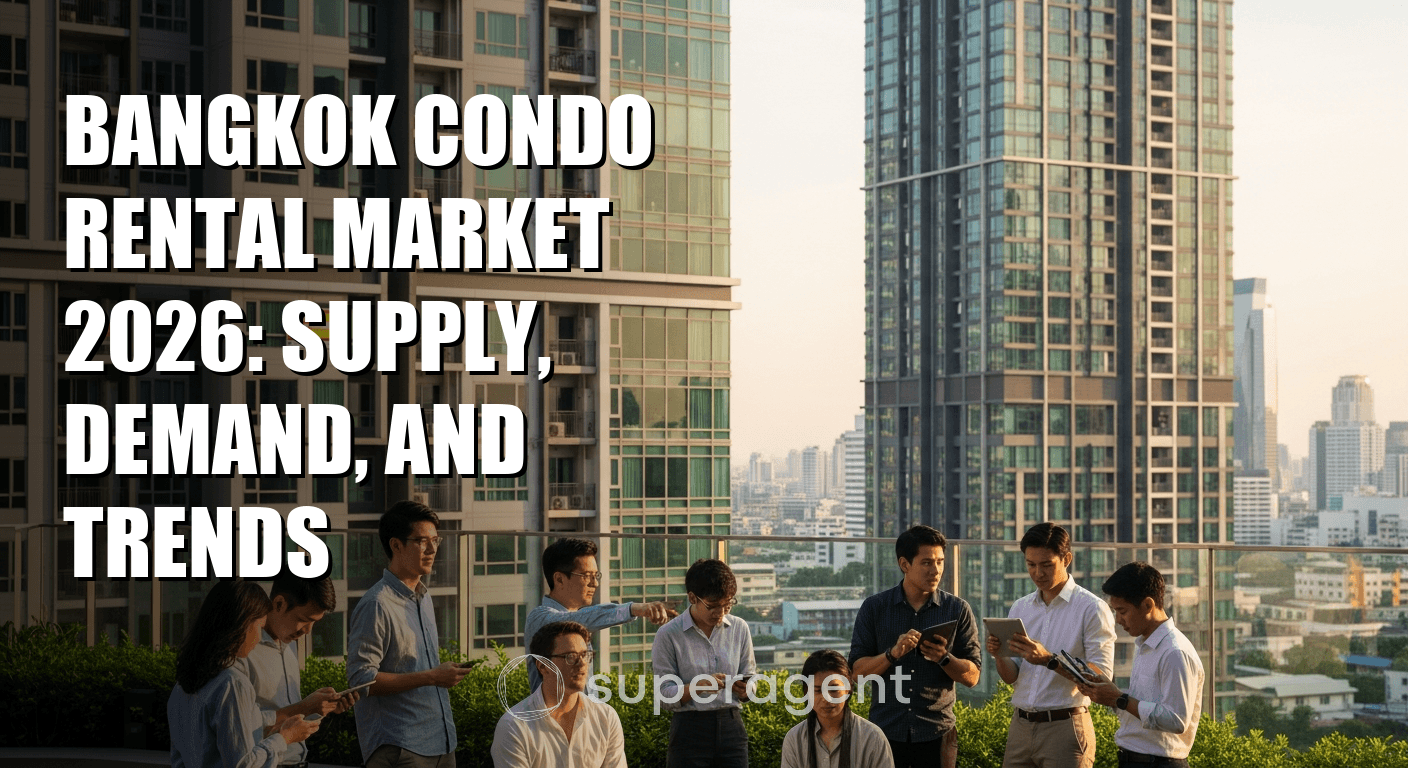
Summary
Analyze the current state of Bangkok's condo rental market with comprehensive data on supply, demand patterns, and emerging trends shaping the industry.
If you've been hunting for a condo in Bangkok lately, you've probably noticed something shifting. The rental market feels different from even two years ago. Landlords are more flexible on terms. Buildings that sat half-empty are suddenly filling up. Neighborhoods that were sleepy side-bets are now hot spots. And rents? They're climbing in some areas, staying flat in others, dropping in a few unexpected pockets.
This isn't random. Something structural is happening in Bangkok's rental market heading into 2026, and if you're serious about finding the right place at the right price, you need to understand what's actually going on beneath the surface.
The Supply Crunch That Changed Everything
Bangkok's condo supply is tightening faster than most people realize. New unit completions in core areas like Ploenchit, Thonglor, and Phrom Phong have slowed noticeably compared to 2023 and 2024. The reason is straightforward: developers got burned chasing the mass-market segment. They built thousands of small units aimed at middle-income buyers and renters, but those buyers didn't materialize in the volume they expected.
Now developers are being more selective. They're targeting either the luxury end (30 million THB and up for ownership) or the ultra-affordable segment (sub-15,000 THB rentals in outer zones). The middle market, where most renters actually hunt, is getting squeezed.
Think about it practically. Twelve months ago, you could find a decent 1-bedroom in a newer building near Asok for 22,000-28,000 THB per month. Today, that same unit costs 26,000-32,000 THB. Not a massive jump, but real. And in neighborhoods further out like Bang Na or Rama 9, older stock is appreciating faster because new supply isn't replacing what gets rented long-term.
According to DDproperty's latest market report, approved condo projects in Bangkok dropped 18% year-over-year through Q3 2025. That directly impacts what's available for rent, especially in the 25,000-40,000 THB range where most working expats and mid-career Thai professionals are hunting.
Demand Keeps Growing, But It's Shifting
Here's what's driving the market right now: three specific groups of renters are competing harder than they were two years ago. First, remote workers and digital nomads. They're not all American software engineers anymore. You're seeing finance people from Singapore, creative studios from Hong Kong, and business service teams from everywhere. They want reliable internet, green space, and to be near the action, which means Ploenchit, Thonglor, Ekkamai, and Petchburi see constant demand.
Second, corporate transfers. Thai companies are expanding their management teams with international hires, and those people need furnished or semi-furnished units in walkable neighborhoods. They're not price-sensitive, but they're also not staying longer than two to three years, so they rent instead of buy. This group is boosting rents in Ari, Silom, and Sukhumvit 50-55.
Third, local young professionals and small families. They're priced out of ownership by Bangkok's land prices, but their incomes are rising. They want modern buildings, security, gyms, and parking. They're less willing to compromise on location than they were five years ago. This group is driving demand in Rama 9, Sukhumvit 71-93, and even emerging areas like Petchkasem and Sena Nikhom.
The catch? They want different things at different price points. Expats in core CBD areas will pay 40,000-60,000 THB for a 2-bed near BTS. Local families want 25,000-35,000 THB for similar size in outer Sukhumvit or Rama 9. The market isn't tightening uniformly. It's fracturing into distinct segments.
Price Movement by Zone: Where Rents Are Actually Headed
Don't trust generalizations about "Bangkok rents rising." That's too broad. Look at specific neighborhoods, because the story changes dramatically depending on where you're looking.
In Sukhumvit's core zone between Ploenchit and Ekkamai, average 1-bedroom rents hit 28,000-35,000 THB by late 2025, up roughly 12% from two years prior. Buildings with solid amenities and less than 15 years old command premium. But walk two sois over into quieter side streets, and you'll find 23,000-27,000 THB for comparable space. The location premium is real and growing.
Silom and Sathon have seen slower price growth, around 5-7% over two years, because supply is more abundant there. You can still find well-maintained 1-beds for 26,000-30,000 THB, which makes it attractive for budget-conscious expats who don't need to be right on Sukhumvit.
The real action is in what Bangkok locals call "emerging zones." Rama 9, where several new projects came online in 2024 and 2025, has pushed rents up from 18,000-22,000 THB to 22,000-27,000 THB for 1-bedroom units in newer buildings. But that's still below Sukhumvit, which is why young Thai families are flooding there. The MRT connection makes commuting to the CBD easy, and your money goes further.
Ratchada-Huay Kwang is similar. It's further out, less glamorous, but the MRT proximity and new supply at reasonable prices (20,000-25,000 THB for 1-bed) are attracting professionals who work downtown. Rents here have climbed 8-10% annually but are stabilizing now that supply is catching up.
Demand vs. Supply: The Numbers That Matter
- Sukhumvit 12-24 (Core): 30,000-36,000 | Low | Very High | Expats, corporates, walkability
- Silom / Sathon: 26,000-31,000 | Moderate | Moderate | Budget expats, Skytrain commute
- Ari / Sanam Pao: 22,000-28,000 | Moderate | Moderate-High | Young professionals, local vibe
- Rama 9 / Sukhumvit 71-93: 22,000-27,000 | High | High | Families, MRT access, value
- Ratchada / Huay Kwang: 20,000-25,000 | High | Moderate | Budget renters, commuters
Furnishing, Terms, and Flexibility Trends
Two years ago, landlords were rigid. Unfurnished only. Two-year minimum leases. Three months' deposit. No negotiation. That's shifted because they have to compete harder for quality tenants in zones with newer supply.
Today you'll see landlords offering furnished options even in older buildings because they know renters want flexibility. Corporate tenants especially want short-term furnished options, and landlords are adapting. You're also seeing more willingness on lease length. Eighteen-month leases are now common where you'd previously see only 24-month minimums.
Deposits are still negotiable but have loosened slightly. One month instead of three is more common in competitive neighborhoods. And utilities bundling is becoming standard in mid-range and up buildings. Some landlords now include water and internet in the quoted rent, which changes the effective cost calculation.
The practical implication? If you're flexible on location and timeline, you have leverage. Landlords in zones with newer supply (Rama 9, outer Sukhumvit) are hungrier for tenants and will negotiate harder on price and terms than in core areas.
What's Coming in 2026
Several projects are scheduled to complete in early 2026 that will add meaningful supply. New buildings in Bangna, Rama 9, and Sena Nikhom will hit the market. That's good for renters seeking value in those zones, but it could also create a short-term glut that keeps rents flat or slightly lower in those areas through mid-2026.
For core Sukhumvit and Silom, new supply is scarce in the pipeline. Expect rents to continue climbing 5-10% annually as demand outpaces supply. The squeeze in desirable zones isn't easing soon.
Interest rates and the Thai economy matter too. Bank of Thailand's monetary policy has been cautious, keeping rates stable. That's supporting borrowing capacity for corporate transfers and remote workers. As long as the baht stays relatively strong against major currencies, expect international renters to maintain purchasing power and keep competing aggressively in premium zones.
One wild card: immigration policy. Longer-stay visa categories for remote workers and retirees would accelerate demand. Shorter-stay crackdowns would suppress it. Keep an eye on that through 2026.
Making Sense of It All
The Bangkok rental market heading into 2026 isn't one story. It's several happening simultaneously in different zones. Core Sukhumvit and Silom are expensive and competitive but supply-constrained, which means rents climb and landlords hold firm on terms. Emerging zones like Rama 9 and outer Sukhumvit have newer supply coming online, which keeps rents more reasonable and creates negotiating room. Budget zones like Ratchada and Huay Kwang are where value renters compete, and supply is abundant enough to keep price growth moderate.
Your actual rental experience depends entirely on which zone you choose and what you're willing to compromise on. If you need to be in the heart of Sukhumvit or Silom for work or lifestyle, expect to pay premium prices and have less flexibility. If you can live 15 minutes further out on the MRT, your money stretches further, and landlords are more willing to negotiate.
The market data shows average rents in central Bangkok running 28,000-35,000 THB for quality 1-bedroom units as of late 2025, with outer zones averaging 20,000-27,000 THB for similar specifications. That spread is only widening as supply dynamics diverge.
When you're actually hunting for a place, don't just look at price. Look at supply velocity in your target zone. Are new buildings completing there? Is demand outpacing supply, or is it balanced? Are landlords actively marketing or do they have waiting lists? That tells you whether you have leverage or need to move fast.
The easiest way to cut through the noise is to see what's actually available in your price range and preferred location right now, then talk to someone who understands local trends. Check Superagent.co to browse current listings and get a real sense of what's on offer in your target neighborhood. The market moves faster than articles can track it, so boots-on-the-ground data matters most.
If you've been hunting for a condo in Bangkok lately, you've probably noticed something shifting. The rental market feels different from even two years ago. Landlords are more flexible on terms. Buildings that sat half-empty are suddenly filling up. Neighborhoods that were sleepy side-bets are now hot spots. And rents? They're climbing in some areas, staying flat in others, dropping in a few unexpected pockets.
This isn't random. Something structural is happening in Bangkok's rental market heading into 2026, and if you're serious about finding the right place at the right price, you need to understand what's actually going on beneath the surface.
The Supply Crunch That Changed Everything
Bangkok's condo supply is tightening faster than most people realize. New unit completions in core areas like Ploenchit, Thonglor, and Phrom Phong have slowed noticeably compared to 2023 and 2024. The reason is straightforward: developers got burned chasing the mass-market segment. They built thousands of small units aimed at middle-income buyers and renters, but those buyers didn't materialize in the volume they expected.
Now developers are being more selective. They're targeting either the luxury end (30 million THB and up for ownership) or the ultra-affordable segment (sub-15,000 THB rentals in outer zones). The middle market, where most renters actually hunt, is getting squeezed.
Think about it practically. Twelve months ago, you could find a decent 1-bedroom in a newer building near Asok for 22,000-28,000 THB per month. Today, that same unit costs 26,000-32,000 THB. Not a massive jump, but real. And in neighborhoods further out like Bang Na or Rama 9, older stock is appreciating faster because new supply isn't replacing what gets rented long-term.
According to DDproperty's latest market report, approved condo projects in Bangkok dropped 18% year-over-year through Q3 2025. That directly impacts what's available for rent, especially in the 25,000-40,000 THB range where most working expats and mid-career Thai professionals are hunting.
Demand Keeps Growing, But It's Shifting
Here's what's driving the market right now: three specific groups of renters are competing harder than they were two years ago. First, remote workers and digital nomads. They're not all American software engineers anymore. You're seeing finance people from Singapore, creative studios from Hong Kong, and business service teams from everywhere. They want reliable internet, green space, and to be near the action, which means Ploenchit, Thonglor, Ekkamai, and Petchburi see constant demand.
Second, corporate transfers. Thai companies are expanding their management teams with international hires, and those people need furnished or semi-furnished units in walkable neighborhoods. They're not price-sensitive, but they're also not staying longer than two to three years, so they rent instead of buy. This group is boosting rents in Ari, Silom, and Sukhumvit 50-55.
Third, local young professionals and small families. They're priced out of ownership by Bangkok's land prices, but their incomes are rising. They want modern buildings, security, gyms, and parking. They're less willing to compromise on location than they were five years ago. This group is driving demand in Rama 9, Sukhumvit 71-93, and even emerging areas like Petchkasem and Sena Nikhom.
The catch? They want different things at different price points. Expats in core CBD areas will pay 40,000-60,000 THB for a 2-bed near BTS. Local families want 25,000-35,000 THB for similar size in outer Sukhumvit or Rama 9. The market isn't tightening uniformly. It's fracturing into distinct segments.
Price Movement by Zone: Where Rents Are Actually Headed
Don't trust generalizations about "Bangkok rents rising." That's too broad. Look at specific neighborhoods, because the story changes dramatically depending on where you're looking.
In Sukhumvit's core zone between Ploenchit and Ekkamai, average 1-bedroom rents hit 28,000-35,000 THB by late 2025, up roughly 12% from two years prior. Buildings with solid amenities and less than 15 years old command premium. But walk two sois over into quieter side streets, and you'll find 23,000-27,000 THB for comparable space. The location premium is real and growing.
Silom and Sathon have seen slower price growth, around 5-7% over two years, because supply is more abundant there. You can still find well-maintained 1-beds for 26,000-30,000 THB, which makes it attractive for budget-conscious expats who don't need to be right on Sukhumvit.
The real action is in what Bangkok locals call "emerging zones." Rama 9, where several new projects came online in 2024 and 2025, has pushed rents up from 18,000-22,000 THB to 22,000-27,000 THB for 1-bedroom units in newer buildings. But that's still below Sukhumvit, which is why young Thai families are flooding there. The MRT connection makes commuting to the CBD easy, and your money goes further.
Ratchada-Huay Kwang is similar. It's further out, less glamorous, but the MRT proximity and new supply at reasonable prices (20,000-25,000 THB for 1-bed) are attracting professionals who work downtown. Rents here have climbed 8-10% annually but are stabilizing now that supply is catching up.
Demand vs. Supply: The Numbers That Matter
- Sukhumvit 12-24 (Core): 30,000-36,000 | Low | Very High | Expats, corporates, walkability
- Silom / Sathon: 26,000-31,000 | Moderate | Moderate | Budget expats, Skytrain commute
- Ari / Sanam Pao: 22,000-28,000 | Moderate | Moderate-High | Young professionals, local vibe
- Rama 9 / Sukhumvit 71-93: 22,000-27,000 | High | High | Families, MRT access, value
- Ratchada / Huay Kwang: 20,000-25,000 | High | Moderate | Budget renters, commuters
Furnishing, Terms, and Flexibility Trends
Two years ago, landlords were rigid. Unfurnished only. Two-year minimum leases. Three months' deposit. No negotiation. That's shifted because they have to compete harder for quality tenants in zones with newer supply.
Talk to us about renting
Share your details and keep reading — we’ll get back to you.
Today you'll see landlords offering furnished options even in older buildings because they know renters want flexibility. Corporate tenants especially want short-term furnished options, and landlords are adapting. You're also seeing more willingness on lease length. Eighteen-month leases are now common where you'd previously see only 24-month minimums.
Deposits are still negotiable but have loosened slightly. One month instead of three is more common in competitive neighborhoods. And utilities bundling is becoming standard in mid-range and up buildings. Some landlords now include water and internet in the quoted rent, which changes the effective cost calculation.
The practical implication? If you're flexible on location and timeline, you have leverage. Landlords in zones with newer supply (Rama 9, outer Sukhumvit) are hungrier for tenants and will negotiate harder on price and terms than in core areas.
What's Coming in 2026
Several projects are scheduled to complete in early 2026 that will add meaningful supply. New buildings in Bangna, Rama 9, and Sena Nikhom will hit the market. That's good for renters seeking value in those zones, but it could also create a short-term glut that keeps rents flat or slightly lower in those areas through mid-2026.
For core Sukhumvit and Silom, new supply is scarce in the pipeline. Expect rents to continue climbing 5-10% annually as demand outpaces supply. The squeeze in desirable zones isn't easing soon.
Interest rates and the Thai economy matter too. Bank of Thailand's monetary policy has been cautious, keeping rates stable. That's supporting borrowing capacity for corporate transfers and remote workers. As long as the baht stays relatively strong against major currencies, expect international renters to maintain purchasing power and keep competing aggressively in premium zones.
One wild card: immigration policy. Longer-stay visa categories for remote workers and retirees would accelerate demand. Shorter-stay crackdowns would suppress it. Keep an eye on that through 2026.
Making Sense of It All
The Bangkok rental market heading into 2026 isn't one story. It's several happening simultaneously in different zones. Core Sukhumvit and Silom are expensive and competitive but supply-constrained, which means rents climb and landlords hold firm on terms. Emerging zones like Rama 9 and outer Sukhumvit have newer supply coming online, which keeps rents more reasonable and creates negotiating room. Budget zones like Ratchada and Huay Kwang are where value renters compete, and supply is abundant enough to keep price growth moderate.
Your actual rental experience depends entirely on which zone you choose and what you're willing to compromise on. If you need to be in the heart of Sukhumvit or Silom for work or lifestyle, expect to pay premium prices and have less flexibility. If you can live 15 minutes further out on the MRT, your money stretches further, and landlords are more willing to negotiate.
The market data shows average rents in central Bangkok running 28,000-35,000 THB for quality 1-bedroom units as of late 2025, with outer zones averaging 20,000-27,000 THB for similar specifications. That spread is only widening as supply dynamics diverge.
When you're actually hunting for a place, don't just look at price. Look at supply velocity in your target zone. Are new buildings completing there? Is demand outpacing supply, or is it balanced? Are landlords actively marketing or do they have waiting lists? That tells you whether you have leverage or need to move fast.
The easiest way to cut through the noise is to see what's actually available in your price range and preferred location right now, then talk to someone who understands local trends. Check Superagent.co to browse current listings and get a real sense of what's on offer in your target neighborhood. The market moves faster than articles can track it, so boots-on-the-ground data matters most.
Share this article
Properties you may like
![[For Rent] CONDO I Aguston Sukhumvit 22 I Pet Friendly I 2 Beds I 2 Baths I Rent 55,000THB/mo](/_next/image?url=https%3A%2F%2Fstorage.googleapis.com%2Fsuperagent-web%2Fattachments%2Flistings%2F2266%2Fd3afcd25-6b79-46cb-9f1f-396acdc3dd10-955-3.jpg&w=3840&q=75)
฿55,000
2 Bed295 sqm
[For Rent] CONDO I Aguston Sukhumvit 22 I Pet Friendly I 2 Beds I 2 Baths I Rent 55,000THB/mo
Phrom Phong
Condo![[For Rent] CONDO I SUPALAI PLACE Sukhumvit 39 I 2 Beds I 2 Baths (1 Jacuzzi) I 55,555THB/mo](/_next/image?url=https%3A%2F%2Fstorage.googleapis.com%2Fsuperagent-web%2Fattachments%2Flistings%2F6743%2Fba530743-48b9-4ac6-92d3-c2247e743cf6-01-supalai-place-skv39-2b-link-heaven.jpg&w=3840&q=75)
฿55,555
2 Bed2142 sqm
[For Rent] CONDO I SUPALAI PLACE Sukhumvit 39 I 2 Beds I 2 Baths (1 Jacuzzi) I 55,555THB/mo
Phrom Phong
Condo![[For Rent] CONDO I Maru Ekkamai 2 I Pet friendly I 2 Beds I 2 Baths I 68,000 THB/mo](/_next/image?url=https%3A%2F%2Fstorage.googleapis.com%2Fsuperagent-web%2Fattachments%2Flistings%2F6602%2F9f1d8f71-ee43-435f-9a44-da16c4092c92-968-1.jpg&w=3840&q=75)
฿68,000
2 Bed360 sqm
[For Rent] CONDO I Maru Ekkamai 2 I Pet friendly I 2 Beds I 2 Baths I 68,000 THB/mo
Ekkamai
Condo![[For Rent] CONDO I Noble State 39 I 2 Beds I 2 Baths I 63,000THB/mo](/_next/image?url=https%3A%2F%2Fstorage.googleapis.com%2Fsuperagent-web%2Fattachments%2Flistings%2F2237%2F60eb58f3-eae5-41ed-a80b-406e004f05d8-940-1.jpg&w=3840&q=75)
฿63,000
2 Bed260 sqm
[For Rent] CONDO I Noble State 39 I 2 Beds I 2 Baths I 63,000THB/mo
Phrom Phong
Condo![[For Rent] CONDO I Rhythm Sukhumvit 36-38 I 2 Beds I 2 Baths I 38,999THB/mo](/_next/image?url=https%3A%2F%2Fstorage.googleapis.com%2Fsuperagent-web%2Fattachments%2Flistings%2F1788%2F942a0215-4128-4c2c-a064-f607e84e7aa4-656-2.jpg&w=3840&q=75)
฿38,999
2 Bed256 sqm
[For Rent] CONDO I Rhythm Sukhumvit 36-38 I 2 Beds I 2 Baths I 38,999THB/mo
Thonglor
Condo![[For Rent] CONDO I CLOUD Thonglor-Phetchaburi I 1 Bed I 1 Bath I 22,500THB/mo](/_next/image?url=https%3A%2F%2Fstorage.googleapis.com%2Fsuperagent-web%2Fattachments%2Flistings%2F6742%2F6cef5361-0dac-4dba-98f1-b0d187559c84-1118-1.jpg&w=3840&q=75)
฿22,500
1 Bed132 sqm
[For Rent] CONDO I CLOUD Thonglor-Phetchaburi I 1 Bed I 1 Bath I 22,500THB/mo
Thonglor
Condo![[For Rent] CONDO I City Smart Sukhumvit 18 I 3 Beds I 3 Baths I 65,000mo/THB](/_next/image?url=https%3A%2F%2Fstorage.googleapis.com%2Fsuperagent-web%2Fattachments%2Flistings%2F6741%2Fd371c89d-a913-42c4-a673-e540afae4f46-1116-1.jpg&w=3840&q=75)
฿65,000
3 Bed3125 sqm
[For Rent] CONDO I City Smart Sukhumvit 18 I 3 Beds I 3 Baths I 65,000mo/THB
Condo![[For Rent] CONDO I The Coast Bangkok I 1 Bed I 1 Bath I 20,000mo/THB](/_next/image?url=https%3A%2F%2Fstorage.googleapis.com%2Fsuperagent-web%2Fattachments%2Flistings%2F6740%2F498477ce-4ffa-4e4c-ab08-0e565d9c4bbe-1115-3.jpg&w=3840&q=75)
฿20,000
1 Bed146 sqm
[For Rent] CONDO I The Coast Bangkok I 1 Bed I 1 Bath I 20,000mo/THB
Bang Na
Condo![[For Rent] CONDO I IDEO Sukhumvit-RAMA 4 I 2 Beds I 2 Baths I 55,000mo/THB](/_next/image?url=https%3A%2F%2Fstorage.googleapis.com%2Fsuperagent-web%2Fattachments%2Flistings%2F6739%2F15df221d-5b8e-497c-b7ce-a6b9b6412cab-1113-1.jpg&w=3840&q=75)
฿55,000
2 Bed265 sqm
[For Rent] CONDO I IDEO Sukhumvit-RAMA 4 I 2 Beds I 2 Baths I 55,000mo/THB
Phra Khanong
Condo![[For Rent] CONDO I Downtown 49 I Pet Friendly I 1 Bed I 1 Bath I 23,000mo/THB](/_next/image?url=https%3A%2F%2Fstorage.googleapis.com%2Fsuperagent-web%2Fattachments%2Flistings%2F6738%2F11cf2ffe-1f01-4ccc-991c-2ad608f1ba73-1112-1.jpg&w=3840&q=75)
฿23,000
1 Bed135 sqm
[For Rent] CONDO I Downtown 49 I Pet Friendly I 1 Bed I 1 Bath I 23,000mo/THB
Thonglor
CondoMore like this
 In Guides · Superagent EditorialHidden Costs of Renting a Condo in Bangkok Nobody Warns You AboutBangkok condo rent looks affordable until month one hits. Here are the real costs beyond the headline figure that catch most renters off guard.25 May 20261 min read
 In Guides · Superagent EditorialWhat a Long-Vacant Bangkok Condo Unit Is Actually Telling YouA Bangkok condo vacant for months signals overpricing, landlord issues, or real problems. Here is how to read the signs.25 May 20261 min read
 In Guides · Superagent EditorialRed Flags in a Bangkok Rental Contract to Watch Out ForBangkok rental contracts often hide risky clauses. Here are the red flags every tenant must catch before signing any lease.25 May 20261 min read
 In Guides · Superagent EditorialWorking Online from a Condo: How to Choose the Perfect Room for ProductivityLearn how to choose the best condo room for working online with tips on lighting, noise, and furniture setup to maximize productivity.9 May 20261 min read