Red Flags in a Bangkok Rental Contract to Watch Out For
Guides
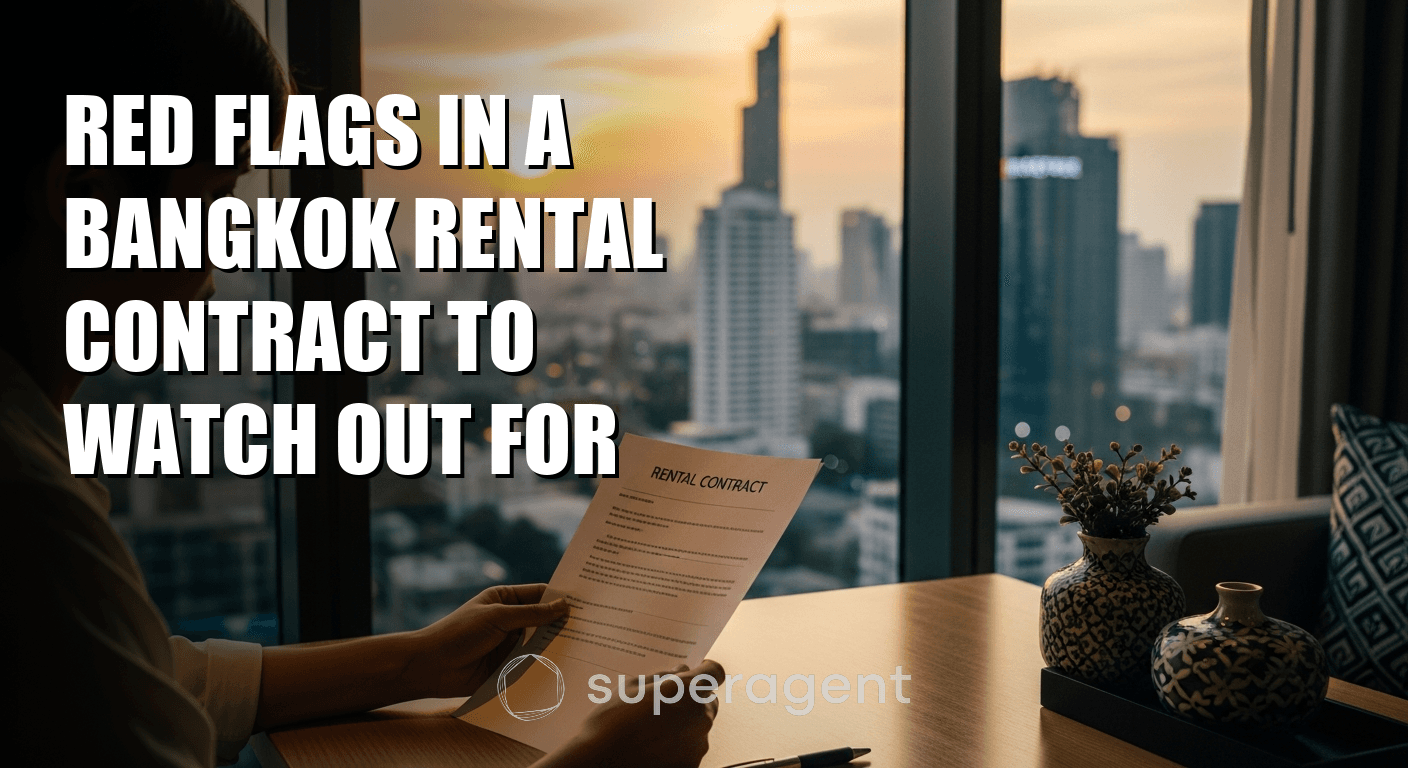
Red Flags in a Bangkok Rental Contract to Watch Out For
Most Bangkok lease contracts favor landlords. These are the clauses to catch and fix before you sign
Summary
Bangkok rental contracts often hide risky clauses. Here are the red flags every tenant must catch before signing any lease.
Why Bangkok Leases Need Close Reading
Most Bangkok rental contracts are written by landlords or their lawyers. The default language protects the landlord's interests, not yours. Many tenants sign without reading in full, then discover the problems only when something goes wrong, usually a deposit dispute at the end of the tenancy.
The good news is that most problematic clauses are identifiable before you sign. You do not need a lawyer for a standard residential lease, but you do need to read carefully and ask questions about anything you do not understand.
Vague Damage Clauses
Watch for any clause that gives the landlord the right to deduct from your deposit for "damages as determined by the landlord" or "wear and tear beyond normal use" without defining what that means. These phrases are intentionally broad and create disputes at checkout.
The fix is a move-in inventory checklist. Before you hand over any money, walk through the unit with the landlord or agent and document the condition of every item, walls, floors, appliances, furniture, fixtures. Both parties sign and date the checklist. This becomes your reference point when you move out.
If the landlord resists doing an inventory checklist, do it yourself on the day you get the keys. Use your phone camera. Timestamp every photo. Send the full set to the landlord by email the same day with a note saying these photos represent the condition of the unit at handover. This creates a record even without a formal checklist.
Arbitrary Utility Deductions
Some Bangkok contracts include a clause allowing the landlord to deduct any unpaid utility bills from your deposit without providing receipts. This is problematic because it gives the landlord the ability to claim bills you have already paid or inflate final readings.
Request an amendment requiring itemized billing with copies of actual invoices. At move-out, insist on seeing the final meter readings before you hand back the keys. Document the meters yourself with photos on the day you leave.
No Notice for Landlord Entry
A contract that allows the landlord or building juristic staff to enter your unit with only verbal notice or no notice at all is a serious problem. This is your home. You have a right to privacy even as a tenant under Thai civil law.
Request a clause requiring at least 24 hours written notice before any entry, including for repairs, inspections, or showings to future tenants. Most reasonable landlords will agree to this. If a landlord refuses this basic term, that refusal itself tells you something important.
The As-Is Condition Clause
Some contracts include language stating that you accept the unit "in its current condition" or "as-is." By itself this is not unusual, but it becomes dangerous without proper documentation. If you accept a unit as-is and there is pre-existing damage that you did not document, you may be held responsible for it when you leave.
Before signing any as-is clause, do a thorough walk-through and photograph every imperfection, scuffs on walls, scratches on floors, chips in fixtures, any marks on furniture. Send these photos to the landlord in writing and ask them to confirm in writing that these defects existed before your tenancy. This protects you against deposit deductions for damage you did not cause.
Auto-Renewal Traps
Some Bangkok leases include an automatic renewal clause that extends the contract by 12 months if you do not give written notice within a specific window before expiry, often 30 to 60 days before the lease end date. If you miss this window, you are locked in for another year.
Check your contract for any mention of automatic renewal or tacit renewal. If such a clause exists, set a calendar reminder at least 90 days before your lease ends so you have time to decide and notify in writing if needed.
Subletting Clauses Without Exceptions
Standard Bangkok leases prohibit subletting, which is expected. But some contracts extend this prohibition to include any form of short-term rental or guest accommodation. If you occasionally have extended family or friends staying for several weeks, or if you want flexibility in your living arrangements, check whether the contract prohibits this.
Some contracts also prohibit any form of short-stay platform use. If this matters to you, either negotiate an exception or look for a landlord who is open to it. Do not sign a contract with prohibitions you intend to ignore, as it creates grounds for lease termination.
Missing Force Majeure Protection
A contract that does not include a force majeure clause leaves both parties exposed if something unexpected makes the unit uninhabitable or impossible to access. Flooding, government closures, building condemnation, or structural damage can all create situations where a tenant needs to exit without full penalty.
Ask for a clause that allows either party to terminate with short notice and without full penalty in the event of circumstances beyond reasonable control. This is a standard protection in commercial leases and worth including in residential ones.
Thai-Only Contracts
If the contract is written only in Thai and you sign it, you are fully bound by the Thai text. Your understanding of what you agreed to in a verbal summary does not matter in a dispute. What is written in Thai is what the law will enforce.
Always request a bilingual version, Thai and English, with both versions signed. If the landlord cannot provide one, have a Thai-speaking person translate the contract before you sign. This is especially important in buildings in Asok, Thong Lo, or Ekkamai where landlords sometimes use standard Thai templates without bilingual support.
Superagent reviews lease contracts on behalf of tenants before signing and flags clauses like these as part of the service. The review is free for tenants.
Krisdika, Office of the Council of State, official source for Thai civil and commercial code, which governs residential lease rights and obligations.
Office of the Consumer Protection Board Thailand, handles complaints related to landlord-tenant disputes and unfair contract terms.
Why Bangkok Leases Need Close Reading
Most Bangkok rental contracts are written by landlords or their lawyers. The default language protects the landlord's interests, not yours. Many tenants sign without reading in full, then discover the problems only when something goes wrong, usually a deposit dispute at the end of the tenancy.
The good news is that most problematic clauses are identifiable before you sign. You do not need a lawyer for a standard residential lease, but you do need to read carefully and ask questions about anything you do not understand.
Vague Damage Clauses
Watch for any clause that gives the landlord the right to deduct from your deposit for "damages as determined by the landlord" or "wear and tear beyond normal use" without defining what that means. These phrases are intentionally broad and create disputes at checkout.
The fix is a move-in inventory checklist. Before you hand over any money, walk through the unit with the landlord or agent and document the condition of every item, walls, floors, appliances, furniture, fixtures. Both parties sign and date the checklist. This becomes your reference point when you move out.
If the landlord resists doing an inventory checklist, do it yourself on the day you get the keys. Use your phone camera. Timestamp every photo. Send the full set to the landlord by email the same day with a note saying these photos represent the condition of the unit at handover. This creates a record even without a formal checklist.
Continue reading after that.
Looking for a condo
to rent?
Leave your name and phone. We'll follow up while you keep reading.
100% Secure
Fast Response
Free Consultation
Arbitrary Utility Deductions
Some Bangkok contracts include a clause allowing the landlord to deduct any unpaid utility bills from your deposit without providing receipts. This is problematic because it gives the landlord the ability to claim bills you have already paid or inflate final readings.
Request an amendment requiring itemized billing with copies of actual invoices. At move-out, insist on seeing the final meter readings before you hand back the keys. Document the meters yourself with photos on the day you leave.
No Notice for Landlord Entry
A contract that allows the landlord or building juristic staff to enter your unit with only verbal notice or no notice at all is a serious problem. This is your home. You have a right to privacy even as a tenant under Thai civil law.
Request a clause requiring at least 24 hours written notice before any entry, including for repairs, inspections, or showings to future tenants. Most reasonable landlords will agree to this. If a landlord refuses this basic term, that refusal itself tells you something important.
The As-Is Condition Clause
Some contracts include language stating that you accept the unit "in its current condition" or "as-is." By itself this is not unusual, but it becomes dangerous without proper documentation. If you accept a unit as-is and there is pre-existing damage that you did not document, you may be held responsible for it when you leave.
Before signing any as-is clause, do a thorough walk-through and photograph every imperfection, scuffs on walls, scratches on floors, chips in fixtures, any marks on furniture. Send these photos to the landlord in writing and ask them to confirm in writing that these defects existed before your tenancy. This protects you against deposit deductions for damage you did not cause.
Auto-Renewal Traps
Some Bangkok leases include an automatic renewal clause that extends the contract by 12 months if you do not give written notice within a specific window before expiry, often 30 to 60 days before the lease end date. If you miss this window, you are locked in for another year.
Check your contract for any mention of automatic renewal or tacit renewal. If such a clause exists, set a calendar reminder at least 90 days before your lease ends so you have time to decide and notify in writing if needed.
Subletting Clauses Without Exceptions
Standard Bangkok leases prohibit subletting, which is expected. But some contracts extend this prohibition to include any form of short-term rental or guest accommodation. If you occasionally have extended family or friends staying for several weeks, or if you want flexibility in your living arrangements, check whether the contract prohibits this.
Some contracts also prohibit any form of short-stay platform use. If this matters to you, either negotiate an exception or look for a landlord who is open to it. Do not sign a contract with prohibitions you intend to ignore, as it creates grounds for lease termination.
Continue reading after that.
Looking for a condo
to rent?
Leave your name and phone. We'll follow up while you keep reading.
100% Secure
Fast Response
Free Consultation
Missing Force Majeure Protection
A contract that does not include a force majeure clause leaves both parties exposed if something unexpected makes the unit uninhabitable or impossible to access. Flooding, government closures, building condemnation, or structural damage can all create situations where a tenant needs to exit without full penalty.
Ask for a clause that allows either party to terminate with short notice and without full penalty in the event of circumstances beyond reasonable control. This is a standard protection in commercial leases and worth including in residential ones.
Thai-Only Contracts
If the contract is written only in Thai and you sign it, you are fully bound by the Thai text. Your understanding of what you agreed to in a verbal summary does not matter in a dispute. What is written in Thai is what the law will enforce.
Always request a bilingual version, Thai and English, with both versions signed. If the landlord cannot provide one, have a Thai-speaking person translate the contract before you sign. This is especially important in buildings in Asok, Thong Lo, or Ekkamai where landlords sometimes use standard Thai templates without bilingual support.
Superagent reviews lease contracts on behalf of tenants before signing and flags clauses like these as part of the service. The review is free for tenants.
Krisdika, Office of the Council of State, official source for Thai civil and commercial code, which governs residential lease rights and obligations.
Office of the Consumer Protection Board Thailand, handles complaints related to landlord-tenant disputes and unfair contract terms.
Share this article
Properties you may like
![[For Rent] CONDO I Maestro 14 Siam-Ratchathewi Pet Friendly I 1 Bed I 1 Bath I 22,000THB/mo](/_next/image?url=https%3A%2F%2Fstorage.googleapis.com%2Fsuperagent-web%2Fattachments%2Flistings%2F6686%2F5ae8a77f-b6fb-4578-a765-e56f493cd25f-1058.png&w=3840&q=75)
฿25,000
1 Bed130 sqm
[For Rent] CONDO I Maestro 14 Siam-Ratchathewi Pet Friendly I 1 Bed I 1 Bath I 22,000THB/mo
Siam
Condo![[For Rent] CONDO I Las Colinas Condominium I 2 Beds I 3 Baths I 85,000THB/mo](/_next/image?url=https%3A%2F%2Fstorage.googleapis.com%2Fsuperagent-web%2Fattachments%2Flistings%2F6828%2F80f345c4-488e-43b2-b017-c9fbb17b520d-99486dd8-4237-4ba2-9207-01ce4f66b21f-media.jpg&w=3840&q=75)
฿85,000
2 Bed3170 sqm
[For Rent] CONDO I Las Colinas Condominium I 2 Beds I 3 Baths I 85,000THB/mo
Asoke
Condo![[For Rent] CONDO I The Diplomat 39 I 2 Beds I 2 Baths I 89,000THB/mo](/_next/image?url=https%3A%2F%2Fstorage.googleapis.com%2Fsuperagent-web%2Fattachments%2Flistings%2F6784%2Ff92c62cc-d3be-42df-adca-b8f96fb02cfb-1163-1.jpg&w=3840&q=75)
฿89,000
2 Bed286 sqm
[For Rent] CONDO I The Diplomat 39 I 2 Beds I 2 Baths I 89,000THB/mo
Phrom Phong
Condo![[For Rent] CONDO I KEN Attitude Rattanathibet I Duplex I 2 Beds I 2 Baths I 40,000THB/mo](/_next/image?url=https%3A%2F%2Fstorage.googleapis.com%2Fsuperagent-web%2Fattachments%2Flistings%2F6852%2F17c1715e-4458-4008-bb0b-072a4c081166-img_0557.jpeg&w=3840&q=75)
฿40,000
2 Bed277 sqm
[For Rent] CONDO I KEN Attitude Rattanathibet I Duplex I 2 Beds I 2 Baths I 40,000THB/mo
Condo![[For Rent] CONDO I H Sukhumvit 43 I 1 Bed I 1 Bath I 28,000THB/mo](/_next/image?url=https%3A%2F%2Fstorage.googleapis.com%2Fsuperagent-web%2Fattachments%2Flistings%2F6851%2Ff355c21a-a282-4338-86c6-dc5bb3368321-1244-1.jpg&w=3840&q=75)
฿28,000
1 Bed143 sqm
[For Rent] CONDO I H Sukhumvit 43 I 1 Bed I 1 Bath I 28,000THB/mo
Phrom Phong
Condo![[For Rent] CONDO I The Base Park West T77 I 2 Beds I 2 Baths I 24,000THB/mo](/_next/image?url=https%3A%2F%2Fstorage.googleapis.com%2Fsuperagent-web%2Fattachments%2Flistings%2F6723%2Fabc06b19-f7fa-4950-98f6-8bdd841b26a6-1098-3.jpg&w=3840&q=75)
฿24,000
2 Bed253 sqm
[For Rent] CONDO I The Base Park West T77 I 2 Beds I 2 Baths I 24,000THB/mo
On Nut
Condo![[For Rent] CONDO I The Room Phaya Thai I 1 Bed I 1 Bath I 20,000THB/mo](/_next/image?url=https%3A%2F%2Fstorage.googleapis.com%2Fsuperagent-web%2Fattachments%2Flistings%2F2042%2F47afcf0d-8998-4283-abfe-8451d5c47178-1000029204.jpg&w=3840&q=75)
฿20,000
1 Bed128 sqm
[For Rent] CONDO I The Room Phaya Thai I 1 Bed I 1 Bath I 20,000THB/mo
Condo![[For Rent] CONDO I IDEO Rama 9-Asoke I Duplex I 1 Bed I 1 Bath I 36,000THB/mo](/_next/image?url=https%3A%2F%2Fstorage.googleapis.com%2Fsuperagent-web%2Fattachments%2Flistings%2F6795%2Fa7e5e587-f4be-4b3e-a635-839870c16713-1174-4.jpg&w=3840&q=75)
฿36,000
1 Bed138 sqm
[For Rent] CONDO I IDEO Rama 9-Asoke I Duplex I 1 Bed I 1 Bath I 36,000THB/mo
Condo![[For Rent/Sale] CONDO I Park Origin Thonglor I 3 Beds I 2 Baths I Rent 95,000 THB/mo - Sale 26mb THB](/_next/image?url=https%3A%2F%2Fstorage.googleapis.com%2Fsuperagent-web%2Fattachments%2Flistings%2F1508%2F725e6df5-039f-428c-a0c8-2f5d596e7833-420-1.jpg&w=3840&q=75)
฿95,000
3 Bed272 sqm
[For Rent/Sale] CONDO I Park Origin Thonglor I 3 Beds I 2 Baths I Rent 95,000 THB/mo - Sale 26mb THB
Thonglor
Condo![[For Rent] CONDO I Maru Ekkamai 2 I Pet friendly I 2 Beds I 2 Baths I 68,000 THB/mo](/_next/image?url=https%3A%2F%2Fstorage.googleapis.com%2Fsuperagent-web%2Fattachments%2Flistings%2F6602%2F9f1d8f71-ee43-435f-9a44-da16c4092c92-968-1.jpg&w=3840&q=75)
฿68,000
2 Bed360 sqm
[For Rent] CONDO I Maru Ekkamai 2 I Pet friendly I 2 Beds I 2 Baths I 68,000 THB/mo
Ekkamai
CondoMore like this
 In Guides · Superagent EditorialHidden Costs of Renting a Condo in Bangkok Nobody Warns You AboutBangkok condo rent looks affordable until month one hits. Here are the real costs beyond the headline figure that catch most renters off guard.25 May 20261 min read
 In Guides · Superagent EditorialWhat a Long-Vacant Bangkok Condo Unit Is Actually Telling YouA Bangkok condo vacant for months signals overpricing, landlord issues, or real problems. Here is how to read the signs.25 May 20261 min read
 In Guides · Superagent EditorialWorking Online from a Condo: How to Choose the Perfect Room for ProductivityLearn how to choose the best condo room for working online with tips on lighting, noise, and furniture setup to maximize productivity.9 May 20261 min read
 In Guides · Superagent EditorialThe Real Reason Bangkok Agents Aren't Finding You TenantsBangkok agents often go weeks without placing a tenant. The issue is structural: incentive gaps, limited networks, and no systematic follow-up on leads.15 Jun 20261 min read