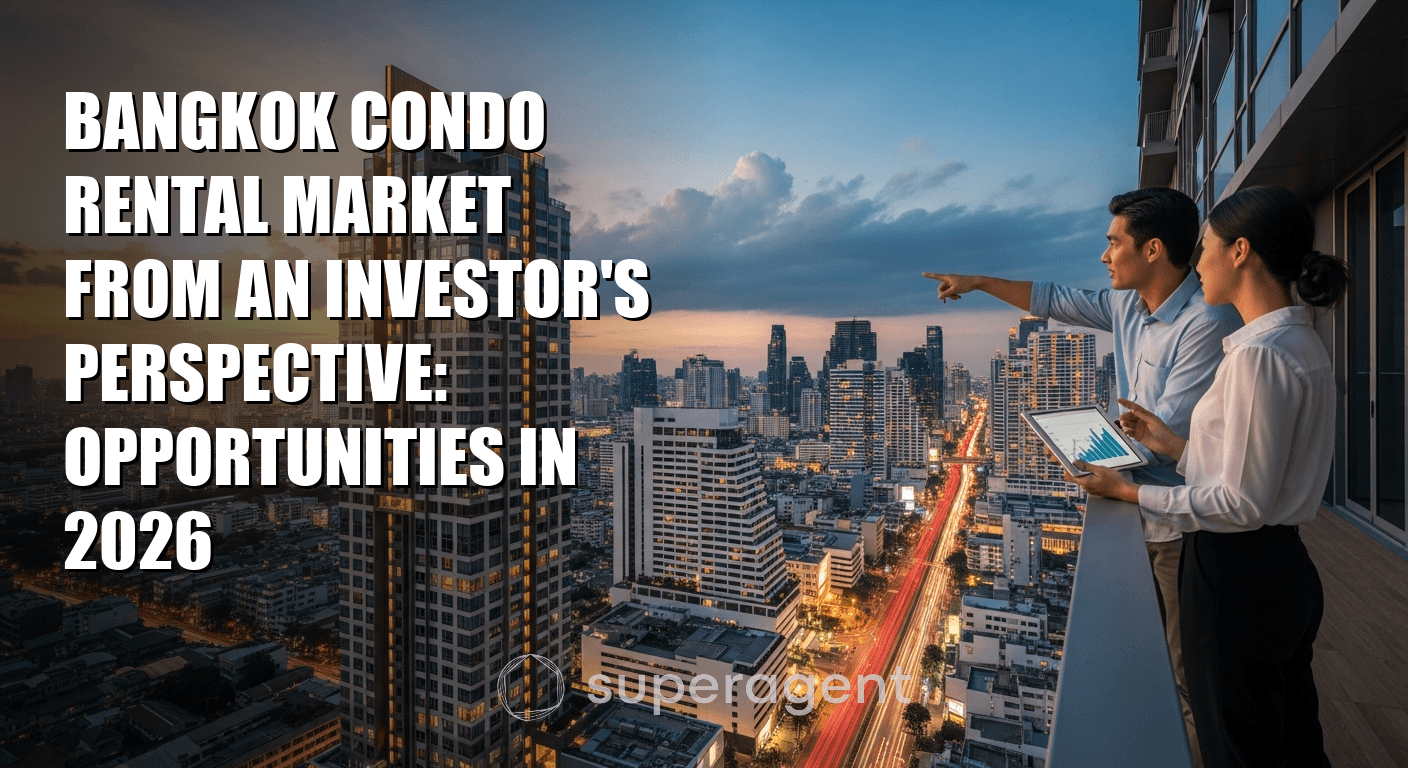
Bangkok Condo Rental Market from an Investor's Perspective: Opportunities in 2026
Guides
Bangkok Condo Rental Market from an Investor's Perspective: Opportunities in 2026
Discover key investment opportunities in Bangkok's rental market as 2026 approaches with shifting demand patterns.
Summary
Explore ตลาดเช่าคอนโดสำหรับนักลงทุน trends and opportunities in 2026. Learn how Bangkok's rental landscape is evolving for property investors seeking retur
If you have been watching Bangkok's condo market for the past year or two, you have probably noticed something shifting. Rental yields are climbing, vacancy rates in some zones are tightening, and property managers are getting pickier about their tenants. For someone with capital sitting on the sidelines, 2026 is shaping up to be an interesting moment to think seriously about condo investment for rental income. The question is not whether to invest, but where, how much you need, and which neighborhoods will actually put money back in your pocket month after month.
The rental condo market in Bangkok is not what it was five years ago. Back then, you could buy almost anything near a BTS station and expect a decent rental queue. Today, tenant quality matters more, location specificity is crucial, and knowing your exit strategy is half the battle. This guide walks you through how to think like an investor in 2026, not just like a buyer.
Why Now is Different: The 2026 Bangkok Rental Market Reality
Bangkok's condo rental market has matured. According to CBRE Thailand, average gross rental yields in central Bangkok zones have hovered between 3.5% and 5.2% over the past two years, with micro-location being the deciding factor between a 2.8% dud and a 5.5% winner. That spread is everything for an investor.
The reason yields vary so wildly is simple: not all condos rent the same way. A one-bedroom in Thonglor between Soi 38 and Soi 47 might command 28,000 to 35,000 THB per month with a three-month waiting list. The same unit two neighborhoods over? Maybe 22,000 to 26,000 THB with a six-week vacancy cycle. The building itself, the floor level, unit size, and whether it has a bathtub or only a shower all matter to today's renters.
Demand has also shifted. Expats working in tech, digital marketing, and e-commerce now outnumber the traditional teaching and service industry crowd. They want fast Wi-Fi, co-working spaces nearby, and access to cafes and gyms. That changes which buildings and neighborhoods stay booked.
Which Neighborhoods Offer the Best Rental Yield in 2026
Let's talk specifics. If you are thinking about buying a condo to rent out, three zones dominate investor conversations right now: Thonglor, Ari, and Petchburi with its spillover into Makkasan.
Thonglor is the obvious choice, but it is also the most saturated. You are looking at entry prices of 3.5 million to 5.2 million THB for a one-bedroom that will rent for 28,000 to 36,000 THB monthly. That works out to a gross yield of about 3.2% to 4.1%. It is solid, but not a knock-your-socks-off return. The upside is tenant stability, fast turnaround between guests, and predictable appreciation. If you buy near BTS Thonglor or BTS Ekkamai, you have a nearly infinite renter pool.
Ari, by contrast, is getting hot. Two-bedroom units there can be scooped up for 2.8 million to 3.8 million THB and rented for 26,000 to 32,000 THB. That is a 4.2% to 5.1% gross yield, and vacancy is lower because fewer investors have woken up to the neighborhood yet. Ari is close enough to Thonglor for business people, but cheaper and quieter. Renters there tend to stay longer, which cuts your turnover costs.
Petchburi and Makkasan are the dark horse. This zone is booming because of the new Airport Rail Link extension and the massive office boom around Rama IX. One-beds there go for 2.2 million to 3.2 million and rent for 20,000 to 26,000 THB monthly. Gross yield, 4.1% to 4.9%. The tenant profile is shifting from backpackers and budget expats to young professionals and families. Lower price entry, better tenant quality, and less competition among landlords.
Understanding Your Actual Monthly Returns After Costs
Here is where most investor conversations go off the rails. Everyone talks gross yield. Almost nobody talks net yield after taxes, maintenance, property management fees, insurance, and the occasional vacancy.
According to Thailand's Revenue Department, rental income on property is taxed as personal income. If you rent out a condo through your own name, you pay progressive income tax on 80% of the gross rental income after deducting 20% as a standard allowance. That means a unit generating 30,000 THB per month (360,000 THB annually) is taxed on 288,000 THB, not the full 360,000. At a mid-range personal tax rate of around 17%, you are paying roughly 49,000 THB annually in income tax.
Then add property management fees, typically 5% to 8% of monthly rent. A 30,000 THB unit costs you 1,500 to 2,400 THB per month in management. Condo common fees run 2,500 to 4,500 THB monthly depending on the building. Building insurance, your own landlord insurance, and a small reserve for maintenance easily add another 1,500 THB monthly.
That 30,000 THB rent check turns into roughly 22,000 to 24,000 THB of actual money in your pocket, month after month. Your net yield just dropped from 3.6% to closer to 2.9%. Still respectable if you also believe the property will appreciate 5% to 7% annually, but nowhere near the headline number.
The Building and Unit Type That Actually Rents
Not all condos are created equal for rental. A 35 square meter studio with no bathtub will always be hard to rent at a premium, no matter the location. A one-bedroom unit with an actual separate kitchen, a bathtub, and floor-to-ceiling windows? That rents fast and commands a 12% to 18% premium over comparable studios.
Building amenities matter hugely. If a property has a gym, a co-working space, or a proper business center, you can add 1,500 to 3,000 THB to the monthly rent. A rooftop garden or a good restaurant on the ground floor attracts the tenant who will stay for two years instead of six months. Building security and package management, especially in zones like Petchburi where delivery is constant, are huge rental multipliers.
Here is a real example. A brand new condo called Ideo Mobi near BTS Bang Bua (on the Sukhumvit line, heading toward Petchburi) opened last year. Similar one-bedrooms in older buildings nearby rent for 22,000 to 25,000 THB. Ideo Mobi units, with their modern finish, gym, and proximity to the new Airport Rail, are getting 26,000 to 29,000 THB consistently with less than two weeks vacancy between tenants. The building's management is sharp, the tenant vetting is professional, and the unit quality is high. Those three factors justify the premium and make the investment safer.
Tax Planning and Legal Structure for Rental Investors
Most Bangkok condo investors hold their properties under their personal name. It is simple, it is cheap to set up, and it avoids corporate red tape. But from a tax standpoint, it is not always optimal.
If you have multiple units or expect your rental income to exceed 1.5 million THB annually, registering as a self-employed individual for tax purposes can actually save you money. You can then deduct all rental expenses directly against income before tax, which is way better than the standard 20% allowance. Repairs, new furniture, marketing for tenants, and even your time managing the property all become deductible.
Some investors also explore setting up a limited company (which costs roughly 10,000 THB and takes a few days), especially if they plan to buy multiple units. Corporate tax rates are a flat 20% on net profit, which can be lower than personal progressive rates once you hit higher income brackets. The company can also hold the property more cleanly for future sale or if you ever need to pass it to family members.
This is not tax advice, but it is the territory you need to explore with an accountant before you commit 3 million THB to a purchase. The difference between smart structure and lazy structure can be 50,000 to 150,000 THB per year in saved taxes.
Exit Strategy and Market Timing for 2026
Every investor needs an exit. Are you planning to hold for five years and then sell? Ten years? Are you betting on appreciation, rental income, or both?
Bangkok condo prices have historically appreciated 4% to 6% annually in strong zones, with softer years at 1% to 2%. If you buy at 3.5 million THB with the intention to hold for seven years and earn 4% annual appreciation, your unit should be worth roughly 4.6 million THB at exit, plus you will have collected maybe 1.8 million THB in net rental income. That is a total return of about 72% over seven years, or roughly 8.3% per year. It is a reasonable outcome, especially for a leveraged investment if you financed part of the purchase.
The risk, of course, is that Bangkok's condo supply keeps expanding, especially in zones where you invested. Too much new supply can flatten prices and increase vacancy. Keeping an eye on upcoming projects in your neighborhood through DDproperty or Fazwaz is essential. If you notice three new mid-range buildings breaking ground within two kilometers of your unit, your rental competition just increased and your appreciation potential just decreased.
- Thonglor: 3.5M to 5.2M THB | 28,000 to 36,000 THB | 3.2% to 4.1% | Stable, high-profile tenants, fast turnaround
- Ari: 2.8M to 3.8M THB | 26,000 to 32,000 THB | 4.2% to 5.1% | Emerging value, longer tenant stays, less saturated
- Petchburi/Makkasan: 2.2M to 3.2M THB | 20,000 to 26,000 THB | 4.1% to 4.9% | Affordable entry, professional tenants, infrastructure growth
The data shows that while Thonglor commands headline rent, Ari and Petchburi deliver better yields at lower entry cost. According to Knight Frank Thailand, zones outside the CBD premium are seeing higher tenant demand in 2025 and 2026 as remote work normalizes and young professionals seek value. That shift favors newer investors looking for better risk-adjusted returns.
Making the Decision: Should You Actually Buy in 2026
If you have been sitting with capital waiting for the right moment, 2026 is solid. Rental rates are stable, tenant demand is strong, and pricing has not yet skyrocketed in secondary zones like Ari and Petchburi. Interest rates in Thailand are holding steady around 2.5% to 3.5% for mortgage financing, which makes leveraged purchases viable for serious investors.
The key is to buy for rental yield, not speculation. Pick a building with strong management, a unit type that rentable (not a weird studio with no kitchen), and a neighborhood with visible tenant demand. Walk the area at different times of day. Talk to property agents who specialize in rentals, not just sales. Check the building's occupancy rate, not just the project's hype.
Your first condo rental investment should be boring, not flashy. You want a one or two-bedroom in a mid-range building where 80% of tenants are working professionals aged 25 to 45, not backpackers or students. That unit will rent reliably, generate steady cash flow, and appreciate without drama. The sexy returns come from your second and third purchase, when you know the market and can spot genuine opportunities.
If you are serious about this path, start by browsing real listings on Superagent and talk to agents who specialize in rental yield analysis, not just transaction volume. Look at neighborhoods beyond the obvious Thonglor hype. Run the actual net yield numbers after taxes and fees. Get a Thai accountant's input on tax structure. Then, when you are ready, move quickly on a building and unit that fits your criteria. The Bangkok rental market rewards preparation and local knowledge, not luck.
If you have been watching Bangkok's condo market for the past year or two, you have probably noticed something shifting. Rental yields are climbing, vacancy rates in some zones are tightening, and property managers are getting pickier about their tenants. For someone with capital sitting on the sidelines, 2026 is shaping up to be an interesting moment to think seriously about condo investment for rental income. The question is not whether to invest, but where, how much you need, and which neighborhoods will actually put money back in your pocket month after month.
The rental condo market in Bangkok is not what it was five years ago. Back then, you could buy almost anything near a BTS station and expect a decent rental queue. Today, tenant quality matters more, location specificity is crucial, and knowing your exit strategy is half the battle. This guide walks you through how to think like an investor in 2026, not just like a buyer.
Why Now is Different: The 2026 Bangkok Rental Market Reality
Bangkok's condo rental market has matured. According to CBRE Thailand, average gross rental yields in central Bangkok zones have hovered between 3.5% and 5.2% over the past two years, with micro-location being the deciding factor between a 2.8% dud and a 5.5% winner. That spread is everything for an investor.
The reason yields vary so wildly is simple: not all condos rent the same way. A one-bedroom in Thonglor between Soi 38 and Soi 47 might command 28,000 to 35,000 THB per month with a three-month waiting list. The same unit two neighborhoods over? Maybe 22,000 to 26,000 THB with a six-week vacancy cycle. The building itself, the floor level, unit size, and whether it has a bathtub or only a shower all matter to today's renters.
Demand has also shifted. Expats working in tech, digital marketing, and e-commerce now outnumber the traditional teaching and service industry crowd. They want fast Wi-Fi, co-working spaces nearby, and access to cafes and gyms. That changes which buildings and neighborhoods stay booked.
Which Neighborhoods Offer the Best Rental Yield in 2026
Let's talk specifics. If you are thinking about buying a condo to rent out, three zones dominate investor conversations right now: Thonglor, Ari, and Petchburi with its spillover into Makkasan.
Thonglor is the obvious choice, but it is also the most saturated. You are looking at entry prices of 3.5 million to 5.2 million THB for a one-bedroom that will rent for 28,000 to 36,000 THB monthly. That works out to a gross yield of about 3.2% to 4.1%. It is solid, but not a knock-your-socks-off return. The upside is tenant stability, fast turnaround between guests, and predictable appreciation. If you buy near BTS Thonglor or BTS Ekkamai, you have a nearly infinite renter pool.
Ari, by contrast, is getting hot. Two-bedroom units there can be scooped up for 2.8 million to 3.8 million THB and rented for 26,000 to 32,000 THB. That is a 4.2% to 5.1% gross yield, and vacancy is lower because fewer investors have woken up to the neighborhood yet. Ari is close enough to Thonglor for business people, but cheaper and quieter. Renters there tend to stay longer, which cuts your turnover costs.
Petchburi and Makkasan are the dark horse. This zone is booming because of the new Airport Rail Link extension and the massive office boom around Rama IX. One-beds there go for 2.2 million to 3.2 million and rent for 20,000 to 26,000 THB monthly. Gross yield, 4.1% to 4.9%. The tenant profile is shifting from backpackers and budget expats to young professionals and families. Lower price entry, better tenant quality, and less competition among landlords.
Understanding Your Actual Monthly Returns After Costs
Here is where most investor conversations go off the rails. Everyone talks gross yield. Almost nobody talks net yield after taxes, maintenance, property management fees, insurance, and the occasional vacancy.
According to Thailand's Revenue Department, rental income on property is taxed as personal income. If you rent out a condo through your own name, you pay progressive income tax on 80% of the gross rental income after deducting 20% as a standard allowance. That means a unit generating 30,000 THB per month (360,000 THB annually) is taxed on 288,000 THB, not the full 360,000. At a mid-range personal tax rate of around 17%, you are paying roughly 49,000 THB annually in income tax.
Then add property management fees, typically 5% to 8% of monthly rent. A 30,000 THB unit costs you 1,500 to 2,400 THB per month in management. Condo common fees run 2,500 to 4,500 THB monthly depending on the building. Building insurance, your own landlord insurance, and a small reserve for maintenance easily add another 1,500 THB monthly.
That 30,000 THB rent check turns into roughly 22,000 to 24,000 THB of actual money in your pocket, month after month. Your net yield just dropped from 3.6% to closer to 2.9%. Still respectable if you also believe the property will appreciate 5% to 7% annually, but nowhere near the headline number.
The Building and Unit Type That Actually Rents
Not all condos are created equal for rental. A 35 square meter studio with no bathtub will always be hard to rent at a premium, no matter the location. A one-bedroom unit with an actual separate kitchen, a bathtub, and floor-to-ceiling windows? That rents fast and commands a 12% to 18% premium over comparable studios.
Building amenities matter hugely. If a property has a gym, a co-working space, or a proper business center, you can add 1,500 to 3,000 THB to the monthly rent. A rooftop garden or a good restaurant on the ground floor attracts the tenant who will stay for two years instead of six months. Building security and package management, especially in zones like Petchburi where delivery is constant, are huge rental multipliers.
Here is a real example. A brand new condo called Ideo Mobi near BTS Bang Bua (on the Sukhumvit line, heading toward Petchburi) opened last year. Similar one-bedrooms in older buildings nearby rent for 22,000 to 25,000 THB. Ideo Mobi units, with their modern finish, gym, and proximity to the new Airport Rail, are getting 26,000 to 29,000 THB consistently with less than two weeks vacancy between tenants. The building's management is sharp, the tenant vetting is professional, and the unit quality is high. Those three factors justify the premium and make the investment safer.
Tax Planning and Legal Structure for Rental Investors
Most Bangkok condo investors hold their properties under their personal name. It is simple, it is cheap to set up, and it avoids corporate red tape. But from a tax standpoint, it is not always optimal.
If you have multiple units or expect your rental income to exceed 1.5 million THB annually, registering as a self-employed individual for tax purposes can actually save you money. You can then deduct all rental expenses directly against income before tax, which is way better than the standard 20% allowance. Repairs, new furniture, marketing for tenants, and even your time managing the property all become deductible.
Talk to us about renting
Share your details and keep reading — we’ll get back to you.
Some investors also explore setting up a limited company (which costs roughly 10,000 THB and takes a few days), especially if they plan to buy multiple units. Corporate tax rates are a flat 20% on net profit, which can be lower than personal progressive rates once you hit higher income brackets. The company can also hold the property more cleanly for future sale or if you ever need to pass it to family members.
This is not tax advice, but it is the territory you need to explore with an accountant before you commit 3 million THB to a purchase. The difference between smart structure and lazy structure can be 50,000 to 150,000 THB per year in saved taxes.
Exit Strategy and Market Timing for 2026
Every investor needs an exit. Are you planning to hold for five years and then sell? Ten years? Are you betting on appreciation, rental income, or both?
Bangkok condo prices have historically appreciated 4% to 6% annually in strong zones, with softer years at 1% to 2%. If you buy at 3.5 million THB with the intention to hold for seven years and earn 4% annual appreciation, your unit should be worth roughly 4.6 million THB at exit, plus you will have collected maybe 1.8 million THB in net rental income. That is a total return of about 72% over seven years, or roughly 8.3% per year. It is a reasonable outcome, especially for a leveraged investment if you financed part of the purchase.
The risk, of course, is that Bangkok's condo supply keeps expanding, especially in zones where you invested. Too much new supply can flatten prices and increase vacancy. Keeping an eye on upcoming projects in your neighborhood through DDproperty or Fazwaz is essential. If you notice three new mid-range buildings breaking ground within two kilometers of your unit, your rental competition just increased and your appreciation potential just decreased.
- Thonglor: 3.5M to 5.2M THB | 28,000 to 36,000 THB | 3.2% to 4.1% | Stable, high-profile tenants, fast turnaround
- Ari: 2.8M to 3.8M THB | 26,000 to 32,000 THB | 4.2% to 5.1% | Emerging value, longer tenant stays, less saturated
- Petchburi/Makkasan: 2.2M to 3.2M THB | 20,000 to 26,000 THB | 4.1% to 4.9% | Affordable entry, professional tenants, infrastructure growth
The data shows that while Thonglor commands headline rent, Ari and Petchburi deliver better yields at lower entry cost. According to Knight Frank Thailand, zones outside the CBD premium are seeing higher tenant demand in 2025 and 2026 as remote work normalizes and young professionals seek value. That shift favors newer investors looking for better risk-adjusted returns.
Making the Decision: Should You Actually Buy in 2026
If you have been sitting with capital waiting for the right moment, 2026 is solid. Rental rates are stable, tenant demand is strong, and pricing has not yet skyrocketed in secondary zones like Ari and Petchburi. Interest rates in Thailand are holding steady around 2.5% to 3.5% for mortgage financing, which makes leveraged purchases viable for serious investors.
The key is to buy for rental yield, not speculation. Pick a building with strong management, a unit type that rentable (not a weird studio with no kitchen), and a neighborhood with visible tenant demand. Walk the area at different times of day. Talk to property agents who specialize in rentals, not just sales. Check the building's occupancy rate, not just the project's hype.
Your first condo rental investment should be boring, not flashy. You want a one or two-bedroom in a mid-range building where 80% of tenants are working professionals aged 25 to 45, not backpackers or students. That unit will rent reliably, generate steady cash flow, and appreciate without drama. The sexy returns come from your second and third purchase, when you know the market and can spot genuine opportunities.
If you are serious about this path, start by browsing real listings on Superagent and talk to agents who specialize in rental yield analysis, not just transaction volume. Look at neighborhoods beyond the obvious Thonglor hype. Run the actual net yield numbers after taxes and fees. Get a Thai accountant's input on tax structure. Then, when you are ready, move quickly on a building and unit that fits your criteria. The Bangkok rental market rewards preparation and local knowledge, not luck.
Share this article
Properties you may like
![[For Rent] CONDO I Aguston Sukhumvit 22 I Pet Friendly I 2 Beds I 2 Baths I Rent 55,000THB/mo](/_next/image?url=https%3A%2F%2Fstorage.googleapis.com%2Fsuperagent-web%2Fattachments%2Flistings%2F2266%2Fd3afcd25-6b79-46cb-9f1f-396acdc3dd10-955-3.jpg&w=3840&q=75)
฿55,000
2 Bed295 sqm
[For Rent] CONDO I Aguston Sukhumvit 22 I Pet Friendly I 2 Beds I 2 Baths I Rent 55,000THB/mo
Phrom Phong
Condo![[For Rent] CONDO I SUPALAI PLACE Sukhumvit 39 I 2 Beds I 2 Baths (1 Jacuzzi) I 55,555THB/mo](/_next/image?url=https%3A%2F%2Fstorage.googleapis.com%2Fsuperagent-web%2Fattachments%2Flistings%2F6743%2Fba530743-48b9-4ac6-92d3-c2247e743cf6-01-supalai-place-skv39-2b-link-heaven.jpg&w=3840&q=75)
฿55,555
2 Bed2142 sqm
[For Rent] CONDO I SUPALAI PLACE Sukhumvit 39 I 2 Beds I 2 Baths (1 Jacuzzi) I 55,555THB/mo
Phrom Phong
Condo![[For Rent] CONDO I Maru Ekkamai 2 I Pet friendly I 2 Beds I 2 Baths I 68,000 THB/mo](/_next/image?url=https%3A%2F%2Fstorage.googleapis.com%2Fsuperagent-web%2Fattachments%2Flistings%2F6602%2F9f1d8f71-ee43-435f-9a44-da16c4092c92-968-1.jpg&w=3840&q=75)
฿68,000
2 Bed360 sqm
[For Rent] CONDO I Maru Ekkamai 2 I Pet friendly I 2 Beds I 2 Baths I 68,000 THB/mo
Ekkamai
Condo![[For Rent] CONDO I Noble State 39 I 2 Beds I 2 Baths I 63,000THB/mo](/_next/image?url=https%3A%2F%2Fstorage.googleapis.com%2Fsuperagent-web%2Fattachments%2Flistings%2F2237%2F60eb58f3-eae5-41ed-a80b-406e004f05d8-940-1.jpg&w=3840&q=75)
฿63,000
2 Bed260 sqm
[For Rent] CONDO I Noble State 39 I 2 Beds I 2 Baths I 63,000THB/mo
Phrom Phong
Condo![[For Rent] CONDO I Rhythm Sukhumvit 36-38 I 2 Beds I 2 Baths I 38,999THB/mo](/_next/image?url=https%3A%2F%2Fstorage.googleapis.com%2Fsuperagent-web%2Fattachments%2Flistings%2F1788%2F942a0215-4128-4c2c-a064-f607e84e7aa4-656-2.jpg&w=3840&q=75)
฿38,999
2 Bed256 sqm
[For Rent] CONDO I Rhythm Sukhumvit 36-38 I 2 Beds I 2 Baths I 38,999THB/mo
Thonglor
Condo![[For Rent] CONDO I CLOUD Thonglor-Phetchaburi I 1 Bed I 1 Bath I 22,500THB/mo](/_next/image?url=https%3A%2F%2Fstorage.googleapis.com%2Fsuperagent-web%2Fattachments%2Flistings%2F6742%2F6cef5361-0dac-4dba-98f1-b0d187559c84-1118-1.jpg&w=3840&q=75)
฿22,500
1 Bed132 sqm
[For Rent] CONDO I CLOUD Thonglor-Phetchaburi I 1 Bed I 1 Bath I 22,500THB/mo
Thonglor
Condo![[For Rent] CONDO I City Smart Sukhumvit 18 I 3 Beds I 3 Baths I 65,000mo/THB](/_next/image?url=https%3A%2F%2Fstorage.googleapis.com%2Fsuperagent-web%2Fattachments%2Flistings%2F6741%2Fd371c89d-a913-42c4-a673-e540afae4f46-1116-1.jpg&w=3840&q=75)
฿65,000
3 Bed3125 sqm
[For Rent] CONDO I City Smart Sukhumvit 18 I 3 Beds I 3 Baths I 65,000mo/THB
Condo![[For Rent] CONDO I The Coast Bangkok I 1 Bed I 1 Bath I 20,000mo/THB](/_next/image?url=https%3A%2F%2Fstorage.googleapis.com%2Fsuperagent-web%2Fattachments%2Flistings%2F6740%2F498477ce-4ffa-4e4c-ab08-0e565d9c4bbe-1115-3.jpg&w=3840&q=75)
฿20,000
1 Bed146 sqm
[For Rent] CONDO I The Coast Bangkok I 1 Bed I 1 Bath I 20,000mo/THB
Bang Na
Condo![[For Rent] CONDO I IDEO Sukhumvit-RAMA 4 I 2 Beds I 2 Baths I 55,000mo/THB](/_next/image?url=https%3A%2F%2Fstorage.googleapis.com%2Fsuperagent-web%2Fattachments%2Flistings%2F6739%2F15df221d-5b8e-497c-b7ce-a6b9b6412cab-1113-1.jpg&w=3840&q=75)
฿55,000
2 Bed265 sqm
[For Rent] CONDO I IDEO Sukhumvit-RAMA 4 I 2 Beds I 2 Baths I 55,000mo/THB
Phra Khanong
Condo![[For Rent] CONDO I Downtown 49 I Pet Friendly I 1 Bed I 1 Bath I 23,000mo/THB](/_next/image?url=https%3A%2F%2Fstorage.googleapis.com%2Fsuperagent-web%2Fattachments%2Flistings%2F6738%2F11cf2ffe-1f01-4ccc-991c-2ad608f1ba73-1112-1.jpg&w=3840&q=75)
฿23,000
1 Bed135 sqm
[For Rent] CONDO I Downtown 49 I Pet Friendly I 1 Bed I 1 Bath I 23,000mo/THB
Thonglor
CondoMore like this
 In Guides · Superagent EditorialHidden Costs of Renting a Condo in Bangkok Nobody Warns You AboutBangkok condo rent looks affordable until month one hits. Here are the real costs beyond the headline figure that catch most renters off guard.25 May 20261 min read
 In Guides · Superagent EditorialWhat a Long-Vacant Bangkok Condo Unit Is Actually Telling YouA Bangkok condo vacant for months signals overpricing, landlord issues, or real problems. Here is how to read the signs.25 May 20261 min read
 In Guides · Superagent EditorialRed Flags in a Bangkok Rental Contract to Watch Out ForBangkok rental contracts often hide risky clauses. Here are the red flags every tenant must catch before signing any lease.25 May 20261 min read
 In Guides · Superagent EditorialWorking Online from a Condo: How to Choose the Perfect Room for ProductivityLearn how to choose the best condo room for working online with tips on lighting, noise, and furniture setup to maximize productivity.9 May 20261 min read