Bangkok Condo Vacancy Rates: Why So Many Empty Units and How It Affects Renters
Guides
Bangkok Condo Vacancy Rates: Why So Many Empty Units and How It Affects Renters
Understanding Bangkok's condo vacancy crisis and what it means for your rental search
Summary
Explore why condos remain vacant in Bangkok and discover how oversupply impacts renters. Find insights on vacancy rates and rental market trends affecting
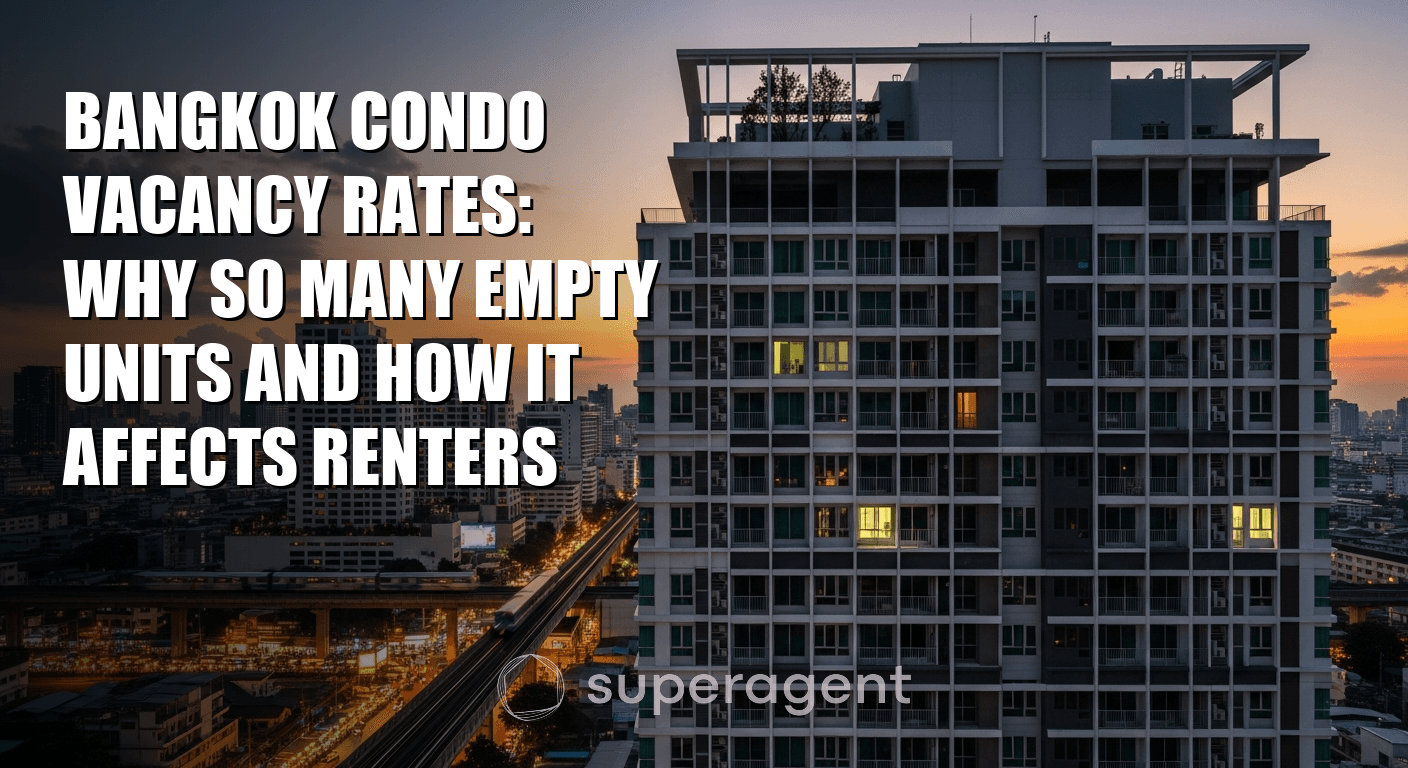
Walk into any real estate office in Bangkok right now and you'll hear the same story: there are more empty condos than there used to be. The market has shifted, and if you're hunting for a place to rent, this actually works in your favor. Vacancy rates across Bangkok's condo market have climbed to levels we haven't seen in years, and understanding why matters when you're negotiating rent or choosing which neighborhood to call home. Let me break down what's actually happening in the Bangkok rental market and how it affects you as a tenant.
The Current Vacancy Rate Problem in Bangkok Condos
According to recent data from property research firms tracking Bangkok's residential market, condo vacancy rates have hovered between 8 and 12 percent citywide, with some premium developments sitting at 15 percent or higher. This is a noticeable jump from the 5 to 7 percent we saw just three years ago. In practical terms, if a 300-unit building in Thonglor used to have 15 empty units, it now has 30 or 40.
The bigger picture is this: Bangkok has experienced a construction boom. Developers saw opportunity during the pandemic when everyone thought remote work was permanent, so they kept building. Lots of units came online between 2021 and 2024. But demand didn't keep pace. Some of that new supply sits empty while landlords wait for the "right" tenant or the right rental price.
You'll notice this most in areas like Ratchadamri, Pratunam, and parts of Siam where older buildings compete with shiny new ones. A 10-year-old condo might sit half empty while a brand new building three sois over has a six-month waiting list.
Why So Many Condos Stay Empty: The Landlord Perspective
Here's what landlords actually tell us: they're holding out. If someone owns a two-bedroom unit in Phrom Phong they inherited from a parent, they might sit on it rather than rent it for 35,000 baht per month when they believe it will eventually fetch 45,000. The carrying costs (maintenance fees, property tax, insurance) are often low enough that waiting feels rational, even if the unit generates zero income.
Foreign owners make up a chunk of this too. A condo purchased as an investment by someone in Singapore or Hong Kong might rent just once or twice a year, or not at all. Thailand's vacation rental market took a hit post-pandemic, and some owners never pivoted back to long-term rentals.
Then there's the quality-control angle. Lots of landlords frankly just don't want the hassle. They'd rather keep a unit empty than deal with tenant complaints, maintenance requests, or the paperwork. This sounds illogical until you realize that a single bad tenant experience can sour an owner on the whole thing for years.
A specific example: I know a 30-unit building near Asok (BTS Asok / MRT Sukhumvit) that's had the same owner for twenty years. Six units sat empty for over a year. When I asked him why, he said his last international tenant trashed a kitchen and skipped owing two months' rent. He decided he'd rather leave them empty than risk it again.
How Oversupply Benefits Renters Right Now
This is the silver lining for you. A buyer's market becomes a renter's market, and it absolutely is one in Bangkok right now. Landlords facing vacant units get creative. They'll negotiate on price, throw in a free month's rent, cover some utility fees, or let you move in mid-month without a penalty.
According to DDproperty, which tracks rental movements across the market, average one-bedroom rents in mid-range areas like Huay Kwang and Dindaeng have remained flat or actually dipped in the last 18 months. A 1-bed in Huay Kwang now sits in the 18,000 to 24,000 baht range, down from the 20,000 to 26,000 range two years ago. That's real money in your pocket.
Premium areas have felt it harder. A 2-bed in Thonglor might command 50,000 to 65,000 baht per month now, versus 60,000 to 75,000 baht in 2022. Landlords in those pricey neighborhoods have had to get realistic or stay empty.
Your leverage as a tenant is highest in buildings that are newer and emptier. If a 40-story development opened two years ago and still has 40 vacant units on floors 15-25, management will absolutely negotiate with you. You can ask for a lower rate, longer lease discounts, or even furniture included. Try the same thing in an older, full building and you'll get turned down flat.
Geographic Variation: Where Vacancy Hits Hardest
The vacancy problem isn't evenly spread. Some neighborhoods are practically full, while others have ghost-town vibes on certain floors. Understanding this geography saves you money and helps you find better deals.
- Thonglor / Ekamai (BTS Thonglor): 12-15% | 50,000-70,000 | Yes, landlords competitive
- Phrom Phong (BTS Phrom Phong): 10-12% | 45,000-65,000 | Moderate, some flexibility
- Pratunam / Ratchadamri (BTS Chidlom): 14-18% | 40,000-60,000 | Yes, strong negotiating power
- Huay Kwang (MRT Huay Kwang): 6-8% | 18,000-28,000 | Limited, area fills fast
- Rama 9 / Sena Nikhom (MRT Rama 9): 9-11% | 22,000-32,000 | Moderate, some room
- Siam / Ratchaprasong (BTS Siam): 11-14% | 38,000-55,000 | Yes, new supply pressure
Notice a pattern? Premium central areas have higher vacancy because developers built aggressively there. More supply means more empty units and more room for you to negotiate. Conversely, mid-market neighborhoods further from the BTS or MRT stay fuller because they're more affordable and attract consistent demand from young professionals and families.
If you're flexible on location, choosing a slightly less trendy area can save you 25 to 40 percent on rent right now while still getting a quality unit. A 1-bed in Rama 9 at 24,000 baht is a much better deal than the same unit in Thonglor at 55,000 baht, especially when you factor in the reduced commute stress.
The Hidden Costs of Vacancy for Building Operations
Empty units create real problems that sometimes trickle down to you. Maintenance teams shrink when occupancy drops, so common areas take longer to get fixed. A broken elevator or a lobby light that's been out for two weeks signals management isn't on top of things. That's often a sign of financial stress in the building.
Some struggling buildings start nickel-and-diming residents: sudden surprise maintenance fee hikes, services getting cut back, or quality declining. In extreme cases, buildings with too many empty units can struggle to maintain reserves, leading to deferred maintenance issues that become your problem as a tenant.
The flip side: management at buildings with good occupancy rates stays sharp and responsive. Less vacancy usually means a healthier, better-run building. If you're choosing between two similar units, the one in the fuller building is often the safer bet long-term.
What Happens Next: Will Vacancy Keep Rising or Stabilize?
The construction pipeline is slowing, which is good. Far fewer condo projects are breaking ground in 2024 compared to 2022. New supply will taper off, which should help rebalance the market. But existing empty units won't vanish overnight. Most experts expect Bangkok's condo market to stabilize somewhere in the 8 to 10 percent vacancy range over the next two years, which is still above historic norms but lower than today.
This matters for your rental strategy. If you're negotiating now, lock in a good lease. Rates probably won't drop much further, but they also won't climb sharply if the market keeps moving toward equilibrium. The window for serious rent discounts is open, but it won't stay open indefinitely.
Real data backs this up. Knight Frank Thailand projects that Bangkok residential rents will see modest growth of 2 to 3 percent annually starting in 2025, assuming no major economic shocks. That's essentially flat when you account for inflation, but it means rents stabilize rather than drop further.
How to Use This Market to Your Advantage
You hold more power than you might think. When a landlord or management company knows their building is competing with twenty other similar buildings nearby, they'll move on price and terms. Here's what actually works right now: ask for a 10 percent discount on advertised rates, request a flexible move-in date to lock in savings, or negotiate shorter lease minimums (6 months instead of 12). Most landlords say yes to at least one of these.
Building age matters less now too. A five-year-old mid-range condo might have sat half empty two years ago because everyone chased new buildings. Today, those buildings are desperate for tenants and offer aggressive deals. You can get quality, slightly older units at significant discounts.
Check lease incentives carefully though. Some landlords offer a "free first month" that really just spreads the rent across more months at higher rates. Read the math. A 30,000-baht-per-month unit with the first month free is actually 31,500 per month across twelve months. Better to negotiate the actual monthly rate down to 27,000 baht.
Location arbitrage works too. If you're open to BTS/MRT proximity rather than walking distance, you can save thousands per month. An MRT station three minutes away by motorcycle taxi gets you out of the premium zone but keeps you connected.
When you're ready to search, tools like Fazwaz and Superagent let you filter by price, location, and amenities, then reach out to landlords directly. With vacancy rates where they are, you'll often get responses within hours because landlords are actively looking for tenants rather than filtering inquiries.
The Bangkok condo market right now is a renter's moment. Oversupply means opportunity. Take advantage of vacant units, thin competition, and landlords willing to negotiate. Prices will stabilize, but the buyer's market won't last forever. Whether you're relocating to Bangkok or already here hunting for a better place, the conditions are genuinely favorable right now. Use that leverage, ask for better terms, and lock in a good deal while you can.
Walk into any real estate office in Bangkok right now and you'll hear the same story: there are more empty condos than there used to be. The market has shifted, and if you're hunting for a place to rent, this actually works in your favor. Vacancy rates across Bangkok's condo market have climbed to levels we haven't seen in years, and understanding why matters when you're negotiating rent or choosing which neighborhood to call home. Let me break down what's actually happening in the Bangkok rental market and how it affects you as a tenant.
The Current Vacancy Rate Problem in Bangkok Condos
According to recent data from property research firms tracking Bangkok's residential market, condo vacancy rates have hovered between 8 and 12 percent citywide, with some premium developments sitting at 15 percent or higher. This is a noticeable jump from the 5 to 7 percent we saw just three years ago. In practical terms, if a 300-unit building in Thonglor used to have 15 empty units, it now has 30 or 40.
The bigger picture is this: Bangkok has experienced a construction boom. Developers saw opportunity during the pandemic when everyone thought remote work was permanent, so they kept building. Lots of units came online between 2021 and 2024. But demand didn't keep pace. Some of that new supply sits empty while landlords wait for the "right" tenant or the right rental price.
You'll notice this most in areas like Ratchadamri, Pratunam, and parts of Siam where older buildings compete with shiny new ones. A 10-year-old condo might sit half empty while a brand new building three sois over has a six-month waiting list.
Why So Many Condos Stay Empty: The Landlord Perspective
Here's what landlords actually tell us: they're holding out. If someone owns a two-bedroom unit in Phrom Phong they inherited from a parent, they might sit on it rather than rent it for 35,000 baht per month when they believe it will eventually fetch 45,000. The carrying costs (maintenance fees, property tax, insurance) are often low enough that waiting feels rational, even if the unit generates zero income.
Foreign owners make up a chunk of this too. A condo purchased as an investment by someone in Singapore or Hong Kong might rent just once or twice a year, or not at all. Thailand's vacation rental market took a hit post-pandemic, and some owners never pivoted back to long-term rentals.
Then there's the quality-control angle. Lots of landlords frankly just don't want the hassle. They'd rather keep a unit empty than deal with tenant complaints, maintenance requests, or the paperwork. This sounds illogical until you realize that a single bad tenant experience can sour an owner on the whole thing for years.
A specific example: I know a 30-unit building near Asok (BTS Asok / MRT Sukhumvit) that's had the same owner for twenty years. Six units sat empty for over a year. When I asked him why, he said his last international tenant trashed a kitchen and skipped owing two months' rent. He decided he'd rather leave them empty than risk it again.
How Oversupply Benefits Renters Right Now
This is the silver lining for you. A buyer's market becomes a renter's market, and it absolutely is one in Bangkok right now. Landlords facing vacant units get creative. They'll negotiate on price, throw in a free month's rent, cover some utility fees, or let you move in mid-month without a penalty.
According to DDproperty, which tracks rental movements across the market, average one-bedroom rents in mid-range areas like Huay Kwang and Dindaeng have remained flat or actually dipped in the last 18 months. A 1-bed in Huay Kwang now sits in the 18,000 to 24,000 baht range, down from the 20,000 to 26,000 range two years ago. That's real money in your pocket.
Premium areas have felt it harder. A 2-bed in Thonglor might command 50,000 to 65,000 baht per month now, versus 60,000 to 75,000 baht in 2022. Landlords in those pricey neighborhoods have had to get realistic or stay empty.
Your leverage as a tenant is highest in buildings that are newer and emptier. If a 40-story development opened two years ago and still has 40 vacant units on floors 15-25, management will absolutely negotiate with you. You can ask for a lower rate, longer lease discounts, or even furniture included. Try the same thing in an older, full building and you'll get turned down flat.
Geographic Variation: Where Vacancy Hits Hardest
The vacancy problem isn't evenly spread. Some neighborhoods are practically full, while others have ghost-town vibes on certain floors. Understanding this geography saves you money and helps you find better deals.
- Thonglor / Ekamai (BTS Thonglor): 12-15% | 50,000-70,000 | Yes, landlords competitive
- Phrom Phong (BTS Phrom Phong): 10-12% | 45,000-65,000 | Moderate, some flexibility
- Pratunam / Ratchadamri (BTS Chidlom): 14-18% | 40,000-60,000 | Yes, strong negotiating power
- Huay Kwang (MRT Huay Kwang): 6-8% | 18,000-28,000 | Limited, area fills fast
- Rama 9 / Sena Nikhom (MRT Rama 9): 9-11% | 22,000-32,000 | Moderate, some room
- Siam / Ratchaprasong (BTS Siam): 11-14% | 38,000-55,000 | Yes, new supply pressure
Notice a pattern? Premium central areas have higher vacancy because developers built aggressively there. More supply means more empty units and more room for you to negotiate. Conversely, mid-market neighborhoods further from the BTS or MRT stay fuller because they're more affordable and attract consistent demand from young professionals and families.
If you're flexible on location, choosing a slightly less trendy area can save you 25 to 40 percent on rent right now while still getting a quality unit. A 1-bed in Rama 9 at 24,000 baht is a much better deal than the same unit in Thonglor at 55,000 baht, especially when you factor in the reduced commute stress.
The Hidden Costs of Vacancy for Building Operations
Empty units create real problems that sometimes trickle down to you. Maintenance teams shrink when occupancy drops, so common areas take longer to get fixed. A broken elevator or a lobby light that's been out for two weeks signals management isn't on top of things. That's often a sign of financial stress in the building.
Talk to us about renting
Share your details and keep reading — we’ll get back to you.
Some struggling buildings start nickel-and-diming residents: sudden surprise maintenance fee hikes, services getting cut back, or quality declining. In extreme cases, buildings with too many empty units can struggle to maintain reserves, leading to deferred maintenance issues that become your problem as a tenant.
The flip side: management at buildings with good occupancy rates stays sharp and responsive. Less vacancy usually means a healthier, better-run building. If you're choosing between two similar units, the one in the fuller building is often the safer bet long-term.
What Happens Next: Will Vacancy Keep Rising or Stabilize?
The construction pipeline is slowing, which is good. Far fewer condo projects are breaking ground in 2024 compared to 2022. New supply will taper off, which should help rebalance the market. But existing empty units won't vanish overnight. Most experts expect Bangkok's condo market to stabilize somewhere in the 8 to 10 percent vacancy range over the next two years, which is still above historic norms but lower than today.
This matters for your rental strategy. If you're negotiating now, lock in a good lease. Rates probably won't drop much further, but they also won't climb sharply if the market keeps moving toward equilibrium. The window for serious rent discounts is open, but it won't stay open indefinitely.
Real data backs this up. Knight Frank Thailand projects that Bangkok residential rents will see modest growth of 2 to 3 percent annually starting in 2025, assuming no major economic shocks. That's essentially flat when you account for inflation, but it means rents stabilize rather than drop further.
How to Use This Market to Your Advantage
You hold more power than you might think. When a landlord or management company knows their building is competing with twenty other similar buildings nearby, they'll move on price and terms. Here's what actually works right now: ask for a 10 percent discount on advertised rates, request a flexible move-in date to lock in savings, or negotiate shorter lease minimums (6 months instead of 12). Most landlords say yes to at least one of these.
Building age matters less now too. A five-year-old mid-range condo might have sat half empty two years ago because everyone chased new buildings. Today, those buildings are desperate for tenants and offer aggressive deals. You can get quality, slightly older units at significant discounts.
Check lease incentives carefully though. Some landlords offer a "free first month" that really just spreads the rent across more months at higher rates. Read the math. A 30,000-baht-per-month unit with the first month free is actually 31,500 per month across twelve months. Better to negotiate the actual monthly rate down to 27,000 baht.
Location arbitrage works too. If you're open to BTS/MRT proximity rather than walking distance, you can save thousands per month. An MRT station three minutes away by motorcycle taxi gets you out of the premium zone but keeps you connected.
When you're ready to search, tools like Fazwaz and Superagent let you filter by price, location, and amenities, then reach out to landlords directly. With vacancy rates where they are, you'll often get responses within hours because landlords are actively looking for tenants rather than filtering inquiries.
The Bangkok condo market right now is a renter's moment. Oversupply means opportunity. Take advantage of vacant units, thin competition, and landlords willing to negotiate. Prices will stabilize, but the buyer's market won't last forever. Whether you're relocating to Bangkok or already here hunting for a better place, the conditions are genuinely favorable right now. Use that leverage, ask for better terms, and lock in a good deal while you can.
Share this article
Properties you may like
![[For Rent] CONDO I Aguston Sukhumvit 22 I Pet Friendly I 2 Beds I 2 Baths I Rent 55,000THB/mo](/_next/image?url=https%3A%2F%2Fstorage.googleapis.com%2Fsuperagent-web%2Fattachments%2Flistings%2F2266%2Fd3afcd25-6b79-46cb-9f1f-396acdc3dd10-955-3.jpg&w=3840&q=75)
฿55,000
2 Bed295 sqm
[For Rent] CONDO I Aguston Sukhumvit 22 I Pet Friendly I 2 Beds I 2 Baths I Rent 55,000THB/mo
Phrom Phong
Condo![[For Rent] CONDO I SUPALAI PLACE Sukhumvit 39 I 2 Beds I 2 Baths (1 Jacuzzi) I 55,555THB/mo](/_next/image?url=https%3A%2F%2Fstorage.googleapis.com%2Fsuperagent-web%2Fattachments%2Flistings%2F6743%2Fba530743-48b9-4ac6-92d3-c2247e743cf6-01-supalai-place-skv39-2b-link-heaven.jpg&w=3840&q=75)
฿55,555
2 Bed2142 sqm
[For Rent] CONDO I SUPALAI PLACE Sukhumvit 39 I 2 Beds I 2 Baths (1 Jacuzzi) I 55,555THB/mo
Phrom Phong
Condo![[For Rent] CONDO I Maru Ekkamai 2 I Pet friendly I 2 Beds I 2 Baths I 68,000 THB/mo](/_next/image?url=https%3A%2F%2Fstorage.googleapis.com%2Fsuperagent-web%2Fattachments%2Flistings%2F6602%2F9f1d8f71-ee43-435f-9a44-da16c4092c92-968-1.jpg&w=3840&q=75)
฿68,000
2 Bed360 sqm
[For Rent] CONDO I Maru Ekkamai 2 I Pet friendly I 2 Beds I 2 Baths I 68,000 THB/mo
Ekkamai
Condo![[For Rent] CONDO I Noble State 39 I 2 Beds I 2 Baths I 63,000THB/mo](/_next/image?url=https%3A%2F%2Fstorage.googleapis.com%2Fsuperagent-web%2Fattachments%2Flistings%2F2237%2F60eb58f3-eae5-41ed-a80b-406e004f05d8-940-1.jpg&w=3840&q=75)
฿63,000
2 Bed260 sqm
[For Rent] CONDO I Noble State 39 I 2 Beds I 2 Baths I 63,000THB/mo
Phrom Phong
Condo![[For Rent] CONDO I Rhythm Sukhumvit 36-38 I 2 Beds I 2 Baths I 38,999THB/mo](/_next/image?url=https%3A%2F%2Fstorage.googleapis.com%2Fsuperagent-web%2Fattachments%2Flistings%2F1788%2F942a0215-4128-4c2c-a064-f607e84e7aa4-656-2.jpg&w=3840&q=75)
฿38,999
2 Bed256 sqm
[For Rent] CONDO I Rhythm Sukhumvit 36-38 I 2 Beds I 2 Baths I 38,999THB/mo
Thonglor
Condo![[For Rent] CONDO I CLOUD Thonglor-Phetchaburi I 1 Bed I 1 Bath I 22,500THB/mo](/_next/image?url=https%3A%2F%2Fstorage.googleapis.com%2Fsuperagent-web%2Fattachments%2Flistings%2F6742%2F6cef5361-0dac-4dba-98f1-b0d187559c84-1118-1.jpg&w=3840&q=75)
฿22,500
1 Bed132 sqm
[For Rent] CONDO I CLOUD Thonglor-Phetchaburi I 1 Bed I 1 Bath I 22,500THB/mo
Thonglor
Condo![[For Rent] CONDO I City Smart Sukhumvit 18 I 3 Beds I 3 Baths I 65,000mo/THB](/_next/image?url=https%3A%2F%2Fstorage.googleapis.com%2Fsuperagent-web%2Fattachments%2Flistings%2F6741%2Fd371c89d-a913-42c4-a673-e540afae4f46-1116-1.jpg&w=3840&q=75)
฿65,000
3 Bed3125 sqm
[For Rent] CONDO I City Smart Sukhumvit 18 I 3 Beds I 3 Baths I 65,000mo/THB
Condo![[For Rent] CONDO I The Coast Bangkok I 1 Bed I 1 Bath I 20,000mo/THB](/_next/image?url=https%3A%2F%2Fstorage.googleapis.com%2Fsuperagent-web%2Fattachments%2Flistings%2F6740%2F498477ce-4ffa-4e4c-ab08-0e565d9c4bbe-1115-3.jpg&w=3840&q=75)
฿20,000
1 Bed146 sqm
[For Rent] CONDO I The Coast Bangkok I 1 Bed I 1 Bath I 20,000mo/THB
Bang Na
Condo![[For Rent] CONDO I IDEO Sukhumvit-RAMA 4 I 2 Beds I 2 Baths I 55,000mo/THB](/_next/image?url=https%3A%2F%2Fstorage.googleapis.com%2Fsuperagent-web%2Fattachments%2Flistings%2F6739%2F15df221d-5b8e-497c-b7ce-a6b9b6412cab-1113-1.jpg&w=3840&q=75)
฿55,000
2 Bed265 sqm
[For Rent] CONDO I IDEO Sukhumvit-RAMA 4 I 2 Beds I 2 Baths I 55,000mo/THB
Phra Khanong
Condo![[For Rent] CONDO I Downtown 49 I Pet Friendly I 1 Bed I 1 Bath I 23,000mo/THB](/_next/image?url=https%3A%2F%2Fstorage.googleapis.com%2Fsuperagent-web%2Fattachments%2Flistings%2F6738%2F11cf2ffe-1f01-4ccc-991c-2ad608f1ba73-1112-1.jpg&w=3840&q=75)
฿23,000
1 Bed135 sqm
[For Rent] CONDO I Downtown 49 I Pet Friendly I 1 Bed I 1 Bath I 23,000mo/THB
Thonglor
CondoMore like this
 In Guides · Superagent EditorialHidden Costs of Renting a Condo in Bangkok Nobody Warns You AboutBangkok condo rent looks affordable until month one hits. Here are the real costs beyond the headline figure that catch most renters off guard.25 May 20261 min read
 In Guides · Superagent EditorialWhat a Long-Vacant Bangkok Condo Unit Is Actually Telling YouA Bangkok condo vacant for months signals overpricing, landlord issues, or real problems. Here is how to read the signs.25 May 20261 min read
 In Guides · Superagent EditorialRed Flags in a Bangkok Rental Contract to Watch Out ForBangkok rental contracts often hide risky clauses. Here are the red flags every tenant must catch before signing any lease.25 May 20261 min read
 In Guides · Superagent EditorialWorking Online from a Condo: How to Choose the Perfect Room for ProductivityLearn how to choose the best condo room for working online with tips on lighting, noise, and furniture setup to maximize productivity.9 May 20261 min read