Bangkok for American Expats: Where to Live, Rent and Work
Guides
Bangkok for American Expats: Where to Live, Rent and Work
Your complete guide to finding the perfect neighborhood and job in Bangkok
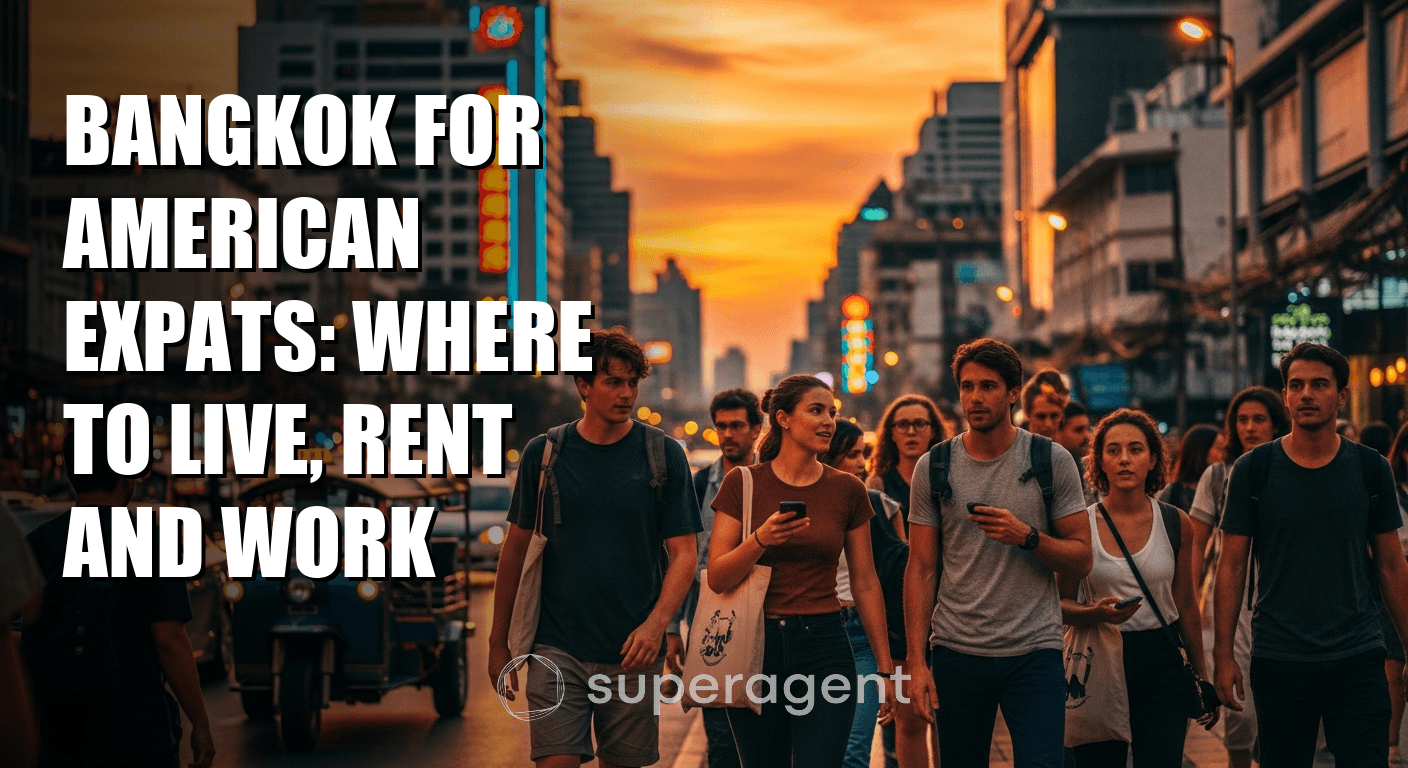
Summary
Discover american expat bangkok living essentials including top neighborhoods, rental tips, visa requirements and job opportunities for Americans relocatin
You landed at Suvarnabhumi with two checked bags and a vague plan. Maybe you got a remote job that finally cut the cord. Maybe your company transferred you. Maybe you just got tired of paying $2,800 for a one-bedroom in Austin and thought, "There has to be a better way." There is. Bangkok has been pulling in American expats for decades, and the city keeps getting better at making them feel at home. But knowing where to live, what to pay, and how to actually set up your life here takes more than a quick scroll through Reddit threads. Let me walk you through it like someone who has done this and watched hundreds of others do it too.
The Neighborhoods American Expats Actually Choose
When Americans first land in Bangkok, they tend to cluster in a few key areas, and for good reason. Sukhumvit is the default. Specifically, the stretch between BTS Nana and BTS Ekkamai has the highest concentration of Western expats in the city. You will hear English on the streets, find bagel shops and craft beer bars within walking distance, and never struggle to locate a pharmacy that stocks American brands.
Thonglor (Sukhumvit Soi 55) is the neighborhood where younger American professionals and creatives settle in. It is trendy, walkable by Bangkok standards, and packed with coworking spaces. If you are in your late twenties or thirties working remotely for a US company, this is likely where you will end up. A one-bedroom condo along Thonglor runs 20,000 to 40,000 THB per month depending on the building and floor.
Families with kids tend to look further out. Phrom Phong and Ekkamai have larger units near international schools. Some American families go all the way to the Bearing or Bang Na area for newer, more spacious condos at lower prices, especially if they are near the BTS Skytrain line. Picture this: a couple from Denver with a toddler found a two-bedroom at Life Sukhumvit 62 near BTS Bang Chak for 22,000 THB per month. They walk to the BTS, ride six stops to Phrom Phong for groceries at Villa Market, and the kid starts at a nearby nursery. That is a real, everyday Bangkok setup.
How Much Does It Actually Cost to Rent in Bangkok?
Rent in Bangkok is, by American standards, shockingly affordable. But the range is wide, and it depends heavily on what you are used to. According to CBRE Thailand's residential market reports, the average rent for a one-bedroom condo in central Bangkok ranges from 15,000 to 35,000 THB per month, which is roughly $420 to $980 USD. For a two-bedroom in a quality building with a pool, gym, and security, expect 25,000 to 55,000 THB per month in popular expat areas.
The sweet spot for most American expats on remote salaries sits around 25,000 to 35,000 THB per month for a well-located one-bedroom in a newer building. At that price range, you are getting buildings like Ideo Q Sukhumvit 36 near BTS Thong Lo, The Lofts Ekkamai, or Noble Reveal on Sukhumvit Soi 63. These condos come fully furnished with air conditioning, a washer, and often a kitchen that is decent enough for meal prep.
Compare that to what you would pay in a US city. A similar one-bedroom in Denver, Seattle, or Miami would run $1,800 to $2,500 per month. In Bangkok, your rent is a fraction of that, and the amenities are typically better. Rooftop pools are standard here, not luxury add-ons.
| Neighborhood | BTS/MRT Station | 1-Bed Rent (THB/mo) | 2-Bed Rent (THB/mo) | Best For |
|---|---|---|---|---|
| Thonglor (Soi 55) | BTS Thong Lo | 22,000 - 40,000 | 35,000 - 65,000 | Young professionals, remote workers |
| Phrom Phong | BTS Phrom Phong | 20,000 - 45,000 | 35,000 - 70,000 | Families, couples |
| Ekkamai (Soi 63) | BTS Ekkamai | 18,000 - 35,000 | 30,000 - 55,000 | Families, quieter lifestyle |
| Asoke / Nana | BTS Asok / MRT Sukhumvit | 18,000 - 38,000 | 30,000 - 60,000 | Corporate expats, nightlife |
| Ari / Saphan Khwai | BTS Ari | 12,000 - 25,000 | 20,000 - 40,000 | Budget-friendly, local vibe |
| On Nut (Soi 77) | BTS On Nut | 10,000 - 22,000 | 18,000 - 35,000 | Budget expats, digital nomads |
Visas and the Legal Side of Working from Bangkok
This is where a lot of Americans get tripped up. You cannot just show up and work indefinitely on tourist visa exemptions. The 30-day visa-free entry is fine for scouting, but if you plan to stay, you need a proper setup. The most common paths for Americans are the Thailand Elite Visa (now called Thailand Privilege), the Long-Term Resident (LTR) Visa for remote workers earning at least $80,000 USD per year, and the traditional Non-B work visa if you are employed by a Thai company.
The LTR Visa has been a game-changer since its launch. It gives you a 10-year stay, a work permit to work remotely, and a reduced personal income tax rate of 17%. Check the Thai Immigration Bureau website for the latest requirements, as they update periodically. A product manager from San Francisco I know applied for the LTR, got approved in about three months, and now works US hours from a condo near MRT Phra Ram 9. He pays less in tax than he did in California and his rent is about one-fifth of what he paid in the Bay Area.
If you are earning under the $80,000 threshold, the Thailand Privilege membership starts at 600,000 THB for five years, which works out to about $280 USD per month for hassle-free long-term residency. It does not include a work permit though, so technically it is designed for retirees and people with passive income.
Healthcare, Banking, and the Practical Stuff
Healthcare is one of the biggest reasons Americans stay in Bangkok long-term. Hospitals here are not just adequate. They are genuinely world-class. Bumrungrad International Hospital near BTS Nana treats over a million patients a year, including a huge number of Americans and Europeans. A general doctor visit costs 1,000 to 2,000 THB without insurance. An MRI that would cost $3,000 in the US runs about 12,000 to 18,000 THB here. Most American expats carry international health insurance like Cigna Global or Pacific Prime, but plenty just pay out of pocket because the costs are so manageable.
Banking is trickier. Opening a Thai bank account as an American requires your passport, a valid visa (not a tourist stamp), and often a letter from your embassy or your condo lease. Bangkok Bank and Kasikorn Bank are the most expat-friendly. Expect the process to take one to two hours. You will want a Thai bank account for paying rent, utilities, and everyday expenses. Wise (formerly TransferWise) is the go-to for moving USD to THB at interbank rates.
Phone plans are easy. Walk into any AIS, True, or DTAC shop at a BTS station and you can get a SIM with unlimited data for about 600 to 900 THB per month. No contracts. No credit checks. You will be connected within 15 minutes.
Where American Expats Hang Out and Build Community
Loneliness is the thing nobody warns you about. Bangkok is an incredible city, but if you do not build a social circle, the excitement wears off fast. The good news is the American expat community here is large and active.
The American Chamber of Commerce in Thailand (AMCHAM) holds monthly networking events, usually in hotels along Wireless Road. If you work in tech or startups, check out Hubba coworking space on Ekkamai Soi 4 or The Hive on Sukhumvit Soi 49. Both host regular meetups and workshops. For something more casual, Brewski on the rooftop of the Radisson Sukhumvit Soi 27 pulls a big expat crowd on weekends.
A marketing consultant from Portland told me that her first real friend group in Bangkok came from a Sunday morning running club that meets at Lumpini Park near MRT Silom. She showed up once, got invited to brunch after, and suddenly had ten people in her phone who understood the weird time-zone math of working US hours from Asia. That is how it works here. You show up, and the community pulls you in.
Kids, Schools, and Family Life
If you are bringing a family, Bangkok has a deep bench of international schools following American curricula. The International School Bangkok (ISB) in Nonthaburi is the big one, with a full American program from pre-K through 12th grade. Tuition runs about 700,000 to 1,000,000 THB per year, which is steep, but many corporate packages cover it. Closer to central Bangkok, NIST International School near BTS Asok follows the IB curriculum and draws a lot of American families.
Families tend to rent two or three-bedroom units in low-rise buildings along Sukhumvit Soi 49 or Soi 39, where there are parks, playgrounds, and a strong international family community. A two-bedroom at Baan Siri 31 near BTS Phrom Phong with a playground and garden goes for about 45,000 to 55,000 THB per month. It is a completely different lifestyle from cramming into a small apartment in Brooklyn or LA, and kids here tend to grow up remarkably worldly.
Bangkok is not a temporary landing pad for most Americans who try it. It becomes home. The cost of living lets you breathe. The food is extraordinary. The healthcare removes a major source of stress. And the city keeps growing, adding new train lines, better infrastructure, and more options every year. The key is finding the right condo in the right neighborhood at the right price, which is exactly the part that usually takes the most time and causes the most headaches.
If you are starting your Bangkok rental search, try Superagent to find verified condo listings across all the neighborhoods mentioned here. The AI matching saves you from scrolling through hundreds of outdated posts, and you can filter by budget, location, and move-in date to find something that actually fits your life.
You landed at Suvarnabhumi with two checked bags and a vague plan. Maybe you got a remote job that finally cut the cord. Maybe your company transferred you. Maybe you just got tired of paying $2,800 for a one-bedroom in Austin and thought, "There has to be a better way." There is. Bangkok has been pulling in American expats for decades, and the city keeps getting better at making them feel at home. But knowing where to live, what to pay, and how to actually set up your life here takes more than a quick scroll through Reddit threads. Let me walk you through it like someone who has done this and watched hundreds of others do it too.
The Neighborhoods American Expats Actually Choose
When Americans first land in Bangkok, they tend to cluster in a few key areas, and for good reason. Sukhumvit is the default. Specifically, the stretch between BTS Nana and BTS Ekkamai has the highest concentration of Western expats in the city. You will hear English on the streets, find bagel shops and craft beer bars within walking distance, and never struggle to locate a pharmacy that stocks American brands.
Thonglor (Sukhumvit Soi 55) is the neighborhood where younger American professionals and creatives settle in. It is trendy, walkable by Bangkok standards, and packed with coworking spaces. If you are in your late twenties or thirties working remotely for a US company, this is likely where you will end up. A one-bedroom condo along Thonglor runs 20,000 to 40,000 THB per month depending on the building and floor.
Families with kids tend to look further out. Phrom Phong and Ekkamai have larger units near international schools. Some American families go all the way to the Bearing or Bang Na area for newer, more spacious condos at lower prices, especially if they are near the BTS Skytrain line. Picture this: a couple from Denver with a toddler found a two-bedroom at Life Sukhumvit 62 near BTS Bang Chak for 22,000 THB per month. They walk to the BTS, ride six stops to Phrom Phong for groceries at Villa Market, and the kid starts at a nearby nursery. That is a real, everyday Bangkok setup.
How Much Does It Actually Cost to Rent in Bangkok?
Rent in Bangkok is, by American standards, shockingly affordable. But the range is wide, and it depends heavily on what you are used to. According to CBRE Thailand's residential market reports, the average rent for a one-bedroom condo in central Bangkok ranges from 15,000 to 35,000 THB per month, which is roughly $420 to $980 USD. For a two-bedroom in a quality building with a pool, gym, and security, expect 25,000 to 55,000 THB per month in popular expat areas.
The sweet spot for most American expats on remote salaries sits around 25,000 to 35,000 THB per month for a well-located one-bedroom in a newer building. At that price range, you are getting buildings like Ideo Q Sukhumvit 36 near BTS Thong Lo, The Lofts Ekkamai, or Noble Reveal on Sukhumvit Soi 63. These condos come fully furnished with air conditioning, a washer, and often a kitchen that is decent enough for meal prep.
Compare that to what you would pay in a US city. A similar one-bedroom in Denver, Seattle, or Miami would run $1,800 to $2,500 per month. In Bangkok, your rent is a fraction of that, and the amenities are typically better. Rooftop pools are standard here, not luxury add-ons.
| Neighborhood | BTS/MRT Station | 1-Bed Rent (THB/mo) | 2-Bed Rent (THB/mo) | Best For |
|---|---|---|---|---|
| Thonglor (Soi 55) | BTS Thong Lo | 22,000 - 40,000 | 35,000 - 65,000 | Young professionals, remote workers |
| Phrom Phong | BTS Phrom Phong | 20,000 - 45,000 | 35,000 - 70,000 | Families, couples |
| Ekkamai (Soi 63) | BTS Ekkamai | 18,000 - 35,000 | 30,000 - 55,000 | Families, quieter lifestyle |
| Asoke / Nana | BTS Asok / MRT Sukhumvit | 18,000 - 38,000 | 30,000 - 60,000 | Corporate expats, nightlife |
| Ari / Saphan Khwai | BTS Ari | 12,000 - 25,000 | 20,000 - 40,000 | Budget-friendly, local vibe |
| On Nut (Soi 77) | BTS On Nut | 10,000 - 22,000 | 18,000 - 35,000 | Budget expats, digital nomads |
Visas and the Legal Side of Working from Bangkok
This is where a lot of Americans get tripped up. You cannot just show up and work indefinitely on tourist visa exemptions. The 30-day visa-free entry is fine for scouting, but if you plan to stay, you need a proper setup. The most common paths for Americans are the Thailand Elite Visa (now called Thailand Privilege), the Long-Term Resident (LTR) Visa for remote workers earning at least $80,000 USD per year, and the traditional Non-B work visa if you are employed by a Thai company.
The LTR Visa has been a game-changer since its launch. It gives you a 10-year stay, a work permit to work remotely, and a reduced personal income tax rate of 17%. Check the Thai Immigration Bureau website for the latest requirements, as they update periodically. A product manager from San Francisco I know applied for the LTR, got approved in about three months, and now works US hours from a condo near MRT Phra Ram 9. He pays less in tax than he did in California and his rent is about one-fifth of what he paid in the Bay Area.
If you are earning under the $80,000 threshold, the Thailand Privilege membership starts at 600,000 THB for five years, which works out to about $280 USD per month for hassle-free long-term residency. It does not include a work permit though, so technically it is designed for retirees and people with passive income.
Healthcare, Banking, and the Practical Stuff
Healthcare is one of the biggest reasons Americans stay in Bangkok long-term. Hospitals here are not just adequate. They are genuinely world-class. Bumrungrad International Hospital near BTS Nana treats over a million patients a year, including a huge number of Americans and Europeans. A general doctor visit costs 1,000 to 2,000 THB without insurance. An MRI that would cost $3,000 in the US runs about 12,000 to 18,000 THB here. Most American expats carry international health insurance like Cigna Global or Pacific Prime, but plenty just pay out of pocket because the costs are so manageable.
Talk to us about renting
Share your details and keep reading — we’ll get back to you.
Banking is trickier. Opening a Thai bank account as an American requires your passport, a valid visa (not a tourist stamp), and often a letter from your embassy or your condo lease. Bangkok Bank and Kasikorn Bank are the most expat-friendly. Expect the process to take one to two hours. You will want a Thai bank account for paying rent, utilities, and everyday expenses. Wise (formerly TransferWise) is the go-to for moving USD to THB at interbank rates.
Phone plans are easy. Walk into any AIS, True, or DTAC shop at a BTS station and you can get a SIM with unlimited data for about 600 to 900 THB per month. No contracts. No credit checks. You will be connected within 15 minutes.
Where American Expats Hang Out and Build Community
Loneliness is the thing nobody warns you about. Bangkok is an incredible city, but if you do not build a social circle, the excitement wears off fast. The good news is the American expat community here is large and active.
The American Chamber of Commerce in Thailand (AMCHAM) holds monthly networking events, usually in hotels along Wireless Road. If you work in tech or startups, check out Hubba coworking space on Ekkamai Soi 4 or The Hive on Sukhumvit Soi 49. Both host regular meetups and workshops. For something more casual, Brewski on the rooftop of the Radisson Sukhumvit Soi 27 pulls a big expat crowd on weekends.
A marketing consultant from Portland told me that her first real friend group in Bangkok came from a Sunday morning running club that meets at Lumpini Park near MRT Silom. She showed up once, got invited to brunch after, and suddenly had ten people in her phone who understood the weird time-zone math of working US hours from Asia. That is how it works here. You show up, and the community pulls you in.
Kids, Schools, and Family Life
If you are bringing a family, Bangkok has a deep bench of international schools following American curricula. The International School Bangkok (ISB) in Nonthaburi is the big one, with a full American program from pre-K through 12th grade. Tuition runs about 700,000 to 1,000,000 THB per year, which is steep, but many corporate packages cover it. Closer to central Bangkok, NIST International School near BTS Asok follows the IB curriculum and draws a lot of American families.
Families tend to rent two or three-bedroom units in low-rise buildings along Sukhumvit Soi 49 or Soi 39, where there are parks, playgrounds, and a strong international family community. A two-bedroom at Baan Siri 31 near BTS Phrom Phong with a playground and garden goes for about 45,000 to 55,000 THB per month. It is a completely different lifestyle from cramming into a small apartment in Brooklyn or LA, and kids here tend to grow up remarkably worldly.
Bangkok is not a temporary landing pad for most Americans who try it. It becomes home. The cost of living lets you breathe. The food is extraordinary. The healthcare removes a major source of stress. And the city keeps growing, adding new train lines, better infrastructure, and more options every year. The key is finding the right condo in the right neighborhood at the right price, which is exactly the part that usually takes the most time and causes the most headaches.
If you are starting your Bangkok rental search, try Superagent to find verified condo listings across all the neighborhoods mentioned here. The AI matching saves you from scrolling through hundreds of outdated posts, and you can filter by budget, location, and move-in date to find something that actually fits your life.
Share this article
Properties you may like
![[For Rent] CONDO I CLOUD Thonglor-Phetchaburi I 1 Bed I 1 Bath I 22,500THB/mo](/_next/image?url=https%3A%2F%2Fstorage.googleapis.com%2Fsuperagent-web%2Fattachments%2Flistings%2F6742%2F6cef5361-0dac-4dba-98f1-b0d187559c84-1118-1.jpg&w=3840&q=75)
฿22,500
1 Bed132 sqm
[For Rent] CONDO I CLOUD Thonglor-Phetchaburi I 1 Bed I 1 Bath I 22,500THB/mo
Thonglor
Condo![[For Rent] CONDO I City Smart Sukhumvit 18 I 3 Beds I 3 Baths I 65,000mo/THB](/_next/image?url=https%3A%2F%2Fstorage.googleapis.com%2Fsuperagent-web%2Fattachments%2Flistings%2F6741%2Fd371c89d-a913-42c4-a673-e540afae4f46-1116-1.jpg&w=3840&q=75)
฿65,000
3 Bed3125 sqm
[For Rent] CONDO I City Smart Sukhumvit 18 I 3 Beds I 3 Baths I 65,000mo/THB
Condo![[For Rent] CONDO I The Coast Bangkok I 1 Bed I 1 Bath I 20,000mo/THB](/_next/image?url=https%3A%2F%2Fstorage.googleapis.com%2Fsuperagent-web%2Fattachments%2Flistings%2F6740%2F498477ce-4ffa-4e4c-ab08-0e565d9c4bbe-1115-3.jpg&w=3840&q=75)
฿20,000
1 Bed146 sqm
[For Rent] CONDO I The Coast Bangkok I 1 Bed I 1 Bath I 20,000mo/THB
Bang Na
Condo![[For Rent] CONDO I IDEO Sukhumvit-RAMA 4 I 2 Beds I 2 Baths I 55,000mo/THB](/_next/image?url=https%3A%2F%2Fstorage.googleapis.com%2Fsuperagent-web%2Fattachments%2Flistings%2F6739%2F15df221d-5b8e-497c-b7ce-a6b9b6412cab-1113-1.jpg&w=3840&q=75)
฿55,000
2 Bed265 sqm
[For Rent] CONDO I IDEO Sukhumvit-RAMA 4 I 2 Beds I 2 Baths I 55,000mo/THB
Phra Khanong
Condo![[For Rent] CONDO I Downtown 49 I Pet Friendly I 1 Bed I 1 Bath I 23,000mo/THB](/_next/image?url=https%3A%2F%2Fstorage.googleapis.com%2Fsuperagent-web%2Fattachments%2Flistings%2F6738%2F11cf2ffe-1f01-4ccc-991c-2ad608f1ba73-1112-1.jpg&w=3840&q=75)
฿23,000
1 Bed135 sqm
[For Rent] CONDO I Downtown 49 I Pet Friendly I 1 Bed I 1 Bath I 23,000mo/THB
Thonglor
Condo![[For Rent] CONDO I Nusasiri Grand Condominium Ekkamai I 2 Beds I 2 Baths I 55,500mo/THB](/_next/image?url=https%3A%2F%2Fstorage.googleapis.com%2Fsuperagent-web%2Fattachments%2Flistings%2F6737%2Feb4785b4-6fd9-4e48-836c-640cc7999e07-1110-5.jpg&w=3840&q=75)
฿55,500
2 Bed280 sqm
[For Rent] CONDO I Nusasiri Grand Condominium Ekkamai I 2 Beds I 2 Baths I 55,500mo/THB
Condo![[For Rent] CONDO I Topview Tower I 3 Beds I 2 Baths I 65,000mo/THB](/_next/image?url=https%3A%2F%2Fstorage.googleapis.com%2Fsuperagent-web%2Fattachments%2Flistings%2F6736%2F8fa8ed0b-5193-4af0-a243-209ec13aa217-1109-11.jpg&w=3840&q=75)
฿65,000
3 Bed2120 sqm
[For Rent] CONDO I Topview Tower I 3 Beds I 2 Baths I 65,000mo/THB
Condo![[For Rent] CONDO I Urbano Absolute Sathon-Taksin I 1 Bed I 1 Bath I 17,500mo/THB](/_next/image?url=https%3A%2F%2Fstorage.googleapis.com%2Fsuperagent-web%2Fattachments%2Flistings%2F6735%2Fb6aa0f79-33a4-4fd9-9fd5-145b740cced8-1108-1.jpg&w=3840&q=75)
฿17,500
1 Bed138 sqm
[For Rent] CONDO I Urbano Absolute Sathon-Taksin I 1 Bed I 1 Bath I 17,500mo/THB
Condo![[For Rent] CONDO I KnightsBridge Prime Sathon I Duplex I 2 Beds I 1 Bath I 46,000THB/mo](/_next/image?url=https%3A%2F%2Fstorage.googleapis.com%2Fsuperagent-web%2Fattachments%2Flistings%2F6734%2Faf8e7500-c684-4f78-9e62-d792c1590ec6-1117-1.jpg&w=3840&q=75)
฿46,000
2 Bed158 sqm
[For Rent] CONDO I KnightsBridge Prime Sathon I Duplex I 2 Beds I 1 Bath I 46,000THB/mo
Sathorn
Condo![[For Rent] CONDO I Life Rama 4 - Asoke I 2 Beds I 1 Bath I 45,000THB/mo](/_next/image?url=https%3A%2F%2Fstorage.googleapis.com%2Fsuperagent-web%2Fattachments%2Flistings%2F6630%2F45e09ffb-5b86-4dcf-ad76-05c21e8e5fef-1003-4.jpg&w=3840&q=75)
฿45,000
2 Bed148 sqm
[For Rent] CONDO I Life Rama 4 - Asoke I 2 Beds I 1 Bath I 45,000THB/mo
Asoke
CondoMore like this
 In Guides · Superagent EditorialHidden Costs of Renting a Condo in Bangkok Nobody Warns You AboutBangkok condo rent looks affordable until month one hits. Here are the real costs beyond the headline figure that catch most renters off guard.25 May 20261 min read
 In Guides · Superagent EditorialWhat a Long-Vacant Bangkok Condo Unit Is Actually Telling YouA Bangkok condo vacant for months signals overpricing, landlord issues, or real problems. Here is how to read the signs.25 May 20261 min read
 In Guides · Superagent EditorialRed Flags in a Bangkok Rental Contract to Watch Out ForBangkok rental contracts often hide risky clauses. Here are the red flags every tenant must catch before signing any lease.25 May 20261 min read
 In Guides · Superagent EditorialWorking Online from a Condo: How to Choose the Perfect Room for ProductivityLearn how to choose the best condo room for working online with tips on lighting, noise, and furniture setup to maximize productivity.9 May 20261 min read