Bangkok vs Chiang Mai: Full Rental Cost and Lifestyle Comparison
Guides
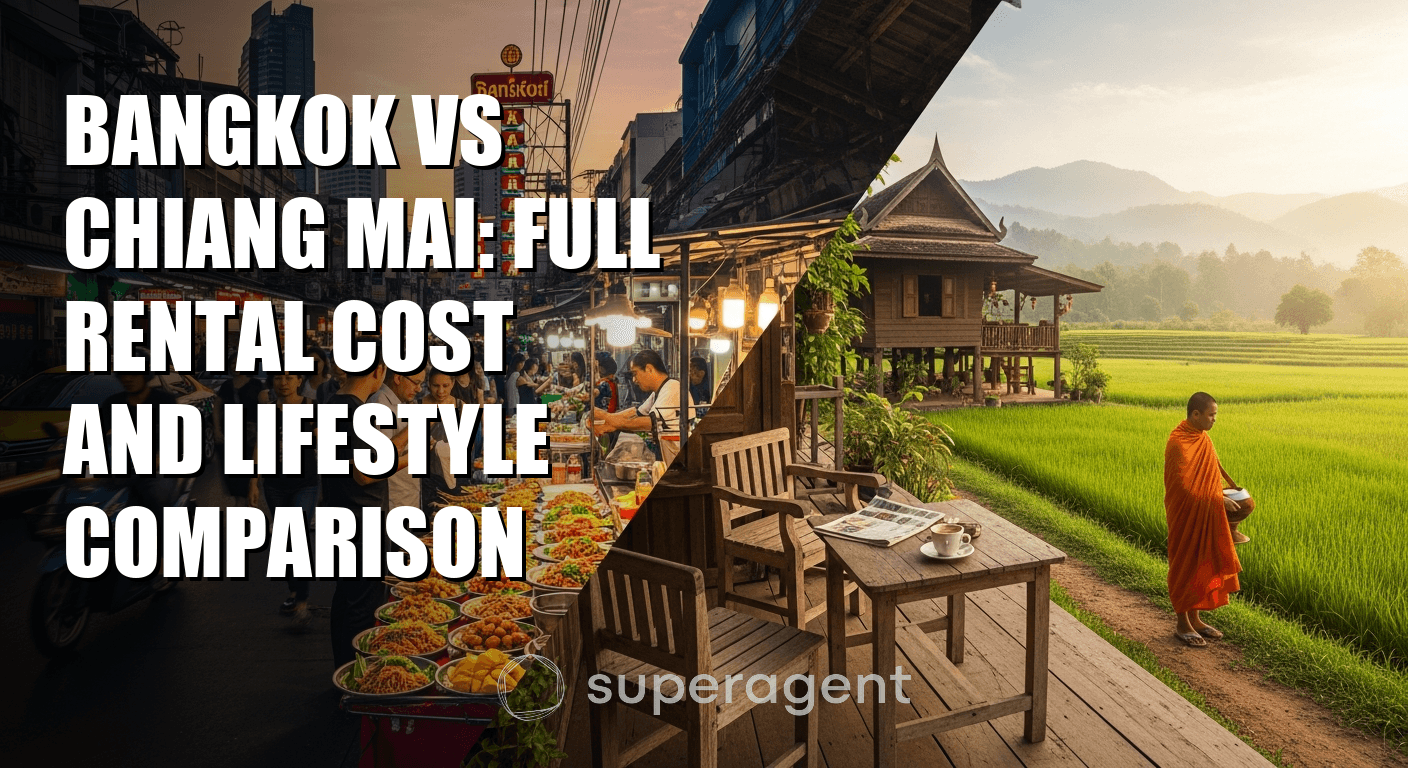
Bangkok vs Chiang Mai: Full Rental Cost and Lifestyle Comparison
Discover which Thai city offers better value for renters and the lifestyle that matches your budget.
Summary
Compare bangkok vs chiang mai rent costs, amenities, and quality of life to find your ideal Thai city for living affordably without sacrificing comfort.
Every few months, someone in a Bangkok expat group posts the same question: "Should I just move to Chiang Mai? Rent is so much cheaper up there." And honestly, it is. But cheaper rent does not automatically mean a better deal. I have lived in Bangkok for years, spent long stretches in Chiang Mai, and helped friends make the move in both directions. The real answer depends on what you need from your daily life, not just what your landlord charges you each month.
Let me break down the actual numbers, the lifestyle tradeoffs, and the things nobody tells you until you have already signed a lease.
The Rent Gap: How Big Is It Really?
Let's start with the number everyone wants to know. According to recent listings on DDproperty, the average rent for a one-bedroom condo in central Bangkok runs between 15,000 and 35,000 THB per month, depending on the neighborhood and building age. In Chiang Mai, a similar one-bedroom unit in the Nimmanhaemin or Old City area goes for 8,000 to 18,000 THB per month. That is roughly 40 to 50 percent less.
But here is the thing. A one-bedroom at a place like Life Asoke Hype near MRT Phetchaburi in Bangkok gets you a rooftop pool, a co-working lounge, a gym that actually has free weights, and a five-minute walk to a major transit hub. In Chiang Mai, your 10,000 THB condo might have a small pool and a basic gym, but you are relying on a motorbike or a Grab to get anywhere.
For context, if you want a two-bedroom condo in Bangkok's Thonglor or Phrom Phong area near BTS stations, you are looking at 30,000 to 65,000 THB per month. In Chiang Mai's Santitham or Nimmanhaemin neighborhoods, a two-bedroom runs 15,000 to 30,000 THB. The savings are real, but they come with trade-offs that affect your daily routine.
Transportation and Getting Around
This is where Bangkok pulls ahead in ways that do not show up on a rent comparison spreadsheet. The BTS Skytrain and MRT system connect dozens of neighborhoods without sitting in traffic. Living near BTS Ekkamai or MRT Lat Phrao means you can commute across the city in 30 minutes for 30 to 60 THB per trip.
Chiang Mai has no rail transit at all. The city has been talking about a light rail system for over a decade, but nothing is operational. You either drive, ride a motorbike, or use the red songthaew trucks that follow loose routes for 30 to 40 THB. Grab is available but wait times outside the central area can be unpredictable.
A friend of mine moved from a condo on Sukhumvit Soi 24 in Bangkok to a house near Chiang Mai's canal area. His rent dropped from 28,000 to 12,000 THB per month. But he ended up buying a motorbike for 45,000 THB, paying 3,000 THB per month in fuel and insurance, and spending significantly more time commuting to his co-working space. After six months, his actual monthly savings were closer to 10,000 THB than the 16,000 THB gap the rent alone suggested.
Cost of Living Beyond Rent
Rent is the biggest single expense, but the rest of your budget matters too. Food costs are surprisingly similar between the two cities at the street food and local restaurant level. A plate of pad kra pao at a street stall costs 50 to 60 THB in both cities. Where the gap widens is in Western dining, imported groceries, and nightlife, where Bangkok prices run 20 to 40 percent higher.
Utilities in Chiang Mai tend to be slightly cheaper because units are smaller and air conditioning use drops significantly from November through February, when nights can drop below 15 degrees Celsius. In Bangkok, you are running the AC at least eight months a year, and electricity bills for a one-bedroom condo commonly hit 2,000 to 4,000 THB per month.
Healthcare is another factor. Bangkok has world-class hospitals like Bumrungrad International Hospital near BTS Nana, plus dozens of other international-standard facilities spread across the city. Chiang Mai has good hospitals too, including Chiang Mai Ram, but the range of specialists and the availability of cutting-edge treatments is narrower. If you have ongoing medical needs, Bangkok gives you more options.
Work, Income, and Career Opportunities
If you work remotely and your income is location-independent, Chiang Mai's lower costs can genuinely stretch your money further. The digital nomad scene there is well-established, with co-working spaces like Punspace and CAMP offering monthly passes for 2,000 to 4,000 THB.
But if your career depends on being in Thailand's economic center, there is no contest. Bangkok is home to virtually every multinational's regional office, most embassies, and the vast majority of Thailand's professional networking events. Living near Silom, Sathorn, or the Asoke intersection puts you minutes from major business districts.
I know a marketing consultant who tried the Chiang Mai move. She saved on rent but flew back to Bangkok for client meetings twice a month. Each trip cost 3,000 to 5,000 THB in flights and a night at a hotel. After a year, she moved back to a condo near BTS Chong Nonsi and said the convenience of being in the same city as her clients was worth every extra baht in rent.
Lifestyle and Social Scene
Chiang Mai offers something Bangkok simply cannot: mountains, cooler weather, and a slower pace. If your ideal weekend involves temple walks, mountain trails, and coffee shops surrounded by rice fields, Chiang Mai delivers that beautifully. The city has a tight-knit expat community that is easy to break into.
Bangkok, on the other hand, has depth. The nightlife ranges from rooftop bars on Sathorn to live jazz on Soi Thonglor. You get world-class international restaurants, major concert venues, and an arts scene that keeps growing around areas like Charoenkrung and Ari. Weekend trips to the beach are easy, with flights to Krabi or Koh Samui taking about an hour.
For families, Bangkok offers more international schools and a wider range of extracurricular activities. Schools like NIST near BTS Asok or Shrewsbury near BTS Krung Thon Buri give families access to top-tier education, though tuition is a separate (and significant) budget line. Chiang Mai has international schools too, like Prem International and Lanna International, but the options are fewer.
Side-by-Side Comparison
- 1-Bed Condo Rent: 15,000 to 35,000 THB/month vs 8,000 to 18,000 THB/month
- 2-Bed Condo Rent: 30,000 to 65,000 THB/month vs 15,000 to 30,000 THB/month
- Public Transit: BTS, MRT, Airport Rail Link, buses, boats vs Songthaew, Grab, personal vehicle
- Monthly Electricity: 2,000 to 4,000 THB vs 1,000 to 2,500 THB
- Street Food Meal: 50 to 80 THB vs 40 to 70 THB
- Co-working Space: 3,000 to 6,000 THB/month vs 2,000 to 4,000 THB/month
- International Hospitals: Many, including Bumrungrad, Samitivej, BNH vs Chiang Mai Ram, Lanna Hospital
- International Schools: Wide selection across all curricula vs Limited but solid options
- Weather (Cool Season): 25 to 32 degrees Celsius vs 12 to 28 degrees Celsius
- Job Market for Professionals: Strong, diverse industries vs Limited, mostly remote or tourism-based
Air Quality: The Elephant in the Room
One thing that rarely comes up in rent comparisons but absolutely should: air quality. Chiang Mai's burning season, roughly February through April, produces some of the worst air pollution readings in the world. AQI levels regularly exceed 200 during peak weeks, which is firmly in the "very unhealthy" range. Many long-term Chiang Mai residents leave the city entirely during this period, heading south to Bangkok or the islands.
Bangkok has its own air quality challenges, especially from December through February, but the levels are typically less severe and the duration shorter. If you have respiratory issues or young children, this is a serious consideration that could offset months of rent savings.
The right choice depends on your priorities. If you are a remote worker with flexible income, no kids, and a love for mountains and community, Chiang Mai can save you 10,000 to 20,000 THB per month while giving you a genuinely enjoyable lifestyle. If you need career access, healthcare variety, world-class transit, and the energy of a true metropolis, Bangkok is hard to beat, even at higher rents.
Neither city is objectively better. But one of them is better for you right now, and that is the question worth answering honestly before you sign anything.
If Bangkok is where you are landing, finding the right condo at the right price does not have to mean scrolling through thousands of listings. Superagent at superagent.co uses AI to match you with condos that fit your budget, your preferred BTS or MRT line, and your actual lifestyle. Try it before your next lease renewal, and see what you have been missing.
Every few months, someone in a Bangkok expat group posts the same question: "Should I just move to Chiang Mai? Rent is so much cheaper up there." And honestly, it is. But cheaper rent does not automatically mean a better deal. I have lived in Bangkok for years, spent long stretches in Chiang Mai, and helped friends make the move in both directions. The real answer depends on what you need from your daily life, not just what your landlord charges you each month.
Let me break down the actual numbers, the lifestyle tradeoffs, and the things nobody tells you until you have already signed a lease.
The Rent Gap: How Big Is It Really?
Let's start with the number everyone wants to know. According to recent listings on DDproperty, the average rent for a one-bedroom condo in central Bangkok runs between 15,000 and 35,000 THB per month, depending on the neighborhood and building age. In Chiang Mai, a similar one-bedroom unit in the Nimmanhaemin or Old City area goes for 8,000 to 18,000 THB per month. That is roughly 40 to 50 percent less.
But here is the thing. A one-bedroom at a place like Life Asoke Hype near MRT Phetchaburi in Bangkok gets you a rooftop pool, a co-working lounge, a gym that actually has free weights, and a five-minute walk to a major transit hub. In Chiang Mai, your 10,000 THB condo might have a small pool and a basic gym, but you are relying on a motorbike or a Grab to get anywhere.
For context, if you want a two-bedroom condo in Bangkok's Thonglor or Phrom Phong area near BTS stations, you are looking at 30,000 to 65,000 THB per month. In Chiang Mai's Santitham or Nimmanhaemin neighborhoods, a two-bedroom runs 15,000 to 30,000 THB. The savings are real, but they come with trade-offs that affect your daily routine.
Transportation and Getting Around
This is where Bangkok pulls ahead in ways that do not show up on a rent comparison spreadsheet. The BTS Skytrain and MRT system connect dozens of neighborhoods without sitting in traffic. Living near BTS Ekkamai or MRT Lat Phrao means you can commute across the city in 30 minutes for 30 to 60 THB per trip.
Chiang Mai has no rail transit at all. The city has been talking about a light rail system for over a decade, but nothing is operational. You either drive, ride a motorbike, or use the red songthaew trucks that follow loose routes for 30 to 40 THB. Grab is available but wait times outside the central area can be unpredictable.
A friend of mine moved from a condo on Sukhumvit Soi 24 in Bangkok to a house near Chiang Mai's canal area. His rent dropped from 28,000 to 12,000 THB per month. But he ended up buying a motorbike for 45,000 THB, paying 3,000 THB per month in fuel and insurance, and spending significantly more time commuting to his co-working space. After six months, his actual monthly savings were closer to 10,000 THB than the 16,000 THB gap the rent alone suggested.
Cost of Living Beyond Rent
Rent is the biggest single expense, but the rest of your budget matters too. Food costs are surprisingly similar between the two cities at the street food and local restaurant level. A plate of pad kra pao at a street stall costs 50 to 60 THB in both cities. Where the gap widens is in Western dining, imported groceries, and nightlife, where Bangkok prices run 20 to 40 percent higher.
Utilities in Chiang Mai tend to be slightly cheaper because units are smaller and air conditioning use drops significantly from November through February, when nights can drop below 15 degrees Celsius. In Bangkok, you are running the AC at least eight months a year, and electricity bills for a one-bedroom condo commonly hit 2,000 to 4,000 THB per month.
Healthcare is another factor. Bangkok has world-class hospitals like Bumrungrad International Hospital near BTS Nana, plus dozens of other international-standard facilities spread across the city. Chiang Mai has good hospitals too, including Chiang Mai Ram, but the range of specialists and the availability of cutting-edge treatments is narrower. If you have ongoing medical needs, Bangkok gives you more options.
Work, Income, and Career Opportunities
If you work remotely and your income is location-independent, Chiang Mai's lower costs can genuinely stretch your money further. The digital nomad scene there is well-established, with co-working spaces like Punspace and CAMP offering monthly passes for 2,000 to 4,000 THB.
But if your career depends on being in Thailand's economic center, there is no contest. Bangkok is home to virtually every multinational's regional office, most embassies, and the vast majority of Thailand's professional networking events. Living near Silom, Sathorn, or the Asoke intersection puts you minutes from major business districts.
I know a marketing consultant who tried the Chiang Mai move. She saved on rent but flew back to Bangkok for client meetings twice a month. Each trip cost 3,000 to 5,000 THB in flights and a night at a hotel. After a year, she moved back to a condo near BTS Chong Nonsi and said the convenience of being in the same city as her clients was worth every extra baht in rent.
Lifestyle and Social Scene
Chiang Mai offers something Bangkok simply cannot: mountains, cooler weather, and a slower pace. If your ideal weekend involves temple walks, mountain trails, and coffee shops surrounded by rice fields, Chiang Mai delivers that beautifully. The city has a tight-knit expat community that is easy to break into.
Talk to us about renting
Share your details and keep reading — we’ll get back to you.
Bangkok, on the other hand, has depth. The nightlife ranges from rooftop bars on Sathorn to live jazz on Soi Thonglor. You get world-class international restaurants, major concert venues, and an arts scene that keeps growing around areas like Charoenkrung and Ari. Weekend trips to the beach are easy, with flights to Krabi or Koh Samui taking about an hour.
For families, Bangkok offers more international schools and a wider range of extracurricular activities. Schools like NIST near BTS Asok or Shrewsbury near BTS Krung Thon Buri give families access to top-tier education, though tuition is a separate (and significant) budget line. Chiang Mai has international schools too, like Prem International and Lanna International, but the options are fewer.
Side-by-Side Comparison
- 1-Bed Condo Rent: 15,000 to 35,000 THB/month vs 8,000 to 18,000 THB/month
- 2-Bed Condo Rent: 30,000 to 65,000 THB/month vs 15,000 to 30,000 THB/month
- Public Transit: BTS, MRT, Airport Rail Link, buses, boats vs Songthaew, Grab, personal vehicle
- Monthly Electricity: 2,000 to 4,000 THB vs 1,000 to 2,500 THB
- Street Food Meal: 50 to 80 THB vs 40 to 70 THB
- Co-working Space: 3,000 to 6,000 THB/month vs 2,000 to 4,000 THB/month
- International Hospitals: Many, including Bumrungrad, Samitivej, BNH vs Chiang Mai Ram, Lanna Hospital
- International Schools: Wide selection across all curricula vs Limited but solid options
- Weather (Cool Season): 25 to 32 degrees Celsius vs 12 to 28 degrees Celsius
- Job Market for Professionals: Strong, diverse industries vs Limited, mostly remote or tourism-based
Air Quality: The Elephant in the Room
One thing that rarely comes up in rent comparisons but absolutely should: air quality. Chiang Mai's burning season, roughly February through April, produces some of the worst air pollution readings in the world. AQI levels regularly exceed 200 during peak weeks, which is firmly in the "very unhealthy" range. Many long-term Chiang Mai residents leave the city entirely during this period, heading south to Bangkok or the islands.
Bangkok has its own air quality challenges, especially from December through February, but the levels are typically less severe and the duration shorter. If you have respiratory issues or young children, this is a serious consideration that could offset months of rent savings.
The right choice depends on your priorities. If you are a remote worker with flexible income, no kids, and a love for mountains and community, Chiang Mai can save you 10,000 to 20,000 THB per month while giving you a genuinely enjoyable lifestyle. If you need career access, healthcare variety, world-class transit, and the energy of a true metropolis, Bangkok is hard to beat, even at higher rents.
Neither city is objectively better. But one of them is better for you right now, and that is the question worth answering honestly before you sign anything.
If Bangkok is where you are landing, finding the right condo at the right price does not have to mean scrolling through thousands of listings. Superagent at superagent.co uses AI to match you with condos that fit your budget, your preferred BTS or MRT line, and your actual lifestyle. Try it before your next lease renewal, and see what you have been missing.
Share this article
Properties you may like
![[For Rent] CONDO I Aguston Sukhumvit 22 I Pet Friendly I 2 Beds I 2 Baths I Rent 55,000THB/mo](/_next/image?url=https%3A%2F%2Fstorage.googleapis.com%2Fsuperagent-web%2Fattachments%2Flistings%2F2266%2Fd3afcd25-6b79-46cb-9f1f-396acdc3dd10-955-3.jpg&w=3840&q=75)
฿55,000
2 Bed295 sqm
[For Rent] CONDO I Aguston Sukhumvit 22 I Pet Friendly I 2 Beds I 2 Baths I Rent 55,000THB/mo
Phrom Phong
Condo![[For Rent] CONDO I SUPALAI PLACE Sukhumvit 39 I 2 Beds I 2 Baths (1 Jacuzzi) I 55,555THB/mo](/_next/image?url=https%3A%2F%2Fstorage.googleapis.com%2Fsuperagent-web%2Fattachments%2Flistings%2F6743%2Fba530743-48b9-4ac6-92d3-c2247e743cf6-01-supalai-place-skv39-2b-link-heaven.jpg&w=3840&q=75)
฿55,555
2 Bed2142 sqm
[For Rent] CONDO I SUPALAI PLACE Sukhumvit 39 I 2 Beds I 2 Baths (1 Jacuzzi) I 55,555THB/mo
Phrom Phong
Condo![[For Rent] CONDO I Maru Ekkamai 2 I Pet friendly I 2 Beds I 2 Baths I 68,000 THB/mo](/_next/image?url=https%3A%2F%2Fstorage.googleapis.com%2Fsuperagent-web%2Fattachments%2Flistings%2F6602%2F9f1d8f71-ee43-435f-9a44-da16c4092c92-968-1.jpg&w=3840&q=75)
฿68,000
2 Bed360 sqm
[For Rent] CONDO I Maru Ekkamai 2 I Pet friendly I 2 Beds I 2 Baths I 68,000 THB/mo
Ekkamai
Condo![[For Rent] CONDO I Noble State 39 I 2 Beds I 2 Baths I 63,000THB/mo](/_next/image?url=https%3A%2F%2Fstorage.googleapis.com%2Fsuperagent-web%2Fattachments%2Flistings%2F2237%2F60eb58f3-eae5-41ed-a80b-406e004f05d8-940-1.jpg&w=3840&q=75)
฿63,000
2 Bed260 sqm
[For Rent] CONDO I Noble State 39 I 2 Beds I 2 Baths I 63,000THB/mo
Phrom Phong
Condo![[For Rent] CONDO I Rhythm Sukhumvit 36-38 I 2 Beds I 2 Baths I 38,999THB/mo](/_next/image?url=https%3A%2F%2Fstorage.googleapis.com%2Fsuperagent-web%2Fattachments%2Flistings%2F1788%2F942a0215-4128-4c2c-a064-f607e84e7aa4-656-2.jpg&w=3840&q=75)
฿38,999
2 Bed256 sqm
[For Rent] CONDO I Rhythm Sukhumvit 36-38 I 2 Beds I 2 Baths I 38,999THB/mo
Thonglor
Condo![[For Rent] CONDO I CLOUD Thonglor-Phetchaburi I 1 Bed I 1 Bath I 22,500THB/mo](/_next/image?url=https%3A%2F%2Fstorage.googleapis.com%2Fsuperagent-web%2Fattachments%2Flistings%2F6742%2F6cef5361-0dac-4dba-98f1-b0d187559c84-1118-1.jpg&w=3840&q=75)
฿22,500
1 Bed132 sqm
[For Rent] CONDO I CLOUD Thonglor-Phetchaburi I 1 Bed I 1 Bath I 22,500THB/mo
Thonglor
Condo![[For Rent] CONDO I City Smart Sukhumvit 18 I 3 Beds I 3 Baths I 65,000mo/THB](/_next/image?url=https%3A%2F%2Fstorage.googleapis.com%2Fsuperagent-web%2Fattachments%2Flistings%2F6741%2Fd371c89d-a913-42c4-a673-e540afae4f46-1116-1.jpg&w=3840&q=75)
฿65,000
3 Bed3125 sqm
[For Rent] CONDO I City Smart Sukhumvit 18 I 3 Beds I 3 Baths I 65,000mo/THB
Condo![[For Rent] CONDO I The Coast Bangkok I 1 Bed I 1 Bath I 20,000mo/THB](/_next/image?url=https%3A%2F%2Fstorage.googleapis.com%2Fsuperagent-web%2Fattachments%2Flistings%2F6740%2F498477ce-4ffa-4e4c-ab08-0e565d9c4bbe-1115-3.jpg&w=3840&q=75)
฿20,000
1 Bed146 sqm
[For Rent] CONDO I The Coast Bangkok I 1 Bed I 1 Bath I 20,000mo/THB
Bang Na
Condo![[For Rent] CONDO I IDEO Sukhumvit-RAMA 4 I 2 Beds I 2 Baths I 55,000mo/THB](/_next/image?url=https%3A%2F%2Fstorage.googleapis.com%2Fsuperagent-web%2Fattachments%2Flistings%2F6739%2F15df221d-5b8e-497c-b7ce-a6b9b6412cab-1113-1.jpg&w=3840&q=75)
฿55,000
2 Bed265 sqm
[For Rent] CONDO I IDEO Sukhumvit-RAMA 4 I 2 Beds I 2 Baths I 55,000mo/THB
Phra Khanong
Condo![[For Rent] CONDO I Downtown 49 I Pet Friendly I 1 Bed I 1 Bath I 23,000mo/THB](/_next/image?url=https%3A%2F%2Fstorage.googleapis.com%2Fsuperagent-web%2Fattachments%2Flistings%2F6738%2F11cf2ffe-1f01-4ccc-991c-2ad608f1ba73-1112-1.jpg&w=3840&q=75)
฿23,000
1 Bed135 sqm
[For Rent] CONDO I Downtown 49 I Pet Friendly I 1 Bed I 1 Bath I 23,000mo/THB
Thonglor
CondoMore like this
 In Guides · Superagent EditorialHidden Costs of Renting a Condo in Bangkok Nobody Warns You AboutBangkok condo rent looks affordable until month one hits. Here are the real costs beyond the headline figure that catch most renters off guard.25 May 20261 min read
 In Guides · Superagent EditorialWhat a Long-Vacant Bangkok Condo Unit Is Actually Telling YouA Bangkok condo vacant for months signals overpricing, landlord issues, or real problems. Here is how to read the signs.25 May 20261 min read
 In Guides · Superagent EditorialRed Flags in a Bangkok Rental Contract to Watch Out ForBangkok rental contracts often hide risky clauses. Here are the red flags every tenant must catch before signing any lease.25 May 20261 min read
 In Guides · Superagent EditorialWorking Online from a Condo: How to Choose the Perfect Room for ProductivityLearn how to choose the best condo room for working online with tips on lighting, noise, and furniture setup to maximize productivity.9 May 20261 min read