BTS vs MRT Condos in Bangkok: Which Transit System Offers Better Rental Value?
Guides
BTS vs MRT Condos in Bangkok: Which Transit System Offers Better Rental Value?
Discover rental price differences and convenience factors between BTS and MRT neighborhoods.
Summary
Compare rental rates and lifestyle benefits in our BTS vs MRT analysis. Find which transit system delivers better value for Bangkok condo renters seeking c
You're hunting for a condo in Bangkok, and one of the first questions hitting your inbox from your agent is simple but heavy: "Do you want to live near BTS or MRT?" It sounds like a straightforward choice, but anyone who has spent more than a month here knows it shapes everything about your daily life, your wallet, and how much time you actually spend commuting in traffic. The difference between these two rail systems matters more than most people realize, and the price gap between them can be pretty shocking once you start looking at real listings.
Why This Decision Shapes Your Bangkok Life
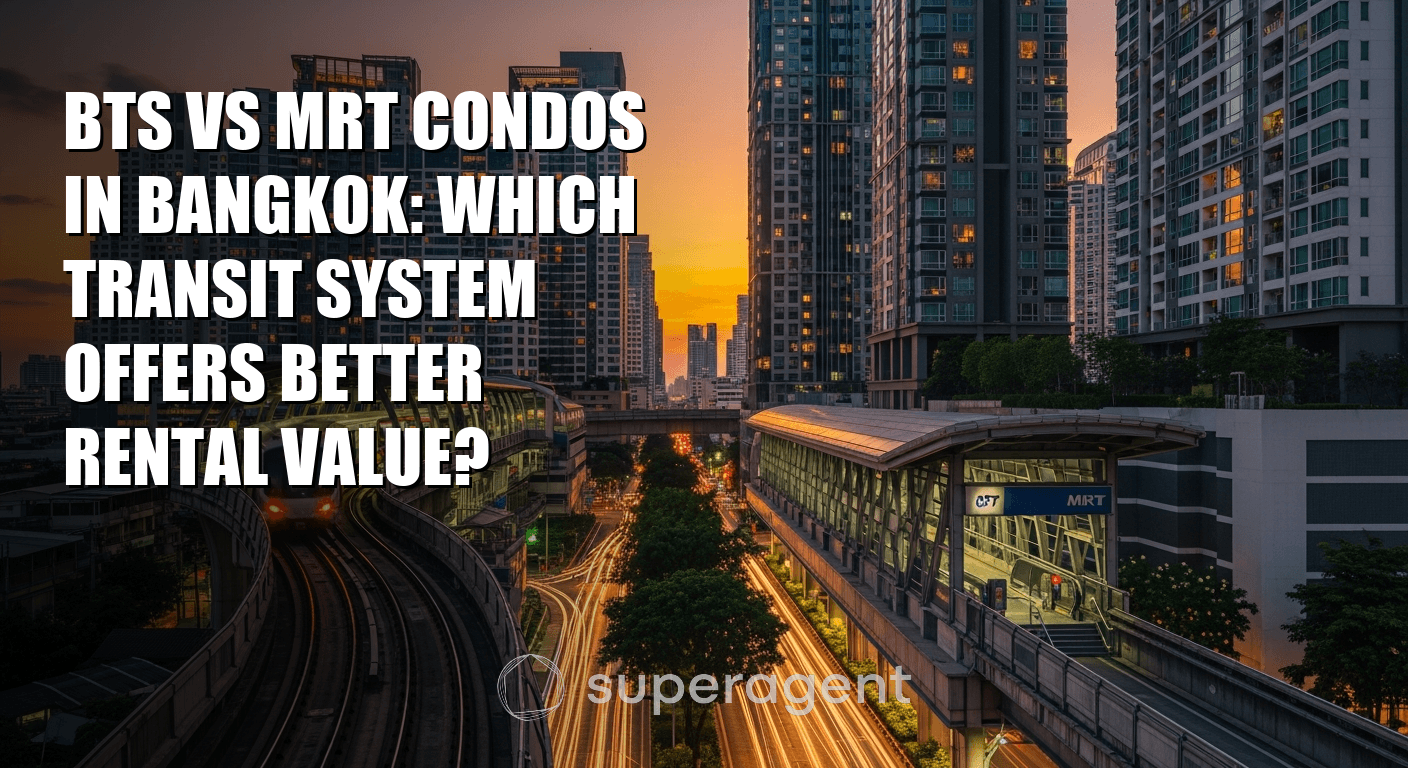
Let me be direct, because I've seen people make this choice badly. The BTS Skytrain and the MRT subway are not interchangeable, even though both are Bangkok's main rail networks. One is above ground, one is below. One hits the premium business and shopping districts. One reaches deeper into residential neighborhoods.
Your choice here determines three things immediately: how much you pay each month, how long your commute actually is in rush hour, and what your neighborhood feels like at night. I've lived near both, and the daily experience is genuinely different.
BTS Proximity: Higher Rents, Premium Access
Let's talk numbers first, because this is where the rubber meets the road. A one-bedroom condo within walking distance of a major BTS station like Chit Lom or Thonglor typically runs you 30,000 to 50,000 THB per month, depending on age, building amenities, and how close you actually are to the station entrance. That's not a typo.
Why? The BTS Skytrain services Bangkok's prime real estate zones. Silom, Sukhumvit, Siam, Chatuchak, Mo Chit, On Nut. These are where the corporate offices cluster, where the shopping malls stand, where expats and young professionals actually want to live. A condo at Ekkamai BTS puts you on Sukhumvit Road, which means restaurants, bars, clinics, convenience stores, and other humans your age all within a five-minute walk.
The commute itself is fast. Thonglor to Chit Lom is literally five minutes on the train. No traffic jams. No unpredictable delays. You know exactly when you'll arrive at work, and you can read on your phone without white-knuckling a steering wheel.
The trade-off is price. Landlords know you're paying for convenience, and they price accordingly. But if you're making a salary that can absorb a 40,000 THB rent, the peace of mind is often worth it.
MRT Proximity: Lower Rents, Deeper Bangkok
Now flip the script. The MRT Bangkok subway network covers different ground. You get neighborhoods like Rama 9, Phetchaburi, Huai Khwang, Ratchadamri, and Bang Na. The rent drops noticeably. A one-bedroom condo near Rama 9 MRT or Huai Khwang MRT typically costs 18,000 to 28,000 THB per month for the same size and condition as the BTS option.
That's real money saved each month. Over a year, choosing MRT over BTS could put an extra 100,000 to 200,000 THB in your pocket. For a family or someone on a tighter budget, that math works.
The neighborhoods feel different too. Less touristy, less polished, but often more authentically Bangkok. You'll eat better, cheaper, and discover places tourists never see. Local markets, proper neighborhood restaurants, the Bangkok that actually exists outside the expat bubbles.
The downside is commute time. MRT trains are less frequent at peak hours, and the network doesn't cover every destination you might want to reach. Getting from Rama 9 to Sukhumvit isn't one train ride, it's a transfer or a taxi.
Walking Distance Versus Station Access: The Hidden Cost
Here's a detail that catches people off guard. "Proximity" to BTS or MRT doesn't mean the same thing everywhere. At some BTS stations, the nearest condo is literally 100 meters away. At others, it's 800 meters, which feels closer than it is when it's 35 degrees Celsius outside.
I once toured a place advertised as "near Asok BTS." It was a 15-minute walk uphill. The landlord counted it as "near" because it was technically in walking range. Technically correct, but my daily reality would have been different.
Check the actual walking distance on Google Maps. If it's more than 500 meters, you're probably looking at a motorcycle taxi or songthaew commute on bad weather days, which defeats half the purpose of living near transit.
Salary, Commute, and Quality of Life Math
Here's the framework I've watched work for people over three years of Bangkok rentals. If you work in the Silom, Sukhumvit, or Siam areas (the financial district, basically), BTS proximity saves you time and mental energy that matters. You're not sitting in Rama 9 traffic trying to reach Sukhumvit. That's a psychological win worth money.
If you work from home three days a week, or your office is off the main rail corridors, MRT near your home starts making more sense. The rent savings outweigh a slightly longer commute because you're not doing it every single day.
If you have a family and need to live on one salary while another person manages household tasks, the MRT rent savings might fund a cleaner, which genuinely improves your quality of life more than a five-minute shorter commute.
- Average 1-Bed Rent: 30,000-50,000 THB/month vs 18,000-28,000 THB/month
- Neighborhoods Served: Sukhumvit, Silom, Siam, Chatuchak vs Rama 9, Phetchaburi, Bang Na, Huai Khwang
- Peak Hour Frequency: 2-3 minutes vs 3-5 minutes
- Dining and Nightlife: Heavy expat presence, international options vs Local Thai, fewer tourists, better prices
- Commute to CBD: 10-25 minutes direct vs 20-40 minutes with transfers
According to recent market data from DDproperty, average condo rents near BTS stations in central Bangkok areas command a premium of approximately 35 to 40 percent compared to similar units near MRT stations, reflecting the established demand for Skytrain accessibility among Bangkok's working professionals and expat community.
Real Scenario: Your Decision Framework
Let's say you earn 80,000 THB per month and work in the Silom financial district. BTS near your office means 35-minute commutes, plenty of time to read or answer emails. MRT forces you near Rama 9 or another outlying station, meaning 50-minute commutes with a transfer. Your hourly rate makes that 30 extra minutes of commute time worth maybe 1,000 THB in lost productivity or stress. Over a month, that's 20,000 THB in real cost, while BTS rent only runs you 15,000 THB extra. BTS wins.
Now say you're a freelancer or remote worker who goes into an office twice a week in Phetchaburi. MRT near home costs you 20,000 THB. BTS would be 35,000 THB. The extra 15,000 THB per month is 180,000 THB per year. That funds a house cleaner, a gym membership, better groceries. Your quality of life improves more from that 15,000 THB than from a 20-minute shorter commute you're only making twice a week. MRT wins.
The "right" answer depends on your life, not on which system is objectively better. Both are good. One is right for you.
When you're ready to search, don't just look at location and price separately. Plug in your actual work address, check real commute times on BTS and MRT's official journey planners, and calculate what your actual daily experience will be. Tour the neighborhoods at the time of day you'll be commuting home. Walk around at 6 PM and see what that area feels like.
You're not just picking a transit line. You're picking the rhythm of your daily life in Bangkok. The rent difference is real, but it's not the only thing that matters. Do the math on your situation, walk the neighborhoods, and then decide. If you want help comparing specific addresses and actual listings in these areas, Superagent lets you filter by BTS and MRT proximity, see verified pricing, and connect with landlords who actually know their neighborhoods.
You're hunting for a condo in Bangkok, and one of the first questions hitting your inbox from your agent is simple but heavy: "Do you want to live near BTS or MRT?" It sounds like a straightforward choice, but anyone who has spent more than a month here knows it shapes everything about your daily life, your wallet, and how much time you actually spend commuting in traffic. The difference between these two rail systems matters more than most people realize, and the price gap between them can be pretty shocking once you start looking at real listings.
Why This Decision Shapes Your Bangkok Life
Let me be direct, because I've seen people make this choice badly. The BTS Skytrain and the MRT subway are not interchangeable, even though both are Bangkok's main rail networks. One is above ground, one is below. One hits the premium business and shopping districts. One reaches deeper into residential neighborhoods.
Your choice here determines three things immediately: how much you pay each month, how long your commute actually is in rush hour, and what your neighborhood feels like at night. I've lived near both, and the daily experience is genuinely different.
BTS Proximity: Higher Rents, Premium Access
Let's talk numbers first, because this is where the rubber meets the road. A one-bedroom condo within walking distance of a major BTS station like Chit Lom or Thonglor typically runs you 30,000 to 50,000 THB per month, depending on age, building amenities, and how close you actually are to the station entrance. That's not a typo.
Why? The BTS Skytrain services Bangkok's prime real estate zones. Silom, Sukhumvit, Siam, Chatuchak, Mo Chit, On Nut. These are where the corporate offices cluster, where the shopping malls stand, where expats and young professionals actually want to live. A condo at Ekkamai BTS puts you on Sukhumvit Road, which means restaurants, bars, clinics, convenience stores, and other humans your age all within a five-minute walk.
The commute itself is fast. Thonglor to Chit Lom is literally five minutes on the train. No traffic jams. No unpredictable delays. You know exactly when you'll arrive at work, and you can read on your phone without white-knuckling a steering wheel.
The trade-off is price. Landlords know you're paying for convenience, and they price accordingly. But if you're making a salary that can absorb a 40,000 THB rent, the peace of mind is often worth it.
MRT Proximity: Lower Rents, Deeper Bangkok
Now flip the script. The MRT Bangkok subway network covers different ground. You get neighborhoods like Rama 9, Phetchaburi, Huai Khwang, Ratchadamri, and Bang Na. The rent drops noticeably. A one-bedroom condo near Rama 9 MRT or Huai Khwang MRT typically costs 18,000 to 28,000 THB per month for the same size and condition as the BTS option.
That's real money saved each month. Over a year, choosing MRT over BTS could put an extra 100,000 to 200,000 THB in your pocket. For a family or someone on a tighter budget, that math works.
The neighborhoods feel different too. Less touristy, less polished, but often more authentically Bangkok. You'll eat better, cheaper, and discover places tourists never see. Local markets, proper neighborhood restaurants, the Bangkok that actually exists outside the expat bubbles.
The downside is commute time. MRT trains are less frequent at peak hours, and the network doesn't cover every destination you might want to reach. Getting from Rama 9 to Sukhumvit isn't one train ride, it's a transfer or a taxi.
Walking Distance Versus Station Access: The Hidden Cost
Here's a detail that catches people off guard. "Proximity" to BTS or MRT doesn't mean the same thing everywhere. At some BTS stations, the nearest condo is literally 100 meters away. At others, it's 800 meters, which feels closer than it is when it's 35 degrees Celsius outside.
I once toured a place advertised as "near Asok BTS." It was a 15-minute walk uphill. The landlord counted it as "near" because it was technically in walking range. Technically correct, but my daily reality would have been different.
Check the actual walking distance on Google Maps. If it's more than 500 meters, you're probably looking at a motorcycle taxi or songthaew commute on bad weather days, which defeats half the purpose of living near transit.
Salary, Commute, and Quality of Life Math
Here's the framework I've watched work for people over three years of Bangkok rentals. If you work in the Silom, Sukhumvit, or Siam areas (the financial district, basically), BTS proximity saves you time and mental energy that matters. You're not sitting in Rama 9 traffic trying to reach Sukhumvit. That's a psychological win worth money.
Talk to us about renting
Share your details and keep reading — we’ll get back to you.
If you work from home three days a week, or your office is off the main rail corridors, MRT near your home starts making more sense. The rent savings outweigh a slightly longer commute because you're not doing it every single day.
If you have a family and need to live on one salary while another person manages household tasks, the MRT rent savings might fund a cleaner, which genuinely improves your quality of life more than a five-minute shorter commute.
- Average 1-Bed Rent: 30,000-50,000 THB/month vs 18,000-28,000 THB/month
- Neighborhoods Served: Sukhumvit, Silom, Siam, Chatuchak vs Rama 9, Phetchaburi, Bang Na, Huai Khwang
- Peak Hour Frequency: 2-3 minutes vs 3-5 minutes
- Dining and Nightlife: Heavy expat presence, international options vs Local Thai, fewer tourists, better prices
- Commute to CBD: 10-25 minutes direct vs 20-40 minutes with transfers
According to recent market data from DDproperty, average condo rents near BTS stations in central Bangkok areas command a premium of approximately 35 to 40 percent compared to similar units near MRT stations, reflecting the established demand for Skytrain accessibility among Bangkok's working professionals and expat community.
Real Scenario: Your Decision Framework
Let's say you earn 80,000 THB per month and work in the Silom financial district. BTS near your office means 35-minute commutes, plenty of time to read or answer emails. MRT forces you near Rama 9 or another outlying station, meaning 50-minute commutes with a transfer. Your hourly rate makes that 30 extra minutes of commute time worth maybe 1,000 THB in lost productivity or stress. Over a month, that's 20,000 THB in real cost, while BTS rent only runs you 15,000 THB extra. BTS wins.
Now say you're a freelancer or remote worker who goes into an office twice a week in Phetchaburi. MRT near home costs you 20,000 THB. BTS would be 35,000 THB. The extra 15,000 THB per month is 180,000 THB per year. That funds a house cleaner, a gym membership, better groceries. Your quality of life improves more from that 15,000 THB than from a 20-minute shorter commute you're only making twice a week. MRT wins.
The "right" answer depends on your life, not on which system is objectively better. Both are good. One is right for you.
When you're ready to search, don't just look at location and price separately. Plug in your actual work address, check real commute times on BTS and MRT's official journey planners, and calculate what your actual daily experience will be. Tour the neighborhoods at the time of day you'll be commuting home. Walk around at 6 PM and see what that area feels like.
You're not just picking a transit line. You're picking the rhythm of your daily life in Bangkok. The rent difference is real, but it's not the only thing that matters. Do the math on your situation, walk the neighborhoods, and then decide. If you want help comparing specific addresses and actual listings in these areas, Superagent lets you filter by BTS and MRT proximity, see verified pricing, and connect with landlords who actually know their neighborhoods.
Share this article
Properties you may like
![[For Rent] CONDO I Aguston Sukhumvit 22 I Pet Friendly I 2 Beds I 2 Baths I Rent 55,000THB/mo](/_next/image?url=https%3A%2F%2Fstorage.googleapis.com%2Fsuperagent-web%2Fattachments%2Flistings%2F2266%2Fd3afcd25-6b79-46cb-9f1f-396acdc3dd10-955-3.jpg&w=3840&q=75)
฿55,000
2 Bed295 sqm
[For Rent] CONDO I Aguston Sukhumvit 22 I Pet Friendly I 2 Beds I 2 Baths I Rent 55,000THB/mo
Phrom Phong
Condo![[For Rent] CONDO I SUPALAI PLACE Sukhumvit 39 I 2 Beds I 2 Baths (1 Jacuzzi) I 55,555THB/mo](/_next/image?url=https%3A%2F%2Fstorage.googleapis.com%2Fsuperagent-web%2Fattachments%2Flistings%2F6743%2Fba530743-48b9-4ac6-92d3-c2247e743cf6-01-supalai-place-skv39-2b-link-heaven.jpg&w=3840&q=75)
฿55,555
2 Bed2142 sqm
[For Rent] CONDO I SUPALAI PLACE Sukhumvit 39 I 2 Beds I 2 Baths (1 Jacuzzi) I 55,555THB/mo
Phrom Phong
Condo![[For Rent] CONDO I Maru Ekkamai 2 I Pet friendly I 2 Beds I 2 Baths I 68,000 THB/mo](/_next/image?url=https%3A%2F%2Fstorage.googleapis.com%2Fsuperagent-web%2Fattachments%2Flistings%2F6602%2F9f1d8f71-ee43-435f-9a44-da16c4092c92-968-1.jpg&w=3840&q=75)
฿68,000
2 Bed360 sqm
[For Rent] CONDO I Maru Ekkamai 2 I Pet friendly I 2 Beds I 2 Baths I 68,000 THB/mo
Ekkamai
Condo![[For Rent] CONDO I Noble State 39 I 2 Beds I 2 Baths I 63,000THB/mo](/_next/image?url=https%3A%2F%2Fstorage.googleapis.com%2Fsuperagent-web%2Fattachments%2Flistings%2F2237%2F60eb58f3-eae5-41ed-a80b-406e004f05d8-940-1.jpg&w=3840&q=75)
฿63,000
2 Bed260 sqm
[For Rent] CONDO I Noble State 39 I 2 Beds I 2 Baths I 63,000THB/mo
Phrom Phong
Condo![[For Rent] CONDO I Rhythm Sukhumvit 36-38 I 2 Beds I 2 Baths I 38,999THB/mo](/_next/image?url=https%3A%2F%2Fstorage.googleapis.com%2Fsuperagent-web%2Fattachments%2Flistings%2F1788%2F942a0215-4128-4c2c-a064-f607e84e7aa4-656-2.jpg&w=3840&q=75)
฿38,999
2 Bed256 sqm
[For Rent] CONDO I Rhythm Sukhumvit 36-38 I 2 Beds I 2 Baths I 38,999THB/mo
Thonglor
Condo![[For Rent] CONDO I CLOUD Thonglor-Phetchaburi I 1 Bed I 1 Bath I 22,500THB/mo](/_next/image?url=https%3A%2F%2Fstorage.googleapis.com%2Fsuperagent-web%2Fattachments%2Flistings%2F6742%2F6cef5361-0dac-4dba-98f1-b0d187559c84-1118-1.jpg&w=3840&q=75)
฿22,500
1 Bed132 sqm
[For Rent] CONDO I CLOUD Thonglor-Phetchaburi I 1 Bed I 1 Bath I 22,500THB/mo
Thonglor
Condo![[For Rent] CONDO I City Smart Sukhumvit 18 I 3 Beds I 3 Baths I 65,000mo/THB](/_next/image?url=https%3A%2F%2Fstorage.googleapis.com%2Fsuperagent-web%2Fattachments%2Flistings%2F6741%2Fd371c89d-a913-42c4-a673-e540afae4f46-1116-1.jpg&w=3840&q=75)
฿65,000
3 Bed3125 sqm
[For Rent] CONDO I City Smart Sukhumvit 18 I 3 Beds I 3 Baths I 65,000mo/THB
Condo![[For Rent] CONDO I The Coast Bangkok I 1 Bed I 1 Bath I 20,000mo/THB](/_next/image?url=https%3A%2F%2Fstorage.googleapis.com%2Fsuperagent-web%2Fattachments%2Flistings%2F6740%2F498477ce-4ffa-4e4c-ab08-0e565d9c4bbe-1115-3.jpg&w=3840&q=75)
฿20,000
1 Bed146 sqm
[For Rent] CONDO I The Coast Bangkok I 1 Bed I 1 Bath I 20,000mo/THB
Bang Na
Condo![[For Rent] CONDO I IDEO Sukhumvit-RAMA 4 I 2 Beds I 2 Baths I 55,000mo/THB](/_next/image?url=https%3A%2F%2Fstorage.googleapis.com%2Fsuperagent-web%2Fattachments%2Flistings%2F6739%2F15df221d-5b8e-497c-b7ce-a6b9b6412cab-1113-1.jpg&w=3840&q=75)
฿55,000
2 Bed265 sqm
[For Rent] CONDO I IDEO Sukhumvit-RAMA 4 I 2 Beds I 2 Baths I 55,000mo/THB
Phra Khanong
Condo![[For Rent] CONDO I Downtown 49 I Pet Friendly I 1 Bed I 1 Bath I 23,000mo/THB](/_next/image?url=https%3A%2F%2Fstorage.googleapis.com%2Fsuperagent-web%2Fattachments%2Flistings%2F6738%2F11cf2ffe-1f01-4ccc-991c-2ad608f1ba73-1112-1.jpg&w=3840&q=75)
฿23,000
1 Bed135 sqm
[For Rent] CONDO I Downtown 49 I Pet Friendly I 1 Bed I 1 Bath I 23,000mo/THB
Thonglor
CondoMore like this
 In Guides · Superagent EditorialHidden Costs of Renting a Condo in Bangkok Nobody Warns You AboutBangkok condo rent looks affordable until month one hits. Here are the real costs beyond the headline figure that catch most renters off guard.25 May 20261 min read
 In Guides · Superagent EditorialWhat a Long-Vacant Bangkok Condo Unit Is Actually Telling YouA Bangkok condo vacant for months signals overpricing, landlord issues, or real problems. Here is how to read the signs.25 May 20261 min read
 In Guides · Superagent EditorialRed Flags in a Bangkok Rental Contract to Watch Out ForBangkok rental contracts often hide risky clauses. Here are the red flags every tenant must catch before signing any lease.25 May 20261 min read
 In Guides · Superagent EditorialWorking Online from a Condo: How to Choose the Perfect Room for ProductivityLearn how to choose the best condo room for working online with tips on lighting, noise, and furniture setup to maximize productivity.9 May 20261 min read