Early Condo Lease Termination Fees in Bangkok: How Much and Can You Negotiate?
Guides
Early Condo Lease Termination Fees in Bangkok: How Much and Can You Negotiate?
Learn what early termination penalties you'll face and strategies to reduce them when breaking your Bangkok condo lease.
Summary
Understand ค่าปรับออกก่อนสัญญา (early termination fees) for Bangkok condos. Discover typical penalty amounts, what factors affect costs, and proven negotia
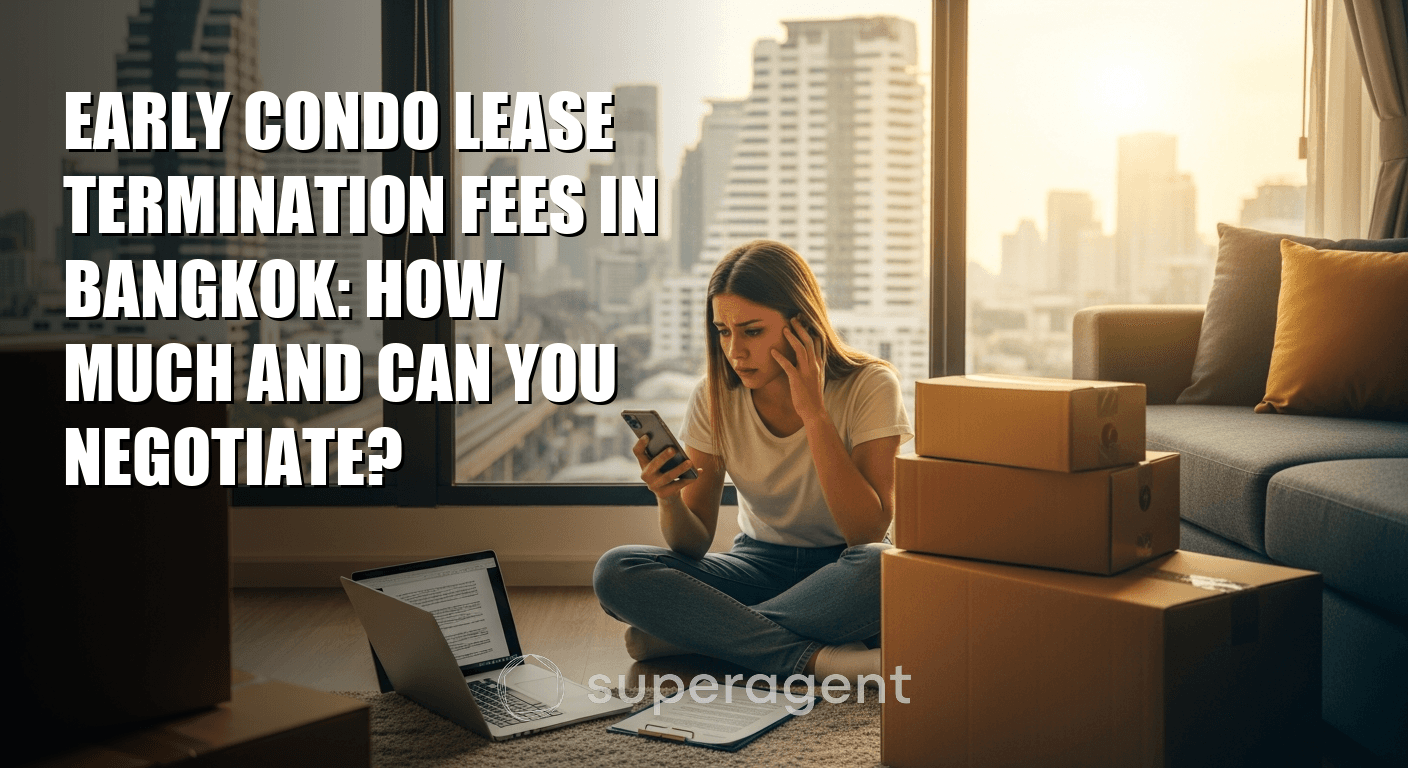
You've found the perfect condo in Thonglor, the rent is reasonable, your furniture is arriving next week, and then life happens. A job transfer. A family emergency back home. A lease that sounded good six months ago but now feels like a trap. You're staring at your rental contract and wondering: how much is it actually going to cost me to leave early?
Early termination fees in Bangkok condos are one of those rental realities that catch people off guard. The penalties can range from a gentle nudge to a serious financial hit, and what you end up paying depends partly on the lease language, partly on your negotiating power, and partly on how reasonable your landlord feels that day. This guide walks you through what those fees actually are, how they work in real Bangkok buildings, and whether you have any room to negotiate your way out.
Why Landlords Charge Early Termination Fees at All
From a landlord's perspective, the math is straightforward. They've counted on your monthly rent to cover mortgage payments, building maintenance, property taxes, and profit. If you walk away six months into a two-year lease, they lose income and now have to market the unit again, deal with vacant months, and start the whole tenant screening process over.
Early termination fees exist to discourage that scenario, or at least to compensate the landlord for their lost revenue while they find a replacement tenant. It's not personal, it's just how the rental math works in a city with high turnover like Bangkok.
That said, not all fees are created equal. Some are negotiable before you sign. Some depend entirely on how many months are left. And some landlords, especially those who manage multiple units and understand the market, are more flexible than owner-occupiers who are banking on every baht.
Standard Early Termination Fee Structures in Bangkok Condos
There's no single Bangkok standard because every lease is negotiated individually. But you'll encounter these patterns repeatedly across the market, whether you're renting in Phrom Phong, Ari, or Ekkamai.
The percentage-of-remaining-rent model is most common. You owe a penalty equal to 30, 50, or 100 percent of the rent for the remaining contract term, depending on how early you leave and what the landlord demands. So if you have eight months left on a 40,000 THB monthly lease and the penalty is 50 percent of remaining rent, you'd owe 160,000 THB plus losing your deposit.
The fixed penalty structure is simpler but less common. You might pay a flat fee like 50,000 THB or 100,000 THB regardless of timing. This is more landlord-friendly because it doesn't reward you for leaving later rather than earlier.
The sliding scale approach is what you'll see in professionally managed properties like large condos near BTS Nana or Chit Lom. Penalties decrease the closer you are to your contract end date. Leave in the first three months, pay 100 percent of remaining rent. Leave between month 4 and 8, pay 75 percent. Leave after month 12, pay 25 percent or your deposit only.
Real example: A one-bedroom condo in Asoke near MRT Sukhumvit, leased at 28,000 THB per month, had a standard two-year contract that included a 50 percent early termination fee on remaining rent. A tenant who needed to leave after nine months would owe 420,000 THB in penalties (50 percent of 28,000 times 12 remaining months) on top of forfeiting the security deposit.
Your Deposit Is Usually Gone Either Way
Here's a hard truth: when you terminate early, most Bangkok landlords will not refund your security deposit. It's contractually separate from rent and is typically used as the first line of compensation for early exit, damages, or unpaid utilities.
Security deposits in Bangkok's condo market typically run one to three months of rent. For a 35,000 THB monthly rental, expect to lose 35,000 to 105,000 THB right there. That's on top of whatever early termination penalty your contract specifies.
Some landlords are more generous, especially if you give three to six months notice and they manage to find a quality replacement tenant before your lease ends. But banking on that goodwill is a mistake. Read your contract carefully and assume your deposit stays with the landlord.
The security deposit situation is even more aggressive if the landlord has a legitimate claim for damages beyond normal wear and tear. A broken air conditioning unit, wall damage, or stained carpeting gives them legal grounds to deduct repair costs before returning anything.
Can You Actually Negotiate This Before Signing?
Yes, and you should try. Many Bangkok landlords, especially individual owners rather than corporate property management companies, are willing to negotiate early termination terms before you sign the lease.
Here's the real negotiating power you have: you're a reliable tenant showing up with references, employment verification, and multiple months of deposit money. Landlords value stability. If you can demonstrate that you're not a flight risk and you're planning to respect the lease, you can sometimes push for a lower early termination penalty or a sliding scale tied to notice period rather than a flat percentage.
Smart negotiating looks like this: propose that if you leave in the first six months, you pay 75 percent of remaining rent. If you leave between month 7 and 12, you pay 50 percent. If you leave after month 12 in a two-year lease, you pay back only your deposit or 25 percent of remaining rent, whichever is less. Frame it as shared risk, not confrontation.
You have almost no negotiating power once you've signed the contract. The time to push back is during the walkthrough at Superagent or when you're reviewing terms via email. Landlords almost never reduce penalties after signature unless your circumstances are genuinely catastrophic and their legal risk is higher than the fee itself.
Example: A software engineer relocating to Bangkok from Singapore negotiated a 12-month lease with a 30 percent early termination clause instead of the requested 50 percent, because she committed to paying six months of rent upfront and provided her company's confirmation letter showing her three-year assignment.
How Landlords Actually Enforce These Fees
This is where real Bangkok rental experience matters. Not every landlord has the stomach or legal resources to actually pursue you for an early termination fee. But some do, and they're increasingly using formal collection processes instead of just keeping your deposit.
What typically happens: you give notice that you're leaving, you forfeit your security deposit, and the landlord calculates the early termination penalty. If it's a company or professional landlord managing multiple units, they'll often deduct it from your final utility billing or pursue it through small claims. If it's an individual landlord and the fee is modest, they might just keep the deposit and move on.
The problem is you don't know which landlord you're dealing with until you're already in negotiation. That's why it's essential to clarify enforcement expectations during the contract phase. Ask directly: "If I need to terminate early, how will the penalty be calculated and enforced?" A landlord who fumbles this question might be flexible later.
Thai contract law does give landlords the right to pursue early termination penalties through formal channels, and a growing number of professional property management operations in Bangkok are willing to do it, especially for larger commercial leases or properties in prime locations like Sukhumvit.
Comparing Your Real Options When You Need to Leave
- Leave in months 1-3 of a 24-month lease: 100% of remaining rent, plus lost deposit | Usually required to honor 30-60 days notice | Low, unless family emergency documented
- Leave in months 4-8: 50-75% of remaining rent, plus lost deposit | 30 days notice often required | Medium, if replacement found quickly
- Leave within 3 months of contract end: Lost deposit only, minimal penalty | Standard notice period applies | High, landlord may waive fees entirely
- Professional landlord with sliding scale clause: Decreases monthly, lowest in final 3 months | Structured notification required | Medium to high, terms pre-agreed
Real Numbers From Bangkok's Current Market
According to rental data from professional Bangkok property sites, the average security deposit across the condo market runs between one and two months of rent, with the modal range sitting at 30,000 to 45,000 THB for one-bedroom units in established neighborhoods like Petchburi, Nana, and Ari. Early termination penalties on those same units typically range from 40,000 THB on the lenient end for properties with sliding scale clauses, up to 200,000 to 300,000 THB for landlords using flat percentage penalties on longer lease terms.
A realistic example: a one-bedroom condo in Sukhumvit Soi 24 rents for 32,000 THB monthly. Standard lease is two years. Typical early termination penalty is 50 percent of remaining rent. If you leave after one year, you owe 192,000 THB in penalties (50 percent of 32,000 times 12 remaining months) plus your forfeited deposit of 32,000 to 64,000 THB. Total cost to exit early: 224,000 to 256,000 THB.
Your Best Exit Strategy
If you genuinely need to terminate early, start with communication. Give your landlord as much notice as possible, three to six months if you can. Landlords are much more flexible when they have time to find replacement tenants, and you might negotiate your penalty down because they're reducing their vacancy risk.
Offer to help market the unit. Provide your own potential replacement. Some landlords will waive penalties entirely if you deliver a qualified replacement tenant who signs a lease before your departure date.
Document everything. Get the early termination terms in writing before you move out. Confirm the deposit refund amount, the penalty calculation, and the timeline for both. Thai landlords often operate on handshakes and verbal agreements, but when money is involved, written confirmation protects you.
Finally, if you're signing a lease and you have any uncertainty about your ability to stay the full term, negotiate the earliest possible release clause. A 12-month lease with a 30 percent exit penalty is infinitely better than a 24-month lease with a 50 percent penalty. You pay for flexibility with slightly higher monthly rent, but it's worth it if your life in Bangkok is still uncertain.
Early termination fees are a real cost of renting in Bangkok, and they're designed to be expensive enough that you think twice before breaking your lease. But they're not immovable. The key is negotiating them before you sign and understanding exactly what you're agreeing to. When you're ready to find your next place in Bangkok with confidence in the terms, Superagent makes comparing lease agreements straightforward, so you can spot these penalties upfront and negotiate like someone who actually knows the market.
You've found the perfect condo in Thonglor, the rent is reasonable, your furniture is arriving next week, and then life happens. A job transfer. A family emergency back home. A lease that sounded good six months ago but now feels like a trap. You're staring at your rental contract and wondering: how much is it actually going to cost me to leave early?
Early termination fees in Bangkok condos are one of those rental realities that catch people off guard. The penalties can range from a gentle nudge to a serious financial hit, and what you end up paying depends partly on the lease language, partly on your negotiating power, and partly on how reasonable your landlord feels that day. This guide walks you through what those fees actually are, how they work in real Bangkok buildings, and whether you have any room to negotiate your way out.
Why Landlords Charge Early Termination Fees at All
From a landlord's perspective, the math is straightforward. They've counted on your monthly rent to cover mortgage payments, building maintenance, property taxes, and profit. If you walk away six months into a two-year lease, they lose income and now have to market the unit again, deal with vacant months, and start the whole tenant screening process over.
Early termination fees exist to discourage that scenario, or at least to compensate the landlord for their lost revenue while they find a replacement tenant. It's not personal, it's just how the rental math works in a city with high turnover like Bangkok.
That said, not all fees are created equal. Some are negotiable before you sign. Some depend entirely on how many months are left. And some landlords, especially those who manage multiple units and understand the market, are more flexible than owner-occupiers who are banking on every baht.
Standard Early Termination Fee Structures in Bangkok Condos
There's no single Bangkok standard because every lease is negotiated individually. But you'll encounter these patterns repeatedly across the market, whether you're renting in Phrom Phong, Ari, or Ekkamai.
The percentage-of-remaining-rent model is most common. You owe a penalty equal to 30, 50, or 100 percent of the rent for the remaining contract term, depending on how early you leave and what the landlord demands. So if you have eight months left on a 40,000 THB monthly lease and the penalty is 50 percent of remaining rent, you'd owe 160,000 THB plus losing your deposit.
The fixed penalty structure is simpler but less common. You might pay a flat fee like 50,000 THB or 100,000 THB regardless of timing. This is more landlord-friendly because it doesn't reward you for leaving later rather than earlier.
The sliding scale approach is what you'll see in professionally managed properties like large condos near BTS Nana or Chit Lom. Penalties decrease the closer you are to your contract end date. Leave in the first three months, pay 100 percent of remaining rent. Leave between month 4 and 8, pay 75 percent. Leave after month 12, pay 25 percent or your deposit only.
Real example: A one-bedroom condo in Asoke near MRT Sukhumvit, leased at 28,000 THB per month, had a standard two-year contract that included a 50 percent early termination fee on remaining rent. A tenant who needed to leave after nine months would owe 420,000 THB in penalties (50 percent of 28,000 times 12 remaining months) on top of forfeiting the security deposit.
Your Deposit Is Usually Gone Either Way
Here's a hard truth: when you terminate early, most Bangkok landlords will not refund your security deposit. It's contractually separate from rent and is typically used as the first line of compensation for early exit, damages, or unpaid utilities.
Security deposits in Bangkok's condo market typically run one to three months of rent. For a 35,000 THB monthly rental, expect to lose 35,000 to 105,000 THB right there. That's on top of whatever early termination penalty your contract specifies.
Some landlords are more generous, especially if you give three to six months notice and they manage to find a quality replacement tenant before your lease ends. But banking on that goodwill is a mistake. Read your contract carefully and assume your deposit stays with the landlord.
The security deposit situation is even more aggressive if the landlord has a legitimate claim for damages beyond normal wear and tear. A broken air conditioning unit, wall damage, or stained carpeting gives them legal grounds to deduct repair costs before returning anything.
Can You Actually Negotiate This Before Signing?
Yes, and you should try. Many Bangkok landlords, especially individual owners rather than corporate property management companies, are willing to negotiate early termination terms before you sign the lease.
Here's the real negotiating power you have: you're a reliable tenant showing up with references, employment verification, and multiple months of deposit money. Landlords value stability. If you can demonstrate that you're not a flight risk and you're planning to respect the lease, you can sometimes push for a lower early termination penalty or a sliding scale tied to notice period rather than a flat percentage.
Smart negotiating looks like this: propose that if you leave in the first six months, you pay 75 percent of remaining rent. If you leave between month 7 and 12, you pay 50 percent. If you leave after month 12 in a two-year lease, you pay back only your deposit or 25 percent of remaining rent, whichever is less. Frame it as shared risk, not confrontation.
You have almost no negotiating power once you've signed the contract. The time to push back is during the walkthrough at Superagent or when you're reviewing terms via email. Landlords almost never reduce penalties after signature unless your circumstances are genuinely catastrophic and their legal risk is higher than the fee itself.
Example: A software engineer relocating to Bangkok from Singapore negotiated a 12-month lease with a 30 percent early termination clause instead of the requested 50 percent, because she committed to paying six months of rent upfront and provided her company's confirmation letter showing her three-year assignment.
How Landlords Actually Enforce These Fees
This is where real Bangkok rental experience matters. Not every landlord has the stomach or legal resources to actually pursue you for an early termination fee. But some do, and they're increasingly using formal collection processes instead of just keeping your deposit.
What typically happens: you give notice that you're leaving, you forfeit your security deposit, and the landlord calculates the early termination penalty. If it's a company or professional landlord managing multiple units, they'll often deduct it from your final utility billing or pursue it through small claims. If it's an individual landlord and the fee is modest, they might just keep the deposit and move on.
Talk to us about renting
Share your details and keep reading — we’ll get back to you.
The problem is you don't know which landlord you're dealing with until you're already in negotiation. That's why it's essential to clarify enforcement expectations during the contract phase. Ask directly: "If I need to terminate early, how will the penalty be calculated and enforced?" A landlord who fumbles this question might be flexible later.
Thai contract law does give landlords the right to pursue early termination penalties through formal channels, and a growing number of professional property management operations in Bangkok are willing to do it, especially for larger commercial leases or properties in prime locations like Sukhumvit.
Comparing Your Real Options When You Need to Leave
- Leave in months 1-3 of a 24-month lease: 100% of remaining rent, plus lost deposit | Usually required to honor 30-60 days notice | Low, unless family emergency documented
- Leave in months 4-8: 50-75% of remaining rent, plus lost deposit | 30 days notice often required | Medium, if replacement found quickly
- Leave within 3 months of contract end: Lost deposit only, minimal penalty | Standard notice period applies | High, landlord may waive fees entirely
- Professional landlord with sliding scale clause: Decreases monthly, lowest in final 3 months | Structured notification required | Medium to high, terms pre-agreed
Real Numbers From Bangkok's Current Market
According to rental data from professional Bangkok property sites, the average security deposit across the condo market runs between one and two months of rent, with the modal range sitting at 30,000 to 45,000 THB for one-bedroom units in established neighborhoods like Petchburi, Nana, and Ari. Early termination penalties on those same units typically range from 40,000 THB on the lenient end for properties with sliding scale clauses, up to 200,000 to 300,000 THB for landlords using flat percentage penalties on longer lease terms.
A realistic example: a one-bedroom condo in Sukhumvit Soi 24 rents for 32,000 THB monthly. Standard lease is two years. Typical early termination penalty is 50 percent of remaining rent. If you leave after one year, you owe 192,000 THB in penalties (50 percent of 32,000 times 12 remaining months) plus your forfeited deposit of 32,000 to 64,000 THB. Total cost to exit early: 224,000 to 256,000 THB.
Your Best Exit Strategy
If you genuinely need to terminate early, start with communication. Give your landlord as much notice as possible, three to six months if you can. Landlords are much more flexible when they have time to find replacement tenants, and you might negotiate your penalty down because they're reducing their vacancy risk.
Offer to help market the unit. Provide your own potential replacement. Some landlords will waive penalties entirely if you deliver a qualified replacement tenant who signs a lease before your departure date.
Document everything. Get the early termination terms in writing before you move out. Confirm the deposit refund amount, the penalty calculation, and the timeline for both. Thai landlords often operate on handshakes and verbal agreements, but when money is involved, written confirmation protects you.
Finally, if you're signing a lease and you have any uncertainty about your ability to stay the full term, negotiate the earliest possible release clause. A 12-month lease with a 30 percent exit penalty is infinitely better than a 24-month lease with a 50 percent penalty. You pay for flexibility with slightly higher monthly rent, but it's worth it if your life in Bangkok is still uncertain.
Early termination fees are a real cost of renting in Bangkok, and they're designed to be expensive enough that you think twice before breaking your lease. But they're not immovable. The key is negotiating them before you sign and understanding exactly what you're agreeing to. When you're ready to find your next place in Bangkok with confidence in the terms, Superagent makes comparing lease agreements straightforward, so you can spot these penalties upfront and negotiate like someone who actually knows the market.
Share this article
Properties you may like
![[For Rent] CONDO I Aguston Sukhumvit 22 I Pet Friendly I 2 Beds I 2 Baths I Rent 55,000THB/mo](/_next/image?url=https%3A%2F%2Fstorage.googleapis.com%2Fsuperagent-web%2Fattachments%2Flistings%2F2266%2Fd3afcd25-6b79-46cb-9f1f-396acdc3dd10-955-3.jpg&w=3840&q=75)
฿55,000
2 Bed295 sqm
[For Rent] CONDO I Aguston Sukhumvit 22 I Pet Friendly I 2 Beds I 2 Baths I Rent 55,000THB/mo
Phrom Phong
Condo![[For Rent] CONDO I SUPALAI PLACE Sukhumvit 39 I 2 Beds I 2 Baths (1 Jacuzzi) I 55,555THB/mo](/_next/image?url=https%3A%2F%2Fstorage.googleapis.com%2Fsuperagent-web%2Fattachments%2Flistings%2F6743%2Fba530743-48b9-4ac6-92d3-c2247e743cf6-01-supalai-place-skv39-2b-link-heaven.jpg&w=3840&q=75)
฿55,555
2 Bed2142 sqm
[For Rent] CONDO I SUPALAI PLACE Sukhumvit 39 I 2 Beds I 2 Baths (1 Jacuzzi) I 55,555THB/mo
Phrom Phong
Condo![[For Rent] CONDO I Maru Ekkamai 2 I Pet friendly I 2 Beds I 2 Baths I 68,000 THB/mo](/_next/image?url=https%3A%2F%2Fstorage.googleapis.com%2Fsuperagent-web%2Fattachments%2Flistings%2F6602%2F9f1d8f71-ee43-435f-9a44-da16c4092c92-968-1.jpg&w=3840&q=75)
฿68,000
2 Bed360 sqm
[For Rent] CONDO I Maru Ekkamai 2 I Pet friendly I 2 Beds I 2 Baths I 68,000 THB/mo
Ekkamai
Condo![[For Rent] CONDO I Noble State 39 I 2 Beds I 2 Baths I 63,000THB/mo](/_next/image?url=https%3A%2F%2Fstorage.googleapis.com%2Fsuperagent-web%2Fattachments%2Flistings%2F2237%2F60eb58f3-eae5-41ed-a80b-406e004f05d8-940-1.jpg&w=3840&q=75)
฿63,000
2 Bed260 sqm
[For Rent] CONDO I Noble State 39 I 2 Beds I 2 Baths I 63,000THB/mo
Phrom Phong
Condo![[For Rent] CONDO I Rhythm Sukhumvit 36-38 I 2 Beds I 2 Baths I 38,999THB/mo](/_next/image?url=https%3A%2F%2Fstorage.googleapis.com%2Fsuperagent-web%2Fattachments%2Flistings%2F1788%2F942a0215-4128-4c2c-a064-f607e84e7aa4-656-2.jpg&w=3840&q=75)
฿38,999
2 Bed256 sqm
[For Rent] CONDO I Rhythm Sukhumvit 36-38 I 2 Beds I 2 Baths I 38,999THB/mo
Thonglor
Condo![[For Rent] CONDO I CLOUD Thonglor-Phetchaburi I 1 Bed I 1 Bath I 22,500THB/mo](/_next/image?url=https%3A%2F%2Fstorage.googleapis.com%2Fsuperagent-web%2Fattachments%2Flistings%2F6742%2F6cef5361-0dac-4dba-98f1-b0d187559c84-1118-1.jpg&w=3840&q=75)
฿22,500
1 Bed132 sqm
[For Rent] CONDO I CLOUD Thonglor-Phetchaburi I 1 Bed I 1 Bath I 22,500THB/mo
Thonglor
Condo![[For Rent] CONDO I City Smart Sukhumvit 18 I 3 Beds I 3 Baths I 65,000mo/THB](/_next/image?url=https%3A%2F%2Fstorage.googleapis.com%2Fsuperagent-web%2Fattachments%2Flistings%2F6741%2Fd371c89d-a913-42c4-a673-e540afae4f46-1116-1.jpg&w=3840&q=75)
฿65,000
3 Bed3125 sqm
[For Rent] CONDO I City Smart Sukhumvit 18 I 3 Beds I 3 Baths I 65,000mo/THB
Condo![[For Rent] CONDO I The Coast Bangkok I 1 Bed I 1 Bath I 20,000mo/THB](/_next/image?url=https%3A%2F%2Fstorage.googleapis.com%2Fsuperagent-web%2Fattachments%2Flistings%2F6740%2F498477ce-4ffa-4e4c-ab08-0e565d9c4bbe-1115-3.jpg&w=3840&q=75)
฿20,000
1 Bed146 sqm
[For Rent] CONDO I The Coast Bangkok I 1 Bed I 1 Bath I 20,000mo/THB
Bang Na
Condo![[For Rent] CONDO I IDEO Sukhumvit-RAMA 4 I 2 Beds I 2 Baths I 55,000mo/THB](/_next/image?url=https%3A%2F%2Fstorage.googleapis.com%2Fsuperagent-web%2Fattachments%2Flistings%2F6739%2F15df221d-5b8e-497c-b7ce-a6b9b6412cab-1113-1.jpg&w=3840&q=75)
฿55,000
2 Bed265 sqm
[For Rent] CONDO I IDEO Sukhumvit-RAMA 4 I 2 Beds I 2 Baths I 55,000mo/THB
Phra Khanong
Condo![[For Rent] CONDO I Downtown 49 I Pet Friendly I 1 Bed I 1 Bath I 23,000mo/THB](/_next/image?url=https%3A%2F%2Fstorage.googleapis.com%2Fsuperagent-web%2Fattachments%2Flistings%2F6738%2F11cf2ffe-1f01-4ccc-991c-2ad608f1ba73-1112-1.jpg&w=3840&q=75)
฿23,000
1 Bed135 sqm
[For Rent] CONDO I Downtown 49 I Pet Friendly I 1 Bed I 1 Bath I 23,000mo/THB
Thonglor
CondoMore like this
 In Guides · Superagent EditorialHidden Costs of Renting a Condo in Bangkok Nobody Warns You AboutBangkok condo rent looks affordable until month one hits. Here are the real costs beyond the headline figure that catch most renters off guard.25 May 20261 min read
 In Guides · Superagent EditorialWhat a Long-Vacant Bangkok Condo Unit Is Actually Telling YouA Bangkok condo vacant for months signals overpricing, landlord issues, or real problems. Here is how to read the signs.25 May 20261 min read
 In Guides · Superagent EditorialRed Flags in a Bangkok Rental Contract to Watch Out ForBangkok rental contracts often hide risky clauses. Here are the red flags every tenant must catch before signing any lease.25 May 20261 min read
 In Guides · Superagent EditorialWorking Online from a Condo: How to Choose the Perfect Room for ProductivityLearn how to choose the best condo room for working online with tips on lighting, noise, and furniture setup to maximize productivity.9 May 20261 min read