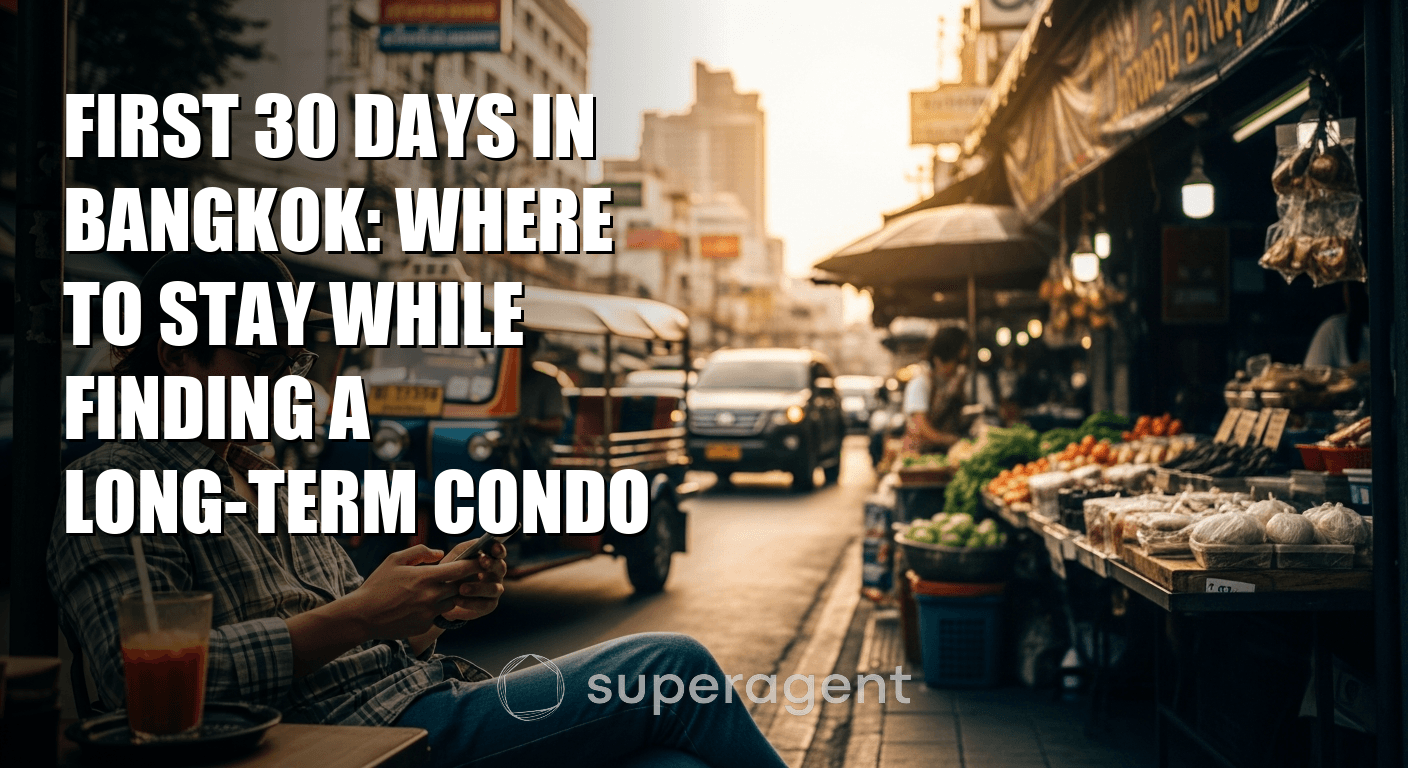
First 30 Days in Bangkok: Where to Stay While Finding a Long-Term Condo
Guides
First 30 Days in Bangkok: Where to Stay While Finding a Long-Term Condo
Smart temporary housing options for relocating to Bangkok while apartment hunting
Summary
Navigate Bangkok relocation smoothly with our guide to 30-day accommodations. Find the perfect temporary base while searching for your long-term condo home
You just landed at Suvarnabhumi, your bags are heavy, your phone is buzzing with LINE messages from agents you found online, and you have exactly zero idea where you should sleep tonight. Welcome to Bangkok. The good news is that this city is incredibly forgiving for newcomers who need a soft landing. The bad news is that signing a 12 month lease on your second day here is one of the most expensive mistakes you can make. Your first 30 days should be a trial run. Stay somewhere flexible, explore neighborhoods on foot and by train, and figure out what actually matters to you before locking in a long term condo. Here is exactly how to do that.
Why You Should Never Sign a Lease Before Living Here for a Month
Bangkok looks completely different on Google Maps than it does at 8 AM on a Monday when you are stuck in traffic on Sukhumvit. That condo near Thong Lo BTS that looked perfect online might sit on a soi that floods every time it rains in September. The "quiet" building near Ari could back up against a night market that runs until 2 AM.
A friend of mine moved here from London and signed a lease at a high rise near Asok within 48 hours. Great building, solid price at 28,000 THB per month for a one bedroom. But she worked in Sathorn, and the commute during rush hour was brutal. She spent three months regretting it before her lease ended. If she had taken 30 days to test the commute, she would have chosen Surasak or Chong Nonsi instead.
According to CBRE Thailand's residential market reports, average asking rents for a one bedroom condo along the Sukhumvit corridor range from 15,000 to 45,000 THB per month depending on building age and proximity to BTS stations. That is a massive range, and the only way to understand what you are actually getting at each price point is to walk through units in person.
Give yourself a month. Stay somewhere temporary. Ride the BTS Skytrain and MRT during peak hours. Eat at local spots in different neighborhoods. Then sign your lease with confidence.
Your Short Term Housing Options for the First 30 Days
Bangkok has more temporary housing options than almost any city in Southeast Asia. The trick is matching your budget and lifestyle to the right type. Here is a quick breakdown of what actually works for a 30 day stay.
- Serviced apartment (Sukhumvit/Silom): 25,000 to 55,000 THB | Professionals, families needing space | Prices spike during peak season (Nov to Feb)
- Airbnb or VRBO condo: 15,000 to 40,000 THB | Solo renters who want a real condo feel | Some buildings ban short stays, so check carefully
- Hostel or guesthouse (Khao San, Silom, On Nut): 6,000 to 15,000 THB | Budget travelers, digital nomads | Limited privacy, noise, shared facilities
- Hotel with monthly rate: 20,000 to 60,000 THB | People who want zero hassle | No kitchen in most rooms, can feel isolating
- Co-living space (Ekkamai, Ari, Phra Khanong): 12,000 to 25,000 THB | Remote workers, social newcomers | Smaller rooms, shared common areas
If you are working remotely and your budget is moderate, a serviced apartment near BTS Phrom Phong or Thong Lo is hard to beat. Buildings like Somerset Sukhumvit Thonglor or Citadines Sukhumvit 8 offer monthly rates that include cleaning, Wi-Fi, and a small kitchen. You will feel settled enough to focus on your condo search without the chaos of hotel living.
The Best Neighborhoods to Base Yourself During Your Search
Where you stay for your first 30 days should be central enough to explore multiple neighborhoods easily. You want to be near a BTS or MRT station, close to grocery stores, and in an area where you can get a feel for daily life in Bangkok.
On Nut is a strong pick for people on a tighter budget. It is the last station in the inner Sukhumvit stretch, and the neighborhood has exploded with cafes, coworking spaces, and affordable condos. You can find serviced apartments here for 15,000 to 20,000 THB per month, and you are only 15 minutes by train from Asok or Siam.
If budget is less of a concern, base yourself around Phrom Phong or Thong Lo. These two stations sit in the heart of the expat belt along Sukhumvit Soi 24 to Soi 55. Restaurants, international grocery stores like Villa Market, and top hospitals like Bumrungrad International Hospital are all within walking distance. It is the easiest place to land if this is your first time in Southeast Asia.
For people who will work in the Silom or Sathorn business district, staying near BTS Chong Nonsi or Sala Daeng makes more sense. You will avoid the cross city commute entirely and can explore neighborhoods like Yan Nawa and Bang Rak on weekends. Monthly hotel deals near Silom Soi 19 can run around 18,000 to 30,000 THB depending on the property.
How to Actually Spend Those 30 Days Productively
Do not just sit in your serviced apartment scrolling through listings. Get out and treat this like a research project. Here is a rough week by week plan that actually works.
Week one: settle in, recover from jet lag, set up your Thai SIM card, and open a basic bank account if you have the right visa. Explore your immediate neighborhood on foot. Eat at the food stalls on your soi. Figure out what you like and do not like about where you are staying right now.
Week two: start visiting neighborhoods seriously. Spend one full day in Ari and Saphan Khwai. Another day along the Sukhumvit line from Nana to Bearing. Take the MRT to Phra Ram 9 and check out the newer condo developments near Jodd Fairs night market. Ride the Gold Line to Khlong San if you are curious about the riverside.
Week three: narrow your list to two or three neighborhoods. Start viewing actual units. This is where you want to see five to ten condos in person. Walk the sois at different times of day. Check the evening noise levels. Ask the building juristic office about utility costs, which typically run 2,000 to 5,000 THB per month on top of rent for electricity and water.
Week four: negotiate and sign your lease. By now you know the neighborhood, you have seen enough units to understand fair pricing, and you can negotiate from a position of knowledge rather than desperation. Most landlords expect some negotiation. Asking for one month free on a 12 month contract or requesting that the landlord replace an old mattress is completely normal.
Common Mistakes That Cost Newcomers Real Money
The biggest one is paying too much because you did not compare enough units. Bangkok's condo market is competitive for landlords, not just tenants. If a one bedroom at Life Sukhumvit 48 is listed at 18,000 THB per month but a similar unit in the same building is available for 15,000 THB, you will only know that if you check multiple listings and talk to multiple agents.
Another classic error is skipping the lease review. Thai residential leases are usually straightforward, but you should always confirm the deposit terms (typically two months rent), the notice period for ending the lease, and whether subleasing is allowed. Some buildings also have strict rules about pets, guests, and renovation. Read every clause before you sign.
A third mistake is ignoring the total cost of living in a building. That condo with a pool on the 30th floor might charge 7 THB per unit of electricity instead of the 4 THB per unit rate from the Metropolitan Electricity Authority. Over a year, that difference can add up to 15,000 THB or more, especially if you run air conditioning regularly. Always ask about the electricity billing method before you commit.
What to Look for When You Are Finally Ready to Sign
After 30 days of exploring, you should have a clear picture of what matters most to you. For some people, it is walkability to a BTS station. For others, it is a quiet soi with street food nearby. Here are the non negotiable things to verify before you put down your deposit.
Check the building's management quality. Walk through the lobby, gym, and pool area. Are they clean and well maintained? Talk to a security guard or the front desk staff. A well run building with responsive management will save you countless headaches over the life of your lease.
Verify the internet speed. Ask to run a speed test in the actual unit if possible. Most newer condos in Bangkok support fiber connections from providers like AIS or True, but older buildings might cap out at 100 Mbps or less. If you work from home, this is critical.
Finally, confirm the contract is in your name and matches what you agreed to verbally. Get a copy of the landlord's ID card and the condo's title deed number. Take timestamped photos of every wall, appliance, and piece of furniture before you move in. This protects your deposit when you eventually move out.
Your first 30 days in Bangkok will be chaotic, exciting, and probably a little overwhelming. But if you resist the urge to rush into a lease and give yourself time to learn the city, you will end up in a condo that actually fits your life here. Take it slow, explore widely, and trust the process. When you are ready to start browsing verified listings and comparing condos across Bangkok's best neighborhoods, Superagent can help you find the right place without the guesswork.
You just landed at Suvarnabhumi, your bags are heavy, your phone is buzzing with LINE messages from agents you found online, and you have exactly zero idea where you should sleep tonight. Welcome to Bangkok. The good news is that this city is incredibly forgiving for newcomers who need a soft landing. The bad news is that signing a 12 month lease on your second day here is one of the most expensive mistakes you can make. Your first 30 days should be a trial run. Stay somewhere flexible, explore neighborhoods on foot and by train, and figure out what actually matters to you before locking in a long term condo. Here is exactly how to do that.
Why You Should Never Sign a Lease Before Living Here for a Month
Bangkok looks completely different on Google Maps than it does at 8 AM on a Monday when you are stuck in traffic on Sukhumvit. That condo near Thong Lo BTS that looked perfect online might sit on a soi that floods every time it rains in September. The "quiet" building near Ari could back up against a night market that runs until 2 AM.
A friend of mine moved here from London and signed a lease at a high rise near Asok within 48 hours. Great building, solid price at 28,000 THB per month for a one bedroom. But she worked in Sathorn, and the commute during rush hour was brutal. She spent three months regretting it before her lease ended. If she had taken 30 days to test the commute, she would have chosen Surasak or Chong Nonsi instead.
According to CBRE Thailand's residential market reports, average asking rents for a one bedroom condo along the Sukhumvit corridor range from 15,000 to 45,000 THB per month depending on building age and proximity to BTS stations. That is a massive range, and the only way to understand what you are actually getting at each price point is to walk through units in person.
Give yourself a month. Stay somewhere temporary. Ride the BTS Skytrain and MRT during peak hours. Eat at local spots in different neighborhoods. Then sign your lease with confidence.
Continue reading after that.
Looking for a condo
to rent?
Leave your name and phone. We'll follow up while you keep reading.
100% Secure
Fast Response
Free Consultation
Your Short Term Housing Options for the First 30 Days
Bangkok has more temporary housing options than almost any city in Southeast Asia. The trick is matching your budget and lifestyle to the right type. Here is a quick breakdown of what actually works for a 30 day stay.
- Serviced apartment (Sukhumvit/Silom): 25,000 to 55,000 THB | Professionals, families needing space | Prices spike during peak season (Nov to Feb)
- Airbnb or VRBO condo: 15,000 to 40,000 THB | Solo renters who want a real condo feel | Some buildings ban short stays, so check carefully
- Hostel or guesthouse (Khao San, Silom, On Nut): 6,000 to 15,000 THB | Budget travelers, digital nomads | Limited privacy, noise, shared facilities
- Hotel with monthly rate: 20,000 to 60,000 THB | People who want zero hassle | No kitchen in most rooms, can feel isolating
- Co-living space (Ekkamai, Ari, Phra Khanong): 12,000 to 25,000 THB | Remote workers, social newcomers | Smaller rooms, shared common areas
If you are working remotely and your budget is moderate, a serviced apartment near BTS Phrom Phong or Thong Lo is hard to beat. Buildings like Somerset Sukhumvit Thonglor or Citadines Sukhumvit 8 offer monthly rates that include cleaning, Wi-Fi, and a small kitchen. You will feel settled enough to focus on your condo search without the chaos of hotel living.
The Best Neighborhoods to Base Yourself During Your Search
Where you stay for your first 30 days should be central enough to explore multiple neighborhoods easily. You want to be near a BTS or MRT station, close to grocery stores, and in an area where you can get a feel for daily life in Bangkok.
On Nut is a strong pick for people on a tighter budget. It is the last station in the inner Sukhumvit stretch, and the neighborhood has exploded with cafes, coworking spaces, and affordable condos. You can find serviced apartments here for 15,000 to 20,000 THB per month, and you are only 15 minutes by train from Asok or Siam.
If budget is less of a concern, base yourself around Phrom Phong or Thong Lo. These two stations sit in the heart of the expat belt along Sukhumvit Soi 24 to Soi 55. Restaurants, international grocery stores like Villa Market, and top hospitals like Bumrungrad International Hospital are all within walking distance. It is the easiest place to land if this is your first time in Southeast Asia.
For people who will work in the Silom or Sathorn business district, staying near BTS Chong Nonsi or Sala Daeng makes more sense. You will avoid the cross city commute entirely and can explore neighborhoods like Yan Nawa and Bang Rak on weekends. Monthly hotel deals near Silom Soi 19 can run around 18,000 to 30,000 THB depending on the property.
How to Actually Spend Those 30 Days Productively
Do not just sit in your serviced apartment scrolling through listings. Get out and treat this like a research project. Here is a rough week by week plan that actually works.
Week one: settle in, recover from jet lag, set up your Thai SIM card, and open a basic bank account if you have the right visa. Explore your immediate neighborhood on foot. Eat at the food stalls on your soi. Figure out what you like and do not like about where you are staying right now.
Week two: start visiting neighborhoods seriously. Spend one full day in Ari and Saphan Khwai. Another day along the Sukhumvit line from Nana to Bearing. Take the MRT to Phra Ram 9 and check out the newer condo developments near Jodd Fairs night market. Ride the Gold Line to Khlong San if you are curious about the riverside.
Week three: narrow your list to two or three neighborhoods. Start viewing actual units. This is where you want to see five to ten condos in person. Walk the sois at different times of day. Check the evening noise levels. Ask the building juristic office about utility costs, which typically run 2,000 to 5,000 THB per month on top of rent for electricity and water.
Week four: negotiate and sign your lease. By now you know the neighborhood, you have seen enough units to understand fair pricing, and you can negotiate from a position of knowledge rather than desperation. Most landlords expect some negotiation. Asking for one month free on a 12 month contract or requesting that the landlord replace an old mattress is completely normal.
Common Mistakes That Cost Newcomers Real Money
The biggest one is paying too much because you did not compare enough units. Bangkok's condo market is competitive for landlords, not just tenants. If a one bedroom at Life Sukhumvit 48 is listed at 18,000 THB per month but a similar unit in the same building is available for 15,000 THB, you will only know that if you check multiple listings and talk to multiple agents.
Continue reading after that.
Looking for a condo
to rent?
Leave your name and phone. We'll follow up while you keep reading.
100% Secure
Fast Response
Free Consultation
Another classic error is skipping the lease review. Thai residential leases are usually straightforward, but you should always confirm the deposit terms (typically two months rent), the notice period for ending the lease, and whether subleasing is allowed. Some buildings also have strict rules about pets, guests, and renovation. Read every clause before you sign.
A third mistake is ignoring the total cost of living in a building. That condo with a pool on the 30th floor might charge 7 THB per unit of electricity instead of the 4 THB per unit rate from the Metropolitan Electricity Authority. Over a year, that difference can add up to 15,000 THB or more, especially if you run air conditioning regularly. Always ask about the electricity billing method before you commit.
What to Look for When You Are Finally Ready to Sign
After 30 days of exploring, you should have a clear picture of what matters most to you. For some people, it is walkability to a BTS station. For others, it is a quiet soi with street food nearby. Here are the non negotiable things to verify before you put down your deposit.
Check the building's management quality. Walk through the lobby, gym, and pool area. Are they clean and well maintained? Talk to a security guard or the front desk staff. A well run building with responsive management will save you countless headaches over the life of your lease.
Verify the internet speed. Ask to run a speed test in the actual unit if possible. Most newer condos in Bangkok support fiber connections from providers like AIS or True, but older buildings might cap out at 100 Mbps or less. If you work from home, this is critical.
Finally, confirm the contract is in your name and matches what you agreed to verbally. Get a copy of the landlord's ID card and the condo's title deed number. Take timestamped photos of every wall, appliance, and piece of furniture before you move in. This protects your deposit when you eventually move out.
Your first 30 days in Bangkok will be chaotic, exciting, and probably a little overwhelming. But if you resist the urge to rush into a lease and give yourself time to learn the city, you will end up in a condo that actually fits your life here. Take it slow, explore widely, and trust the process. When you are ready to start browsing verified listings and comparing condos across Bangkok's best neighborhoods, Superagent can help you find the right place without the guesswork.
Share this article
Properties you may like
![[For Rent] CONDO I Las Colinas Condominium I 2 Beds I 3 Baths I 85,000THB/mo](/_next/image?url=https%3A%2F%2Fstorage.googleapis.com%2Fsuperagent-web%2Fattachments%2Flistings%2F6828%2F80f345c4-488e-43b2-b017-c9fbb17b520d-99486dd8-4237-4ba2-9207-01ce4f66b21f-media.jpg&w=3840&q=75)
฿85,000
2 Bed3170 sqm
[For Rent] CONDO I Las Colinas Condominium I 2 Beds I 3 Baths I 85,000THB/mo
Asoke
Condo![[For Rent] CONDO I Ashton Asoke I 1 Bed I 1 Bath I 30,000THB/mo](/_next/image?url=https%3A%2F%2Fstorage.googleapis.com%2Fsuperagent-web%2Fattachments%2Flistings%2F6876%2Fb7ce9bbe-f877-4ff5-bb54-8ad0026db940-1272-4.jpg&w=3840&q=75)
฿30,000
1 Bed135 sqm
[For Rent] CONDO I Ashton Asoke I 1 Bed I 1 Bath I 30,000THB/mo
Asoke
Condo![[For Rent] CONDO I Skyrise Avenue Sukhumvit 64 I 2 Beds I 2 Baths I 27,000THB/mo](/_next/image?url=https%3A%2F%2Fstorage.googleapis.com%2Fsuperagent-web%2Fattachments%2Flistings%2F2001%2F670f91de-c251-4e81-971c-8e30ed2158cd-screenshot-2026-07-05-at-11.38.53-pm.png&w=3840&q=75)
฿27,000
2 Bed252 sqm
[For Rent] CONDO I Skyrise Avenue Sukhumvit 64 I 2 Beds I 2 Baths I 27,000THB/mo
Punnawithi
Condo![[For Rent] CONDO I Park Origin Ratchathewi I Duplex I 2 Beds I 1 Bath I 32,000THB/mo](/_next/image?url=https%3A%2F%2Fstorage.googleapis.com%2Fsuperagent-web%2Fattachments%2Flistings%2F6896%2Fb79a7d21-7533-4b0d-bb19-762ebfafab62-1318-6.jpg&w=3840&q=75)
฿32,000
2 Bed135.9 sqm
[For Rent] CONDO I Park Origin Ratchathewi I Duplex I 2 Beds I 1 Bath I 32,000THB/mo
Ratchathewi
Condo![[For Rent] CONDO I Park Origin Phayathai I Studio I 1 Bath I 28,000THB/mo](/_next/image?url=https%3A%2F%2Fstorage.googleapis.com%2Fsuperagent-web%2Fattachments%2Flistings%2F6757%2Fb226df93-94c6-46fa-aeba-ebfadc7f81b8-1000006042.jpg&w=3840&q=75)
฿28,000
Studio129 sqm
[For Rent] CONDO I Park Origin Phayathai I Studio I 1 Bath I 28,000THB/mo
Phaya Thai
Condo![[For Rent] CONDO I Ideo Mobi Sukhumvit 81 I Duplex I 1 Bed I 1 Bath I 28,000THB/mo](/_next/image?url=https%3A%2F%2Fstorage.googleapis.com%2Fsuperagent-web%2Fattachments%2Flistings%2F1849%2Fc8b2c033-3b5f-4615-b2b0-4972f40141f0-705-13.jpg&w=3840&q=75)
฿28,000
1 Bed143 sqm
[For Rent] CONDO I Ideo Mobi Sukhumvit 81 I Duplex I 1 Bed I 1 Bath I 28,000THB/mo
On Nut
Condo![[For Rent] CONDO I Siamese Sukhumvit 48 I 1 Bed I 1 Bath I 28,000THB/mo](/_next/image?url=https%3A%2F%2Fstorage.googleapis.com%2Fsuperagent-web%2Fattachments%2Flistings%2F6841%2Febc2dce2-2e9b-4e6d-a01c-0cfa619dfa13-1231-6.jpg&w=3840&q=75)
฿28,000
1 Bed144 sqm
[For Rent] CONDO I Siamese Sukhumvit 48 I 1 Bed I 1 Bath I 28,000THB/mo
Condo![[For Rent] CONDO I Ashton Asoke I 1 Bed I 1 Bath I 22,000THB/mo](/_next/image?url=https%3A%2F%2Fstorage.googleapis.com%2Fsuperagent-web%2Fattachments%2Flistings%2F6802%2Fe06b9b73-1207-414a-ab04-1685de0c7eaa-20220808_153124_0.jpg&w=3840&q=75)
฿22,000
1 Bed134 sqm
[For Rent] CONDO I Ashton Asoke I 1 Bed I 1 Bath I 22,000THB/mo
Asoke
Condo![[For Rent] CONDO I HQ Thonglor Soi 4 I 1 Bed I 1 Bath I 35,000 THB/mo](/_next/image?url=https%3A%2F%2Fstorage.googleapis.com%2Fsuperagent-web%2Fattachments%2Flistings%2F1445%2F72352585-1bc2-41a8-bd62-ddcbf8189fe9-376-5.jpg&w=3840&q=75)
฿35,000
1 Bed143.6 sqm
[For Rent] CONDO I HQ Thonglor Soi 4 I 1 Bed I 1 Bath I 35,000 THB/mo
Thonglor
Condo![[For Rent] CONDO I The Master Centrium Asoke - Sukhumvit I Duplex I 2 Beds I 3 Baths I 75,000 THB/mo](/_next/image?url=https%3A%2F%2Fstorage.googleapis.com%2Fsuperagent-web%2Fattachments%2Flistings%2F1545%2F97932b6a-c358-45e4-b5f9-995dbf5a3cf0-441-2.jpg&w=3840&q=75)
฿75,000
2 Bed3150 sqm
[For Rent] CONDO I The Master Centrium Asoke - Sukhumvit I Duplex I 2 Beds I 3 Baths I 75,000 THB/mo
Asoke
CondoMore like this
 In Guides · Superagent EditorialHidden Costs of Renting a Condo in Bangkok Nobody Warns You AboutBangkok condo rent looks affordable until month one hits. Here are the real costs beyond the headline figure that catch most renters off guard.25 May 20261 min read
 In Guides · Superagent EditorialWhat a Long-Vacant Bangkok Condo Unit Is Actually Telling YouA Bangkok condo vacant for months signals overpricing, landlord issues, or real problems. Here is how to read the signs.25 May 20261 min read
 In Guides · Superagent EditorialRed Flags in a Bangkok Rental Contract to Watch Out ForBangkok rental contracts often hide risky clauses. Here are the red flags every tenant must catch before signing any lease.25 May 20261 min read
 In Guides · Superagent EditorialWorking Online from a Condo: How to Choose the Perfect Room for ProductivityLearn how to choose the best condo room for working online with tips on lighting, noise, and furniture setup to maximize productivity.9 May 20261 min read