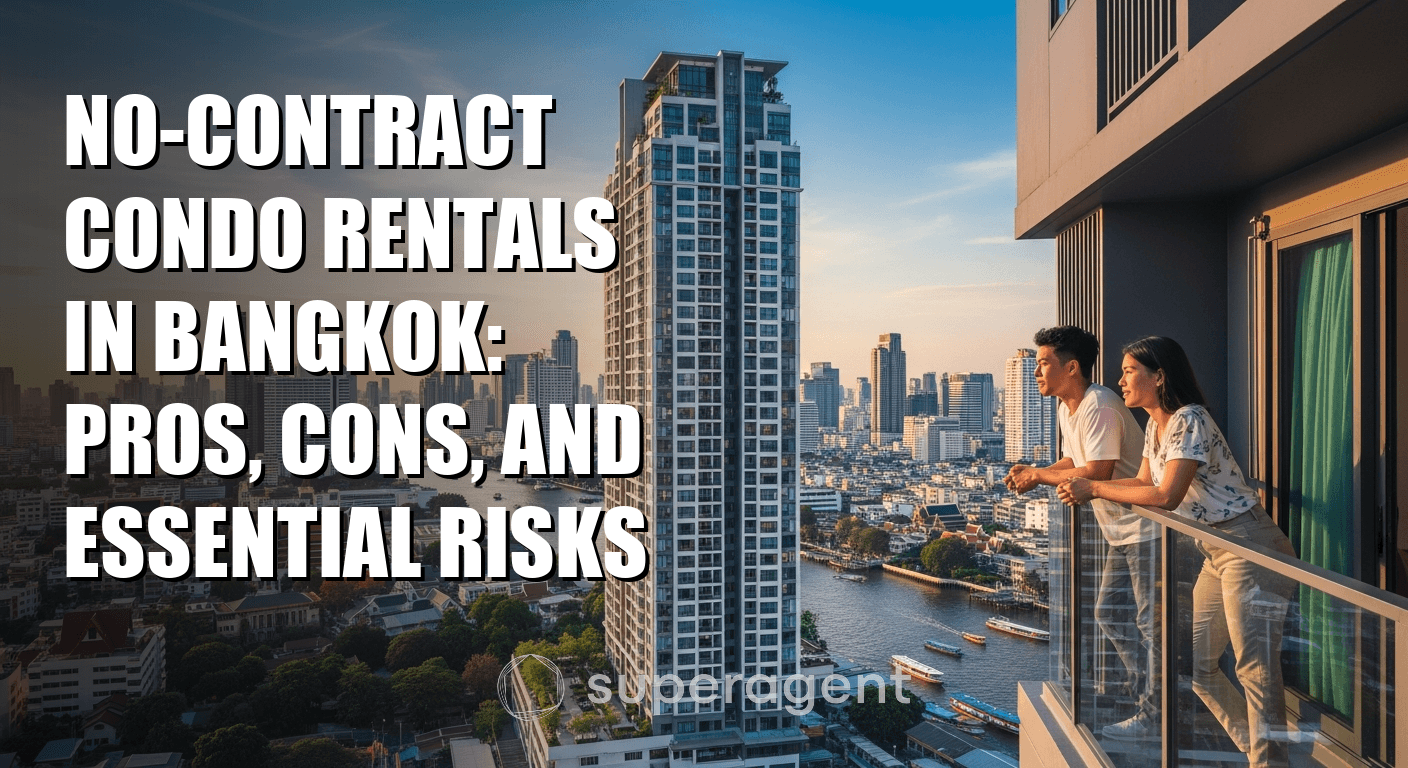
No-Contract Condo Rentals in Bangkok: Pros, Cons, and Essential Risks
Guides
No-Contract Condo Rentals in Bangkok: Pros, Cons, and Essential Risks
Understand the benefits and dangers of renting a condo without a lease agreement in Bangkok.
Summary
เช่าคอนโดไม่มีสัญญา offers flexibility but carries significant risks. Learn the pros, cons, and what renters must know before signing nothing.
You're scrolling through condo listings in Bangkok, and you spot a place that looks perfect. The price is right, the location is ideal near BTS Thonglor, and the owner says, "No contract needed, just move in." Your heart says yes, but your gut starts sending warning signals. Should you go for it?
Renting a condo without a formal contract happens all the time in Bangkok. Some landlords prefer the flexibility. Some tenants want to avoid paperwork. But what looks like a quick, hassle-free deal can turn into a nightmare if things go wrong. We've seen expats get locked out without notice. We've heard stories of deposits disappearing. And we know locals who found themselves in messy disputes that cost them time and money.
If you're thinking about signing up for a no-contract rental in Bangkok, you need to understand exactly what you're getting into. Let's break down the real pros, the genuine risks, and what actually happens when things fall apart.
What Does "No Contract" Actually Mean in Bangkok?
A no-contract condo rental in Bangkok usually means you and the owner have made a verbal agreement. There's no written lease document filed anywhere. Payment happens month to month, sometimes in cash, sometimes via bank transfer. You might have a receipt, you might not. The owner might say, "Let's just do this informally," or they might not use those words but just never bring out a lease form.
Here's the thing: in Thailand, a verbal rental agreement is actually enforceable under the Rent and Lease Act, but proving what you agreed to becomes incredibly difficult if there's a dispute. You have no paper trail. You have no timestamp on conversations. If your landlord claims you agreed to something different, or if they change the terms after a few months, you're in a weak position legally.
Some landlords in Bangkok do this because they're avoiding tax reporting. Some do it because they don't trust formal contracts. Some are just casual about it and don't see the harm. Whatever the reason, you're taking on risk.
The Real Benefits (Yes, There Are Some)
Let's be honest: there are reasons people go for no-contract rentals, and some of them are legitimate. If you're staying in Bangkok for just three months while you figure out where you want to live long-term, a formal one-year lease feels restrictive. Many landlords want two months deposit plus one month advance rent for a contract. No-contract agreements often mean less upfront cash required.
Consider this real scenario: You're a freelancer who just moved to Bangkok and got a short-term client project that might last anywhere from two to six months. A condo in Prakanong near BTS Prakanong offers a room for 12,000 THB per month with a contract requiring 36,000 THB upfront (two months deposit, one month advance). A similar place two sois over offers the same room, same condition, same price, but the owner says "just pay monthly, give me 15,000 THB today to hold it." The flexibility here is real.
You also skip bureaucratic hassles. No landlord asking for work permits, no visa verification questions, no requirements to register with the local immigration office through your condo. Some people value that privacy, rightly or not. Eviction is faster too, if you need to leave unexpectedly, because there's no lease to formally terminate. You just give notice and go, though the landlord still has the legal right to ask for reasonable notice.
The Major Risks You Cannot Ignore
Now for the hard part. No-contract rentals leave you completely exposed on several fronts. Let's go through them one by one, because these are not small concerns.
First, your deposit is not protected. You hand over cash or a bank transfer. There's no independent escrow account. The landlord holds your money in their personal account. If they decide they don't want to return it, you have to prove you paid it. Without a signed receipt with the lease attached, that becomes extremely difficult. We've heard stories of expats losing deposits of 30,000 to 50,000 THB to landlords who claim they never received a deposit at all, or who claim the tenant caused damage.
Second, you can be evicted at any time, sometimes with very little notice. Legally, the landlord still has to follow proper notice procedures, but if you're not on a registered contract, enforcement becomes fuzzy. A landlord can change the locks or tell you to leave next week, and you'll have a hard time proving you had rights. Compare this to a one-year lease: if a landlord wants you out, they must give you proper notice and follow legal process.
Third, any dispute becomes expensive and slow. If something goes wrong, you cannot easily file a complaint with the Rental Jurisprudence or take your landlord to court without spending 15,000 to 30,000 THB on legal fees and months of time. A formal contract makes dispute resolution faster because you have written proof of the terms.
Fourth, you have no proof of residence for official purposes. If you need to open a Thai bank account, get a Thai phone plan, register for healthcare, or renew your visa, you often need proof of address. A rental contract works. A verbal arrangement does not. We know people who have had to scramble trying to get unofficial letters from landlords that immigration or banks rejected.
What Happens If It Goes Wrong
Let's walk through a realistic bad-case scenario. You've been renting a one-bedroom in Ekkamai near BTS Ekkamai for five months at 18,000 THB per month, no contract. You paid a 18,000 THB deposit in cash. The landlord told you to give a week's notice if you want to leave. One day, the owner's adult child comes back to Bangkok from abroad and needs the unit. The landlord texts you: "Need you out in three days." You push back, ask about your deposit. The landlord says, "You damaged the walls. Deposit keeps to fix." You're furious. You know you didn't damage anything. What do you do?
Without a contract, your options are limited. You can try to negotiate, you can hire a lawyer (expensive), or you can accept the loss and move on. You cannot easily point to written terms about notice period. You cannot show a damage inspection report from move-in. You have no leverage. The lawyer you hire will tell you the case is risky and could take months.
With a formal contract, this same scenario is completely different. You have written terms saying the landlord must give you 30 days' notice (or whatever you agreed). You have a signed agreement on the damage policy. If the landlord tries to keep your deposit without proper process, you have a documented claim.
Tax, Immigration, and Official Issues
Here's something many renters in Bangkok don't think about until it's too late: some no-contract rentals put you in a gray area with Thai authorities. If you're staying longer than 90 days, immigration generally prefers that you have documented residence. No-contract rentals make that harder to prove. Some immigration officers accept a landlord's letter. Some do not. You risk having an immigration officer question your legal stay.
Additionally, the landlord might not be paying proper tax on the rental income. This is their problem, not yours legally, but if there's ever a dispute, it can complicate things. Thai authorities are increasingly tracking short-term and informal rental income, and a landlord renting without contracts might suddenly feel pressure to evict and clean up their situation. You could be caught in the crossfire.
For visa purposes, having a formal lease is your safest path. Thailand's Immigration Bureau asks for proof of residence when processing extensions or long-term visas. A signed, dated rental agreement is accepted proof. A verbal arrangement is not.
How to Evaluate a No-Contract Offer Safely
If you're still considering a no-contract rental after reading all that, you're not alone. Some situations genuinely call for flexibility. If you do proceed, do this:
Get everything in writing via email or messages with the landlord. Even if there's no formal contract, exchange messages that lay out the rent, deposit, notice period, utilities included, and pet policy. This creates a record you can reference later. Screenshot or download the entire conversation.
Pay the deposit via bank transfer, never cash. Include a note in the transfer description like "Deposit for unit 4/X, Soi Y, rent agreement from [date] to [date]." This creates a paper trail. Ask the landlord to confirm receipt in writing.
Take photos of the condo condition on move-in and share them with the landlord via email. Note any existing damage, stains, scratches, or wear. This protects you from false damage claims later.
Know the local market rate. If you're looking at a one-bedroom in Ari near BTS Ari, the market rate is around 22,000 to 30,000 THB per month depending on condition and amenities. If an offer seems too cheap, ask why. Sometimes it's a legitimate deal. Sometimes the landlord has other plans or is desperate for quick cash.
Comparison: Contract vs. No-Contract Rentals in Bangkok
| Factor | With Formal Contract | Without Contract |
|---|---|---|
| Upfront costs | 2 months deposit plus 1 month rent (3x monthly) | 1 month deposit or less (1x to 1.5x monthly) |
| Notice to evict | 30-60 days (legally required) | Unclear, often no protection |
| Deposit protection | Higher standard of proof needed to withhold | No protection, owner can claim damage |
| Proof of residence | Accepted by immigration, banks, schools | Often rejected or disputed |
| Dispute resolution | Written terms, legal clarity | Expensive, slow, high risk |
| Flexibility to leave | Locked in, early exit may incur penalties | Easy to leave, but also easy to be evicted |
| Time in Bangkok market | Best for 6+ months or long-term stays | Best for 1-4 month stays only |
The Bottom Line for Bangkok Renters
No-contract rentals can work in Bangkok if you stay short-term, under four months, and you're dealing with a trustworthy landlord. But "trustworthy" is hard to verify upfront. Most people who regret no-contract rentals say the same thing: "I thought it would be fine because the owner seemed nice." Personality is not a contract.
If you're staying six months or longer, or if you need proof of residence for immigration, work, banking, or school registration, get a proper lease. The extra 10,000 to 20,000 THB upfront is insurance. If you're staying three months to test out a new neighborhood or a new job, a no-contract rental can make sense. Just document everything in writing and pay via bank transfer.
The market in Bangkok has plenty of options on both sides. You can find formal lease condos with fair prices if you know where to look. And you can find honest landlords willing to do no-contract arrangements if you know how to protect yourself. The key is understanding what you're choosing and what risks come with it.
If you're hunting for a reliable condo in Bangkok and want to compare both contract and no-contract options with transparency built in, check out Superagent. Our platform lets you filter by lease term, upfront costs, and neighborhood, so you can find a place that fits your timeline and budget. You can also message landlords directly to confirm terms in writing before you commit to anything.
You're scrolling through condo listings in Bangkok, and you spot a place that looks perfect. The price is right, the location is ideal near BTS Thonglor, and the owner says, "No contract needed, just move in." Your heart says yes, but your gut starts sending warning signals. Should you go for it?
Renting a condo without a formal contract happens all the time in Bangkok. Some landlords prefer the flexibility. Some tenants want to avoid paperwork. But what looks like a quick, hassle-free deal can turn into a nightmare if things go wrong. We've seen expats get locked out without notice. We've heard stories of deposits disappearing. And we know locals who found themselves in messy disputes that cost them time and money.
If you're thinking about signing up for a no-contract rental in Bangkok, you need to understand exactly what you're getting into. Let's break down the real pros, the genuine risks, and what actually happens when things fall apart.
What Does "No Contract" Actually Mean in Bangkok?
A no-contract condo rental in Bangkok usually means you and the owner have made a verbal agreement. There's no written lease document filed anywhere. Payment happens month to month, sometimes in cash, sometimes via bank transfer. You might have a receipt, you might not. The owner might say, "Let's just do this informally," or they might not use those words but just never bring out a lease form.
Here's the thing: in Thailand, a verbal rental agreement is actually enforceable under the Rent and Lease Act, but proving what you agreed to becomes incredibly difficult if there's a dispute. You have no paper trail. You have no timestamp on conversations. If your landlord claims you agreed to something different, or if they change the terms after a few months, you're in a weak position legally.
Some landlords in Bangkok do this because they're avoiding tax reporting. Some do it because they don't trust formal contracts. Some are just casual about it and don't see the harm. Whatever the reason, you're taking on risk.
The Real Benefits (Yes, There Are Some)
Let's be honest: there are reasons people go for no-contract rentals, and some of them are legitimate. If you're staying in Bangkok for just three months while you figure out where you want to live long-term, a formal one-year lease feels restrictive. Many landlords want two months deposit plus one month advance rent for a contract. No-contract agreements often mean less upfront cash required.
Consider this real scenario: You're a freelancer who just moved to Bangkok and got a short-term client project that might last anywhere from two to six months. A condo in Prakanong near BTS Prakanong offers a room for 12,000 THB per month with a contract requiring 36,000 THB upfront (two months deposit, one month advance). A similar place two sois over offers the same room, same condition, same price, but the owner says "just pay monthly, give me 15,000 THB today to hold it." The flexibility here is real.
You also skip bureaucratic hassles. No landlord asking for work permits, no visa verification questions, no requirements to register with the local immigration office through your condo. Some people value that privacy, rightly or not. Eviction is faster too, if you need to leave unexpectedly, because there's no lease to formally terminate. You just give notice and go, though the landlord still has the legal right to ask for reasonable notice.
The Major Risks You Cannot Ignore
Now for the hard part. No-contract rentals leave you completely exposed on several fronts. Let's go through them one by one, because these are not small concerns.
First, your deposit is not protected. You hand over cash or a bank transfer. There's no independent escrow account. The landlord holds your money in their personal account. If they decide they don't want to return it, you have to prove you paid it. Without a signed receipt with the lease attached, that becomes extremely difficult. We've heard stories of expats losing deposits of 30,000 to 50,000 THB to landlords who claim they never received a deposit at all, or who claim the tenant caused damage.
Second, you can be evicted at any time, sometimes with very little notice. Legally, the landlord still has to follow proper notice procedures, but if you're not on a registered contract, enforcement becomes fuzzy. A landlord can change the locks or tell you to leave next week, and you'll have a hard time proving you had rights. Compare this to a one-year lease: if a landlord wants you out, they must give you proper notice and follow legal process.
Third, any dispute becomes expensive and slow. If something goes wrong, you cannot easily file a complaint with the Rental Jurisprudence or take your landlord to court without spending 15,000 to 30,000 THB on legal fees and months of time. A formal contract makes dispute resolution faster because you have written proof of the terms.
Fourth, you have no proof of residence for official purposes. If you need to open a Thai bank account, get a Thai phone plan, register for healthcare, or renew your visa, you often need proof of address. A rental contract works. A verbal arrangement does not. We know people who have had to scramble trying to get unofficial letters from landlords that immigration or banks rejected.
What Happens If It Goes Wrong
Let's walk through a realistic bad-case scenario. You've been renting a one-bedroom in Ekkamai near BTS Ekkamai for five months at 18,000 THB per month, no contract. You paid a 18,000 THB deposit in cash. The landlord told you to give a week's notice if you want to leave. One day, the owner's adult child comes back to Bangkok from abroad and needs the unit. The landlord texts you: "Need you out in three days." You push back, ask about your deposit. The landlord says, "You damaged the walls. Deposit keeps to fix." You're furious. You know you didn't damage anything. What do you do?
Without a contract, your options are limited. You can try to negotiate, you can hire a lawyer (expensive), or you can accept the loss and move on. You cannot easily point to written terms about notice period. You cannot show a damage inspection report from move-in. You have no leverage. The lawyer you hire will tell you the case is risky and could take months.
With a formal contract, this same scenario is completely different. You have written terms saying the landlord must give you 30 days' notice (or whatever you agreed). You have a signed agreement on the damage policy. If the landlord tries to keep your deposit without proper process, you have a documented claim.
Tax, Immigration, and Official Issues
Here's something many renters in Bangkok don't think about until it's too late: some no-contract rentals put you in a gray area with Thai authorities. If you're staying longer than 90 days, immigration generally prefers that you have documented residence. No-contract rentals make that harder to prove. Some immigration officers accept a landlord's letter. Some do not. You risk having an immigration officer question your legal stay.
Talk to us about renting
Share your details and keep reading — we’ll get back to you.
Additionally, the landlord might not be paying proper tax on the rental income. This is their problem, not yours legally, but if there's ever a dispute, it can complicate things. Thai authorities are increasingly tracking short-term and informal rental income, and a landlord renting without contracts might suddenly feel pressure to evict and clean up their situation. You could be caught in the crossfire.
For visa purposes, having a formal lease is your safest path. Thailand's Immigration Bureau asks for proof of residence when processing extensions or long-term visas. A signed, dated rental agreement is accepted proof. A verbal arrangement is not.
How to Evaluate a No-Contract Offer Safely
If you're still considering a no-contract rental after reading all that, you're not alone. Some situations genuinely call for flexibility. If you do proceed, do this:
Get everything in writing via email or messages with the landlord. Even if there's no formal contract, exchange messages that lay out the rent, deposit, notice period, utilities included, and pet policy. This creates a record you can reference later. Screenshot or download the entire conversation.
Pay the deposit via bank transfer, never cash. Include a note in the transfer description like "Deposit for unit 4/X, Soi Y, rent agreement from [date] to [date]." This creates a paper trail. Ask the landlord to confirm receipt in writing.
Take photos of the condo condition on move-in and share them with the landlord via email. Note any existing damage, stains, scratches, or wear. This protects you from false damage claims later.
Know the local market rate. If you're looking at a one-bedroom in Ari near BTS Ari, the market rate is around 22,000 to 30,000 THB per month depending on condition and amenities. If an offer seems too cheap, ask why. Sometimes it's a legitimate deal. Sometimes the landlord has other plans or is desperate for quick cash.
Comparison: Contract vs. No-Contract Rentals in Bangkok
| Factor | With Formal Contract | Without Contract |
|---|---|---|
| Upfront costs | 2 months deposit plus 1 month rent (3x monthly) | 1 month deposit or less (1x to 1.5x monthly) |
| Notice to evict | 30-60 days (legally required) | Unclear, often no protection |
| Deposit protection | Higher standard of proof needed to withhold | No protection, owner can claim damage |
| Proof of residence | Accepted by immigration, banks, schools | Often rejected or disputed |
| Dispute resolution | Written terms, legal clarity | Expensive, slow, high risk |
| Flexibility to leave | Locked in, early exit may incur penalties | Easy to leave, but also easy to be evicted |
| Time in Bangkok market | Best for 6+ months or long-term stays | Best for 1-4 month stays only |
The Bottom Line for Bangkok Renters
No-contract rentals can work in Bangkok if you stay short-term, under four months, and you're dealing with a trustworthy landlord. But "trustworthy" is hard to verify upfront. Most people who regret no-contract rentals say the same thing: "I thought it would be fine because the owner seemed nice." Personality is not a contract.
If you're staying six months or longer, or if you need proof of residence for immigration, work, banking, or school registration, get a proper lease. The extra 10,000 to 20,000 THB upfront is insurance. If you're staying three months to test out a new neighborhood or a new job, a no-contract rental can make sense. Just document everything in writing and pay via bank transfer.
The market in Bangkok has plenty of options on both sides. You can find formal lease condos with fair prices if you know where to look. And you can find honest landlords willing to do no-contract arrangements if you know how to protect yourself. The key is understanding what you're choosing and what risks come with it.
If you're hunting for a reliable condo in Bangkok and want to compare both contract and no-contract options with transparency built in, check out Superagent. Our platform lets you filter by lease term, upfront costs, and neighborhood, so you can find a place that fits your timeline and budget. You can also message landlords directly to confirm terms in writing before you commit to anything.
Share this article
Properties you may like
![[For Rent] CONDO I Aguston Sukhumvit 22 I Pet Friendly I 2 Beds I 2 Baths I Rent 55,000THB/mo](/_next/image?url=https%3A%2F%2Fstorage.googleapis.com%2Fsuperagent-web%2Fattachments%2Flistings%2F2266%2Fd3afcd25-6b79-46cb-9f1f-396acdc3dd10-955-3.jpg&w=3840&q=75)
฿55,000
2 Bed295 sqm
[For Rent] CONDO I Aguston Sukhumvit 22 I Pet Friendly I 2 Beds I 2 Baths I Rent 55,000THB/mo
Phrom Phong
Condo![[For Rent] CONDO I SUPALAI PLACE Sukhumvit 39 I 2 Beds I 2 Baths (1 Jacuzzi) I 55,555THB/mo](/_next/image?url=https%3A%2F%2Fstorage.googleapis.com%2Fsuperagent-web%2Fattachments%2Flistings%2F6743%2Fba530743-48b9-4ac6-92d3-c2247e743cf6-01-supalai-place-skv39-2b-link-heaven.jpg&w=3840&q=75)
฿55,555
2 Bed2142 sqm
[For Rent] CONDO I SUPALAI PLACE Sukhumvit 39 I 2 Beds I 2 Baths (1 Jacuzzi) I 55,555THB/mo
Phrom Phong
Condo![[For Rent] CONDO I Maru Ekkamai 2 I Pet friendly I 2 Beds I 2 Baths I 68,000 THB/mo](/_next/image?url=https%3A%2F%2Fstorage.googleapis.com%2Fsuperagent-web%2Fattachments%2Flistings%2F6602%2F9f1d8f71-ee43-435f-9a44-da16c4092c92-968-1.jpg&w=3840&q=75)
฿68,000
2 Bed360 sqm
[For Rent] CONDO I Maru Ekkamai 2 I Pet friendly I 2 Beds I 2 Baths I 68,000 THB/mo
Ekkamai
Condo![[For Rent] CONDO I Noble State 39 I 2 Beds I 2 Baths I 63,000THB/mo](/_next/image?url=https%3A%2F%2Fstorage.googleapis.com%2Fsuperagent-web%2Fattachments%2Flistings%2F2237%2F60eb58f3-eae5-41ed-a80b-406e004f05d8-940-1.jpg&w=3840&q=75)
฿63,000
2 Bed260 sqm
[For Rent] CONDO I Noble State 39 I 2 Beds I 2 Baths I 63,000THB/mo
Phrom Phong
Condo![[For Rent] CONDO I Rhythm Sukhumvit 36-38 I 2 Beds I 2 Baths I 38,999THB/mo](/_next/image?url=https%3A%2F%2Fstorage.googleapis.com%2Fsuperagent-web%2Fattachments%2Flistings%2F1788%2F942a0215-4128-4c2c-a064-f607e84e7aa4-656-2.jpg&w=3840&q=75)
฿38,999
2 Bed256 sqm
[For Rent] CONDO I Rhythm Sukhumvit 36-38 I 2 Beds I 2 Baths I 38,999THB/mo
Thonglor
Condo![[For Rent] CONDO I CLOUD Thonglor-Phetchaburi I 1 Bed I 1 Bath I 22,500THB/mo](/_next/image?url=https%3A%2F%2Fstorage.googleapis.com%2Fsuperagent-web%2Fattachments%2Flistings%2F6742%2F6cef5361-0dac-4dba-98f1-b0d187559c84-1118-1.jpg&w=3840&q=75)
฿22,500
1 Bed132 sqm
[For Rent] CONDO I CLOUD Thonglor-Phetchaburi I 1 Bed I 1 Bath I 22,500THB/mo
Thonglor
Condo![[For Rent] CONDO I City Smart Sukhumvit 18 I 3 Beds I 3 Baths I 65,000mo/THB](/_next/image?url=https%3A%2F%2Fstorage.googleapis.com%2Fsuperagent-web%2Fattachments%2Flistings%2F6741%2Fd371c89d-a913-42c4-a673-e540afae4f46-1116-1.jpg&w=3840&q=75)
฿65,000
3 Bed3125 sqm
[For Rent] CONDO I City Smart Sukhumvit 18 I 3 Beds I 3 Baths I 65,000mo/THB
Condo![[For Rent] CONDO I The Coast Bangkok I 1 Bed I 1 Bath I 20,000mo/THB](/_next/image?url=https%3A%2F%2Fstorage.googleapis.com%2Fsuperagent-web%2Fattachments%2Flistings%2F6740%2F498477ce-4ffa-4e4c-ab08-0e565d9c4bbe-1115-3.jpg&w=3840&q=75)
฿20,000
1 Bed146 sqm
[For Rent] CONDO I The Coast Bangkok I 1 Bed I 1 Bath I 20,000mo/THB
Bang Na
Condo![[For Rent] CONDO I IDEO Sukhumvit-RAMA 4 I 2 Beds I 2 Baths I 55,000mo/THB](/_next/image?url=https%3A%2F%2Fstorage.googleapis.com%2Fsuperagent-web%2Fattachments%2Flistings%2F6739%2F15df221d-5b8e-497c-b7ce-a6b9b6412cab-1113-1.jpg&w=3840&q=75)
฿55,000
2 Bed265 sqm
[For Rent] CONDO I IDEO Sukhumvit-RAMA 4 I 2 Beds I 2 Baths I 55,000mo/THB
Phra Khanong
Condo![[For Rent] CONDO I Downtown 49 I Pet Friendly I 1 Bed I 1 Bath I 23,000mo/THB](/_next/image?url=https%3A%2F%2Fstorage.googleapis.com%2Fsuperagent-web%2Fattachments%2Flistings%2F6738%2F11cf2ffe-1f01-4ccc-991c-2ad608f1ba73-1112-1.jpg&w=3840&q=75)
฿23,000
1 Bed135 sqm
[For Rent] CONDO I Downtown 49 I Pet Friendly I 1 Bed I 1 Bath I 23,000mo/THB
Thonglor
CondoMore like this
 In Guides · Superagent EditorialHidden Costs of Renting a Condo in Bangkok Nobody Warns You AboutBangkok condo rent looks affordable until month one hits. Here are the real costs beyond the headline figure that catch most renters off guard.25 May 20261 min read
 In Guides · Superagent EditorialWhat a Long-Vacant Bangkok Condo Unit Is Actually Telling YouA Bangkok condo vacant for months signals overpricing, landlord issues, or real problems. Here is how to read the signs.25 May 20261 min read
 In Guides · Superagent EditorialRed Flags in a Bangkok Rental Contract to Watch Out ForBangkok rental contracts often hide risky clauses. Here are the red flags every tenant must catch before signing any lease.25 May 20261 min read
 In Guides · Superagent EditorialWorking Online from a Condo: How to Choose the Perfect Room for ProductivityLearn how to choose the best condo room for working online with tips on lighting, noise, and furniture setup to maximize productivity.9 May 20261 min read