Serviced Apartment vs Condo Monthly Rental Bangkok: Full Comparison
Guides
Serviced Apartment vs Condo Monthly Rental Bangkok: Full Comparison
Choose the perfect Bangkok monthly rental between serviced apartments and condos
Summary
Compare serviced apartment vs condo monthly rentals in Bangkok. Discover key differences in cost, amenities, flexibility and what suits your needs best.
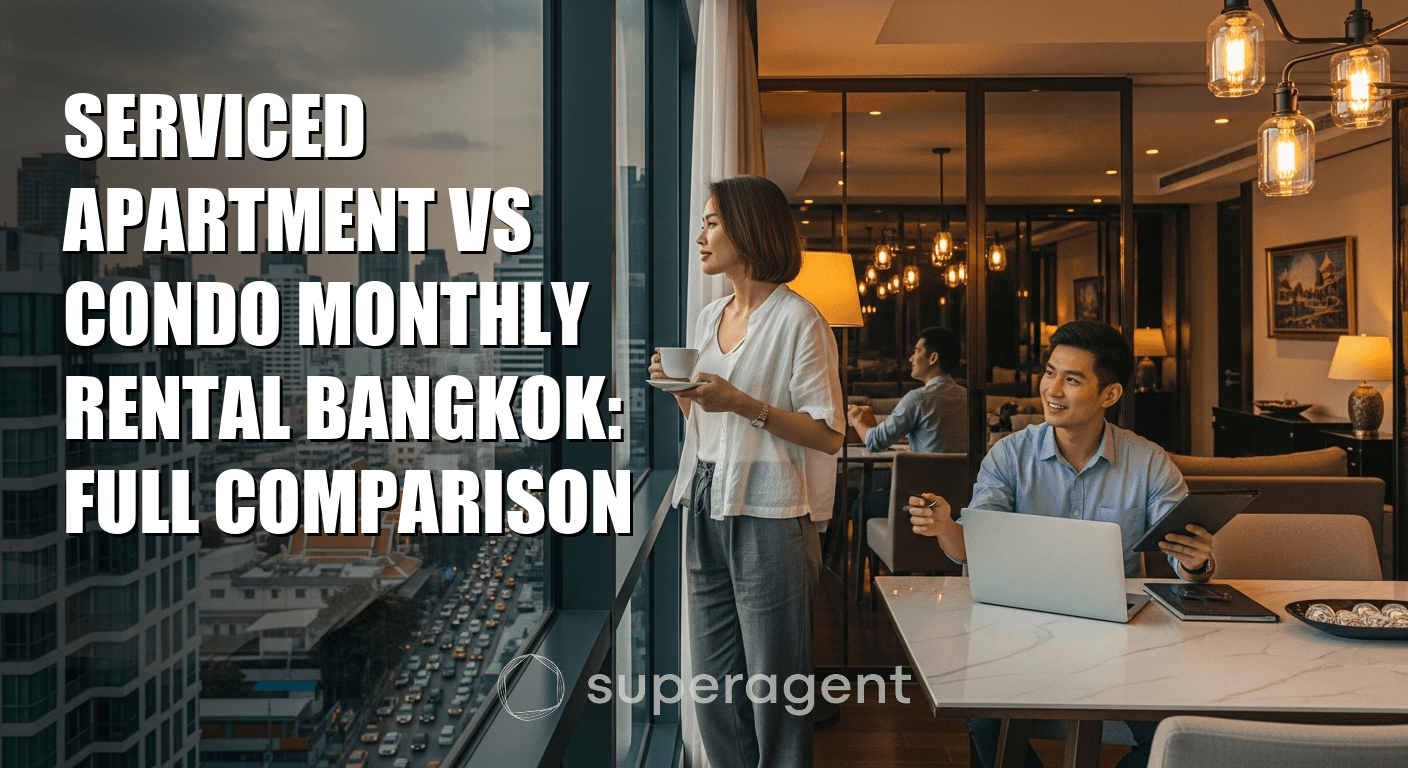
You just landed in Bangkok, signed a six-month contract with a company in Asoke, and now you need a place to stay. You open a property search and immediately hit the fork in the road that trips up almost every newcomer: do you go with a serviced apartment or a monthly condo rental? Both look great in photos. Both seem to cluster around the same BTS stations. But the price gap can be enormous, and the lifestyle difference is even bigger. This guide breaks it all down so you can pick the right option for your budget, your timeline, and the way you actually want to live in Bangkok.
What Exactly Is the Difference?
A serviced apartment is essentially a hotel-style unit that you rent by the month. It comes fully furnished, usually with weekly housekeeping, a front desk, linen changes, and sometimes even breakfast. Think of places like Somerset Sukhumvit Thonglor or Citadines Sukhumvit 8. You sign a short lease, often as brief as one month, and you walk in with nothing but a suitcase.
A condo monthly rental, on the other hand, means you are renting a privately owned unit inside a condominium building. The owner furnishes it (or sometimes leaves it bare), and you sign a lease, typically 6 to 12 months. You handle your own cleaning, your own internet setup, and your own electricity bill. Buildings like The Lumpini 24, Ideo Q Sukhumvit 36, or Life Asoke Hype are classic examples.
Picture this: a marketing manager relocating to Bangkok for a one-year assignment takes a serviced apartment at Jasmine Grande Residence near BTS Nana for the first month at around 45,000 THB while apartment hunting. After two weeks of viewings, she locks in a one-bedroom condo at Ashton Asoke, a five-minute walk from MRT Sukhumvit, for 28,000 THB per month on a 12-month lease. That first month of overlap cost her, but it saved her from signing a lease sight unseen.
Cost Breakdown: Where Your Money Actually Goes
This is where the gap gets real. According to CBRE Thailand's residential market reports, the average monthly rent for a one-bedroom condo in central Bangkok (Sukhumvit, Silom, Sathorn corridors) ranges from 15,000 to 35,000 THB depending on age, size, and proximity to a BTS or MRT station. A comparable serviced apartment in the same areas starts at 35,000 THB and easily climbs past 70,000 THB for a well-known brand.
But the sticker price is only part of the story. With a condo rental, you pay a security deposit (usually two months), electricity at the building's rate (often 7 to 9 THB per unit versus the government rate of roughly 4 THB), water, internet, and any maintenance issues your landlord is slow to fix. With a serviced apartment, almost everything is bundled. Electricity, water, Wi-Fi, housekeeping, even gym access. No surprise bills.
Say you are comparing a serviced studio at Marriott Executive Apartments Sukhumvit Park near BTS Phrom Phong at 55,000 THB all-in versus a one-bedroom condo at Noble Refine on Sukhumvit Soi 26 at 22,000 THB plus roughly 3,000 to 5,000 THB in utilities. Over 12 months, the condo saves you somewhere around 300,000 to 360,000 THB. That is a meaningful number.
Flexibility, Lease Terms, and Exit Strategy
Serviced apartments win on flexibility, no contest. Most operators let you go month to month, and some even offer weekly rates. If your project gets cancelled or you decide Bangkok is not for you, you pack up and leave. No penalty, no drama.
Condo leases in Bangkok are almost always 6 or 12 months. Breaking a lease early usually means forfeiting your two-month deposit. Some landlords will negotiate, but many will not. The Thai Revenue Department also requires landlords to declare rental income and pay tax on it, which means legitimate landlords prefer longer, stable leases and are less willing to let you walk early.
A real scenario: a software developer on a three-month contract near MRT Phra Ram 9 books a serviced apartment at Qiss Residence for 30,000 THB per month. It is more expensive than a condo, but he avoids the deposit hit, the furniture he does not need, and the hassle of setting up AIS fiber internet for just 90 days. For him, the premium is worth it.
Daily Life: What Living There Actually Feels Like
In a serviced apartment, your daily experience leans closer to hotel living. Someone cleans your room a few times a week. The lobby has security and a concierge. If the air conditioning breaks at midnight, there is a maintenance hotline. You will meet other expats in the elevator, mostly short-termers, digital nomads, and business travelers. It can feel a bit transient.
In a condo, you are a resident. You build a routine with the security guards, get to know the auntie who runs the laundry shop on the soi, and settle into a neighborhood. Buildings like Ideo Mobi Sukhumvit near BTS On Nut or The Base Park West near BTS Udom Suk have strong communities of young Thai professionals and long-term expats. You cook in your own kitchen, hang your own curtains, and make the space yours.
The tradeoff is responsibility. When the washing machine in your condo breaks, you text your landlord and wait. Sometimes you wait a long time. Facilities vary wildly between buildings. A newer condo like Whizdom Essence on Sukhumvit 101 might have a rooftop pool, co-working space, and a full gym. An older walk-up on Sukhumvit Soi 49 might have a lobby guard and nothing else.
According to DDproperty, newer condos built after 2018 tend to offer amenities that rival serviced apartments, which has narrowed the lifestyle gap significantly in recent years.
Head-to-Head Comparison Table
- Typical 1-Bed Price (Central Bangkok): 35,000 to 75,000 THB/month vs 15,000 to 35,000 THB/month
- Minimum Lease: 1 month (sometimes weekly) vs 6 to 12 months
- Security Deposit: Usually 1 month vs Usually 2 months
- Furnishing: Fully furnished, hotel-grade vs Varies by owner (fully to partially furnished)
- Utilities Included: Yes (electricity, water, Wi-Fi, cable) vs No (paid separately, 3,000 to 6,000 THB/month)
- Housekeeping: Included (2 to 4 times per week) vs Not included (hire privately, 300 to 500 THB per visit)
- Maintenance Response: Fast (in-house team) vs Depends on landlord responsiveness
- Community Feel: Transient, hotel-like vs Residential, neighborhood-based
- Best For: Short stays, new arrivals, corporate relocations vs Long-term residents, budget-conscious renters, families
- Customization: Very limited vs Moderate (negotiate with landlord)
Who Should Pick Which Option (and When to Switch)
If you are arriving in Bangkok for the first time and your contract is under three months, a serviced apartment is almost always the smarter play. The convenience premium pays for itself in time saved and stress avoided. You do not need to wire a deposit to a stranger, argue about a broken microwave, or figure out how to get electricity transferred into your name.
If you know you are staying six months or longer, the math overwhelmingly favors a condo rental. At an average savings of 15,000 to 30,000 THB per month compared to a serviced apartment, you are looking at 90,000 to 180,000 THB saved over six months. That is a meaningful chunk of change, enough to fund weekend trips to Koh Samet, a new scooter, or simply a bigger emergency fund.
The smartest approach many expats use is a hybrid strategy. Book a serviced apartment for your first 2 to 4 weeks. Use that time to ride the BTS, explore neighborhoods like Thonglor, Ekkamai, Ari, and Sathorn on foot, and view condos in person before committing. Once you find the right unit in the right building near the right BTS station, sign your lease and move in with confidence.
Families with kids face a slightly different calculation. If you are enrolling a child at a school like NIST International School near BTS Asoke, locking in a condo within walking distance for 12 months gives you stability that a serviced apartment cannot match. But if the school year does not start for two months, a serviced apartment nearby bridges the gap perfectly.
Making Your Decision Faster
The serviced apartment vs condo debate really comes down to three variables: how long you are staying, how much you want to spend, and how much hassle you are willing to manage. Under three months? Serviced apartment. Over six months? Condo. Somewhere in between? Start serviced, then transition.
Whatever you choose, doing your research before you arrive saves you time and money. Browse verified listings, compare real prices across neighborhoods, and filter by BTS or MRT proximity so you are not wandering blindly through Bangkok's sprawling rental market. Superagent at superagent.co helps you search condos across Bangkok with AI-powered matching, real photos, and transparent pricing, so you can skip the guesswork and find a place that actually fits your life here.
You just landed in Bangkok, signed a six-month contract with a company in Asoke, and now you need a place to stay. You open a property search and immediately hit the fork in the road that trips up almost every newcomer: do you go with a serviced apartment or a monthly condo rental? Both look great in photos. Both seem to cluster around the same BTS stations. But the price gap can be enormous, and the lifestyle difference is even bigger. This guide breaks it all down so you can pick the right option for your budget, your timeline, and the way you actually want to live in Bangkok.
What Exactly Is the Difference?
A serviced apartment is essentially a hotel-style unit that you rent by the month. It comes fully furnished, usually with weekly housekeeping, a front desk, linen changes, and sometimes even breakfast. Think of places like Somerset Sukhumvit Thonglor or Citadines Sukhumvit 8. You sign a short lease, often as brief as one month, and you walk in with nothing but a suitcase.
A condo monthly rental, on the other hand, means you are renting a privately owned unit inside a condominium building. The owner furnishes it (or sometimes leaves it bare), and you sign a lease, typically 6 to 12 months. You handle your own cleaning, your own internet setup, and your own electricity bill. Buildings like The Lumpini 24, Ideo Q Sukhumvit 36, or Life Asoke Hype are classic examples.
Picture this: a marketing manager relocating to Bangkok for a one-year assignment takes a serviced apartment at Jasmine Grande Residence near BTS Nana for the first month at around 45,000 THB while apartment hunting. After two weeks of viewings, she locks in a one-bedroom condo at Ashton Asoke, a five-minute walk from MRT Sukhumvit, for 28,000 THB per month on a 12-month lease. That first month of overlap cost her, but it saved her from signing a lease sight unseen.
Continue reading after that.
Looking for a condo
to rent?
Leave your name and phone. We'll follow up while you keep reading.
100% Secure
Fast Response
Free Consultation
Cost Breakdown: Where Your Money Actually Goes
This is where the gap gets real. According to CBRE Thailand's residential market reports, the average monthly rent for a one-bedroom condo in central Bangkok (Sukhumvit, Silom, Sathorn corridors) ranges from 15,000 to 35,000 THB depending on age, size, and proximity to a BTS or MRT station. A comparable serviced apartment in the same areas starts at 35,000 THB and easily climbs past 70,000 THB for a well-known brand.
But the sticker price is only part of the story. With a condo rental, you pay a security deposit (usually two months), electricity at the building's rate (often 7 to 9 THB per unit versus the government rate of roughly 4 THB), water, internet, and any maintenance issues your landlord is slow to fix. With a serviced apartment, almost everything is bundled. Electricity, water, Wi-Fi, housekeeping, even gym access. No surprise bills.
Say you are comparing a serviced studio at Marriott Executive Apartments Sukhumvit Park near BTS Phrom Phong at 55,000 THB all-in versus a one-bedroom condo at Noble Refine on Sukhumvit Soi 26 at 22,000 THB plus roughly 3,000 to 5,000 THB in utilities. Over 12 months, the condo saves you somewhere around 300,000 to 360,000 THB. That is a meaningful number.
Flexibility, Lease Terms, and Exit Strategy
Serviced apartments win on flexibility, no contest. Most operators let you go month to month, and some even offer weekly rates. If your project gets cancelled or you decide Bangkok is not for you, you pack up and leave. No penalty, no drama.
Condo leases in Bangkok are almost always 6 or 12 months. Breaking a lease early usually means forfeiting your two-month deposit. Some landlords will negotiate, but many will not. The Thai Revenue Department also requires landlords to declare rental income and pay tax on it, which means legitimate landlords prefer longer, stable leases and are less willing to let you walk early.
A real scenario: a software developer on a three-month contract near MRT Phra Ram 9 books a serviced apartment at Qiss Residence for 30,000 THB per month. It is more expensive than a condo, but he avoids the deposit hit, the furniture he does not need, and the hassle of setting up AIS fiber internet for just 90 days. For him, the premium is worth it.
Daily Life: What Living There Actually Feels Like
In a serviced apartment, your daily experience leans closer to hotel living. Someone cleans your room a few times a week. The lobby has security and a concierge. If the air conditioning breaks at midnight, there is a maintenance hotline. You will meet other expats in the elevator, mostly short-termers, digital nomads, and business travelers. It can feel a bit transient.
In a condo, you are a resident. You build a routine with the security guards, get to know the auntie who runs the laundry shop on the soi, and settle into a neighborhood. Buildings like Ideo Mobi Sukhumvit near BTS On Nut or The Base Park West near BTS Udom Suk have strong communities of young Thai professionals and long-term expats. You cook in your own kitchen, hang your own curtains, and make the space yours.
The tradeoff is responsibility. When the washing machine in your condo breaks, you text your landlord and wait. Sometimes you wait a long time. Facilities vary wildly between buildings. A newer condo like Whizdom Essence on Sukhumvit 101 might have a rooftop pool, co-working space, and a full gym. An older walk-up on Sukhumvit Soi 49 might have a lobby guard and nothing else.
According to DDproperty, newer condos built after 2018 tend to offer amenities that rival serviced apartments, which has narrowed the lifestyle gap significantly in recent years.
Head-to-Head Comparison Table
- Typical 1-Bed Price (Central Bangkok): 35,000 to 75,000 THB/month vs 15,000 to 35,000 THB/month
- Minimum Lease: 1 month (sometimes weekly) vs 6 to 12 months
- Security Deposit: Usually 1 month vs Usually 2 months
- Furnishing: Fully furnished, hotel-grade vs Varies by owner (fully to partially furnished)
- Utilities Included: Yes (electricity, water, Wi-Fi, cable) vs No (paid separately, 3,000 to 6,000 THB/month)
- Housekeeping: Included (2 to 4 times per week) vs Not included (hire privately, 300 to 500 THB per visit)
- Maintenance Response: Fast (in-house team) vs Depends on landlord responsiveness
- Community Feel: Transient, hotel-like vs Residential, neighborhood-based
- Best For: Short stays, new arrivals, corporate relocations vs Long-term residents, budget-conscious renters, families
- Customization: Very limited vs Moderate (negotiate with landlord)
Who Should Pick Which Option (and When to Switch)
If you are arriving in Bangkok for the first time and your contract is under three months, a serviced apartment is almost always the smarter play. The convenience premium pays for itself in time saved and stress avoided. You do not need to wire a deposit to a stranger, argue about a broken microwave, or figure out how to get electricity transferred into your name.
Continue reading after that.
Looking for a condo
to rent?
Leave your name and phone. We'll follow up while you keep reading.
100% Secure
Fast Response
Free Consultation
If you know you are staying six months or longer, the math overwhelmingly favors a condo rental. At an average savings of 15,000 to 30,000 THB per month compared to a serviced apartment, you are looking at 90,000 to 180,000 THB saved over six months. That is a meaningful chunk of change, enough to fund weekend trips to Koh Samet, a new scooter, or simply a bigger emergency fund.
The smartest approach many expats use is a hybrid strategy. Book a serviced apartment for your first 2 to 4 weeks. Use that time to ride the BTS, explore neighborhoods like Thonglor, Ekkamai, Ari, and Sathorn on foot, and view condos in person before committing. Once you find the right unit in the right building near the right BTS station, sign your lease and move in with confidence.
Families with kids face a slightly different calculation. If you are enrolling a child at a school like NIST International School near BTS Asoke, locking in a condo within walking distance for 12 months gives you stability that a serviced apartment cannot match. But if the school year does not start for two months, a serviced apartment nearby bridges the gap perfectly.
Making Your Decision Faster
The serviced apartment vs condo debate really comes down to three variables: how long you are staying, how much you want to spend, and how much hassle you are willing to manage. Under three months? Serviced apartment. Over six months? Condo. Somewhere in between? Start serviced, then transition.
Whatever you choose, doing your research before you arrive saves you time and money. Browse verified listings, compare real prices across neighborhoods, and filter by BTS or MRT proximity so you are not wandering blindly through Bangkok's sprawling rental market. Superagent at superagent.co helps you search condos across Bangkok with AI-powered matching, real photos, and transparent pricing, so you can skip the guesswork and find a place that actually fits your life here.
Share this article
Properties you may like
![[For Rent] CONDO I Las Colinas Condominium I 2 Beds I 3 Baths I 85,000THB/mo](/_next/image?url=https%3A%2F%2Fstorage.googleapis.com%2Fsuperagent-web%2Fattachments%2Flistings%2F6828%2F80f345c4-488e-43b2-b017-c9fbb17b520d-99486dd8-4237-4ba2-9207-01ce4f66b21f-media.jpg&w=3840&q=75)
฿85,000
2 Bed3170 sqm
[For Rent] CONDO I Las Colinas Condominium I 2 Beds I 3 Baths I 85,000THB/mo
Asoke
Condo![[For Rent] CONDO I Ashton Asoke I 1 Bed I 1 Bath I 30,000THB/mo](/_next/image?url=https%3A%2F%2Fstorage.googleapis.com%2Fsuperagent-web%2Fattachments%2Flistings%2F6876%2Fb7ce9bbe-f877-4ff5-bb54-8ad0026db940-1272-4.jpg&w=3840&q=75)
฿30,000
1 Bed135 sqm
[For Rent] CONDO I Ashton Asoke I 1 Bed I 1 Bath I 30,000THB/mo
Asoke
Condo![[For Rent] CONDO I Skyrise Avenue Sukhumvit 64 I 2 Beds I 2 Baths I 27,000THB/mo](/_next/image?url=https%3A%2F%2Fstorage.googleapis.com%2Fsuperagent-web%2Fattachments%2Flistings%2F2001%2F670f91de-c251-4e81-971c-8e30ed2158cd-screenshot-2026-07-05-at-11.38.53-pm.png&w=3840&q=75)
฿27,000
2 Bed252 sqm
[For Rent] CONDO I Skyrise Avenue Sukhumvit 64 I 2 Beds I 2 Baths I 27,000THB/mo
Punnawithi
Condo![[For Rent] CONDO I Park Origin Ratchathewi I Duplex I 2 Beds I 1 Bath I 32,000THB/mo](/_next/image?url=https%3A%2F%2Fstorage.googleapis.com%2Fsuperagent-web%2Fattachments%2Flistings%2F6896%2Fb79a7d21-7533-4b0d-bb19-762ebfafab62-1318-6.jpg&w=3840&q=75)
฿32,000
2 Bed135.9 sqm
[For Rent] CONDO I Park Origin Ratchathewi I Duplex I 2 Beds I 1 Bath I 32,000THB/mo
Ratchathewi
Condo![[For Rent] CONDO I Park Origin Phayathai I Studio I 1 Bath I 28,000THB/mo](/_next/image?url=https%3A%2F%2Fstorage.googleapis.com%2Fsuperagent-web%2Fattachments%2Flistings%2F6757%2Fb226df93-94c6-46fa-aeba-ebfadc7f81b8-1000006042.jpg&w=3840&q=75)
฿28,000
Studio129 sqm
[For Rent] CONDO I Park Origin Phayathai I Studio I 1 Bath I 28,000THB/mo
Phaya Thai
Condo![[For Rent] CONDO I Ideo Mobi Sukhumvit 81 I Duplex I 1 Bed I 1 Bath I 28,000THB/mo](/_next/image?url=https%3A%2F%2Fstorage.googleapis.com%2Fsuperagent-web%2Fattachments%2Flistings%2F1849%2Fc8b2c033-3b5f-4615-b2b0-4972f40141f0-705-13.jpg&w=3840&q=75)
฿28,000
1 Bed143 sqm
[For Rent] CONDO I Ideo Mobi Sukhumvit 81 I Duplex I 1 Bed I 1 Bath I 28,000THB/mo
On Nut
Condo![[For Rent] CONDO I Siamese Sukhumvit 48 I 1 Bed I 1 Bath I 28,000THB/mo](/_next/image?url=https%3A%2F%2Fstorage.googleapis.com%2Fsuperagent-web%2Fattachments%2Flistings%2F6841%2Febc2dce2-2e9b-4e6d-a01c-0cfa619dfa13-1231-6.jpg&w=3840&q=75)
฿28,000
1 Bed144 sqm
[For Rent] CONDO I Siamese Sukhumvit 48 I 1 Bed I 1 Bath I 28,000THB/mo
Condo![[For Rent] CONDO I Ashton Asoke I 1 Bed I 1 Bath I 22,000THB/mo](/_next/image?url=https%3A%2F%2Fstorage.googleapis.com%2Fsuperagent-web%2Fattachments%2Flistings%2F6802%2Fe06b9b73-1207-414a-ab04-1685de0c7eaa-20220808_153124_0.jpg&w=3840&q=75)
฿22,000
1 Bed134 sqm
[For Rent] CONDO I Ashton Asoke I 1 Bed I 1 Bath I 22,000THB/mo
Asoke
Condo![[For Rent] CONDO I HQ Thonglor Soi 4 I 1 Bed I 1 Bath I 35,000 THB/mo](/_next/image?url=https%3A%2F%2Fstorage.googleapis.com%2Fsuperagent-web%2Fattachments%2Flistings%2F1445%2F72352585-1bc2-41a8-bd62-ddcbf8189fe9-376-5.jpg&w=3840&q=75)
฿35,000
1 Bed143.6 sqm
[For Rent] CONDO I HQ Thonglor Soi 4 I 1 Bed I 1 Bath I 35,000 THB/mo
Thonglor
Condo![[For Rent] CONDO I The Master Centrium Asoke - Sukhumvit I Duplex I 2 Beds I 3 Baths I 75,000 THB/mo](/_next/image?url=https%3A%2F%2Fstorage.googleapis.com%2Fsuperagent-web%2Fattachments%2Flistings%2F1545%2F97932b6a-c358-45e4-b5f9-995dbf5a3cf0-441-2.jpg&w=3840&q=75)
฿75,000
2 Bed3150 sqm
[For Rent] CONDO I The Master Centrium Asoke - Sukhumvit I Duplex I 2 Beds I 3 Baths I 75,000 THB/mo
Asoke
CondoMore like this
 In Guides · Superagent EditorialHidden Costs of Renting a Condo in Bangkok Nobody Warns You AboutBangkok condo rent looks affordable until month one hits. Here are the real costs beyond the headline figure that catch most renters off guard.25 May 20261 min read
 In Guides · Superagent EditorialWhat a Long-Vacant Bangkok Condo Unit Is Actually Telling YouA Bangkok condo vacant for months signals overpricing, landlord issues, or real problems. Here is how to read the signs.25 May 20261 min read
 In Guides · Superagent EditorialRed Flags in a Bangkok Rental Contract to Watch Out ForBangkok rental contracts often hide risky clauses. Here are the red flags every tenant must catch before signing any lease.25 May 20261 min read
 In Guides · Superagent EditorialWorking Online from a Condo: How to Choose the Perfect Room for ProductivityLearn how to choose the best condo room for working online with tips on lighting, noise, and furniture setup to maximize productivity.9 May 20261 min read