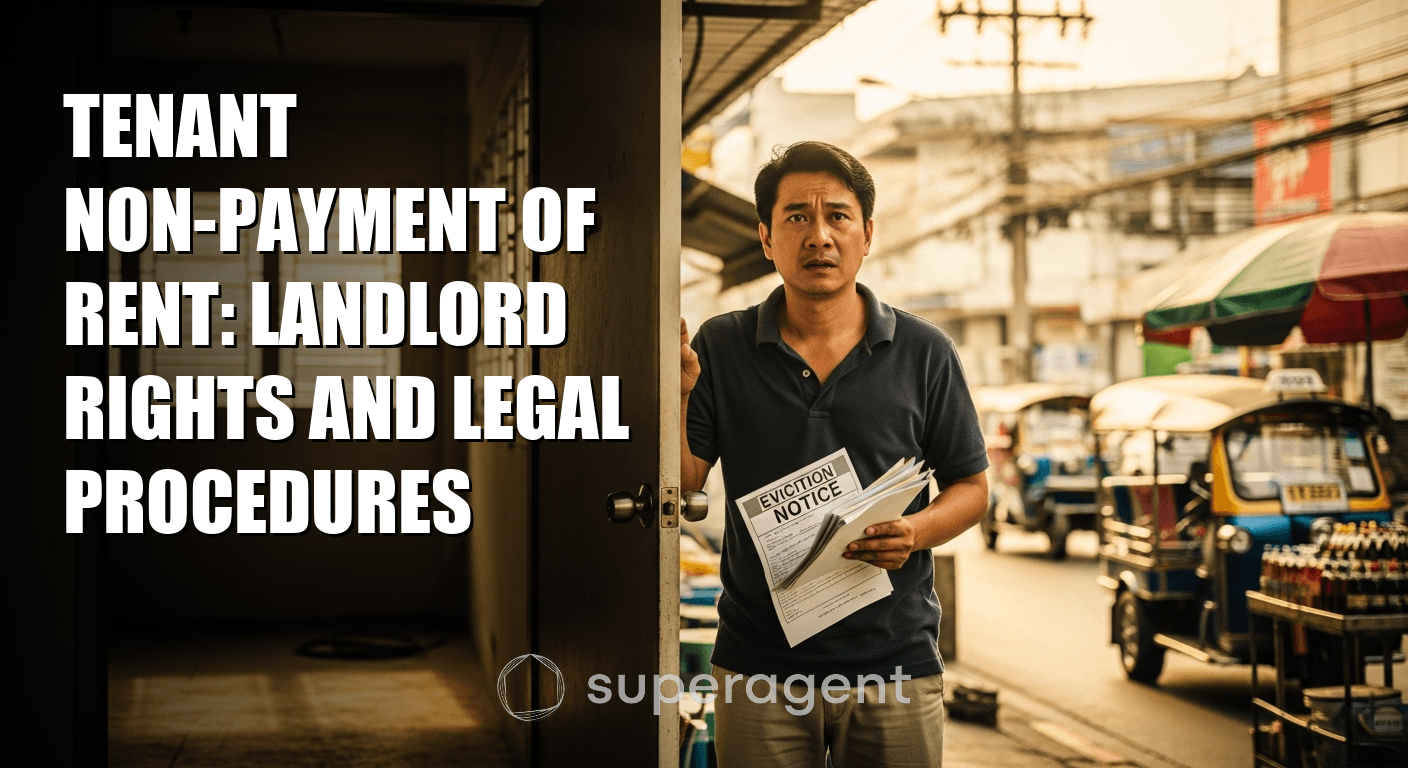
Tenant Non-Payment of Rent: Landlord Rights and Legal Procedures
Guides
Tenant Non-Payment of Rent: Landlord Rights and Legal Procedures
Know your legal options when tenants fail to pay rent in Bangkok.
Summary
When tenants don't pay rent, landlords need clear steps to protect their rights. Learn the legal procedures for handling non-payment situations in Bangkok.
You signed a lease, paid your deposit, and moved into your condo in Sukhumvit or Sathorn. Everything felt solid. Then three months in, your tenant stops paying rent. No messages. No explanations. Just silence and an empty bank account from your end every month.
If you own property in Bangkok and rent it out, this scenario is real. It happens more often than landlords want to admit, and most don't know their actual rights or how to respond legally. The good news: Thai rental law actually protects you quite well. The bad news: you need to follow specific steps, or you'll waste time and money going nowhere.
This guide walks you through what you can actually do when a tenant doesn't pay, what your rights are under Thai law, and how to handle it without getting tangled up in Bangkok's legal system.
Understand Your Legal Position as a Landlord
Thailand's rental framework is built into the Civil and Commercial Code and the Landlord and Tenant Act. You have real protections, but they only work if you know them and apply them correctly.
First, know this: a signed lease agreement is a binding contract. If your tenant stops paying, they're breaching that contract. You're not just owed money because you feel owed it. You have a legal claim. The law recognizes three main rights for landlords when rent goes unpaid: you can demand payment with legal notice, you can terminate the lease, and you can evict the tenant if they don't comply.
The specifics depend on your lease terms and how long the rent is overdue. Most standard Bangkok condo leases state that if rent is late by more than 5 to 7 days, you have grounds to act. Some leases give a grace period up to 15 days. Check your lease first. That detail matters.
Think of it this way: a tenant in Thonglor who hasn't paid for two months is in clear breach. You don't need to wait six months hoping they'll pay. You have legal standing to move forward immediately.
Document Everything Before Taking Action
This step separates landlords who win cases from those who lose them. Thai courts work on evidence. No evidence, no case.
Create a clear record of when rent was due, when you didn't receive it, and any communication with the tenant about the unpaid amount. Keep bank statements showing no deposit. Take screenshots of any messages, emails, or Line conversations where the tenant acknowledged the debt or promised to pay. Photograph the lease agreement itself with visible signatures.
If you've sent payment reminders, keep those too. Print them. Save them to your computer twice. A landlord in Phrom Phong with email proof that they sent a formal demand on the 5th of the month and received no response has a much stronger case than one who just remembers being angry about it.
Many landlords also keep a ledger: date rent was due, date you should have received it, date payment actually arrived (or note if it never arrived), and any fees or penalties charged. This document becomes your evidence in court if it comes to that.
Send a Formal Written Demand
You cannot just show up and tell them to leave. You need to send a formal demand for payment. This is not a casual text. This is a legal step.
The demand should be written, dated, and clearly state the amount owed, the period it covers, the payment due date you're giving them (usually 7 to 14 days), and what happens if they don't pay by that date. Send it via registered mail so you have proof of delivery, or use a courier service that provides a signed receipt. Email alone is weaker, but do it anyway along with the formal notice.
Here's a real example: a condo owner in Ari sent their non-paying tenant a formal notice on 15 March stating that 60,000 THB for February and March rent was due by 30 March, or eviction proceedings would begin. They sent it via Thailand Post registered mail and got a receipt signed by someone at the building. That receipt is gold in court. Without it, the tenant can claim they never received it.
This step takes about 500 to 1,000 THB and 2 to 3 days. It's cheap insurance.
Know When You Can Evict Without Going to Court
If your lease includes a clause allowing immediate eviction for non-payment after a certain grace period (usually 7 to 15 days overdue), and you've followed proper notice procedure, Thai law may allow you to have the tenant removed without a full court case. This is called "self-help eviction" with legal backing.
In practice, though, this is risky. Courts in Bangkok have become stricter about protecting tenants, even bad-paying ones. Most landlords and property managers now go through formal eviction proceedings to avoid issues later.
The threshold for self-help eviction is high: the lease must explicitly allow it, you must have given proper legal notice, the grace period must have fully expired, and the tenant must have refused all reasonable settlement attempts. Miss any one of those, and you could face a lawsuit yourself for wrongful eviction.
A tenant in Silom paid rent so late that they were 30 days overdue. Their lease said eviction could happen after 15 days. But the landlord never sent a formal notice, just told them verbally. When the landlord tried to lock them out, the tenant sued and won because proper procedure wasn't followed. The landlord ended up paying damages.
File for Eviction at the Civil Court
This is the standard path for most non-paying tenant situations in Bangkok. You file at the Civil Court in the district where the property is located.
You'll need your lease, your proof of ownership or authorization to collect rent, documentation of non-payment, the formal demand letter, and proof that the tenant received it. Courts in central Bangkok hear hundreds of these cases monthly. The average timeline is 2 to 4 months from filing to judgment, assuming it's straightforward.
Costs run about 2,000 to 5,000 THB in filing fees plus any lawyer fees if you hire one. Most property managers in Bangkok recommend hiring a lawyer because the paperwork is specific and mistakes can delay everything by months. A decent lawyer charges 5,000 to 15,000 THB for a straightforward eviction case.
- Formal written demand: 2-3 days | 500-1,000 THB | First step; may resolve issue quickly
- Civil Court eviction filing: 2-4 months | 7,000-20,000 THB total | Formal removal when demand fails
- Court enforcement (bailiff): 1-2 weeks after judgment | 2,000-5,000 THB | Actually removing tenant after court wins
- Small claims court (if under 100k THB): 1-2 months | 3,000-8,000 THB | Debt recovery only, not physical eviction
The Civil Court path is slower but cleanest legally. Once you win, you have a court order. The tenant can't fight it again or claim you illegally removed them.
Consider Debt Recovery in Small Claims Court
If your only goal is to get paid, not necessarily get the tenant out, small claims court in Bangkok might work. If the unpaid rent is under 100,000 THB, you can file here instead of full Civil Court.
Small claims is faster (about 1 to 2 months) and cheaper (3,000 to 8,000 THB in fees and lawyer costs combined). You'll get a judgment for the money owed. Then you can pursue debt collection separately if the tenant ignores the judgment.
This only recovers rent money, though. It doesn't remove the tenant. So if they're still living there and still not paying, you haven't solved your core problem. Use this if you expect the tenant will eventually pay or if you want a legal judgment on record before deciding whether to also pursue eviction.
A tenant in Ratchada owed 75,000 THB in back rent across three months. Their landlord filed in small claims court, won in 6 weeks, and got a judgment. The tenant then paid to avoid escalation to eviction. The whole process cost 7,000 THB and took less time than Civil Court eviction would have.
Protect Yourself Moving Forward
Once you've dealt with a non-paying tenant, the lesson is clear: prevention beats cure every single time.
Vet tenants carefully. Run background checks if possible, ask for references, and contact their employer to verify income. A tenant earning 150,000 THB monthly in a tech job near BTS Thong Lo is statistically less likely to default than someone whose income source is unclear.
Set deposits high enough to cover at least one month's rent plus utilities. If a tenant owes you 60,000 THB and their deposit is only 20,000 THB, you're out 40,000 THB. A deposit of 60,000 to 80,000 THB for a condo renting at 25,000 to 35,000 THB per month is standard in Bangkok and reasonable.
Use a property management company or a lawyer-drafted lease that's specific and clear. Vague leases lead to disputes. Clear leases prevent them. Include specific late payment terms, how notice will be delivered, and what happens after grace periods expire.
According to DDproperty data, average rent for a 1-bedroom condo in central Bangkok ranges from 25,000 to 35,000 THB monthly, with longer lease terms (12 months) typically offering better tenant retention than short 3 to 6 month leases. Longer commitments mean tenants are more likely to stay current because they have skin in the game.
What You Cannot Do as a Landlord
Know your limits. Thai courts protect tenants from some landlord actions, even when rent is unpaid.
You cannot lock the tenant out yourself or change the locks. That's illegal, even if they owe you money. You cannot cut off utilities intentionally. You cannot remove their belongings. You cannot threaten violence or use any form of intimidation. If you do any of these, the tenant can sue you, and they'll likely win.
One landlord in Asoke tried to lock a non-paying tenant out on their own. The tenant called police, filed a complaint, and the landlord ended up in legal trouble and had to pay damages. The non-payment was real, but the landlord's response broke Thai law.
Stick to the legal process. It's slower but it works, and it protects you from becoming the accused instead of the victim.
Dealing with a non-paying tenant is frustrating and expensive, but it's manageable if you know your rights and follow procedure. Document everything, send formal notice, and don't skip steps hoping it'll go away faster. It won't. A proper eviction case in Bangkok's Civil Court takes 2 to 4 months but actually works. Trying shortcuts costs you more time and money in the long run.
If you're renting out a condo in Bangkok and want to avoid these headaches entirely, strong tenant screening before they move in is your best tool. Look for consistent income, stable employment, positive references, and willingness to sign longer leases. These are the tenants who pay on time, every time.
When you're ready to list a property for rent in Bangkok or need help finding the right long-term tenant, Superagent.co connects you with vetted renters and makes the whole process faster and less stressful. Our platform screens tenants so you can focus on what actually matters: collecting rent on time and keeping your property occupied with reliable people.
You signed a lease, paid your deposit, and moved into your condo in Sukhumvit or Sathorn. Everything felt solid. Then three months in, your tenant stops paying rent. No messages. No explanations. Just silence and an empty bank account from your end every month.
If you own property in Bangkok and rent it out, this scenario is real. It happens more often than landlords want to admit, and most don't know their actual rights or how to respond legally. The good news: Thai rental law actually protects you quite well. The bad news: you need to follow specific steps, or you'll waste time and money going nowhere.
This guide walks you through what you can actually do when a tenant doesn't pay, what your rights are under Thai law, and how to handle it without getting tangled up in Bangkok's legal system.
Understand Your Legal Position as a Landlord
Thailand's rental framework is built into the Civil and Commercial Code and the Landlord and Tenant Act. You have real protections, but they only work if you know them and apply them correctly.
First, know this: a signed lease agreement is a binding contract. If your tenant stops paying, they're breaching that contract. You're not just owed money because you feel owed it. You have a legal claim. The law recognizes three main rights for landlords when rent goes unpaid: you can demand payment with legal notice, you can terminate the lease, and you can evict the tenant if they don't comply.
The specifics depend on your lease terms and how long the rent is overdue. Most standard Bangkok condo leases state that if rent is late by more than 5 to 7 days, you have grounds to act. Some leases give a grace period up to 15 days. Check your lease first. That detail matters.
Think of it this way: a tenant in Thonglor who hasn't paid for two months is in clear breach. You don't need to wait six months hoping they'll pay. You have legal standing to move forward immediately.
Document Everything Before Taking Action
This step separates landlords who win cases from those who lose them. Thai courts work on evidence. No evidence, no case.
Create a clear record of when rent was due, when you didn't receive it, and any communication with the tenant about the unpaid amount. Keep bank statements showing no deposit. Take screenshots of any messages, emails, or Line conversations where the tenant acknowledged the debt or promised to pay. Photograph the lease agreement itself with visible signatures.
Continue reading after that.
Looking for a condo
to rent?
Leave your name and phone. We'll follow up while you keep reading.
100% Secure
Fast Response
Free Consultation
If you've sent payment reminders, keep those too. Print them. Save them to your computer twice. A landlord in Phrom Phong with email proof that they sent a formal demand on the 5th of the month and received no response has a much stronger case than one who just remembers being angry about it.
Many landlords also keep a ledger: date rent was due, date you should have received it, date payment actually arrived (or note if it never arrived), and any fees or penalties charged. This document becomes your evidence in court if it comes to that.
Send a Formal Written Demand
You cannot just show up and tell them to leave. You need to send a formal demand for payment. This is not a casual text. This is a legal step.
The demand should be written, dated, and clearly state the amount owed, the period it covers, the payment due date you're giving them (usually 7 to 14 days), and what happens if they don't pay by that date. Send it via registered mail so you have proof of delivery, or use a courier service that provides a signed receipt. Email alone is weaker, but do it anyway along with the formal notice.
Here's a real example: a condo owner in Ari sent their non-paying tenant a formal notice on 15 March stating that 60,000 THB for February and March rent was due by 30 March, or eviction proceedings would begin. They sent it via Thailand Post registered mail and got a receipt signed by someone at the building. That receipt is gold in court. Without it, the tenant can claim they never received it.
This step takes about 500 to 1,000 THB and 2 to 3 days. It's cheap insurance.
Know When You Can Evict Without Going to Court
If your lease includes a clause allowing immediate eviction for non-payment after a certain grace period (usually 7 to 15 days overdue), and you've followed proper notice procedure, Thai law may allow you to have the tenant removed without a full court case. This is called "self-help eviction" with legal backing.
In practice, though, this is risky. Courts in Bangkok have become stricter about protecting tenants, even bad-paying ones. Most landlords and property managers now go through formal eviction proceedings to avoid issues later.
The threshold for self-help eviction is high: the lease must explicitly allow it, you must have given proper legal notice, the grace period must have fully expired, and the tenant must have refused all reasonable settlement attempts. Miss any one of those, and you could face a lawsuit yourself for wrongful eviction.
A tenant in Silom paid rent so late that they were 30 days overdue. Their lease said eviction could happen after 15 days. But the landlord never sent a formal notice, just told them verbally. When the landlord tried to lock them out, the tenant sued and won because proper procedure wasn't followed. The landlord ended up paying damages.
File for Eviction at the Civil Court
This is the standard path for most non-paying tenant situations in Bangkok. You file at the Civil Court in the district where the property is located.
You'll need your lease, your proof of ownership or authorization to collect rent, documentation of non-payment, the formal demand letter, and proof that the tenant received it. Courts in central Bangkok hear hundreds of these cases monthly. The average timeline is 2 to 4 months from filing to judgment, assuming it's straightforward.
Costs run about 2,000 to 5,000 THB in filing fees plus any lawyer fees if you hire one. Most property managers in Bangkok recommend hiring a lawyer because the paperwork is specific and mistakes can delay everything by months. A decent lawyer charges 5,000 to 15,000 THB for a straightforward eviction case.
- Formal written demand: 2-3 days | 500-1,000 THB | First step; may resolve issue quickly
- Civil Court eviction filing: 2-4 months | 7,000-20,000 THB total | Formal removal when demand fails
- Court enforcement (bailiff): 1-2 weeks after judgment | 2,000-5,000 THB | Actually removing tenant after court wins
- Small claims court (if under 100k THB): 1-2 months | 3,000-8,000 THB | Debt recovery only, not physical eviction
The Civil Court path is slower but cleanest legally. Once you win, you have a court order. The tenant can't fight it again or claim you illegally removed them.
Consider Debt Recovery in Small Claims Court
If your only goal is to get paid, not necessarily get the tenant out, small claims court in Bangkok might work. If the unpaid rent is under 100,000 THB, you can file here instead of full Civil Court.
Small claims is faster (about 1 to 2 months) and cheaper (3,000 to 8,000 THB in fees and lawyer costs combined). You'll get a judgment for the money owed. Then you can pursue debt collection separately if the tenant ignores the judgment.
This only recovers rent money, though. It doesn't remove the tenant. So if they're still living there and still not paying, you haven't solved your core problem. Use this if you expect the tenant will eventually pay or if you want a legal judgment on record before deciding whether to also pursue eviction.
A tenant in Ratchada owed 75,000 THB in back rent across three months. Their landlord filed in small claims court, won in 6 weeks, and got a judgment. The tenant then paid to avoid escalation to eviction. The whole process cost 7,000 THB and took less time than Civil Court eviction would have.
Continue reading after that.
Looking for a condo
to rent?
Leave your name and phone. We'll follow up while you keep reading.
100% Secure
Fast Response
Free Consultation
Protect Yourself Moving Forward
Once you've dealt with a non-paying tenant, the lesson is clear: prevention beats cure every single time.
Vet tenants carefully. Run background checks if possible, ask for references, and contact their employer to verify income. A tenant earning 150,000 THB monthly in a tech job near BTS Thong Lo is statistically less likely to default than someone whose income source is unclear.
Set deposits high enough to cover at least one month's rent plus utilities. If a tenant owes you 60,000 THB and their deposit is only 20,000 THB, you're out 40,000 THB. A deposit of 60,000 to 80,000 THB for a condo renting at 25,000 to 35,000 THB per month is standard in Bangkok and reasonable.
Use a property management company or a lawyer-drafted lease that's specific and clear. Vague leases lead to disputes. Clear leases prevent them. Include specific late payment terms, how notice will be delivered, and what happens after grace periods expire.
According to DDproperty data, average rent for a 1-bedroom condo in central Bangkok ranges from 25,000 to 35,000 THB monthly, with longer lease terms (12 months) typically offering better tenant retention than short 3 to 6 month leases. Longer commitments mean tenants are more likely to stay current because they have skin in the game.
What You Cannot Do as a Landlord
Know your limits. Thai courts protect tenants from some landlord actions, even when rent is unpaid.
You cannot lock the tenant out yourself or change the locks. That's illegal, even if they owe you money. You cannot cut off utilities intentionally. You cannot remove their belongings. You cannot threaten violence or use any form of intimidation. If you do any of these, the tenant can sue you, and they'll likely win.
One landlord in Asoke tried to lock a non-paying tenant out on their own. The tenant called police, filed a complaint, and the landlord ended up in legal trouble and had to pay damages. The non-payment was real, but the landlord's response broke Thai law.
Stick to the legal process. It's slower but it works, and it protects you from becoming the accused instead of the victim.
Dealing with a non-paying tenant is frustrating and expensive, but it's manageable if you know your rights and follow procedure. Document everything, send formal notice, and don't skip steps hoping it'll go away faster. It won't. A proper eviction case in Bangkok's Civil Court takes 2 to 4 months but actually works. Trying shortcuts costs you more time and money in the long run.
If you're renting out a condo in Bangkok and want to avoid these headaches entirely, strong tenant screening before they move in is your best tool. Look for consistent income, stable employment, positive references, and willingness to sign longer leases. These are the tenants who pay on time, every time.
When you're ready to list a property for rent in Bangkok or need help finding the right long-term tenant, Superagent.co connects you with vetted renters and makes the whole process faster and less stressful. Our platform screens tenants so you can focus on what actually matters: collecting rent on time and keeping your property occupied with reliable people.
Share this article
Properties you may like
![[For Rent] CONDO I Las Colinas Condominium I 2 Beds I 3 Baths I 85,000THB/mo](/_next/image?url=https%3A%2F%2Fstorage.googleapis.com%2Fsuperagent-web%2Fattachments%2Flistings%2F6828%2F80f345c4-488e-43b2-b017-c9fbb17b520d-99486dd8-4237-4ba2-9207-01ce4f66b21f-media.jpg&w=3840&q=75)
฿85,000
2 Bed3170 sqm
[For Rent] CONDO I Las Colinas Condominium I 2 Beds I 3 Baths I 85,000THB/mo
Asoke
Condo![[For Rent] CONDO I Ashton Asoke I 1 Bed I 1 Bath I 30,000THB/mo](/_next/image?url=https%3A%2F%2Fstorage.googleapis.com%2Fsuperagent-web%2Fattachments%2Flistings%2F6876%2Fb7ce9bbe-f877-4ff5-bb54-8ad0026db940-1272-4.jpg&w=3840&q=75)
฿30,000
1 Bed135 sqm
[For Rent] CONDO I Ashton Asoke I 1 Bed I 1 Bath I 30,000THB/mo
Asoke
Condo![[For Rent] CONDO I Skyrise Avenue Sukhumvit 64 I 2 Beds I 2 Baths I 27,000THB/mo](/_next/image?url=https%3A%2F%2Fstorage.googleapis.com%2Fsuperagent-web%2Fattachments%2Flistings%2F2001%2F670f91de-c251-4e81-971c-8e30ed2158cd-screenshot-2026-07-05-at-11.38.53-pm.png&w=3840&q=75)
฿27,000
2 Bed252 sqm
[For Rent] CONDO I Skyrise Avenue Sukhumvit 64 I 2 Beds I 2 Baths I 27,000THB/mo
Punnawithi
Condo![[For Rent] CONDO I Park Origin Ratchathewi I Duplex I 2 Beds I 1 Bath I 32,000THB/mo](/_next/image?url=https%3A%2F%2Fstorage.googleapis.com%2Fsuperagent-web%2Fattachments%2Flistings%2F6896%2Fb79a7d21-7533-4b0d-bb19-762ebfafab62-1318-6.jpg&w=3840&q=75)
฿32,000
2 Bed135.9 sqm
[For Rent] CONDO I Park Origin Ratchathewi I Duplex I 2 Beds I 1 Bath I 32,000THB/mo
Ratchathewi
Condo![[For Rent] CONDO I Park Origin Phayathai I Studio I 1 Bath I 28,000THB/mo](/_next/image?url=https%3A%2F%2Fstorage.googleapis.com%2Fsuperagent-web%2Fattachments%2Flistings%2F6757%2Fb226df93-94c6-46fa-aeba-ebfadc7f81b8-1000006042.jpg&w=3840&q=75)
฿28,000
Studio129 sqm
[For Rent] CONDO I Park Origin Phayathai I Studio I 1 Bath I 28,000THB/mo
Phaya Thai
Condo![[For Rent] CONDO I Ideo Mobi Sukhumvit 81 I Duplex I 1 Bed I 1 Bath I 28,000THB/mo](/_next/image?url=https%3A%2F%2Fstorage.googleapis.com%2Fsuperagent-web%2Fattachments%2Flistings%2F1849%2Fc8b2c033-3b5f-4615-b2b0-4972f40141f0-705-13.jpg&w=3840&q=75)
฿28,000
1 Bed143 sqm
[For Rent] CONDO I Ideo Mobi Sukhumvit 81 I Duplex I 1 Bed I 1 Bath I 28,000THB/mo
On Nut
Condo![[For Rent] CONDO I Siamese Sukhumvit 48 I 1 Bed I 1 Bath I 28,000THB/mo](/_next/image?url=https%3A%2F%2Fstorage.googleapis.com%2Fsuperagent-web%2Fattachments%2Flistings%2F6841%2Febc2dce2-2e9b-4e6d-a01c-0cfa619dfa13-1231-6.jpg&w=3840&q=75)
฿28,000
1 Bed144 sqm
[For Rent] CONDO I Siamese Sukhumvit 48 I 1 Bed I 1 Bath I 28,000THB/mo
Condo![[For Rent] CONDO I Ashton Asoke I 1 Bed I 1 Bath I 22,000THB/mo](/_next/image?url=https%3A%2F%2Fstorage.googleapis.com%2Fsuperagent-web%2Fattachments%2Flistings%2F6802%2Fe06b9b73-1207-414a-ab04-1685de0c7eaa-20220808_153124_0.jpg&w=3840&q=75)
฿22,000
1 Bed134 sqm
[For Rent] CONDO I Ashton Asoke I 1 Bed I 1 Bath I 22,000THB/mo
Asoke
Condo![[For Rent] CONDO I HQ Thonglor Soi 4 I 1 Bed I 1 Bath I 35,000 THB/mo](/_next/image?url=https%3A%2F%2Fstorage.googleapis.com%2Fsuperagent-web%2Fattachments%2Flistings%2F1445%2F72352585-1bc2-41a8-bd62-ddcbf8189fe9-376-5.jpg&w=3840&q=75)
฿35,000
1 Bed143.6 sqm
[For Rent] CONDO I HQ Thonglor Soi 4 I 1 Bed I 1 Bath I 35,000 THB/mo
Thonglor
Condo![[For Rent] CONDO I The Master Centrium Asoke - Sukhumvit I Duplex I 2 Beds I 3 Baths I 75,000 THB/mo](/_next/image?url=https%3A%2F%2Fstorage.googleapis.com%2Fsuperagent-web%2Fattachments%2Flistings%2F1545%2F97932b6a-c358-45e4-b5f9-995dbf5a3cf0-441-2.jpg&w=3840&q=75)
฿75,000
2 Bed3150 sqm
[For Rent] CONDO I The Master Centrium Asoke - Sukhumvit I Duplex I 2 Beds I 3 Baths I 75,000 THB/mo
Asoke
CondoMore like this
 In Guides · Superagent EditorialHidden Costs of Renting a Condo in Bangkok Nobody Warns You AboutBangkok condo rent looks affordable until month one hits. Here are the real costs beyond the headline figure that catch most renters off guard.25 May 20261 min read
 In Guides · Superagent EditorialWhat a Long-Vacant Bangkok Condo Unit Is Actually Telling YouA Bangkok condo vacant for months signals overpricing, landlord issues, or real problems. Here is how to read the signs.25 May 20261 min read
 In Guides · Superagent EditorialRed Flags in a Bangkok Rental Contract to Watch Out ForBangkok rental contracts often hide risky clauses. Here are the red flags every tenant must catch before signing any lease.25 May 20261 min read
 In Guides · Superagent EditorialWorking Online from a Condo: How to Choose the Perfect Room for ProductivityLearn how to choose the best condo room for working online with tips on lighting, noise, and furniture setup to maximize productivity.9 May 20261 min read