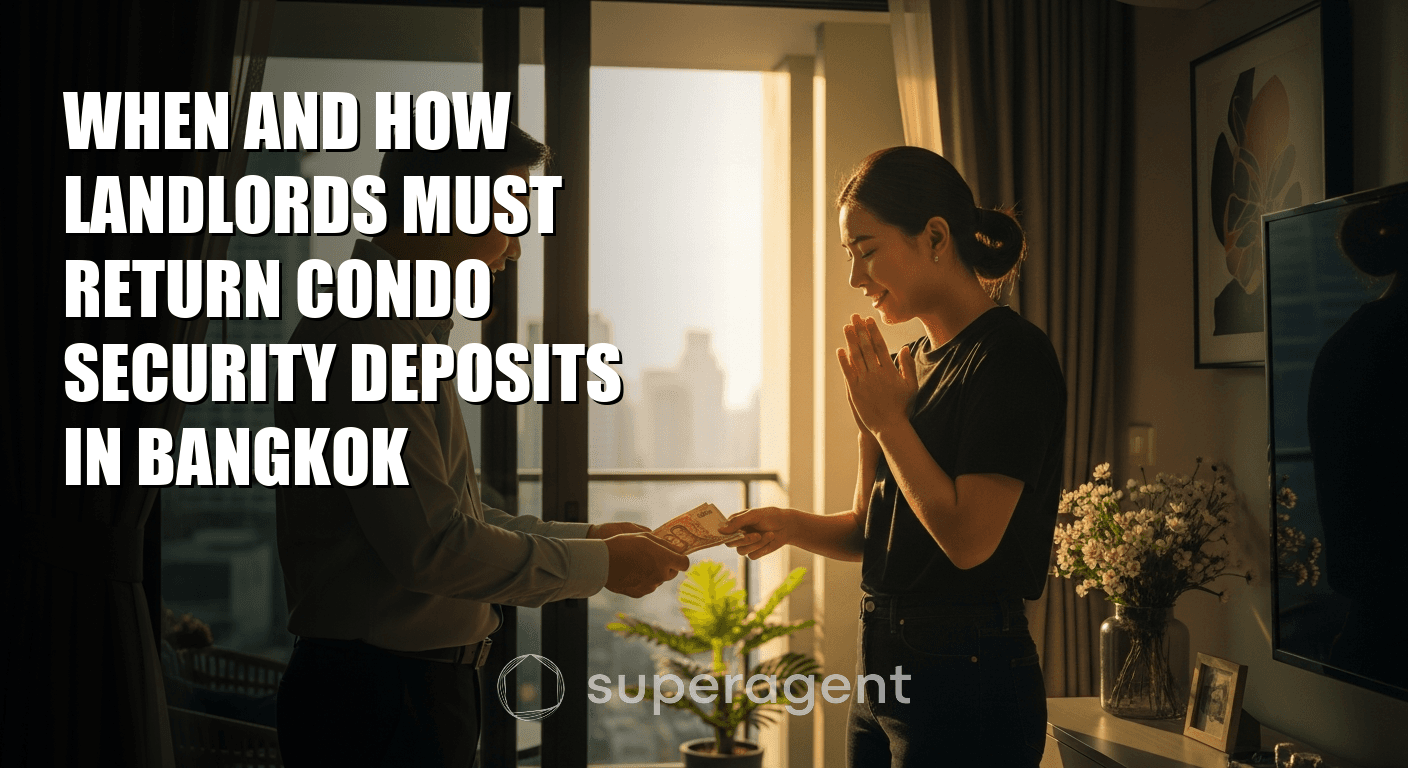
When and How Landlords Must Return Condo Security Deposits in Bangkok
Guides
When and How Landlords Must Return Condo Security Deposits in Bangkok
Learn the legal timeline and procedures for getting your security deposit back in Thailand.
Summary
Understand when condo security deposits must be returned and what landlords need to do. Know your rights about เงินประกันคอนโด refunds in Bangkok rentals.
You've just handed over three months' rent as a condo security deposit in Bangkok, and now you're wondering: will I actually see that money again? If you're renting near Thong Lor or Asok, or anywhere else in the city, this is the question that keeps people up at night. Security deposits in Thailand's rental market aren't as straightforward as they sound, and the rules change depending on whether your landlord is a professional developer, a private owner, or someone managing a portfolio of units.
The short answer: yes, you should get your security deposit back, but timing and conditions matter. Most landlords in Bangkok do return deposits within 15 to 30 days after you move out, provided you haven't damaged the unit or broken the lease early. But there are deductions, disputes, and gray areas that catch renters off guard every month. This guide walks you through exactly what happens to that money, when you can expect it, and what you should do if your landlord tries to keep any of it.
What is a Condo Security Deposit in Bangkok?
A security deposit, locally called a "holding deposit" or simply part of the rental agreement terms, is money you give your landlord upfront to protect against damage, unpaid rent, or early termination. In Bangkok's rental market, this is typically one to three months of rent, depending on the building and your negotiation. For a mid-range 1-bedroom condo near BTS Ekamai renting for 18,000 to 22,000 THB per month, you're looking at handing over 36,000 to 66,000 THB as a deposit.
Unlike security deposits in some countries, Thai law doesn't require landlords to hold deposits in a separate account or pay you interest. The money sits with your landlord, and it's meant to cover damages beyond normal wear and tear when you leave. Think of it as insurance for the landlord, not a savings account for you.
Many professional condos in Sukhumvit and Silom have clearer, written policies about deposits. Private owners, especially those managing one or two units in smaller buildings around Phrom Phong or Nana, might be more flexible on the amount, but also less transparent about refund timelines.
When and How Should Your Landlord Return Your Deposit?
Thai rental law doesn't specify an exact deadline for deposit refunds. Most formal lease agreements say 7 to 14 days after move-out, but in practice, many Bangkok landlords take 15 to 30 days to inspect the unit, document any damage, and process the return. Some take longer if you're on a short-term lease or if you broke the contract early.
Here's what usually happens: you give notice to vacate, you clean out on your last day, and the landlord (or property manager) does a walk-through. They check for holes in walls, stains on carpets, broken appliances, and missing furniture. If everything looks good, they release the deposit. If not, they itemize deductions and return the remainder.
In high-end buildings like those near BTS Thong Lor or in the Emporium area, property managers typically send you an inspection report within a week. Private landlords might be slower, especially if they live outside Bangkok or manage the unit part-time. Always ask for the inspection report in writing before you hand over your final keys.
What Can Your Landlord Deduct From Your Deposit?
Not every scratch or mark means your landlord can take money. Thai consumer protection and rental customs recognize the difference between normal wear and tear and actual damage. That small scuff on the kitchen wall from years of cooking? Normal. A hole you punched in the bedroom wall? Landlord's deduction. The line is fuzzy, which is why disputes happen.
Common deductions include repairs for broken windows, damaged door locks, stained upholstery that can't be cleaned, missing light fixtures, or water damage you caused. Some landlords also deduct unpaid utilities or internet bills, though this should be stated clearly in your lease. A few will deduct for minor repainting even if you didn't cause damage, which is technically unfair but happens anyway.
The practical guide: take photos of the unit before you move in and get the landlord's confirmation of its condition in writing. When you leave, take photos of the clean unit and get a copy of the inspection report. This protects both you and the landlord, and it removes the "he said, she said" problem that plagues Bangkok rentals.
One real example: a renter in a Sukhumvit condo near Nana paid 60,000 THB as a two-month deposit on a 30,000 THB monthly lease. When she moved out after two years, the landlord claimed 8,000 THB for wall repainting and carpet cleaning, returning 52,000 THB after 20 days. She accepted it without documentation and couldn't dispute it later. Had she photographed the unit condition on move-in day and requested an itemized receipt, she could have negotiated the carpet deduction.
Early Termination and Deposit Penalties
Breaking your lease early in Bangkok often comes with a price, and it affects your deposit. Most rental agreements require 30 to 60 days' notice for lease end. If you terminate early, landlords commonly keep a portion of your deposit as a penalty, even if the unit has no damage. This can be a full month's rent or more, depending on how much of your lease remains.
Some landlords are strict about this. Others will negotiate, especially if you leave the unit in pristine condition and they can find a replacement tenant quickly. Buildings managed by professional companies near BTS Asok or Phetchburi tend to enforce early termination clauses fairly consistently, while smaller operations might be more flexible if you ask politely and offer to help market the place to future renters.
Your lease should clearly state early termination fees. If it doesn't, you're in a gray area. Before signing a one-year lease, ask the landlord or agent exactly how much you'll lose if you need to leave at month eight or nine. For Bangkok expats on work visas, this is crucial information, because job changes and relocations happen.
What If Your Landlord Refuses to Return Your Deposit?
If your landlord ghosts you or refuses to return your deposit without a valid reason, you have options, though they're slow and bureaucratic. Thai law gives you the right to sue in a local court, but proving your case requires documentation. This is where those move-in and move-out photos matter, plus your lease agreement and any written communication about the deposit.
Before you escalate, try direct communication. Send a formal email or registered letter requesting the deposit and inspection report within 7 days. Many landlords just need a gentle push. If that fails, contact the building's property management company if there is one, or ask your real estate agent to mediate. Professional agents in Bangkok have relationships with landlords and can often resolve disputes faster than you can alone.
If the amount is small, let it go. The cost of taking a landlord to court, hiring a Thai lawyer, and losing time will exceed any recovery. If it's substantial (several months' rent), and you have documentation, you can file a complaint with Thai Revenue Department or pursue a civil case. Most expats and long-term renters simply find a new landlord and move on, which is why documentation is your real protection.
How to Protect Your Deposit From Day One
The best time to protect your security deposit is before you move in. Request a professional inspection report when you sign the lease. Walk through the unit with the landlord, take timestamped photos of every room, and have both of you sign off on the unit's condition. This single step eliminates 90 percent of deposit disputes in Bangkok.
Keep your lease agreement and any deposit receipt. Make monthly payments via bank transfer so you have proof of rent payment, not cash. If the landlord asks for cash deposits, insist on a written receipt with the date, amount, and what it covers. Take care of the unit during your stay. Normal cleaning and minor maintenance prevent large deductions.
When you prepare to move out, give written notice at least 30 days in advance. Clean the unit thoroughly, repair any minor damage you caused, and schedule the final inspection while you're still in the space. Don't hand over your keys until you've seen the inspection report and discussed any deductions face-to-face. Ask the landlord when you can expect the deposit refund and request it in writing.
- Full lease term, no damage: 7 to 15 days after move-out | 100 percent | Delayed processing, landlord slow to inspect
- Minor repairs needed (scuffs, painting): 15 to 30 days | 80 to 95 percent | Deduction disputes, no itemized receipt
- Significant damage (holes, broken fixtures): 20 to 45 days | 50 to 80 percent | Large deductions, landlord unresponsive with details
- Early termination, good condition: 30 to 60 days | 60 to 90 percent | Early termination penalty, deposit held longer
- Unpaid rent or bills at move-out: Indefinite | Zero to variable | Full deposit loss, legal dispute likely
The reality of Bangkok condo rentals is that most landlords are fair and return deposits on time. Professional buildings managed by companies like those handling properties near BTS Phetchburi or around Silom consistently follow their policies. Private landlords vary widely. Your deposit isn't lost money, but it's not guaranteed either. The difference between getting it back fully and losing a chunk often comes down to documentation and communication.
On average, renters in Bangkok report deposit returns between 14 and 28 days after move-out, according to feedback from local rental agents. About 70 percent get their full deposit back, while 25 percent see minor deductions (1,000 to 5,000 THB) for cleaning or minor repairs, and 5 percent face disputes. These numbers improve dramatically when renters take photos and request written inspection reports.
Start your deposit protection strategy now. Whether you're signing a lease tomorrow or you're already settled in a unit near Ekamai or Phrom Phong, photograph the space today and keep that record. When the time comes to move, you'll have proof of what was there before you, and what you leave behind. That evidence is worth more than any verbal promise from any landlord in Bangkok.
Looking for a rental in Bangkok where transparency and clear lease terms are the standard? Check out Superagent.co, where you can browse verified condos with detailed information and connect directly with landlords who are clear about their deposit policies. Taking the right approach to your security deposit now saves you stress and money later.
You've just handed over three months' rent as a condo security deposit in Bangkok, and now you're wondering: will I actually see that money again? If you're renting near Thong Lor or Asok, or anywhere else in the city, this is the question that keeps people up at night. Security deposits in Thailand's rental market aren't as straightforward as they sound, and the rules change depending on whether your landlord is a professional developer, a private owner, or someone managing a portfolio of units.
The short answer: yes, you should get your security deposit back, but timing and conditions matter. Most landlords in Bangkok do return deposits within 15 to 30 days after you move out, provided you haven't damaged the unit or broken the lease early. But there are deductions, disputes, and gray areas that catch renters off guard every month. This guide walks you through exactly what happens to that money, when you can expect it, and what you should do if your landlord tries to keep any of it.
What is a Condo Security Deposit in Bangkok?
A security deposit, locally called a "holding deposit" or simply part of the rental agreement terms, is money you give your landlord upfront to protect against damage, unpaid rent, or early termination. In Bangkok's rental market, this is typically one to three months of rent, depending on the building and your negotiation. For a mid-range 1-bedroom condo near BTS Ekamai renting for 18,000 to 22,000 THB per month, you're looking at handing over 36,000 to 66,000 THB as a deposit.
Unlike security deposits in some countries, Thai law doesn't require landlords to hold deposits in a separate account or pay you interest. The money sits with your landlord, and it's meant to cover damages beyond normal wear and tear when you leave. Think of it as insurance for the landlord, not a savings account for you.
Many professional condos in Sukhumvit and Silom have clearer, written policies about deposits. Private owners, especially those managing one or two units in smaller buildings around Phrom Phong or Nana, might be more flexible on the amount, but also less transparent about refund timelines.
Continue reading after that.
Looking for a condo
to rent?
Leave your name and phone. We'll follow up while you keep reading.
100% Secure
Fast Response
Free Consultation
When and How Should Your Landlord Return Your Deposit?
Thai rental law doesn't specify an exact deadline for deposit refunds. Most formal lease agreements say 7 to 14 days after move-out, but in practice, many Bangkok landlords take 15 to 30 days to inspect the unit, document any damage, and process the return. Some take longer if you're on a short-term lease or if you broke the contract early.
Here's what usually happens: you give notice to vacate, you clean out on your last day, and the landlord (or property manager) does a walk-through. They check for holes in walls, stains on carpets, broken appliances, and missing furniture. If everything looks good, they release the deposit. If not, they itemize deductions and return the remainder.
In high-end buildings like those near BTS Thong Lor or in the Emporium area, property managers typically send you an inspection report within a week. Private landlords might be slower, especially if they live outside Bangkok or manage the unit part-time. Always ask for the inspection report in writing before you hand over your final keys.
What Can Your Landlord Deduct From Your Deposit?
Not every scratch or mark means your landlord can take money. Thai consumer protection and rental customs recognize the difference between normal wear and tear and actual damage. That small scuff on the kitchen wall from years of cooking? Normal. A hole you punched in the bedroom wall? Landlord's deduction. The line is fuzzy, which is why disputes happen.
Common deductions include repairs for broken windows, damaged door locks, stained upholstery that can't be cleaned, missing light fixtures, or water damage you caused. Some landlords also deduct unpaid utilities or internet bills, though this should be stated clearly in your lease. A few will deduct for minor repainting even if you didn't cause damage, which is technically unfair but happens anyway.
The practical guide: take photos of the unit before you move in and get the landlord's confirmation of its condition in writing. When you leave, take photos of the clean unit and get a copy of the inspection report. This protects both you and the landlord, and it removes the "he said, she said" problem that plagues Bangkok rentals.
One real example: a renter in a Sukhumvit condo near Nana paid 60,000 THB as a two-month deposit on a 30,000 THB monthly lease. When she moved out after two years, the landlord claimed 8,000 THB for wall repainting and carpet cleaning, returning 52,000 THB after 20 days. She accepted it without documentation and couldn't dispute it later. Had she photographed the unit condition on move-in day and requested an itemized receipt, she could have negotiated the carpet deduction.
Early Termination and Deposit Penalties
Breaking your lease early in Bangkok often comes with a price, and it affects your deposit. Most rental agreements require 30 to 60 days' notice for lease end. If you terminate early, landlords commonly keep a portion of your deposit as a penalty, even if the unit has no damage. This can be a full month's rent or more, depending on how much of your lease remains.
Some landlords are strict about this. Others will negotiate, especially if you leave the unit in pristine condition and they can find a replacement tenant quickly. Buildings managed by professional companies near BTS Asok or Phetchburi tend to enforce early termination clauses fairly consistently, while smaller operations might be more flexible if you ask politely and offer to help market the place to future renters.
Your lease should clearly state early termination fees. If it doesn't, you're in a gray area. Before signing a one-year lease, ask the landlord or agent exactly how much you'll lose if you need to leave at month eight or nine. For Bangkok expats on work visas, this is crucial information, because job changes and relocations happen.
What If Your Landlord Refuses to Return Your Deposit?
If your landlord ghosts you or refuses to return your deposit without a valid reason, you have options, though they're slow and bureaucratic. Thai law gives you the right to sue in a local court, but proving your case requires documentation. This is where those move-in and move-out photos matter, plus your lease agreement and any written communication about the deposit.
Before you escalate, try direct communication. Send a formal email or registered letter requesting the deposit and inspection report within 7 days. Many landlords just need a gentle push. If that fails, contact the building's property management company if there is one, or ask your real estate agent to mediate. Professional agents in Bangkok have relationships with landlords and can often resolve disputes faster than you can alone.
If the amount is small, let it go. The cost of taking a landlord to court, hiring a Thai lawyer, and losing time will exceed any recovery. If it's substantial (several months' rent), and you have documentation, you can file a complaint with Thai Revenue Department or pursue a civil case. Most expats and long-term renters simply find a new landlord and move on, which is why documentation is your real protection.
How to Protect Your Deposit From Day One
The best time to protect your security deposit is before you move in. Request a professional inspection report when you sign the lease. Walk through the unit with the landlord, take timestamped photos of every room, and have both of you sign off on the unit's condition. This single step eliminates 90 percent of deposit disputes in Bangkok.
Continue reading after that.
Looking for a condo
to rent?
Leave your name and phone. We'll follow up while you keep reading.
100% Secure
Fast Response
Free Consultation
Keep your lease agreement and any deposit receipt. Make monthly payments via bank transfer so you have proof of rent payment, not cash. If the landlord asks for cash deposits, insist on a written receipt with the date, amount, and what it covers. Take care of the unit during your stay. Normal cleaning and minor maintenance prevent large deductions.
When you prepare to move out, give written notice at least 30 days in advance. Clean the unit thoroughly, repair any minor damage you caused, and schedule the final inspection while you're still in the space. Don't hand over your keys until you've seen the inspection report and discussed any deductions face-to-face. Ask the landlord when you can expect the deposit refund and request it in writing.
- Full lease term, no damage: 7 to 15 days after move-out | 100 percent | Delayed processing, landlord slow to inspect
- Minor repairs needed (scuffs, painting): 15 to 30 days | 80 to 95 percent | Deduction disputes, no itemized receipt
- Significant damage (holes, broken fixtures): 20 to 45 days | 50 to 80 percent | Large deductions, landlord unresponsive with details
- Early termination, good condition: 30 to 60 days | 60 to 90 percent | Early termination penalty, deposit held longer
- Unpaid rent or bills at move-out: Indefinite | Zero to variable | Full deposit loss, legal dispute likely
The reality of Bangkok condo rentals is that most landlords are fair and return deposits on time. Professional buildings managed by companies like those handling properties near BTS Phetchburi or around Silom consistently follow their policies. Private landlords vary widely. Your deposit isn't lost money, but it's not guaranteed either. The difference between getting it back fully and losing a chunk often comes down to documentation and communication.
On average, renters in Bangkok report deposit returns between 14 and 28 days after move-out, according to feedback from local rental agents. About 70 percent get their full deposit back, while 25 percent see minor deductions (1,000 to 5,000 THB) for cleaning or minor repairs, and 5 percent face disputes. These numbers improve dramatically when renters take photos and request written inspection reports.
Start your deposit protection strategy now. Whether you're signing a lease tomorrow or you're already settled in a unit near Ekamai or Phrom Phong, photograph the space today and keep that record. When the time comes to move, you'll have proof of what was there before you, and what you leave behind. That evidence is worth more than any verbal promise from any landlord in Bangkok.
Looking for a rental in Bangkok where transparency and clear lease terms are the standard? Check out Superagent.co, where you can browse verified condos with detailed information and connect directly with landlords who are clear about their deposit policies. Taking the right approach to your security deposit now saves you stress and money later.
Share this article
Properties you may like
![[For Rent] CONDO I Las Colinas Condominium I 2 Beds I 3 Baths I 85,000THB/mo](/_next/image?url=https%3A%2F%2Fstorage.googleapis.com%2Fsuperagent-web%2Fattachments%2Flistings%2F6828%2F80f345c4-488e-43b2-b017-c9fbb17b520d-99486dd8-4237-4ba2-9207-01ce4f66b21f-media.jpg&w=3840&q=75)
฿85,000
2 Bed3170 sqm
[For Rent] CONDO I Las Colinas Condominium I 2 Beds I 3 Baths I 85,000THB/mo
Asoke
Condo![[For Rent] CONDO I Ashton Asoke I 1 Bed I 1 Bath I 30,000THB/mo](/_next/image?url=https%3A%2F%2Fstorage.googleapis.com%2Fsuperagent-web%2Fattachments%2Flistings%2F6876%2Fb7ce9bbe-f877-4ff5-bb54-8ad0026db940-1272-4.jpg&w=3840&q=75)
฿30,000
1 Bed135 sqm
[For Rent] CONDO I Ashton Asoke I 1 Bed I 1 Bath I 30,000THB/mo
Asoke
Condo![[For Rent] CONDO I Skyrise Avenue Sukhumvit 64 I 2 Beds I 2 Baths I 27,000THB/mo](/_next/image?url=https%3A%2F%2Fstorage.googleapis.com%2Fsuperagent-web%2Fattachments%2Flistings%2F2001%2F670f91de-c251-4e81-971c-8e30ed2158cd-screenshot-2026-07-05-at-11.38.53-pm.png&w=3840&q=75)
฿27,000
2 Bed252 sqm
[For Rent] CONDO I Skyrise Avenue Sukhumvit 64 I 2 Beds I 2 Baths I 27,000THB/mo
Punnawithi
Condo![[For Rent] CONDO I Park Origin Ratchathewi I Duplex I 2 Beds I 1 Bath I 32,000THB/mo](/_next/image?url=https%3A%2F%2Fstorage.googleapis.com%2Fsuperagent-web%2Fattachments%2Flistings%2F6896%2Fb79a7d21-7533-4b0d-bb19-762ebfafab62-1318-6.jpg&w=3840&q=75)
฿32,000
2 Bed135.9 sqm
[For Rent] CONDO I Park Origin Ratchathewi I Duplex I 2 Beds I 1 Bath I 32,000THB/mo
Ratchathewi
Condo![[For Rent] CONDO I Park Origin Phayathai I Studio I 1 Bath I 28,000THB/mo](/_next/image?url=https%3A%2F%2Fstorage.googleapis.com%2Fsuperagent-web%2Fattachments%2Flistings%2F6757%2Fb226df93-94c6-46fa-aeba-ebfadc7f81b8-1000006042.jpg&w=3840&q=75)
฿28,000
Studio129 sqm
[For Rent] CONDO I Park Origin Phayathai I Studio I 1 Bath I 28,000THB/mo
Phaya Thai
Condo![[For Rent] CONDO I Ideo Mobi Sukhumvit 81 I Duplex I 1 Bed I 1 Bath I 28,000THB/mo](/_next/image?url=https%3A%2F%2Fstorage.googleapis.com%2Fsuperagent-web%2Fattachments%2Flistings%2F1849%2Fc8b2c033-3b5f-4615-b2b0-4972f40141f0-705-13.jpg&w=3840&q=75)
฿28,000
1 Bed143 sqm
[For Rent] CONDO I Ideo Mobi Sukhumvit 81 I Duplex I 1 Bed I 1 Bath I 28,000THB/mo
On Nut
Condo![[For Rent] CONDO I Siamese Sukhumvit 48 I 1 Bed I 1 Bath I 28,000THB/mo](/_next/image?url=https%3A%2F%2Fstorage.googleapis.com%2Fsuperagent-web%2Fattachments%2Flistings%2F6841%2Febc2dce2-2e9b-4e6d-a01c-0cfa619dfa13-1231-6.jpg&w=3840&q=75)
฿28,000
1 Bed144 sqm
[For Rent] CONDO I Siamese Sukhumvit 48 I 1 Bed I 1 Bath I 28,000THB/mo
Condo![[For Rent] CONDO I Ashton Asoke I 1 Bed I 1 Bath I 22,000THB/mo](/_next/image?url=https%3A%2F%2Fstorage.googleapis.com%2Fsuperagent-web%2Fattachments%2Flistings%2F6802%2Fe06b9b73-1207-414a-ab04-1685de0c7eaa-20220808_153124_0.jpg&w=3840&q=75)
฿22,000
1 Bed134 sqm
[For Rent] CONDO I Ashton Asoke I 1 Bed I 1 Bath I 22,000THB/mo
Asoke
Condo![[For Rent] CONDO I HQ Thonglor Soi 4 I 1 Bed I 1 Bath I 35,000 THB/mo](/_next/image?url=https%3A%2F%2Fstorage.googleapis.com%2Fsuperagent-web%2Fattachments%2Flistings%2F1445%2F72352585-1bc2-41a8-bd62-ddcbf8189fe9-376-5.jpg&w=3840&q=75)
฿35,000
1 Bed143.6 sqm
[For Rent] CONDO I HQ Thonglor Soi 4 I 1 Bed I 1 Bath I 35,000 THB/mo
Thonglor
Condo![[For Rent] CONDO I The Master Centrium Asoke - Sukhumvit I Duplex I 2 Beds I 3 Baths I 75,000 THB/mo](/_next/image?url=https%3A%2F%2Fstorage.googleapis.com%2Fsuperagent-web%2Fattachments%2Flistings%2F1545%2F97932b6a-c358-45e4-b5f9-995dbf5a3cf0-441-2.jpg&w=3840&q=75)
฿75,000
2 Bed3150 sqm
[For Rent] CONDO I The Master Centrium Asoke - Sukhumvit I Duplex I 2 Beds I 3 Baths I 75,000 THB/mo
Asoke
CondoMore like this
 In Guides · Superagent EditorialHidden Costs of Renting a Condo in Bangkok Nobody Warns You AboutBangkok condo rent looks affordable until month one hits. Here are the real costs beyond the headline figure that catch most renters off guard.25 May 20261 min read
 In Guides · Superagent EditorialWhat a Long-Vacant Bangkok Condo Unit Is Actually Telling YouA Bangkok condo vacant for months signals overpricing, landlord issues, or real problems. Here is how to read the signs.25 May 20261 min read
 In Guides · Superagent EditorialRed Flags in a Bangkok Rental Contract to Watch Out ForBangkok rental contracts often hide risky clauses. Here are the red flags every tenant must catch before signing any lease.25 May 20261 min read
 In Guides · Superagent EditorialWorking Online from a Condo: How to Choose the Perfect Room for ProductivityLearn how to choose the best condo room for working online with tips on lighting, noise, and furniture setup to maximize productivity.9 May 20261 min read