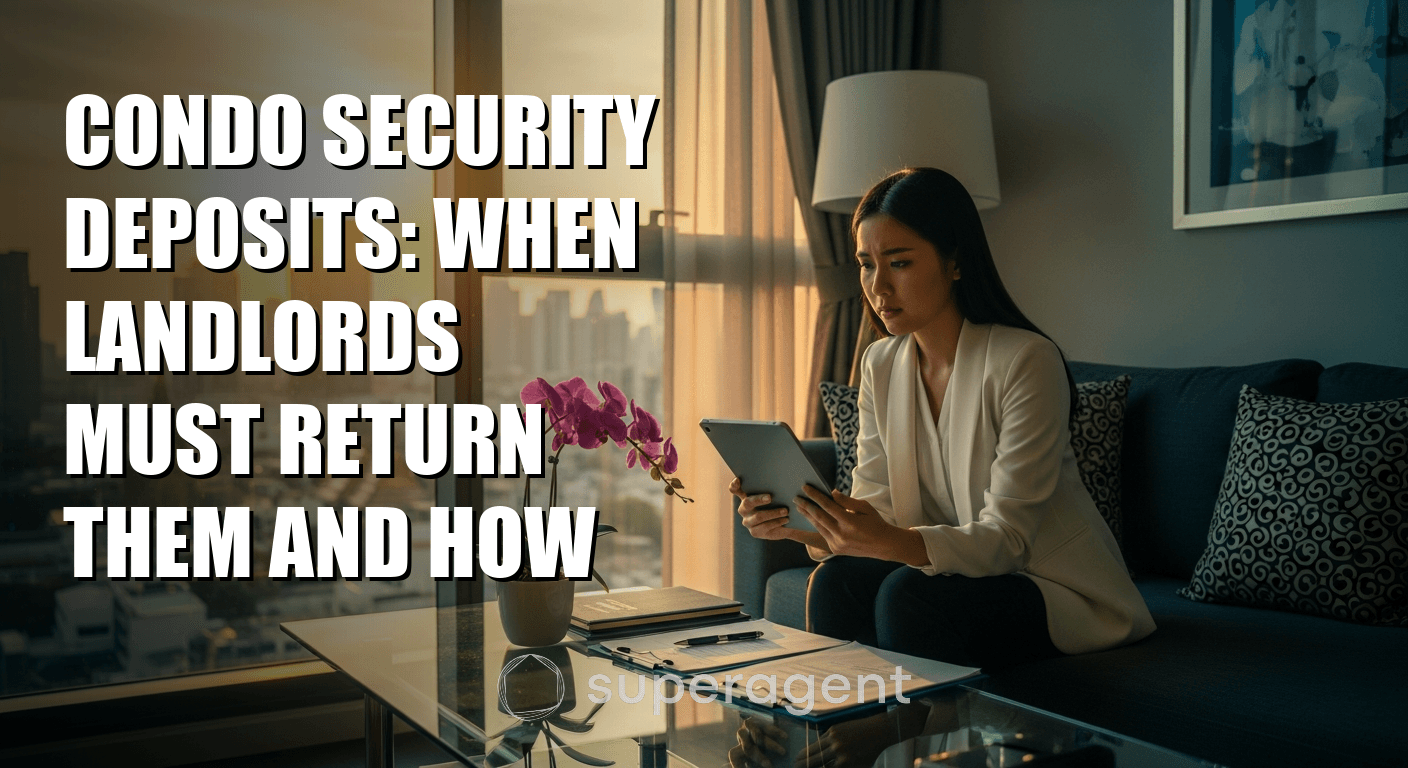
Condo Security Deposits: When Landlords Must Return Them and How
Guides
Condo Security Deposits: When Landlords Must Return Them and How
Learn the legal requirements and timeline for returning condo security deposits in Bangkok.
Summary
Discover whether condo security deposits are refundable and when landlords must return them. Understanding Thai rental laws for security deposit returns en
You hand over 50,000 THB as a security deposit when you sign the lease on your condo near BTS Thonglor. Six months later, you're moving out and expecting to get that money back. But here's the question every tenant in Bangkok asks: when will the landlord actually return it, and what could go wrong?
The security deposit, or "earnest money" as some call it, is probably the most confusing part of the Thai rental process. Unlike other countries with clear deposit laws, Thailand doesn't have a single, ironclad rule that protects your money. Instead, it depends entirely on what's written in your lease agreement. This guide walks you through what you need to know about getting your condo deposit back in Bangkok, plus what to do if your landlord drags their feet or refuses to return it.
What Actually Is a Condo Deposit in Thailand?
A security deposit in a Thai condo rental is money you pay upfront as insurance. It sits with the landlord during your tenancy to cover any damage you cause, unpaid utilities, or rent arrears. In Bangkok, deposits typically range from one to three months' rent. For a two-bedroom condo in Ekkamai or Phrom Phong, that could be 40,000 to 75,000 THB.
The key thing to understand is that a deposit is different from the first month's rent. You pay both. The deposit is held in reserve and should be refunded when you move out, assuming no damages or issues. The first month's rent you pay goes directly to the landlord as income.
In practice, many Bangkok landlords treat deposits loosely. Some keep them in a separate account, others mix them with personal funds. This is why clarity in your lease matters enormously.
When Should Your Deposit Be Returned?
Thai law doesn't specify a hard deadline. This is the frustrating part. Everything hinges on what your lease says. Most Bangkok leases include deposit clauses that say something like "the deposit shall be returned within 15 days of lease termination" or "within 30 days after the tenant vacates and the unit is inspected."
Best practice: 14 to 30 days after you hand over your keys is a reasonable expectation. If your lease doesn't mention timing at all, you're in a grey zone. Many landlords will drag it out to 45 to 90 days while they "inspect" or wait to fill the next lease.
Let's say you're renting a one-bedroom near BTS Ari for 22,000 THB per month with a two-month deposit of 44,000 THB. Your lease says the deposit returns within 21 days of move-out. Count from the day you hand over keys, not from when you notify the landlord you're leaving. If you hand over keys on March 15, the deadline is April 5.
A real scenario from Superagent users: one tenant in Rama 9 waited four months for their deposit while the landlord claimed to be doing "deep cleaning and repairs." No itemized list of damages, no receipts. They got the money back only when they threatened to file a complaint with the local tambon office.
Deductions and What Landlords Can Actually Charge
Your deposit will not be returned in full if the landlord can prove you owe money. Common legitimate deductions include unpaid rent, unpaid utilities (water, electricity), and repairs for damage beyond normal wear and tear. The gray area is huge here.
Normal wear and tear (scuffed walls, small nail holes, faded paint) should not be deducted. Broken window glass, large holes in walls, damaged tiles, or broken appliances can be charged to you. Smoke stains, deep cleaning costs, and carpet stains are common battle points.
A typical breakdown: if you owe 3,000 THB in late electricity bills and caused a broken AC compressor (estimated 8,000 THB to repair), your landlord can deduct 11,000 THB from a 50,000 THB deposit and return 39,000 THB. But only if you agreed to liability for those items in the lease and if the deductions are reasonable and documented.
- Unpaid rent: Yes | Varies by lease | No, documented in lease
- Unpaid utilities: Yes | 500-3,000 THB | Yes, utility bills
- Broken windows or glass doors: Yes | 2,000-6,000 THB | Yes, repair invoice
- AC or appliance repair: Yes | 3,000-15,000 THB | Yes, repair invoice
- Carpet or tile replacement: Yes, if damage caused | 5,000-30,000 THB | Yes, detailed receipt
- Paint touch-ups (normal wear): No | N/A | Landlord responsibility
- General cleaning: No (unless unit left filthy) | N/A | No standard deduction
- Furniture cleaning or stain removal: Maybe, depends on lease | 1,000-5,000 THB | Yes, if deducted
Here's a data point: according to DDproperty's 2023 rental survey, disputes over deposit deductions account for roughly 35 percent of rental complaints in Bangkok. Most revolve around unclear damage assessments and missing receipts.
The golden rule: any deduction must come with a receipt or invoice. If your landlord tells you "I deducted 10,000 THB for AC repair but I'll handle it myself," that's a red flag. Legitimate deductions always have proof.
How to Protect Your Deposit from Day One
The best way to get your deposit back is to prevent problems before they start. This begins with what you sign.
First, get a detailed move-in inspection report in writing. Walk through the condo with the landlord or agent on the day you receive keys, take photos of every room, every appliance, walls, windows, floors. Document existing damage. If there's a crack in the bathroom tile, a stain on the carpet, or a dent in the fridge, photograph it and have the landlord sign off that it was pre-existing. This protects you from being charged for damage you didn't cause.
Second, keep copies of everything. Your signed lease, your deposit receipt, utility bills showing your account in good standing, rental payment records. When you move out, take final photos of the unit showing you left it clean and undamaged. Many Superagent users photograph themselves handing over keys.
Third, clarify the lease language. Your contract should spell out exactly what happens to the deposit, what deductions are possible, the timeline for return, and the process for dispute. Vague language favors the landlord. For example, "tenant liable for all damages" is too broad. "Tenant liable for damage caused by tenant negligence, excluding normal wear and tear" is clearer.
A scenario: you're renting near BTS Nana for 28,000 THB per month with a 56,000 THB deposit. Before moving in, you take 30 photos. The living room sofa has a faded stain. The master bedroom wall has scuff marks. The kitchen faucet drips slightly. All documented. Sixteen months later, when you leave, the landlord can't claim you caused these things.
What to Do If Your Landlord Won't Return the Deposit
If 30 days pass and your deposit hasn't arrived, or if you believe the deductions are unfair, escalation starts.
Step one is direct communication. Message your landlord or agent in writing (use Line, email, or WeChat to create a record) asking for specific details: exact amount to be returned, any deductions and why, and the promised return date. Keep all responses.
Step two is the formal demand letter. If the landlord ignores you or refuses to return the money without legitimate cause, send a registered letter (ส่งจดหมายลงทะเบียน) to their address stating the lease terms, amount owed, and a deadline (typically 7 to 14 days). Get proof of delivery.
Step three is filing a complaint. You can lodge a complaint with your local tambon administrative office (สำนักที่ว่าการอำเภอ) or contact the Thai Consumer Protection Board. These are free options, though they're slow. The government also runs a community mediation center (ศูนย์ประนิธานข้อพิพาท) in each district that can help resolve disputes at no cost.
Step four, if needed, is small claims court (ศาลสั่งขัดสินค่าเสียหายเล็กน้อย). You can sue for the deposit plus damages. This requires legal help and costs money, but it's an option if the amount is substantial and the landlord is clearly refusing to return it without cause.
A real case: a tenant in Rama 4 had their 60,000 THB deposit withheld for "wall damage and cleaning." No itemized list, no receipts. After a complaint to the tambon office and a follow-up meeting with a mediator, the landlord returned 45,000 THB. The process took two months.
Red Flags and How to Avoid Problem Landlords
Some Bangkok landlords are professional and straightforward. Others are notorious for keeping deposits. Learn the warning signs.
Red flag one: the landlord won't put deposit terms in writing. If they say "don't worry, I always return it, no need to write it down," that's a problem. Anything not in the lease is unenforceable in your favor.
Red flag two: the lease says the deposit is "non-refundable" or "only partially refundable." This is not standard and often goes against Thai rental practice. In some cases, it may not be legally enforceable, but why rent from someone willing to propose it?
Red flag three: the landlord or agent demands cash with no receipt. You need a paper trail. Demand a receipt that shows the date, amount, and the phrase "security deposit for unit [address], refundable at lease termination."
Red flag four: the landlord owns only one or two units and handles everything themselves with no system. Not always a disaster, but it raises the risk that your money sits in their personal account and gets spent. Professional property management companies and larger developments have better checks.
Red flag five: reviews or word-of-mouth suggest this landlord routinely withholds deposits. Ask your agent directly. In expat Facebook groups for Bangkok rentals, ask if anyone has rented from this building and what happened with their deposits.
The Bottom Line: Timing and Next Steps
Your condo deposit should come back within 21 to 30 days of move-out, minus any legitimate, documented deductions. In Bangkok's real rental market, this doesn't always happen smoothly, but knowing your rights and the rules makes a huge difference.
Before you sign a lease, have the deposit clause explained clearly. Before you move out, take photos and confirm the expected return date. If problems arise, document everything and escalate step by step, starting with a written request and ending, if necessary, with mediation or legal action.
The good news: most landlords in Bangkok do return deposits, even if slowly. The ones who don't often cave under pressure once you've documented the issue and shown you're serious about following up. Your leverage is the threat of a complaint, mediation, or court case, and the fact that their reputation (especially among expats) matters.
Looking for a condo rental in Bangkok where the landlord is reliable and terms are crystal clear? That's exactly the kind of transparent, vetted listing you'll find on Superagent. Every property and landlord on the platform has been screened, and deposit terms are spelled out upfront. Browse apartments in Thonglor, Ekkamai, Rama 9, or anywhere else in Bangkok, and rent with confidence knowing the rules are fair and documented.
You hand over 50,000 THB as a security deposit when you sign the lease on your condo near BTS Thonglor. Six months later, you're moving out and expecting to get that money back. But here's the question every tenant in Bangkok asks: when will the landlord actually return it, and what could go wrong?
The security deposit, or "earnest money" as some call it, is probably the most confusing part of the Thai rental process. Unlike other countries with clear deposit laws, Thailand doesn't have a single, ironclad rule that protects your money. Instead, it depends entirely on what's written in your lease agreement. This guide walks you through what you need to know about getting your condo deposit back in Bangkok, plus what to do if your landlord drags their feet or refuses to return it.
What Actually Is a Condo Deposit in Thailand?
A security deposit in a Thai condo rental is money you pay upfront as insurance. It sits with the landlord during your tenancy to cover any damage you cause, unpaid utilities, or rent arrears. In Bangkok, deposits typically range from one to three months' rent. For a two-bedroom condo in Ekkamai or Phrom Phong, that could be 40,000 to 75,000 THB.
The key thing to understand is that a deposit is different from the first month's rent. You pay both. The deposit is held in reserve and should be refunded when you move out, assuming no damages or issues. The first month's rent you pay goes directly to the landlord as income.
In practice, many Bangkok landlords treat deposits loosely. Some keep them in a separate account, others mix them with personal funds. This is why clarity in your lease matters enormously.
When Should Your Deposit Be Returned?
Thai law doesn't specify a hard deadline. This is the frustrating part. Everything hinges on what your lease says. Most Bangkok leases include deposit clauses that say something like "the deposit shall be returned within 15 days of lease termination" or "within 30 days after the tenant vacates and the unit is inspected."
Best practice: 14 to 30 days after you hand over your keys is a reasonable expectation. If your lease doesn't mention timing at all, you're in a grey zone. Many landlords will drag it out to 45 to 90 days while they "inspect" or wait to fill the next lease.
Continue reading after that.
Looking for a condo
to rent?
Leave your name and phone. We'll follow up while you keep reading.
100% Secure
Fast Response
Free Consultation
Let's say you're renting a one-bedroom near BTS Ari for 22,000 THB per month with a two-month deposit of 44,000 THB. Your lease says the deposit returns within 21 days of move-out. Count from the day you hand over keys, not from when you notify the landlord you're leaving. If you hand over keys on March 15, the deadline is April 5.
A real scenario from Superagent users: one tenant in Rama 9 waited four months for their deposit while the landlord claimed to be doing "deep cleaning and repairs." No itemized list of damages, no receipts. They got the money back only when they threatened to file a complaint with the local tambon office.
Deductions and What Landlords Can Actually Charge
Your deposit will not be returned in full if the landlord can prove you owe money. Common legitimate deductions include unpaid rent, unpaid utilities (water, electricity), and repairs for damage beyond normal wear and tear. The gray area is huge here.
Normal wear and tear (scuffed walls, small nail holes, faded paint) should not be deducted. Broken window glass, large holes in walls, damaged tiles, or broken appliances can be charged to you. Smoke stains, deep cleaning costs, and carpet stains are common battle points.
A typical breakdown: if you owe 3,000 THB in late electricity bills and caused a broken AC compressor (estimated 8,000 THB to repair), your landlord can deduct 11,000 THB from a 50,000 THB deposit and return 39,000 THB. But only if you agreed to liability for those items in the lease and if the deductions are reasonable and documented.
- Unpaid rent: Yes | Varies by lease | No, documented in lease
- Unpaid utilities: Yes | 500-3,000 THB | Yes, utility bills
- Broken windows or glass doors: Yes | 2,000-6,000 THB | Yes, repair invoice
- AC or appliance repair: Yes | 3,000-15,000 THB | Yes, repair invoice
- Carpet or tile replacement: Yes, if damage caused | 5,000-30,000 THB | Yes, detailed receipt
- Paint touch-ups (normal wear): No | N/A | Landlord responsibility
- General cleaning: No (unless unit left filthy) | N/A | No standard deduction
- Furniture cleaning or stain removal: Maybe, depends on lease | 1,000-5,000 THB | Yes, if deducted
Here's a data point: according to DDproperty's 2023 rental survey, disputes over deposit deductions account for roughly 35 percent of rental complaints in Bangkok. Most revolve around unclear damage assessments and missing receipts.
The golden rule: any deduction must come with a receipt or invoice. If your landlord tells you "I deducted 10,000 THB for AC repair but I'll handle it myself," that's a red flag. Legitimate deductions always have proof.
How to Protect Your Deposit from Day One
The best way to get your deposit back is to prevent problems before they start. This begins with what you sign.
First, get a detailed move-in inspection report in writing. Walk through the condo with the landlord or agent on the day you receive keys, take photos of every room, every appliance, walls, windows, floors. Document existing damage. If there's a crack in the bathroom tile, a stain on the carpet, or a dent in the fridge, photograph it and have the landlord sign off that it was pre-existing. This protects you from being charged for damage you didn't cause.
Second, keep copies of everything. Your signed lease, your deposit receipt, utility bills showing your account in good standing, rental payment records. When you move out, take final photos of the unit showing you left it clean and undamaged. Many Superagent users photograph themselves handing over keys.
Third, clarify the lease language. Your contract should spell out exactly what happens to the deposit, what deductions are possible, the timeline for return, and the process for dispute. Vague language favors the landlord. For example, "tenant liable for all damages" is too broad. "Tenant liable for damage caused by tenant negligence, excluding normal wear and tear" is clearer.
A scenario: you're renting near BTS Nana for 28,000 THB per month with a 56,000 THB deposit. Before moving in, you take 30 photos. The living room sofa has a faded stain. The master bedroom wall has scuff marks. The kitchen faucet drips slightly. All documented. Sixteen months later, when you leave, the landlord can't claim you caused these things.
What to Do If Your Landlord Won't Return the Deposit
If 30 days pass and your deposit hasn't arrived, or if you believe the deductions are unfair, escalation starts.
Step one is direct communication. Message your landlord or agent in writing (use Line, email, or WeChat to create a record) asking for specific details: exact amount to be returned, any deductions and why, and the promised return date. Keep all responses.
Step two is the formal demand letter. If the landlord ignores you or refuses to return the money without legitimate cause, send a registered letter (ส่งจดหมายลงทะเบียน) to their address stating the lease terms, amount owed, and a deadline (typically 7 to 14 days). Get proof of delivery.
Step three is filing a complaint. You can lodge a complaint with your local tambon administrative office (สำนักที่ว่าการอำเภอ) or contact the Thai Consumer Protection Board. These are free options, though they're slow. The government also runs a community mediation center (ศูนย์ประนิธานข้อพิพาท) in each district that can help resolve disputes at no cost.
Step four, if needed, is small claims court (ศาลสั่งขัดสินค่าเสียหายเล็กน้อย). You can sue for the deposit plus damages. This requires legal help and costs money, but it's an option if the amount is substantial and the landlord is clearly refusing to return it without cause.
Continue reading after that.
Looking for a condo
to rent?
Leave your name and phone. We'll follow up while you keep reading.
100% Secure
Fast Response
Free Consultation
A real case: a tenant in Rama 4 had their 60,000 THB deposit withheld for "wall damage and cleaning." No itemized list, no receipts. After a complaint to the tambon office and a follow-up meeting with a mediator, the landlord returned 45,000 THB. The process took two months.
Red Flags and How to Avoid Problem Landlords
Some Bangkok landlords are professional and straightforward. Others are notorious for keeping deposits. Learn the warning signs.
Red flag one: the landlord won't put deposit terms in writing. If they say "don't worry, I always return it, no need to write it down," that's a problem. Anything not in the lease is unenforceable in your favor.
Red flag two: the lease says the deposit is "non-refundable" or "only partially refundable." This is not standard and often goes against Thai rental practice. In some cases, it may not be legally enforceable, but why rent from someone willing to propose it?
Red flag three: the landlord or agent demands cash with no receipt. You need a paper trail. Demand a receipt that shows the date, amount, and the phrase "security deposit for unit [address], refundable at lease termination."
Red flag four: the landlord owns only one or two units and handles everything themselves with no system. Not always a disaster, but it raises the risk that your money sits in their personal account and gets spent. Professional property management companies and larger developments have better checks.
Red flag five: reviews or word-of-mouth suggest this landlord routinely withholds deposits. Ask your agent directly. In expat Facebook groups for Bangkok rentals, ask if anyone has rented from this building and what happened with their deposits.
The Bottom Line: Timing and Next Steps
Your condo deposit should come back within 21 to 30 days of move-out, minus any legitimate, documented deductions. In Bangkok's real rental market, this doesn't always happen smoothly, but knowing your rights and the rules makes a huge difference.
Before you sign a lease, have the deposit clause explained clearly. Before you move out, take photos and confirm the expected return date. If problems arise, document everything and escalate step by step, starting with a written request and ending, if necessary, with mediation or legal action.
The good news: most landlords in Bangkok do return deposits, even if slowly. The ones who don't often cave under pressure once you've documented the issue and shown you're serious about following up. Your leverage is the threat of a complaint, mediation, or court case, and the fact that their reputation (especially among expats) matters.
Looking for a condo rental in Bangkok where the landlord is reliable and terms are crystal clear? That's exactly the kind of transparent, vetted listing you'll find on Superagent. Every property and landlord on the platform has been screened, and deposit terms are spelled out upfront. Browse apartments in Thonglor, Ekkamai, Rama 9, or anywhere else in Bangkok, and rent with confidence knowing the rules are fair and documented.
Share this article
Properties you may like
![[For Rent] CONDO I Las Colinas Condominium I 2 Beds I 3 Baths I 85,000THB/mo](/_next/image?url=https%3A%2F%2Fstorage.googleapis.com%2Fsuperagent-web%2Fattachments%2Flistings%2F6828%2F80f345c4-488e-43b2-b017-c9fbb17b520d-99486dd8-4237-4ba2-9207-01ce4f66b21f-media.jpg&w=3840&q=75)
฿85,000
2 Bed3170 sqm
[For Rent] CONDO I Las Colinas Condominium I 2 Beds I 3 Baths I 85,000THB/mo
Asoke
Condo![[For Rent] CONDO I Ashton Asoke I 1 Bed I 1 Bath I 30,000THB/mo](/_next/image?url=https%3A%2F%2Fstorage.googleapis.com%2Fsuperagent-web%2Fattachments%2Flistings%2F6876%2Fb7ce9bbe-f877-4ff5-bb54-8ad0026db940-1272-4.jpg&w=3840&q=75)
฿30,000
1 Bed135 sqm
[For Rent] CONDO I Ashton Asoke I 1 Bed I 1 Bath I 30,000THB/mo
Asoke
Condo![[For Rent] CONDO I Skyrise Avenue Sukhumvit 64 I 2 Beds I 2 Baths I 27,000THB/mo](/_next/image?url=https%3A%2F%2Fstorage.googleapis.com%2Fsuperagent-web%2Fattachments%2Flistings%2F2001%2F670f91de-c251-4e81-971c-8e30ed2158cd-screenshot-2026-07-05-at-11.38.53-pm.png&w=3840&q=75)
฿27,000
2 Bed252 sqm
[For Rent] CONDO I Skyrise Avenue Sukhumvit 64 I 2 Beds I 2 Baths I 27,000THB/mo
Punnawithi
Condo![[For Rent] CONDO I Park Origin Ratchathewi I Duplex I 2 Beds I 1 Bath I 32,000THB/mo](/_next/image?url=https%3A%2F%2Fstorage.googleapis.com%2Fsuperagent-web%2Fattachments%2Flistings%2F6896%2Fb79a7d21-7533-4b0d-bb19-762ebfafab62-1318-6.jpg&w=3840&q=75)
฿32,000
2 Bed135.9 sqm
[For Rent] CONDO I Park Origin Ratchathewi I Duplex I 2 Beds I 1 Bath I 32,000THB/mo
Ratchathewi
Condo![[For Rent] CONDO I Park Origin Phayathai I Studio I 1 Bath I 28,000THB/mo](/_next/image?url=https%3A%2F%2Fstorage.googleapis.com%2Fsuperagent-web%2Fattachments%2Flistings%2F6757%2Fb226df93-94c6-46fa-aeba-ebfadc7f81b8-1000006042.jpg&w=3840&q=75)
฿28,000
Studio129 sqm
[For Rent] CONDO I Park Origin Phayathai I Studio I 1 Bath I 28,000THB/mo
Phaya Thai
Condo![[For Rent] CONDO I Ideo Mobi Sukhumvit 81 I Duplex I 1 Bed I 1 Bath I 28,000THB/mo](/_next/image?url=https%3A%2F%2Fstorage.googleapis.com%2Fsuperagent-web%2Fattachments%2Flistings%2F1849%2Fc8b2c033-3b5f-4615-b2b0-4972f40141f0-705-13.jpg&w=3840&q=75)
฿28,000
1 Bed143 sqm
[For Rent] CONDO I Ideo Mobi Sukhumvit 81 I Duplex I 1 Bed I 1 Bath I 28,000THB/mo
On Nut
Condo![[For Rent] CONDO I Siamese Sukhumvit 48 I 1 Bed I 1 Bath I 28,000THB/mo](/_next/image?url=https%3A%2F%2Fstorage.googleapis.com%2Fsuperagent-web%2Fattachments%2Flistings%2F6841%2Febc2dce2-2e9b-4e6d-a01c-0cfa619dfa13-1231-6.jpg&w=3840&q=75)
฿28,000
1 Bed144 sqm
[For Rent] CONDO I Siamese Sukhumvit 48 I 1 Bed I 1 Bath I 28,000THB/mo
Condo![[For Rent] CONDO I Ashton Asoke I 1 Bed I 1 Bath I 22,000THB/mo](/_next/image?url=https%3A%2F%2Fstorage.googleapis.com%2Fsuperagent-web%2Fattachments%2Flistings%2F6802%2Fe06b9b73-1207-414a-ab04-1685de0c7eaa-20220808_153124_0.jpg&w=3840&q=75)
฿22,000
1 Bed134 sqm
[For Rent] CONDO I Ashton Asoke I 1 Bed I 1 Bath I 22,000THB/mo
Asoke
Condo![[For Rent] CONDO I HQ Thonglor Soi 4 I 1 Bed I 1 Bath I 35,000 THB/mo](/_next/image?url=https%3A%2F%2Fstorage.googleapis.com%2Fsuperagent-web%2Fattachments%2Flistings%2F1445%2F72352585-1bc2-41a8-bd62-ddcbf8189fe9-376-5.jpg&w=3840&q=75)
฿35,000
1 Bed143.6 sqm
[For Rent] CONDO I HQ Thonglor Soi 4 I 1 Bed I 1 Bath I 35,000 THB/mo
Thonglor
Condo![[For Rent] CONDO I The Master Centrium Asoke - Sukhumvit I Duplex I 2 Beds I 3 Baths I 75,000 THB/mo](/_next/image?url=https%3A%2F%2Fstorage.googleapis.com%2Fsuperagent-web%2Fattachments%2Flistings%2F1545%2F97932b6a-c358-45e4-b5f9-995dbf5a3cf0-441-2.jpg&w=3840&q=75)
฿75,000
2 Bed3150 sqm
[For Rent] CONDO I The Master Centrium Asoke - Sukhumvit I Duplex I 2 Beds I 3 Baths I 75,000 THB/mo
Asoke
CondoMore like this
 In Guides · Superagent EditorialHidden Costs of Renting a Condo in Bangkok Nobody Warns You AboutBangkok condo rent looks affordable until month one hits. Here are the real costs beyond the headline figure that catch most renters off guard.25 May 20261 min read
 In Guides · Superagent EditorialWhat a Long-Vacant Bangkok Condo Unit Is Actually Telling YouA Bangkok condo vacant for months signals overpricing, landlord issues, or real problems. Here is how to read the signs.25 May 20261 min read
 In Guides · Superagent EditorialRed Flags in a Bangkok Rental Contract to Watch Out ForBangkok rental contracts often hide risky clauses. Here are the red flags every tenant must catch before signing any lease.25 May 20261 min read
 In Guides · Superagent EditorialWorking Online from a Condo: How to Choose the Perfect Room for ProductivityLearn how to choose the best condo room for working online with tips on lighting, noise, and furniture setup to maximize productivity.9 May 20261 min read