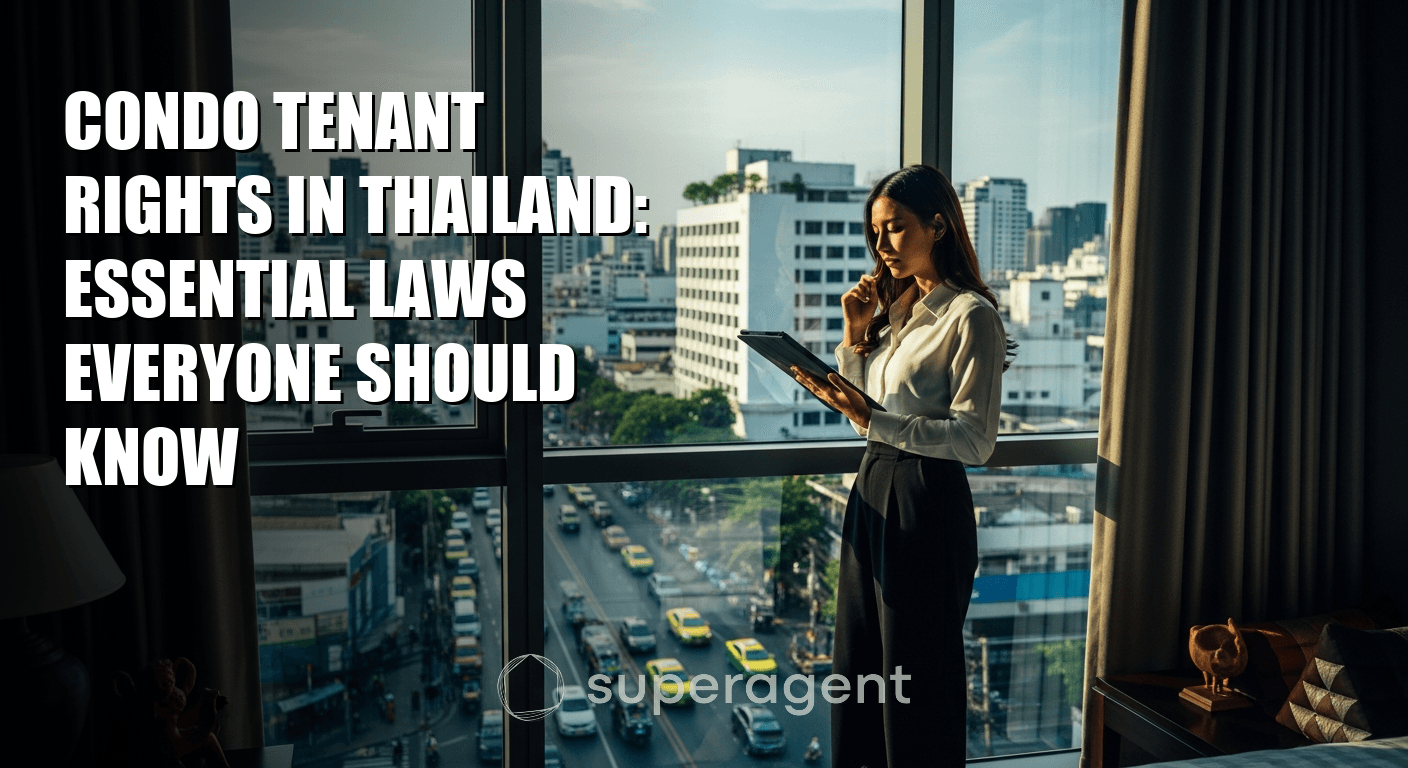
Condo Tenant Rights in Thailand: Essential Laws Everyone Should Know
Guides
Condo Tenant Rights in Thailand: Essential Laws Everyone Should Know
Learn your legal protections as a condo renter in Thailand
Summary
สิทธิ์ผู้เช่าคอนโดไทย are protected by Thai law. Discover essential tenant rights, lease regulations, and legal protections every condo renter must underst
If you are renting a condo in Bangkok, you have legal rights whether you know it or not. Most tenants do not. You might be living in a one-bedroom in Thonglor, a studio near BTS Ari, or a two-bed unit in Rama 9, but the laws that protect you are the same. This guide covers what every renter in Thailand needs to understand about tenant protection, security deposits, lease terms, and what to do if things go wrong. Read it before you sign anything.
The Legal Foundation: Thailand's Tenant Protection Laws
Thailand's Civil and Commercial Code sections 544 to 637 form the backbone of tenant rights in this country. These laws exist to balance the relationship between landlord and tenant, and they apply to nearly every condo rental in Bangkok. Many landlords and tenants ignore them because they are not widely explained in English or in simple Thai.
The reality is that your lease agreement cannot override these protections. If your landlord tries to include terms that violate the code, those terms are unenforceable. For instance, a clause stating you forfeit your entire security deposit for any minor damage is illegal, regardless of what the contract says. You should read the official text before signing, which you can find through the Land Department website.
Most rental disputes in Bangkok arise because tenants did not know their baseline rights. You have the right to quiet enjoyment of the property, the right to a secure deposit that must be returned, and the right to know the true total cost of renting. That last one matters more than people think.
Security Deposits: What Landlords Can and Cannot Do
A security deposit in Bangkok typically runs one to two months of rent. If you are paying 25,000 THB per month for a one-bedroom in Asok or Phrom Phong, expect to put down 25,000 to 50,000 THB upfront. The law is clear on what happens next: your landlord must return that money within 15 days of the lease ending, minus only legitimate deductions for actual damage beyond normal wear and tear.
Here is the catch that catches most people. Landlords often claim damage costs without providing receipts or proof. They deduct for things like faded paint, worn carpet, or minor wall marks that are part of living in a space. That is not legal. Normal wear is your landlord's responsibility. You only owe for damage you caused that is beyond what would happen from regular use.
Many expats in Bangkok have lost deposits this way. Someone moves out of a condo in Ploenchit, the landlord claims 15,000 THB for "wall repairs," and by then the tenant is back in London. To protect yourself, take photos of every wall, floor, and fixture on move-in day. Have your landlord sign off on the condition. Do the same on move-out day. Send photos via email to your landlord immediately. This is not paranoia. This is how you keep your deposit.
If your landlord refuses to return your deposit without valid proof of damage costs, you have the right to file a complaint with the local district office or take civil action. The process is not fast, but the law is on your side if you have documentation.
Lease Terms: What You Must Know Before Signing
Your lease agreement must state the rental period, the monthly rent amount, the security deposit amount, and the conditions for renewal or termination. It must be in writing. If it is not, you have minimal protection if disputes arise. A verbal agreement with your landlord might seem friendly, but it offers almost no legal standing in Bangkok.
The law requires that most residential leases in Thailand specify a clear end date. An open-ended lease is not standard. If your lease says you can stay "as long as you want," it is actually illegal, and either party can terminate with just 30 days notice. Most landlords do not know this, which is why you see it happen.
You also have the right to know the total cost of renting. This means rent plus utilities, parking, building fees, or any other mandatory charge must be transparent upfront. Some buildings near BTS Chong Nonsi charge 28,000 THB rent but then add 3,000 THB in maintenance, 800 THB for parking, and 200 THB for building insurance. That is legitimate if disclosed. Hiding it until move-in is not.
If your lease was signed in Thai and you do not read Thai fluently, you have the right to demand an English translation before you sign. Do not let anyone pressure you into signing a document you do not fully understand. A translator costs 500 to 1,000 THB. A bad lease can cost you thousands.
Eviction Rights: When Can a Landlord Remove You
Your landlord cannot evict you without legal cause and proper notice. This is something many tenants in Bangkok do not realize. A landlord cannot simply decide they want you out and change the locks tomorrow. That would be illegal under Thai law, and it happens, but it is not legal.
Valid reasons for eviction include non-payment of rent for three months or more, material breach of the lease agreement, or if the lease term has expired and the landlord chooses not to renew. Even then, the landlord must follow a formal process. They must serve written notice, usually 30 days in advance, and if you do not leave, they must file a lawsuit in court. The court decides if eviction is justified.
If you live in a condo building like those around Sukhumvit or in Rama 9, the building management cannot evict you on their own. They have no legal authority. Only your landlord can initiate eviction, and only through the courts. If someone tells you that you must leave because the building said so, that is a red flag. Verify it with your landlord in writing before you pack a single box.
Illegal eviction is a criminal matter in Thailand. If your landlord changes the locks, cuts utilities, removes your belongings, or uses intimidation to force you out without going through the courts, you can file a police report. This is rare but it happens, especially in buildings where the landlord is not responsive or transparent.
Maintenance, Repairs, and the Landlord's Obligations
Your landlord has a legal obligation to maintain the property in a livable condition. This includes structural integrity, plumbing, electrical systems, and appliances that came with the unit. If your air conditioning breaks, if the hot water fails, if there is a leak from the unit above, or if the toilet does not work, your landlord must fix it. That is not a favor. That is their job.
The timeline matters. If the repair is urgent and affects your safety or health, your landlord must act quickly, typically within a few days. If it is less urgent, they have more time, but they cannot ignore it indefinitely. You should report repairs in writing via email so you have a record of the request and date.
One common issue in Bangkok condos: landlords trying to shift maintenance costs to tenants. A condo in Phetchaburi has water damage from the building's aging pipes, and the landlord tells the tenant they must pay for the repair. That is incorrect. Structural problems and shared building systems are the building's responsibility, not the tenant's. Your landlord can negotiate with the building management, but they cannot pass the cost to you without legal justification.
If your landlord refuses to make necessary repairs, you have the right to make repairs yourself and deduct the cost from your next rent payment. You must notify your landlord first and give them a reasonable chance to fix it. This is a nuclear option and should only be used if the landlord is genuinely unresponsive, but it exists as a last resort.
Privacy and Access Rights
Your landlord does not have the right to enter your unit whenever they want. Thai law requires landlords to give advance notice, typically 24 hours, before entering for inspections or repairs. They cannot enter without your consent except in genuine emergencies like fire, flooding, or gas leaks.
Some landlords in Bangkok try to enter units regularly under the guise of "routine inspections." This is not routine if you are not informed. If your landlord shows up unannounced and tries to use a master key, you can refuse entry. If they enter anyway, that is trespassing, and you have legal recourse.
This becomes especially important if you rent in a unit where the landlord lives nearby or in the same building. Boundaries matter. Make it clear in writing at the start of the lease that you expect notice before any entry. Keep those emails so you have proof of the agreement.
Comparing Your Rights Across Different Lease Scenarios
- Fixed 12-month lease, rent paid on time: Only after lease expires or for material breach | Full deposit return within 15 days of move-out, minus legitimate damage costs only | Landlord must repair building systems and provided appliances within reasonable time
- Month-to-month or "as long as you want" arrangement: Yes, with 30 days notice without cause | Same protection applies, but less stability | Same rights, but higher turnover risk means less incentive for landlord investment
- You are 2 months behind on rent: Yes, if rent arrears reach 3 months, landlord can sue for eviction | Deposit remains protected, but may be offset against back rent | Landlord can refuse repairs until arrears are paid, with some exceptions for health and safety
- Lease term expired, landlord does not renew: Yes, landlord does not need cause, but must give written notice | Full deposit return unless damage claims are valid | Landlord still must keep property livable until you leave
What to Do If Your Landlord Violates Your Rights
Start by documenting everything. Take photos, save all messages, keep copies of emails, and write down dates and times of incidents. If your landlord is retaliating against you for asserting your rights, or if they are breaking the law, you need a record.
Next, send a formal letter to your landlord describing the issue and requesting resolution within a specific timeframe, usually 7 to 15 days. Send it via registered mail or email so you have proof of delivery. Many landlords will fix the problem once they realize you are serious and have documentation.
If that does not work, you can file a complaint with your local district office or take the matter to the housing court. Thailand has housing courts specifically designed to handle tenant disputes. The process is relatively simple and inexpensive compared to international standards. You can also contact a lawyer specializing in property law. Many offer free initial consultations.
If you are part of a condo building, remember that the building management and the landlord are separate entities. Building rules are different from lease terms. If the issue involves building maintenance or rules, you might also file a complaint with the building's juristic person, which is the legal entity managing the common areas.
The key insight here is that you have remedies available. Most tenants in Bangkok do not use them because they do not know they exist. Landlords count on that ignorance. Once you demonstrate you know your rights, many disputes resolve quickly.
Renting a condo in Bangkok does not require you to surrender your legal protections. Whether you are in a high-rise in Sathorn, a mid-range unit near BTS Anusawari, or a smaller building in Lat Krabang, these same laws protect you. Know your rights before you sign the lease. Document everything once you move in. Communicate in writing, not verbally. Keep copies of all agreements.
If you are searching for your next rental in Bangkok and want a landlord and property that respects tenant rights from day one, start your search on Superagent. You can filter by location, price, and lease terms that work for you. The platform connects you with vetted listings so you spend less time worrying about legalities and more time actually enjoying your place in Bangkok.
If you are renting a condo in Bangkok, you have legal rights whether you know it or not. Most tenants do not. You might be living in a one-bedroom in Thonglor, a studio near BTS Ari, or a two-bed unit in Rama 9, but the laws that protect you are the same. This guide covers what every renter in Thailand needs to understand about tenant protection, security deposits, lease terms, and what to do if things go wrong. Read it before you sign anything.
The Legal Foundation: Thailand's Tenant Protection Laws
Thailand's Civil and Commercial Code sections 544 to 637 form the backbone of tenant rights in this country. These laws exist to balance the relationship between landlord and tenant, and they apply to nearly every condo rental in Bangkok. Many landlords and tenants ignore them because they are not widely explained in English or in simple Thai.
The reality is that your lease agreement cannot override these protections. If your landlord tries to include terms that violate the code, those terms are unenforceable. For instance, a clause stating you forfeit your entire security deposit for any minor damage is illegal, regardless of what the contract says. You should read the official text before signing, which you can find through the Land Department website.
Most rental disputes in Bangkok arise because tenants did not know their baseline rights. You have the right to quiet enjoyment of the property, the right to a secure deposit that must be returned, and the right to know the true total cost of renting. That last one matters more than people think.
Security Deposits: What Landlords Can and Cannot Do
A security deposit in Bangkok typically runs one to two months of rent. If you are paying 25,000 THB per month for a one-bedroom in Asok or Phrom Phong, expect to put down 25,000 to 50,000 THB upfront. The law is clear on what happens next: your landlord must return that money within 15 days of the lease ending, minus only legitimate deductions for actual damage beyond normal wear and tear.
Here is the catch that catches most people. Landlords often claim damage costs without providing receipts or proof. They deduct for things like faded paint, worn carpet, or minor wall marks that are part of living in a space. That is not legal. Normal wear is your landlord's responsibility. You only owe for damage you caused that is beyond what would happen from regular use.
Continue reading after that.
Looking for a condo
to rent?
Leave your name and phone. We'll follow up while you keep reading.
100% Secure
Fast Response
Free Consultation
Many expats in Bangkok have lost deposits this way. Someone moves out of a condo in Ploenchit, the landlord claims 15,000 THB for "wall repairs," and by then the tenant is back in London. To protect yourself, take photos of every wall, floor, and fixture on move-in day. Have your landlord sign off on the condition. Do the same on move-out day. Send photos via email to your landlord immediately. This is not paranoia. This is how you keep your deposit.
If your landlord refuses to return your deposit without valid proof of damage costs, you have the right to file a complaint with the local district office or take civil action. The process is not fast, but the law is on your side if you have documentation.
Lease Terms: What You Must Know Before Signing
Your lease agreement must state the rental period, the monthly rent amount, the security deposit amount, and the conditions for renewal or termination. It must be in writing. If it is not, you have minimal protection if disputes arise. A verbal agreement with your landlord might seem friendly, but it offers almost no legal standing in Bangkok.
The law requires that most residential leases in Thailand specify a clear end date. An open-ended lease is not standard. If your lease says you can stay "as long as you want," it is actually illegal, and either party can terminate with just 30 days notice. Most landlords do not know this, which is why you see it happen.
You also have the right to know the total cost of renting. This means rent plus utilities, parking, building fees, or any other mandatory charge must be transparent upfront. Some buildings near BTS Chong Nonsi charge 28,000 THB rent but then add 3,000 THB in maintenance, 800 THB for parking, and 200 THB for building insurance. That is legitimate if disclosed. Hiding it until move-in is not.
If your lease was signed in Thai and you do not read Thai fluently, you have the right to demand an English translation before you sign. Do not let anyone pressure you into signing a document you do not fully understand. A translator costs 500 to 1,000 THB. A bad lease can cost you thousands.
Eviction Rights: When Can a Landlord Remove You
Your landlord cannot evict you without legal cause and proper notice. This is something many tenants in Bangkok do not realize. A landlord cannot simply decide they want you out and change the locks tomorrow. That would be illegal under Thai law, and it happens, but it is not legal.
Valid reasons for eviction include non-payment of rent for three months or more, material breach of the lease agreement, or if the lease term has expired and the landlord chooses not to renew. Even then, the landlord must follow a formal process. They must serve written notice, usually 30 days in advance, and if you do not leave, they must file a lawsuit in court. The court decides if eviction is justified.
If you live in a condo building like those around Sukhumvit or in Rama 9, the building management cannot evict you on their own. They have no legal authority. Only your landlord can initiate eviction, and only through the courts. If someone tells you that you must leave because the building said so, that is a red flag. Verify it with your landlord in writing before you pack a single box.
Illegal eviction is a criminal matter in Thailand. If your landlord changes the locks, cuts utilities, removes your belongings, or uses intimidation to force you out without going through the courts, you can file a police report. This is rare but it happens, especially in buildings where the landlord is not responsive or transparent.
Maintenance, Repairs, and the Landlord's Obligations
Your landlord has a legal obligation to maintain the property in a livable condition. This includes structural integrity, plumbing, electrical systems, and appliances that came with the unit. If your air conditioning breaks, if the hot water fails, if there is a leak from the unit above, or if the toilet does not work, your landlord must fix it. That is not a favor. That is their job.
The timeline matters. If the repair is urgent and affects your safety or health, your landlord must act quickly, typically within a few days. If it is less urgent, they have more time, but they cannot ignore it indefinitely. You should report repairs in writing via email so you have a record of the request and date.
One common issue in Bangkok condos: landlords trying to shift maintenance costs to tenants. A condo in Phetchaburi has water damage from the building's aging pipes, and the landlord tells the tenant they must pay for the repair. That is incorrect. Structural problems and shared building systems are the building's responsibility, not the tenant's. Your landlord can negotiate with the building management, but they cannot pass the cost to you without legal justification.
If your landlord refuses to make necessary repairs, you have the right to make repairs yourself and deduct the cost from your next rent payment. You must notify your landlord first and give them a reasonable chance to fix it. This is a nuclear option and should only be used if the landlord is genuinely unresponsive, but it exists as a last resort.
Privacy and Access Rights
Your landlord does not have the right to enter your unit whenever they want. Thai law requires landlords to give advance notice, typically 24 hours, before entering for inspections or repairs. They cannot enter without your consent except in genuine emergencies like fire, flooding, or gas leaks.
Some landlords in Bangkok try to enter units regularly under the guise of "routine inspections." This is not routine if you are not informed. If your landlord shows up unannounced and tries to use a master key, you can refuse entry. If they enter anyway, that is trespassing, and you have legal recourse.
This becomes especially important if you rent in a unit where the landlord lives nearby or in the same building. Boundaries matter. Make it clear in writing at the start of the lease that you expect notice before any entry. Keep those emails so you have proof of the agreement.
Continue reading after that.
Looking for a condo
to rent?
Leave your name and phone. We'll follow up while you keep reading.
100% Secure
Fast Response
Free Consultation
Comparing Your Rights Across Different Lease Scenarios
- Fixed 12-month lease, rent paid on time: Only after lease expires or for material breach | Full deposit return within 15 days of move-out, minus legitimate damage costs only | Landlord must repair building systems and provided appliances within reasonable time
- Month-to-month or "as long as you want" arrangement: Yes, with 30 days notice without cause | Same protection applies, but less stability | Same rights, but higher turnover risk means less incentive for landlord investment
- You are 2 months behind on rent: Yes, if rent arrears reach 3 months, landlord can sue for eviction | Deposit remains protected, but may be offset against back rent | Landlord can refuse repairs until arrears are paid, with some exceptions for health and safety
- Lease term expired, landlord does not renew: Yes, landlord does not need cause, but must give written notice | Full deposit return unless damage claims are valid | Landlord still must keep property livable until you leave
What to Do If Your Landlord Violates Your Rights
Start by documenting everything. Take photos, save all messages, keep copies of emails, and write down dates and times of incidents. If your landlord is retaliating against you for asserting your rights, or if they are breaking the law, you need a record.
Next, send a formal letter to your landlord describing the issue and requesting resolution within a specific timeframe, usually 7 to 15 days. Send it via registered mail or email so you have proof of delivery. Many landlords will fix the problem once they realize you are serious and have documentation.
If that does not work, you can file a complaint with your local district office or take the matter to the housing court. Thailand has housing courts specifically designed to handle tenant disputes. The process is relatively simple and inexpensive compared to international standards. You can also contact a lawyer specializing in property law. Many offer free initial consultations.
If you are part of a condo building, remember that the building management and the landlord are separate entities. Building rules are different from lease terms. If the issue involves building maintenance or rules, you might also file a complaint with the building's juristic person, which is the legal entity managing the common areas.
The key insight here is that you have remedies available. Most tenants in Bangkok do not use them because they do not know they exist. Landlords count on that ignorance. Once you demonstrate you know your rights, many disputes resolve quickly.
Renting a condo in Bangkok does not require you to surrender your legal protections. Whether you are in a high-rise in Sathorn, a mid-range unit near BTS Anusawari, or a smaller building in Lat Krabang, these same laws protect you. Know your rights before you sign the lease. Document everything once you move in. Communicate in writing, not verbally. Keep copies of all agreements.
If you are searching for your next rental in Bangkok and want a landlord and property that respects tenant rights from day one, start your search on Superagent. You can filter by location, price, and lease terms that work for you. The platform connects you with vetted listings so you spend less time worrying about legalities and more time actually enjoying your place in Bangkok.
Share this article
Properties you may like
![[For Rent] CONDO I Las Colinas Condominium I 2 Beds I 3 Baths I 85,000THB/mo](/_next/image?url=https%3A%2F%2Fstorage.googleapis.com%2Fsuperagent-web%2Fattachments%2Flistings%2F6828%2F80f345c4-488e-43b2-b017-c9fbb17b520d-99486dd8-4237-4ba2-9207-01ce4f66b21f-media.jpg&w=3840&q=75)
฿85,000
2 Bed3170 sqm
[For Rent] CONDO I Las Colinas Condominium I 2 Beds I 3 Baths I 85,000THB/mo
Asoke
Condo![[For Rent] CONDO I Ashton Asoke I 1 Bed I 1 Bath I 30,000THB/mo](/_next/image?url=https%3A%2F%2Fstorage.googleapis.com%2Fsuperagent-web%2Fattachments%2Flistings%2F6876%2Fb7ce9bbe-f877-4ff5-bb54-8ad0026db940-1272-4.jpg&w=3840&q=75)
฿30,000
1 Bed135 sqm
[For Rent] CONDO I Ashton Asoke I 1 Bed I 1 Bath I 30,000THB/mo
Asoke
Condo![[For Rent] CONDO I Skyrise Avenue Sukhumvit 64 I 2 Beds I 2 Baths I 27,000THB/mo](/_next/image?url=https%3A%2F%2Fstorage.googleapis.com%2Fsuperagent-web%2Fattachments%2Flistings%2F2001%2F670f91de-c251-4e81-971c-8e30ed2158cd-screenshot-2026-07-05-at-11.38.53-pm.png&w=3840&q=75)
฿27,000
2 Bed252 sqm
[For Rent] CONDO I Skyrise Avenue Sukhumvit 64 I 2 Beds I 2 Baths I 27,000THB/mo
Punnawithi
Condo![[For Rent] CONDO I Park Origin Ratchathewi I Duplex I 2 Beds I 1 Bath I 32,000THB/mo](/_next/image?url=https%3A%2F%2Fstorage.googleapis.com%2Fsuperagent-web%2Fattachments%2Flistings%2F6896%2Fb79a7d21-7533-4b0d-bb19-762ebfafab62-1318-6.jpg&w=3840&q=75)
฿32,000
2 Bed135.9 sqm
[For Rent] CONDO I Park Origin Ratchathewi I Duplex I 2 Beds I 1 Bath I 32,000THB/mo
Ratchathewi
Condo![[For Rent] CONDO I Park Origin Phayathai I Studio I 1 Bath I 28,000THB/mo](/_next/image?url=https%3A%2F%2Fstorage.googleapis.com%2Fsuperagent-web%2Fattachments%2Flistings%2F6757%2Fb226df93-94c6-46fa-aeba-ebfadc7f81b8-1000006042.jpg&w=3840&q=75)
฿28,000
Studio129 sqm
[For Rent] CONDO I Park Origin Phayathai I Studio I 1 Bath I 28,000THB/mo
Phaya Thai
Condo![[For Rent] CONDO I Ideo Mobi Sukhumvit 81 I Duplex I 1 Bed I 1 Bath I 28,000THB/mo](/_next/image?url=https%3A%2F%2Fstorage.googleapis.com%2Fsuperagent-web%2Fattachments%2Flistings%2F1849%2Fc8b2c033-3b5f-4615-b2b0-4972f40141f0-705-13.jpg&w=3840&q=75)
฿28,000
1 Bed143 sqm
[For Rent] CONDO I Ideo Mobi Sukhumvit 81 I Duplex I 1 Bed I 1 Bath I 28,000THB/mo
On Nut
Condo![[For Rent] CONDO I Siamese Sukhumvit 48 I 1 Bed I 1 Bath I 28,000THB/mo](/_next/image?url=https%3A%2F%2Fstorage.googleapis.com%2Fsuperagent-web%2Fattachments%2Flistings%2F6841%2Febc2dce2-2e9b-4e6d-a01c-0cfa619dfa13-1231-6.jpg&w=3840&q=75)
฿28,000
1 Bed144 sqm
[For Rent] CONDO I Siamese Sukhumvit 48 I 1 Bed I 1 Bath I 28,000THB/mo
Condo![[For Rent] CONDO I Ashton Asoke I 1 Bed I 1 Bath I 22,000THB/mo](/_next/image?url=https%3A%2F%2Fstorage.googleapis.com%2Fsuperagent-web%2Fattachments%2Flistings%2F6802%2Fe06b9b73-1207-414a-ab04-1685de0c7eaa-20220808_153124_0.jpg&w=3840&q=75)
฿22,000
1 Bed134 sqm
[For Rent] CONDO I Ashton Asoke I 1 Bed I 1 Bath I 22,000THB/mo
Asoke
Condo![[For Rent] CONDO I HQ Thonglor Soi 4 I 1 Bed I 1 Bath I 35,000 THB/mo](/_next/image?url=https%3A%2F%2Fstorage.googleapis.com%2Fsuperagent-web%2Fattachments%2Flistings%2F1445%2F72352585-1bc2-41a8-bd62-ddcbf8189fe9-376-5.jpg&w=3840&q=75)
฿35,000
1 Bed143.6 sqm
[For Rent] CONDO I HQ Thonglor Soi 4 I 1 Bed I 1 Bath I 35,000 THB/mo
Thonglor
Condo![[For Rent] CONDO I The Master Centrium Asoke - Sukhumvit I Duplex I 2 Beds I 3 Baths I 75,000 THB/mo](/_next/image?url=https%3A%2F%2Fstorage.googleapis.com%2Fsuperagent-web%2Fattachments%2Flistings%2F1545%2F97932b6a-c358-45e4-b5f9-995dbf5a3cf0-441-2.jpg&w=3840&q=75)
฿75,000
2 Bed3150 sqm
[For Rent] CONDO I The Master Centrium Asoke - Sukhumvit I Duplex I 2 Beds I 3 Baths I 75,000 THB/mo
Asoke
CondoMore like this
 In Guides · Superagent EditorialHidden Costs of Renting a Condo in Bangkok Nobody Warns You AboutBangkok condo rent looks affordable until month one hits. Here are the real costs beyond the headline figure that catch most renters off guard.25 May 20261 min read
 In Guides · Superagent EditorialWhat a Long-Vacant Bangkok Condo Unit Is Actually Telling YouA Bangkok condo vacant for months signals overpricing, landlord issues, or real problems. Here is how to read the signs.25 May 20261 min read
 In Guides · Superagent EditorialRed Flags in a Bangkok Rental Contract to Watch Out ForBangkok rental contracts often hide risky clauses. Here are the red flags every tenant must catch before signing any lease.25 May 20261 min read
 In Guides · Superagent EditorialWorking Online from a Condo: How to Choose the Perfect Room for ProductivityLearn how to choose the best condo room for working online with tips on lighting, noise, and furniture setup to maximize productivity.9 May 20261 min read