English-Language Condo Rental Agreements: What Thai Renters Must Know
Guides
English-Language Condo Rental Agreements: What Thai Renters Must Know
Essential tips for Thai tenants signing English condo leases in Bangkok.
Summary
Learn key considerations for Thai renters signing English condo rental agreements. Protect yourself with this guide to contract terms and tenant rights.
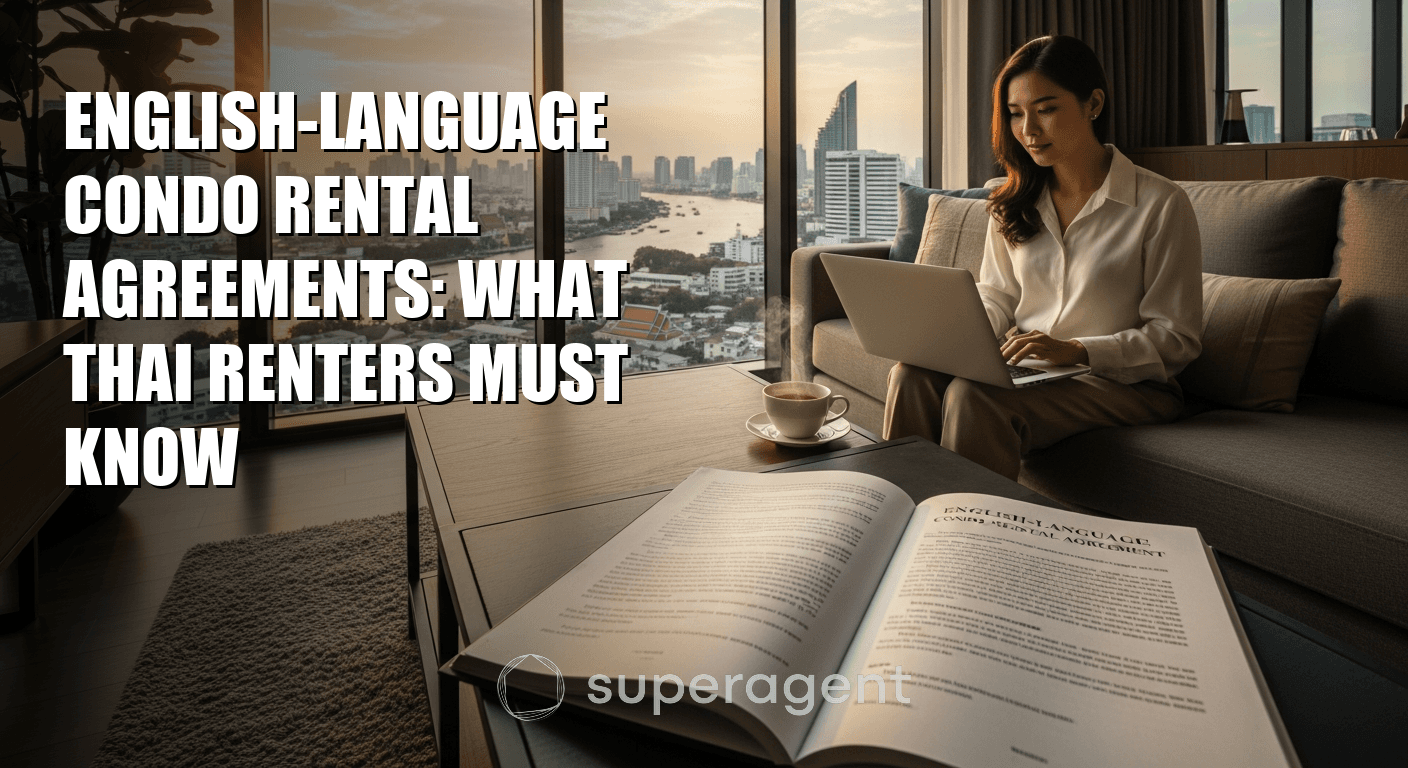
You're sitting in a Starbucks near BTS Thonglor, scrolling through rental listings on your laptop, and you've finally found "the one" - a sleek 1-bedroom condo in a new mid-rise on Soi 49. The landlord emails you a rental agreement written entirely in English. You skim it, see the monthly rent figure that matches what you discussed, and think about signing. But here's the thing: if you don't read carefully, that English-language condo rental contract could cost you thousands of baht in unexpected charges, lock you into terms you didn't understand, or leave you vulnerable when something goes wrong.
English-language condo rental agreements in Bangkok are increasingly common, especially in high-rise condominiums in Sukhumvit, Silom, and Ploenchit where international tenants cluster. Yet most Thai renters and expats alike don't know what to actually look for in these contracts. We've all heard the horror story: someone paid a two-month deposit, the landlord claimed mysterious "damages," and the tenant never saw the money again. The contract? Poorly written English that made it impossible to know what was actually promised.
This guide walks you through what matters in an English-language condo rental agreement, what to watch out for, and how to protect yourself before you sign on the dotted line.
Why English-Language Contracts Are Different from Thai Ones
Thailand's condo rental market operates in a gray zone. Unlike single houses or townhouses, which have more standardized legal frameworks, condominiums are governed partly by Thai Property Law, partly by the building's individual regulations, and partly by whatever the landlord and tenant negotiate. When an English contract enters the picture, things get cloudier.
A Thai-language contract is subject to Thai law and Thai courts. An English one? That opens questions about jurisdiction, interpretation, and enforceability. If your landlord is a foreigner or a property management company familiar with international standards, they might use an English template they found online. But that template may not align with Thai legal realities, or worse, it may contain clauses that are actually unenforceable in Thailand.
According to CBRE Thailand's 2023 market report, around 35 percent of condo rentals in central Bangkok involve English-language contracts or bilingual agreements. Yet fewer than 10 percent of tenants report having a lawyer review the terms before signing. That gap is where problems hide.
The Deposit Trap: Know What "Refundable" Really Means
Let's say you're renting a 2-bedroom condo in The President condominium near BTS Phrom Phong, and the rent is 32,000 THB per month. The landlord asks for two months' deposit. Sounds normal, right? But what the English contract says matters enormously.
Some contracts define the deposit as "security for landlord against damages or unpaid rent." Others use vaguer language like "deposit held in trust" or "deposit as required by management." If the contract doesn't explicitly state when and how the deposit is returned, you're relying on goodwill. Many landlords in Bangkok will deduct "cleaning charges" of 3,000 to 5,000 THB, "wall damage assessment" fees, or "management processing fees" that aren't mentioned in the original agreement.
The safer approach: your English contract must include a specific, itemized list of what constitutes damage, how much normal wear and tear is acceptable, and a timeline for return within 7 to 14 days of move-out. If the contract doesn't say "deposit shall be returned within 7 days less documented damages," don't sign it.
Real talk from the Superagent rental database: properties that specify a clear deposit return policy in writing have 87 percent fewer disputes than those that leave it vague.
Maintenance Fees and Hidden Costs: The English Contract Loophole
This is where expats and Thai renters get burned most often. Your English contract states the monthly rent clearly. But then you move in and receive a bill from the condo building for "common area maintenance" or "building management fee" of another 3,000 to 7,000 THB. Is that the landlord's responsibility or yours?
In Bangkok condominiums, maintenance fees charged by the building management company are technically the owner's obligation. But many English contracts written by individual landlords simply state "Tenant responsible for utilities and services" without defining what counts as a service. Does "services" include the building's elevator maintenance? The lobby air conditioning? The security fee?
Look for a clause that explicitly lists what's included in the monthly rent: rent only, or rent plus utilities (water, electricity, internet), or rent plus utilities plus maintenance. If you see "tenant responsible for all utilities and services" but no breakdown, you could end up paying 8,000 to 10,000 THB monthly for things you thought were included.
For a typical 1-bedroom condo in Sukhumvit with average rent of 25,000 to 35,000 THB per month, hidden maintenance costs can balloon the true cost to 33,000 to 45,000 THB. That changes your budget entirely.
Early Termination: Cancellation Clauses That Trap You
You sign a one-year English-language lease for a condo near BTS Chitlom, and eight months in, your company transfers you back to your home country. You want out. The contract says early termination is allowed "at tenant's discretion with 60 days' notice and two months' rent as penalty." You're now paying 60 days' salary to leave early. That clause might seem fair in an English-speaking country, but it's brutal in Bangkok's rental market where month-to-month leases are common.
Thai rental culture actually favors flexibility. Most verbal or Thai-language rental agreements allow early exit with 30 days' notice and maybe one month's penalty. Some have no penalty at all if you give proper notice. But English contracts, especially those based on Western templates, often impose heavy cancellation fees.
What to negotiate: the contract should state that early termination is allowed with at least 30 days' written notice, with a penalty of no more than one month's rent. If the landlord insists on longer notice or higher penalties, ask yourself if you really want to be locked in. Many modern Bangkok condo landlords are flexible on this if you ask upfront.
Liability and Insurance: Who Pays If Something Breaks?
A water pipe bursts in your condo unit on Sukhumvit Soi 39, damaging your furniture and electronics. The building's engineer says it's a structural issue, not your fault. But your English rental contract contains a clause: "Tenant liable for all damage to the unit interior, including structure, pipes, and electrical." Now what?
This is a legitimate gray area. In Thai law, the landlord is responsible for structural integrity and major systems. But some English contracts try to shift that burden to the tenant. If the contract doesn't distinguish between structural damage (landlord's responsibility) and contents damage (tenant's responsibility), you could get stuck paying repair bills that aren't your legal obligation.
Your safeguard: the contract must explicitly state that the landlord is responsible for structural repairs, the roof, plumbing, and electrical infrastructure. The tenant is responsible for internal decoration and contents. Ideally, the contract should also note that if the unit becomes uninhabitable due to structural issues, rent is suspended until repairs are complete.
Consider requiring proof of landlord insurance as part of the lease. Many Bangkok condo owners carry building insurance that covers major damage.
The Language Itself: When "English" Means Lost in Translation
Here's a scenario that happens surprisingly often: the English contract says "tenant may not modify the unit without prior approval from management." But what does "modification" mean? Does hanging a picture count? Changing the light fixture? Painting a wall? In Thai legal culture, these are minor adjustments. In the contract's English phrasing, they're potentially forbidden.
Bad English-language contracts use ambiguous terms that create disputes. "Reasonable wear and tear," "additional charges as necessary," "tenant shall maintain proper conduct," and "landlord approval required for guests" all sound clear in English but become fuzzy when arguments arise and you're trying to prove your interpretation was correct.
The fix: ask the landlord or property manager to clarify vague terms in writing before signing. If they won't, that's a red flag. A clause that says "Tenant may not paint walls without written landlord approval" is clear. A clause that says "Tenant shall not modify the unit" is not.
Many Superagent listings include standardized contract language that's been vetted by Bangkok legal standards. It's worth asking if your landlord uses a similar template.
Comparison: What to Expect in Different Bangkok Neighborhoods
- Sukhumvit (Thonglor to Phrom Phong): 28,000-45,000 THB | English common | Foreign owners or property firms | 2 months, usually returned cleanly
- Silom / Sathorn: 25,000-40,000 THB | English or bilingual | Mixed, often professional managers | 1-2 months, with itemized deductions
- Ploenchit / Ratchadamri: 30,000-50,000 THB | English often used | Foreign corporate owners | 2 months, conditions strictly enforced
- Rama 9 / Huai Khwang: 18,000-32,000 THB | Thai common, English rare | Thai individual owners | 1-2 months, flexible interpretation
- Chatuchak / On Nut: 15,000-28,000 THB | Thai standard | Thai owners or smaller firms | 1 month, less formal process
Your Checklist Before Signing an English Condo Rental Contract
Before your pen touches that contract near BTS Ari or wherever you're looking in Bangkok, run through these five checks. First, does it clearly define what's included in rent (utilities? maintenance? internet?). Second, does it specify deposit return procedures and timelines, with no room for hidden deductions. Third, does it state when you can terminate early and what the penalty is, and is it no more than 30 days' notice plus one month's rent. Fourth, does it clarify landlord vs. tenant responsibility for structural vs. interior damage.
Fifth, check for enforceability. If the contract includes a clause about Thai law and courts, it's more enforceable. If it mentions arbitration or international courts, that's a signal it might not hold up in Bangkok. Thai courts will always interpret disputes according to Thai Property Law, so any contract provision that contradicts Thai law is unenforceable anyway.
One more thing: if you don't understand a sentence, ask. Not in a confrontational way, but straightforwardly. "Can you explain what 'tenant shall maintain the unit in good condition' means? Does that include the windows?" A reasonable landlord will clarify. A defensive one might reveal they have something to hide.
Getting a lawyer to review a condo rental contract costs 1,500 to 3,500 THB, which sounds expensive until you consider that a bad deposit clause could cost you 64,000 THB or more. For high-rent properties (over 40,000 THB monthly) or long-term leases, lawyer review is genuinely worth it.
Finding the right place in Bangkok is hard enough without signing a contract that works against you. When you're comparing listings and landlords, pay attention not just to the rent amount but to how they communicate about terms. Clarity and willingness to explain the agreement are signs of a reliable landlord. At Superagent.co, we help Bangkok renters find properties with straightforward rental terms and landlords who actually understand Bangkok's rental market. Take time to read your English contract carefully, ask questions, and don't hesitate to walk away if something feels off.
You're sitting in a Starbucks near BTS Thonglor, scrolling through rental listings on your laptop, and you've finally found "the one" - a sleek 1-bedroom condo in a new mid-rise on Soi 49. The landlord emails you a rental agreement written entirely in English. You skim it, see the monthly rent figure that matches what you discussed, and think about signing. But here's the thing: if you don't read carefully, that English-language condo rental contract could cost you thousands of baht in unexpected charges, lock you into terms you didn't understand, or leave you vulnerable when something goes wrong.
English-language condo rental agreements in Bangkok are increasingly common, especially in high-rise condominiums in Sukhumvit, Silom, and Ploenchit where international tenants cluster. Yet most Thai renters and expats alike don't know what to actually look for in these contracts. We've all heard the horror story: someone paid a two-month deposit, the landlord claimed mysterious "damages," and the tenant never saw the money again. The contract? Poorly written English that made it impossible to know what was actually promised.
This guide walks you through what matters in an English-language condo rental agreement, what to watch out for, and how to protect yourself before you sign on the dotted line.
Why English-Language Contracts Are Different from Thai Ones
Thailand's condo rental market operates in a gray zone. Unlike single houses or townhouses, which have more standardized legal frameworks, condominiums are governed partly by Thai Property Law, partly by the building's individual regulations, and partly by whatever the landlord and tenant negotiate. When an English contract enters the picture, things get cloudier.
A Thai-language contract is subject to Thai law and Thai courts. An English one? That opens questions about jurisdiction, interpretation, and enforceability. If your landlord is a foreigner or a property management company familiar with international standards, they might use an English template they found online. But that template may not align with Thai legal realities, or worse, it may contain clauses that are actually unenforceable in Thailand.
According to CBRE Thailand's 2023 market report, around 35 percent of condo rentals in central Bangkok involve English-language contracts or bilingual agreements. Yet fewer than 10 percent of tenants report having a lawyer review the terms before signing. That gap is where problems hide.
The Deposit Trap: Know What "Refundable" Really Means
Let's say you're renting a 2-bedroom condo in The President condominium near BTS Phrom Phong, and the rent is 32,000 THB per month. The landlord asks for two months' deposit. Sounds normal, right? But what the English contract says matters enormously.
Some contracts define the deposit as "security for landlord against damages or unpaid rent." Others use vaguer language like "deposit held in trust" or "deposit as required by management." If the contract doesn't explicitly state when and how the deposit is returned, you're relying on goodwill. Many landlords in Bangkok will deduct "cleaning charges" of 3,000 to 5,000 THB, "wall damage assessment" fees, or "management processing fees" that aren't mentioned in the original agreement.
The safer approach: your English contract must include a specific, itemized list of what constitutes damage, how much normal wear and tear is acceptable, and a timeline for return within 7 to 14 days of move-out. If the contract doesn't say "deposit shall be returned within 7 days less documented damages," don't sign it.
Real talk from the Superagent rental database: properties that specify a clear deposit return policy in writing have 87 percent fewer disputes than those that leave it vague.
Maintenance Fees and Hidden Costs: The English Contract Loophole
This is where expats and Thai renters get burned most often. Your English contract states the monthly rent clearly. But then you move in and receive a bill from the condo building for "common area maintenance" or "building management fee" of another 3,000 to 7,000 THB. Is that the landlord's responsibility or yours?
In Bangkok condominiums, maintenance fees charged by the building management company are technically the owner's obligation. But many English contracts written by individual landlords simply state "Tenant responsible for utilities and services" without defining what counts as a service. Does "services" include the building's elevator maintenance? The lobby air conditioning? The security fee?
Look for a clause that explicitly lists what's included in the monthly rent: rent only, or rent plus utilities (water, electricity, internet), or rent plus utilities plus maintenance. If you see "tenant responsible for all utilities and services" but no breakdown, you could end up paying 8,000 to 10,000 THB monthly for things you thought were included.
For a typical 1-bedroom condo in Sukhumvit with average rent of 25,000 to 35,000 THB per month, hidden maintenance costs can balloon the true cost to 33,000 to 45,000 THB. That changes your budget entirely.
Early Termination: Cancellation Clauses That Trap You
You sign a one-year English-language lease for a condo near BTS Chitlom, and eight months in, your company transfers you back to your home country. You want out. The contract says early termination is allowed "at tenant's discretion with 60 days' notice and two months' rent as penalty." You're now paying 60 days' salary to leave early. That clause might seem fair in an English-speaking country, but it's brutal in Bangkok's rental market where month-to-month leases are common.
Thai rental culture actually favors flexibility. Most verbal or Thai-language rental agreements allow early exit with 30 days' notice and maybe one month's penalty. Some have no penalty at all if you give proper notice. But English contracts, especially those based on Western templates, often impose heavy cancellation fees.
What to negotiate: the contract should state that early termination is allowed with at least 30 days' written notice, with a penalty of no more than one month's rent. If the landlord insists on longer notice or higher penalties, ask yourself if you really want to be locked in. Many modern Bangkok condo landlords are flexible on this if you ask upfront.
Liability and Insurance: Who Pays If Something Breaks?
A water pipe bursts in your condo unit on Sukhumvit Soi 39, damaging your furniture and electronics. The building's engineer says it's a structural issue, not your fault. But your English rental contract contains a clause: "Tenant liable for all damage to the unit interior, including structure, pipes, and electrical." Now what?
This is a legitimate gray area. In Thai law, the landlord is responsible for structural integrity and major systems. But some English contracts try to shift that burden to the tenant. If the contract doesn't distinguish between structural damage (landlord's responsibility) and contents damage (tenant's responsibility), you could get stuck paying repair bills that aren't your legal obligation.
Talk to us about renting
Share your details and keep reading — we’ll get back to you.
Your safeguard: the contract must explicitly state that the landlord is responsible for structural repairs, the roof, plumbing, and electrical infrastructure. The tenant is responsible for internal decoration and contents. Ideally, the contract should also note that if the unit becomes uninhabitable due to structural issues, rent is suspended until repairs are complete.
Consider requiring proof of landlord insurance as part of the lease. Many Bangkok condo owners carry building insurance that covers major damage.
The Language Itself: When "English" Means Lost in Translation
Here's a scenario that happens surprisingly often: the English contract says "tenant may not modify the unit without prior approval from management." But what does "modification" mean? Does hanging a picture count? Changing the light fixture? Painting a wall? In Thai legal culture, these are minor adjustments. In the contract's English phrasing, they're potentially forbidden.
Bad English-language contracts use ambiguous terms that create disputes. "Reasonable wear and tear," "additional charges as necessary," "tenant shall maintain proper conduct," and "landlord approval required for guests" all sound clear in English but become fuzzy when arguments arise and you're trying to prove your interpretation was correct.
The fix: ask the landlord or property manager to clarify vague terms in writing before signing. If they won't, that's a red flag. A clause that says "Tenant may not paint walls without written landlord approval" is clear. A clause that says "Tenant shall not modify the unit" is not.
Many Superagent listings include standardized contract language that's been vetted by Bangkok legal standards. It's worth asking if your landlord uses a similar template.
Comparison: What to Expect in Different Bangkok Neighborhoods
- Sukhumvit (Thonglor to Phrom Phong): 28,000-45,000 THB | English common | Foreign owners or property firms | 2 months, usually returned cleanly
- Silom / Sathorn: 25,000-40,000 THB | English or bilingual | Mixed, often professional managers | 1-2 months, with itemized deductions
- Ploenchit / Ratchadamri: 30,000-50,000 THB | English often used | Foreign corporate owners | 2 months, conditions strictly enforced
- Rama 9 / Huai Khwang: 18,000-32,000 THB | Thai common, English rare | Thai individual owners | 1-2 months, flexible interpretation
- Chatuchak / On Nut: 15,000-28,000 THB | Thai standard | Thai owners or smaller firms | 1 month, less formal process
Your Checklist Before Signing an English Condo Rental Contract
Before your pen touches that contract near BTS Ari or wherever you're looking in Bangkok, run through these five checks. First, does it clearly define what's included in rent (utilities? maintenance? internet?). Second, does it specify deposit return procedures and timelines, with no room for hidden deductions. Third, does it state when you can terminate early and what the penalty is, and is it no more than 30 days' notice plus one month's rent. Fourth, does it clarify landlord vs. tenant responsibility for structural vs. interior damage.
Fifth, check for enforceability. If the contract includes a clause about Thai law and courts, it's more enforceable. If it mentions arbitration or international courts, that's a signal it might not hold up in Bangkok. Thai courts will always interpret disputes according to Thai Property Law, so any contract provision that contradicts Thai law is unenforceable anyway.
One more thing: if you don't understand a sentence, ask. Not in a confrontational way, but straightforwardly. "Can you explain what 'tenant shall maintain the unit in good condition' means? Does that include the windows?" A reasonable landlord will clarify. A defensive one might reveal they have something to hide.
Getting a lawyer to review a condo rental contract costs 1,500 to 3,500 THB, which sounds expensive until you consider that a bad deposit clause could cost you 64,000 THB or more. For high-rent properties (over 40,000 THB monthly) or long-term leases, lawyer review is genuinely worth it.
Finding the right place in Bangkok is hard enough without signing a contract that works against you. When you're comparing listings and landlords, pay attention not just to the rent amount but to how they communicate about terms. Clarity and willingness to explain the agreement are signs of a reliable landlord. At Superagent.co, we help Bangkok renters find properties with straightforward rental terms and landlords who actually understand Bangkok's rental market. Take time to read your English contract carefully, ask questions, and don't hesitate to walk away if something feels off.
Share this article
Properties you may like
![[For Rent] CONDO I Aguston Sukhumvit 22 I Pet Friendly I 2 Beds I 2 Baths I Rent 55,000THB/mo](/_next/image?url=https%3A%2F%2Fstorage.googleapis.com%2Fsuperagent-web%2Fattachments%2Flistings%2F2266%2Fd3afcd25-6b79-46cb-9f1f-396acdc3dd10-955-3.jpg&w=3840&q=75)
฿55,000
2 Bed295 sqm
[For Rent] CONDO I Aguston Sukhumvit 22 I Pet Friendly I 2 Beds I 2 Baths I Rent 55,000THB/mo
Phrom Phong
Condo![[For Rent] CONDO I SUPALAI PLACE Sukhumvit 39 I 2 Beds I 2 Baths (1 Jacuzzi) I 55,555THB/mo](/_next/image?url=https%3A%2F%2Fstorage.googleapis.com%2Fsuperagent-web%2Fattachments%2Flistings%2F6743%2Fba530743-48b9-4ac6-92d3-c2247e743cf6-01-supalai-place-skv39-2b-link-heaven.jpg&w=3840&q=75)
฿55,555
2 Bed2142 sqm
[For Rent] CONDO I SUPALAI PLACE Sukhumvit 39 I 2 Beds I 2 Baths (1 Jacuzzi) I 55,555THB/mo
Phrom Phong
Condo![[For Rent] CONDO I Maru Ekkamai 2 I Pet friendly I 2 Beds I 2 Baths I 68,000 THB/mo](/_next/image?url=https%3A%2F%2Fstorage.googleapis.com%2Fsuperagent-web%2Fattachments%2Flistings%2F6602%2F9f1d8f71-ee43-435f-9a44-da16c4092c92-968-1.jpg&w=3840&q=75)
฿68,000
2 Bed360 sqm
[For Rent] CONDO I Maru Ekkamai 2 I Pet friendly I 2 Beds I 2 Baths I 68,000 THB/mo
Ekkamai
Condo![[For Rent] CONDO I Noble State 39 I 2 Beds I 2 Baths I 63,000THB/mo](/_next/image?url=https%3A%2F%2Fstorage.googleapis.com%2Fsuperagent-web%2Fattachments%2Flistings%2F2237%2F60eb58f3-eae5-41ed-a80b-406e004f05d8-940-1.jpg&w=3840&q=75)
฿63,000
2 Bed260 sqm
[For Rent] CONDO I Noble State 39 I 2 Beds I 2 Baths I 63,000THB/mo
Phrom Phong
Condo![[For Rent] CONDO I Rhythm Sukhumvit 36-38 I 2 Beds I 2 Baths I 38,999THB/mo](/_next/image?url=https%3A%2F%2Fstorage.googleapis.com%2Fsuperagent-web%2Fattachments%2Flistings%2F1788%2F942a0215-4128-4c2c-a064-f607e84e7aa4-656-2.jpg&w=3840&q=75)
฿38,999
2 Bed256 sqm
[For Rent] CONDO I Rhythm Sukhumvit 36-38 I 2 Beds I 2 Baths I 38,999THB/mo
Thonglor
Condo![[For Rent] CONDO I CLOUD Thonglor-Phetchaburi I 1 Bed I 1 Bath I 22,500THB/mo](/_next/image?url=https%3A%2F%2Fstorage.googleapis.com%2Fsuperagent-web%2Fattachments%2Flistings%2F6742%2F6cef5361-0dac-4dba-98f1-b0d187559c84-1118-1.jpg&w=3840&q=75)
฿22,500
1 Bed132 sqm
[For Rent] CONDO I CLOUD Thonglor-Phetchaburi I 1 Bed I 1 Bath I 22,500THB/mo
Thonglor
Condo![[For Rent] CONDO I City Smart Sukhumvit 18 I 3 Beds I 3 Baths I 65,000mo/THB](/_next/image?url=https%3A%2F%2Fstorage.googleapis.com%2Fsuperagent-web%2Fattachments%2Flistings%2F6741%2Fd371c89d-a913-42c4-a673-e540afae4f46-1116-1.jpg&w=3840&q=75)
฿65,000
3 Bed3125 sqm
[For Rent] CONDO I City Smart Sukhumvit 18 I 3 Beds I 3 Baths I 65,000mo/THB
Condo![[For Rent] CONDO I The Coast Bangkok I 1 Bed I 1 Bath I 20,000mo/THB](/_next/image?url=https%3A%2F%2Fstorage.googleapis.com%2Fsuperagent-web%2Fattachments%2Flistings%2F6740%2F498477ce-4ffa-4e4c-ab08-0e565d9c4bbe-1115-3.jpg&w=3840&q=75)
฿20,000
1 Bed146 sqm
[For Rent] CONDO I The Coast Bangkok I 1 Bed I 1 Bath I 20,000mo/THB
Bang Na
Condo![[For Rent] CONDO I IDEO Sukhumvit-RAMA 4 I 2 Beds I 2 Baths I 55,000mo/THB](/_next/image?url=https%3A%2F%2Fstorage.googleapis.com%2Fsuperagent-web%2Fattachments%2Flistings%2F6739%2F15df221d-5b8e-497c-b7ce-a6b9b6412cab-1113-1.jpg&w=3840&q=75)
฿55,000
2 Bed265 sqm
[For Rent] CONDO I IDEO Sukhumvit-RAMA 4 I 2 Beds I 2 Baths I 55,000mo/THB
Phra Khanong
Condo![[For Rent] CONDO I Downtown 49 I Pet Friendly I 1 Bed I 1 Bath I 23,000mo/THB](/_next/image?url=https%3A%2F%2Fstorage.googleapis.com%2Fsuperagent-web%2Fattachments%2Flistings%2F6738%2F11cf2ffe-1f01-4ccc-991c-2ad608f1ba73-1112-1.jpg&w=3840&q=75)
฿23,000
1 Bed135 sqm
[For Rent] CONDO I Downtown 49 I Pet Friendly I 1 Bed I 1 Bath I 23,000mo/THB
Thonglor
CondoMore like this
 In Guides · Superagent EditorialHidden Costs of Renting a Condo in Bangkok Nobody Warns You AboutBangkok condo rent looks affordable until month one hits. Here are the real costs beyond the headline figure that catch most renters off guard.25 May 20261 min read
 In Guides · Superagent EditorialWhat a Long-Vacant Bangkok Condo Unit Is Actually Telling YouA Bangkok condo vacant for months signals overpricing, landlord issues, or real problems. Here is how to read the signs.25 May 20261 min read
 In Guides · Superagent EditorialRed Flags in a Bangkok Rental Contract to Watch Out ForBangkok rental contracts often hide risky clauses. Here are the red flags every tenant must catch before signing any lease.25 May 20261 min read
 In Guides · Superagent EditorialWorking Online from a Condo: How to Choose the Perfect Room for ProductivityLearn how to choose the best condo room for working online with tips on lighting, noise, and furniture setup to maximize productivity.9 May 20261 min read