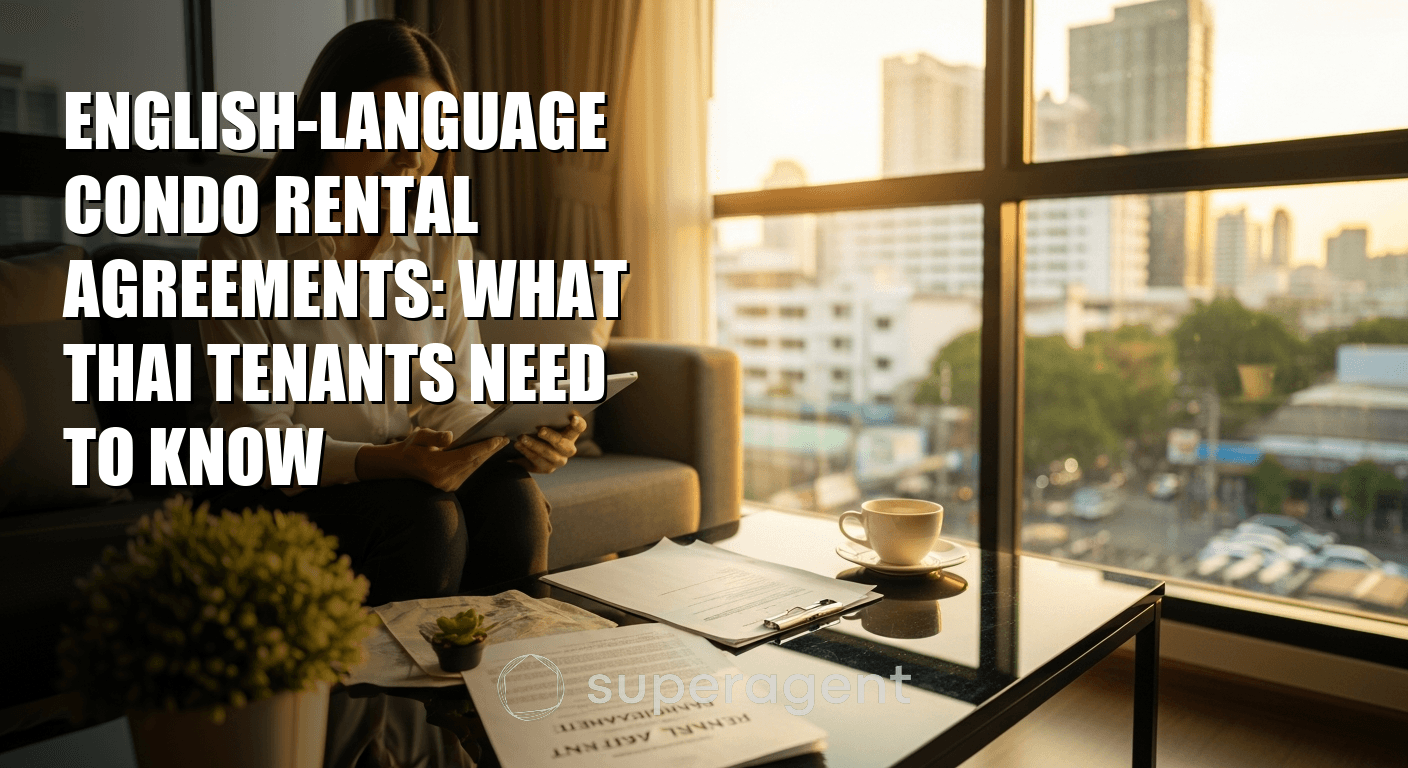
English-Language Condo Rental Agreements: What Thai Tenants Need to Know
Guides
English-Language Condo Rental Agreements: What Thai Tenants Need to Know
Essential tips for Thai renters signing English condo leases in Bangkok
Summary
Thai tenants signing English condo rental agreements need legal protection. Learn key contract terms, clauses to watch, and safety tips for renting condos
You've found a condo in Bangkok you love. The price is right, the location is perfect, and you're ready to sign. Then you see the lease agreement, and it's in English. Your Thai is decent for ordering khao soi at Soi 38, but legal documents? That's a different story. This is where a lot of expats and Thai renters trip up, and honestly, it's a mistake that can cost you thousands of baht and months of headache.
English-language condo rental agreements in Bangkok aren't standardized. Some are fair. Some are written to protect the landlord so heavily that you'll wonder if you're renting a condo or signing away your firstborn. The problem is worse because many renters, especially expats new to Bangkok, don't know what to look for. They see standard clauses in other countries and assume they work the same way here. They don't.
Let me walk you through what you actually need to know about English-language condo leases in Bangkok, what red flags should make you nervous, and how to protect yourself.
Why English Leases Matter in Bangkok's Rental Market
Bangkok's condo market has exploded over the last decade. According to DDproperty, there are over 500,000 condominiums registered in Bangkok, and a huge chunk of them are rented by international tenants. From Phrom Phong to Thonglor to Rama IX, English-language leases have become the norm, not the exception.
The issue is that English agreements often mix Thai law, International standards, and whatever the landlord's lawyer decided to throw in. You end up with a frankenstein document that nobody fully understands. I've seen English leases in Ekkamai that literally contradict Thai tenant law, and the renters had no idea until they tried to break the lease.
If you're signing in English, you're accepting a version of the agreement that might not align with what Thai law actually allows. And here's the kicker, most disputes end up in Thai courts anyway, which follow Thai law, not the English translation you signed.
Deposit and Damage Clauses, Where Most Tenants Get Burned
The deposit section is where landlords slip in terms that would never fly in Western countries. I know renters in Ari who lost their full deposit because the English lease defined normal wear and tear so narrowly that even light scratches counted as damage.
Here's what to watch for. The lease should specify exactly what the deposit covers. Ideally, it says something like "damages beyond normal wear and tear." But a lot of English agreements use vague language like "any damage to the unit" or "the property must be returned in perfect condition." That's a trap. A scratch on a door, a small hole from a nail, a faded paint spot from sun exposure, those are normal, but under a badly written lease, the landlord can claim you owe money.
In Bangkok's current rental market, security deposits typically run 30,000 to 50,000 THB for a one-bedroom in mid-range buildings like those near BTS Phrom Phong or MRT Rama IX. The English lease should itemize what counts as damage and provide a timeline for returning the deposit, usually within 15 to 30 days of move-out. If the lease doesn't mention a deadline, you could be waiting months.
Another common clause that catches people off guard is when the lease says the landlord can withhold the deposit for "future damage" or "potential repairs." That's not legitimate, and it's not how Thai law works. Thai rental law assumes deposits are returned unless there's documented, agreed-upon damage.
Repair and Maintenance Responsibilities, They're Not What You Think
Most English leases in Bangkok dump maintenance and repair costs on the tenant. That sounds normal until you realize it includes things that should be the building's responsibility. I rented a two-bed in Sukhumvit near the BTS Nana line where the English lease made me responsible for air conditioning repair. The AC unit broke after two years, and the landlord wanted me to pay 8,000 baht for the repair. I fought it, and we eventually split the cost, but I shouldn't have had to negotiate.
Thai law actually protects tenants here. Unless the damage was caused by your negligence or misuse, the landlord is supposed to fix major systems like AC, plumbing, and electrical. But an English lease can override that if you're not careful. Look for clauses that specify what you're responsible for and what's the landlord's job. If the lease says you're responsible for "all repairs and maintenance," that's too broad. Push back and get specifics in writing.
The same goes for utility damage. If a pipe bursts or the water heater fails, that's not your fault and shouldn't be your bill. Make sure the English lease clearly states that structural, plumbing, and electrical systems are the landlord's responsibility.
Early Termination and Penalty Clauses That Can Trap You
This is probably the most important section. Bangkok is transient, expats move constantly. Your company relocates you, a family emergency happens, you get a better job offer in Singapore. You need to break your lease. Then you read the termination clause in your English agreement, and it says you owe three months' rent as a penalty, or you forfeit your deposit, or you have to find your own replacement tenant.
Some of these clauses are unenforceable under Thai law, but that's a problem because you have to hire a lawyer to prove it. I know someone who broke a two-year lease early in Thonglor and got hit with a 60,000 THB penalty even though they gave two months' notice. The English lease didn't specify that early termination was an option, so the landlord claimed they had no choice but to penalize.
What you actually want is a clause that allows early termination with reasonable notice, usually 30 to 60 days, with maybe a small penalty like forfeiting one month's rent. Anything more than that is landlord-heavy. If the lease doesn't mention early termination at all, assume the landlord will try to enforce the full contract.
Also check if the lease specifies what happens if you break it. Some agreements say you lose your deposit. Others say you owe rent for the full term. Some say the landlord will try to re-rent and you're only liable for the difference. The English lease should be crystal clear on this, or you're signing a blank check.
Tenant Responsibilities You Might Not Expect
English-language leases often include clauses that feel standard but are actually weighted toward the landlord in ways that Thai renters don't realize. One that pops up constantly is insurance. Some English agreements require the tenant to carry renter's insurance, something that's not common in Thailand and isn't legally required. It's nice protection to have, but it shouldn't be mandatory unless you're signing with a foreign landlord or managing company.
Another sneaky clause is access. The English lease might say the landlord or their agent can enter the unit "for inspections, repairs, or maintenance" with minimal notice, sometimes 24 hours or less. In Thailand, landlords have entry rights, but they're supposed to be reasonable. A clause that allows entry anytime for any reason gives the landlord too much power. Push for at least 24 to 48 hours' written notice and specify that entry can only happen for legitimate purposes.
I also see clauses about subletting and guests that are unreasonably restrictive. Some English leases say you can't sublet without written permission, which is normal, but then they make getting permission nearly impossible. Others limit the number of guests or charge extra for long-term guests. These might violate Thai law, which generally gives tenants more flexibility.
Price Increases and Lease Renewal, Read the Fine Print
Bangkok's rental market has been relatively stable, with average one-bedroom rents in popular expat areas like Ekkamai ranging from 22,000 to 35,000 THB per month depending on the building and amenities. But if you're signing a multi-year lease, what happens when it renews or expires? The English agreement should specify how rent increases are handled.
Some leases say rent increases annually by a fixed percentage, typically 3 to 5 percent. Others say the landlord can increase it "at fair market rate" or "as agreed," which gives them room to jack up the price significantly. I know someone in Rama IX who signed a two-year lease with no increase clause specified. When the lease was up, the landlord wanted an additional 3,000 baht per month, a 12 percent jump. They had to renegotiate because the lease didn't protect either side.
Look for a clause that either caps the annual increase, specifies it's tied to inflation, or requires mutual agreement for any changes. If the English lease has a huge blank space where the increase percentage should go, that's a red flag. Don't sign it.
Comparison of Common English Lease Terms in Bangkok
- Deposit Return: Returned within 15 days, itemized deductions allowed | Returned "at landlord's discretion," no timeline | Get 30 days max, require written itemization of any deductions
- Early Termination: 60 days notice, one month penalty | Full lease term penalty or no termination allowed | Push for 60-day notice with maximum one month's rent penalty
- Repairs: Landlord covers all structural and major systems | Tenant responsible for all repairs including AC, plumbing | Specify landlord covers AC, plumbing, electrical, structural items
- Rent Increase: Max 3-5% annually or capped at inflation | Unlimited increase or vague "fair market rate" | Cap increases at 3-5% or require mutual written agreement
- Landlord Entry: 48 hours' written notice for legitimate reasons only | 24 hours notice or no notice required, any reason | Require 48 hours notice and specify reasons: repairs, inspections only
- Guest Policy: Reasonable guests and short-term stays allowed | Restrictions on visitors, charges for guests | Ensure lease doesn't restrict normal guest use of the condo
How Thai Law Protects You, Even If Your Lease Is in English
Here's the thing that a lot of renters don't know. Even if you sign an English lease, Thai law still applies if a dispute ends up in court. There's a section of Thai law, the Land Code and the Rent Act, that covers residential tenancies. Some terms in an English lease might be void if they contradict Thai law, but you have to be able to prove it, and that costs money.
For example, Thai law says you're entitled to notice before the landlord enters your unit. If your English lease says the landlord can come in whenever they want, that clause might be unenforceable. But if you end up in a dispute, you'll have to hire a lawyer to argue that point. It's better to get the lease right before you sign.
According to the Thai Land Department, landlords in Thailand must provide habitable units and maintain essential services. That includes working water, electricity, and structural integrity. If an English lease tries to make you responsible for things that Thai law says are the landlord's job, those clauses might not hold up, but again, you have to fight it out in court.
Red Flags That Should Make You Walk Away
Some English leases are just bad, and you should reject them outright. If the lease says the landlord can evict you without notice, that's not legal in Thailand. If it says you're responsible for damages "caused by any means whatsoever," that's too broad. If it gives the landlord unlimited rights to increase rent, that's a trap. If the deposit forfeiture clause is poorly defined, if there's no mention of how long the lease is or what the exact rent is, those are all deal-breakers.
Also watch out for leases written in awkward English that doesn't match Thai rental customs. Some are translated badly from Thai, and the translation loses legal meaning. Others are clearly copied from Western templates that don't apply to Thai law. If something in the English lease feels off or seems to contradict normal practice in Bangkok, ask questions. Don't assume it's standard.
What To Do Before You Sign
First, read the entire English lease carefully, even the boring parts. Take your time. If something is unclear, ask the landlord or their agent to explain it. Get the explanation in writing, ideally as an amendment to the lease. Second, compare it to the sample lease structure I've outlined here. Does it have reasonable termination clauses, deposit return timelines, and repair responsibilities? Third, if you're paying more than 40,000 baht per month or signing a long-term lease, consider having a Thai lawyer review it. It costs maybe 2,000 to 5,000 baht, and it can save you tens of thousands later.
Take screenshots of the English lease before you sign it. Keep a copy on your phone, email, and cloud storage. If there's a dispute later, you want proof of what the original agreement said. Also, ask if there's a Thai version of the lease. If there is, request it and compare the two. Sometimes the Thai version has different terms because it was written to comply with Thai law. If they don't match, that's a huge red flag.
The Bangkok rental market moves fast. You find a place, you like it, and you want to move in quickly. But signing a bad English lease can trap you for years. Take the extra hour to read it carefully and negotiate the terms you don't like. Most Bangkok landlords are willing to adjust things if you ask politely and professionally.
If you're hunting for a condo in Bangkok and want to avoid this headache entirely, Superagent.co can help you find places with transparent, clear rental terms. We work with verified landlords who understand the Bangkok market and can explain their leases clearly. Start your search today and save yourself the stress.
You've found a condo in Bangkok you love. The price is right, the location is perfect, and you're ready to sign. Then you see the lease agreement, and it's in English. Your Thai is decent for ordering khao soi at Soi 38, but legal documents? That's a different story. This is where a lot of expats and Thai renters trip up, and honestly, it's a mistake that can cost you thousands of baht and months of headache.
English-language condo rental agreements in Bangkok aren't standardized. Some are fair. Some are written to protect the landlord so heavily that you'll wonder if you're renting a condo or signing away your firstborn. The problem is worse because many renters, especially expats new to Bangkok, don't know what to look for. They see standard clauses in other countries and assume they work the same way here. They don't.
Let me walk you through what you actually need to know about English-language condo leases in Bangkok, what red flags should make you nervous, and how to protect yourself.
Why English Leases Matter in Bangkok's Rental Market
Bangkok's condo market has exploded over the last decade. According to DDproperty, there are over 500,000 condominiums registered in Bangkok, and a huge chunk of them are rented by international tenants. From Phrom Phong to Thonglor to Rama IX, English-language leases have become the norm, not the exception.
The issue is that English agreements often mix Thai law, International standards, and whatever the landlord's lawyer decided to throw in. You end up with a frankenstein document that nobody fully understands. I've seen English leases in Ekkamai that literally contradict Thai tenant law, and the renters had no idea until they tried to break the lease.
If you're signing in English, you're accepting a version of the agreement that might not align with what Thai law actually allows. And here's the kicker, most disputes end up in Thai courts anyway, which follow Thai law, not the English translation you signed.
Deposit and Damage Clauses, Where Most Tenants Get Burned
The deposit section is where landlords slip in terms that would never fly in Western countries. I know renters in Ari who lost their full deposit because the English lease defined normal wear and tear so narrowly that even light scratches counted as damage.
Here's what to watch for. The lease should specify exactly what the deposit covers. Ideally, it says something like "damages beyond normal wear and tear." But a lot of English agreements use vague language like "any damage to the unit" or "the property must be returned in perfect condition." That's a trap. A scratch on a door, a small hole from a nail, a faded paint spot from sun exposure, those are normal, but under a badly written lease, the landlord can claim you owe money.
In Bangkok's current rental market, security deposits typically run 30,000 to 50,000 THB for a one-bedroom in mid-range buildings like those near BTS Phrom Phong or MRT Rama IX. The English lease should itemize what counts as damage and provide a timeline for returning the deposit, usually within 15 to 30 days of move-out. If the lease doesn't mention a deadline, you could be waiting months.
Another common clause that catches people off guard is when the lease says the landlord can withhold the deposit for "future damage" or "potential repairs." That's not legitimate, and it's not how Thai law works. Thai rental law assumes deposits are returned unless there's documented, agreed-upon damage.
Repair and Maintenance Responsibilities, They're Not What You Think
Most English leases in Bangkok dump maintenance and repair costs on the tenant. That sounds normal until you realize it includes things that should be the building's responsibility. I rented a two-bed in Sukhumvit near the BTS Nana line where the English lease made me responsible for air conditioning repair. The AC unit broke after two years, and the landlord wanted me to pay 8,000 baht for the repair. I fought it, and we eventually split the cost, but I shouldn't have had to negotiate.
Thai law actually protects tenants here. Unless the damage was caused by your negligence or misuse, the landlord is supposed to fix major systems like AC, plumbing, and electrical. But an English lease can override that if you're not careful. Look for clauses that specify what you're responsible for and what's the landlord's job. If the lease says you're responsible for "all repairs and maintenance," that's too broad. Push back and get specifics in writing.
The same goes for utility damage. If a pipe bursts or the water heater fails, that's not your fault and shouldn't be your bill. Make sure the English lease clearly states that structural, plumbing, and electrical systems are the landlord's responsibility.
Early Termination and Penalty Clauses That Can Trap You
This is probably the most important section. Bangkok is transient, expats move constantly. Your company relocates you, a family emergency happens, you get a better job offer in Singapore. You need to break your lease. Then you read the termination clause in your English agreement, and it says you owe three months' rent as a penalty, or you forfeit your deposit, or you have to find your own replacement tenant.
Some of these clauses are unenforceable under Thai law, but that's a problem because you have to hire a lawyer to prove it. I know someone who broke a two-year lease early in Thonglor and got hit with a 60,000 THB penalty even though they gave two months' notice. The English lease didn't specify that early termination was an option, so the landlord claimed they had no choice but to penalize.
What you actually want is a clause that allows early termination with reasonable notice, usually 30 to 60 days, with maybe a small penalty like forfeiting one month's rent. Anything more than that is landlord-heavy. If the lease doesn't mention early termination at all, assume the landlord will try to enforce the full contract.
Also check if the lease specifies what happens if you break it. Some agreements say you lose your deposit. Others say you owe rent for the full term. Some say the landlord will try to re-rent and you're only liable for the difference. The English lease should be crystal clear on this, or you're signing a blank check.
Tenant Responsibilities You Might Not Expect
English-language leases often include clauses that feel standard but are actually weighted toward the landlord in ways that Thai renters don't realize. One that pops up constantly is insurance. Some English agreements require the tenant to carry renter's insurance, something that's not common in Thailand and isn't legally required. It's nice protection to have, but it shouldn't be mandatory unless you're signing with a foreign landlord or managing company.
Another sneaky clause is access. The English lease might say the landlord or their agent can enter the unit "for inspections, repairs, or maintenance" with minimal notice, sometimes 24 hours or less. In Thailand, landlords have entry rights, but they're supposed to be reasonable. A clause that allows entry anytime for any reason gives the landlord too much power. Push for at least 24 to 48 hours' written notice and specify that entry can only happen for legitimate purposes.
I also see clauses about subletting and guests that are unreasonably restrictive. Some English leases say you can't sublet without written permission, which is normal, but then they make getting permission nearly impossible. Others limit the number of guests or charge extra for long-term guests. These might violate Thai law, which generally gives tenants more flexibility.
Price Increases and Lease Renewal, Read the Fine Print
Bangkok's rental market has been relatively stable, with average one-bedroom rents in popular expat areas like Ekkamai ranging from 22,000 to 35,000 THB per month depending on the building and amenities. But if you're signing a multi-year lease, what happens when it renews or expires? The English agreement should specify how rent increases are handled.
Some leases say rent increases annually by a fixed percentage, typically 3 to 5 percent. Others say the landlord can increase it "at fair market rate" or "as agreed," which gives them room to jack up the price significantly. I know someone in Rama IX who signed a two-year lease with no increase clause specified. When the lease was up, the landlord wanted an additional 3,000 baht per month, a 12 percent jump. They had to renegotiate because the lease didn't protect either side.
Talk to us about renting
Share your details and keep reading — we’ll get back to you.
Look for a clause that either caps the annual increase, specifies it's tied to inflation, or requires mutual agreement for any changes. If the English lease has a huge blank space where the increase percentage should go, that's a red flag. Don't sign it.
Comparison of Common English Lease Terms in Bangkok
- Deposit Return: Returned within 15 days, itemized deductions allowed | Returned "at landlord's discretion," no timeline | Get 30 days max, require written itemization of any deductions
- Early Termination: 60 days notice, one month penalty | Full lease term penalty or no termination allowed | Push for 60-day notice with maximum one month's rent penalty
- Repairs: Landlord covers all structural and major systems | Tenant responsible for all repairs including AC, plumbing | Specify landlord covers AC, plumbing, electrical, structural items
- Rent Increase: Max 3-5% annually or capped at inflation | Unlimited increase or vague "fair market rate" | Cap increases at 3-5% or require mutual written agreement
- Landlord Entry: 48 hours' written notice for legitimate reasons only | 24 hours notice or no notice required, any reason | Require 48 hours notice and specify reasons: repairs, inspections only
- Guest Policy: Reasonable guests and short-term stays allowed | Restrictions on visitors, charges for guests | Ensure lease doesn't restrict normal guest use of the condo
How Thai Law Protects You, Even If Your Lease Is in English
Here's the thing that a lot of renters don't know. Even if you sign an English lease, Thai law still applies if a dispute ends up in court. There's a section of Thai law, the Land Code and the Rent Act, that covers residential tenancies. Some terms in an English lease might be void if they contradict Thai law, but you have to be able to prove it, and that costs money.
For example, Thai law says you're entitled to notice before the landlord enters your unit. If your English lease says the landlord can come in whenever they want, that clause might be unenforceable. But if you end up in a dispute, you'll have to hire a lawyer to argue that point. It's better to get the lease right before you sign.
According to the Thai Land Department, landlords in Thailand must provide habitable units and maintain essential services. That includes working water, electricity, and structural integrity. If an English lease tries to make you responsible for things that Thai law says are the landlord's job, those clauses might not hold up, but again, you have to fight it out in court.
Red Flags That Should Make You Walk Away
Some English leases are just bad, and you should reject them outright. If the lease says the landlord can evict you without notice, that's not legal in Thailand. If it says you're responsible for damages "caused by any means whatsoever," that's too broad. If it gives the landlord unlimited rights to increase rent, that's a trap. If the deposit forfeiture clause is poorly defined, if there's no mention of how long the lease is or what the exact rent is, those are all deal-breakers.
Also watch out for leases written in awkward English that doesn't match Thai rental customs. Some are translated badly from Thai, and the translation loses legal meaning. Others are clearly copied from Western templates that don't apply to Thai law. If something in the English lease feels off or seems to contradict normal practice in Bangkok, ask questions. Don't assume it's standard.
What To Do Before You Sign
First, read the entire English lease carefully, even the boring parts. Take your time. If something is unclear, ask the landlord or their agent to explain it. Get the explanation in writing, ideally as an amendment to the lease. Second, compare it to the sample lease structure I've outlined here. Does it have reasonable termination clauses, deposit return timelines, and repair responsibilities? Third, if you're paying more than 40,000 baht per month or signing a long-term lease, consider having a Thai lawyer review it. It costs maybe 2,000 to 5,000 baht, and it can save you tens of thousands later.
Take screenshots of the English lease before you sign it. Keep a copy on your phone, email, and cloud storage. If there's a dispute later, you want proof of what the original agreement said. Also, ask if there's a Thai version of the lease. If there is, request it and compare the two. Sometimes the Thai version has different terms because it was written to comply with Thai law. If they don't match, that's a huge red flag.
The Bangkok rental market moves fast. You find a place, you like it, and you want to move in quickly. But signing a bad English lease can trap you for years. Take the extra hour to read it carefully and negotiate the terms you don't like. Most Bangkok landlords are willing to adjust things if you ask politely and professionally.
If you're hunting for a condo in Bangkok and want to avoid this headache entirely, Superagent.co can help you find places with transparent, clear rental terms. We work with verified landlords who understand the Bangkok market and can explain their leases clearly. Start your search today and save yourself the stress.
Share this article
Properties you may like
![[For Rent] CONDO I Aguston Sukhumvit 22 I Pet Friendly I 2 Beds I 2 Baths I Rent 55,000THB/mo](/_next/image?url=https%3A%2F%2Fstorage.googleapis.com%2Fsuperagent-web%2Fattachments%2Flistings%2F2266%2Fd3afcd25-6b79-46cb-9f1f-396acdc3dd10-955-3.jpg&w=3840&q=75)
฿55,000
2 Bed295 sqm
[For Rent] CONDO I Aguston Sukhumvit 22 I Pet Friendly I 2 Beds I 2 Baths I Rent 55,000THB/mo
Phrom Phong
Condo![[For Rent] CONDO I SUPALAI PLACE Sukhumvit 39 I 2 Beds I 2 Baths (1 Jacuzzi) I 55,555THB/mo](/_next/image?url=https%3A%2F%2Fstorage.googleapis.com%2Fsuperagent-web%2Fattachments%2Flistings%2F6743%2Fba530743-48b9-4ac6-92d3-c2247e743cf6-01-supalai-place-skv39-2b-link-heaven.jpg&w=3840&q=75)
฿55,555
2 Bed2142 sqm
[For Rent] CONDO I SUPALAI PLACE Sukhumvit 39 I 2 Beds I 2 Baths (1 Jacuzzi) I 55,555THB/mo
Phrom Phong
Condo![[For Rent] CONDO I Maru Ekkamai 2 I Pet friendly I 2 Beds I 2 Baths I 68,000 THB/mo](/_next/image?url=https%3A%2F%2Fstorage.googleapis.com%2Fsuperagent-web%2Fattachments%2Flistings%2F6602%2F9f1d8f71-ee43-435f-9a44-da16c4092c92-968-1.jpg&w=3840&q=75)
฿68,000
2 Bed360 sqm
[For Rent] CONDO I Maru Ekkamai 2 I Pet friendly I 2 Beds I 2 Baths I 68,000 THB/mo
Ekkamai
Condo![[For Rent] CONDO I Noble State 39 I 2 Beds I 2 Baths I 63,000THB/mo](/_next/image?url=https%3A%2F%2Fstorage.googleapis.com%2Fsuperagent-web%2Fattachments%2Flistings%2F2237%2F60eb58f3-eae5-41ed-a80b-406e004f05d8-940-1.jpg&w=3840&q=75)
฿63,000
2 Bed260 sqm
[For Rent] CONDO I Noble State 39 I 2 Beds I 2 Baths I 63,000THB/mo
Phrom Phong
Condo![[For Rent] CONDO I Rhythm Sukhumvit 36-38 I 2 Beds I 2 Baths I 38,999THB/mo](/_next/image?url=https%3A%2F%2Fstorage.googleapis.com%2Fsuperagent-web%2Fattachments%2Flistings%2F1788%2F942a0215-4128-4c2c-a064-f607e84e7aa4-656-2.jpg&w=3840&q=75)
฿38,999
2 Bed256 sqm
[For Rent] CONDO I Rhythm Sukhumvit 36-38 I 2 Beds I 2 Baths I 38,999THB/mo
Thonglor
Condo![[For Rent] CONDO I CLOUD Thonglor-Phetchaburi I 1 Bed I 1 Bath I 22,500THB/mo](/_next/image?url=https%3A%2F%2Fstorage.googleapis.com%2Fsuperagent-web%2Fattachments%2Flistings%2F6742%2F6cef5361-0dac-4dba-98f1-b0d187559c84-1118-1.jpg&w=3840&q=75)
฿22,500
1 Bed132 sqm
[For Rent] CONDO I CLOUD Thonglor-Phetchaburi I 1 Bed I 1 Bath I 22,500THB/mo
Thonglor
Condo![[For Rent] CONDO I City Smart Sukhumvit 18 I 3 Beds I 3 Baths I 65,000mo/THB](/_next/image?url=https%3A%2F%2Fstorage.googleapis.com%2Fsuperagent-web%2Fattachments%2Flistings%2F6741%2Fd371c89d-a913-42c4-a673-e540afae4f46-1116-1.jpg&w=3840&q=75)
฿65,000
3 Bed3125 sqm
[For Rent] CONDO I City Smart Sukhumvit 18 I 3 Beds I 3 Baths I 65,000mo/THB
Condo![[For Rent] CONDO I The Coast Bangkok I 1 Bed I 1 Bath I 20,000mo/THB](/_next/image?url=https%3A%2F%2Fstorage.googleapis.com%2Fsuperagent-web%2Fattachments%2Flistings%2F6740%2F498477ce-4ffa-4e4c-ab08-0e565d9c4bbe-1115-3.jpg&w=3840&q=75)
฿20,000
1 Bed146 sqm
[For Rent] CONDO I The Coast Bangkok I 1 Bed I 1 Bath I 20,000mo/THB
Bang Na
Condo![[For Rent] CONDO I IDEO Sukhumvit-RAMA 4 I 2 Beds I 2 Baths I 55,000mo/THB](/_next/image?url=https%3A%2F%2Fstorage.googleapis.com%2Fsuperagent-web%2Fattachments%2Flistings%2F6739%2F15df221d-5b8e-497c-b7ce-a6b9b6412cab-1113-1.jpg&w=3840&q=75)
฿55,000
2 Bed265 sqm
[For Rent] CONDO I IDEO Sukhumvit-RAMA 4 I 2 Beds I 2 Baths I 55,000mo/THB
Phra Khanong
Condo![[For Rent] CONDO I Downtown 49 I Pet Friendly I 1 Bed I 1 Bath I 23,000mo/THB](/_next/image?url=https%3A%2F%2Fstorage.googleapis.com%2Fsuperagent-web%2Fattachments%2Flistings%2F6738%2F11cf2ffe-1f01-4ccc-991c-2ad608f1ba73-1112-1.jpg&w=3840&q=75)
฿23,000
1 Bed135 sqm
[For Rent] CONDO I Downtown 49 I Pet Friendly I 1 Bed I 1 Bath I 23,000mo/THB
Thonglor
CondoMore like this
 In Guides · Superagent EditorialHidden Costs of Renting a Condo in Bangkok Nobody Warns You AboutBangkok condo rent looks affordable until month one hits. Here are the real costs beyond the headline figure that catch most renters off guard.25 May 20261 min read
 In Guides · Superagent EditorialWhat a Long-Vacant Bangkok Condo Unit Is Actually Telling YouA Bangkok condo vacant for months signals overpricing, landlord issues, or real problems. Here is how to read the signs.25 May 20261 min read
 In Guides · Superagent EditorialRed Flags in a Bangkok Rental Contract to Watch Out ForBangkok rental contracts often hide risky clauses. Here are the red flags every tenant must catch before signing any lease.25 May 20261 min read
 In Guides · Superagent EditorialWorking Online from a Condo: How to Choose the Perfect Room for ProductivityLearn how to choose the best condo room for working online with tips on lighting, noise, and furniture setup to maximize productivity.9 May 20261 min read