How to File a Complaint Against Your Bangkok Landlord: Steps and Authorities
Guides
How to File a Complaint Against Your Bangkok Landlord: Steps and Authorities
Protect your rights as a renter with this complete guide to filing complaints against exploitative landlords.
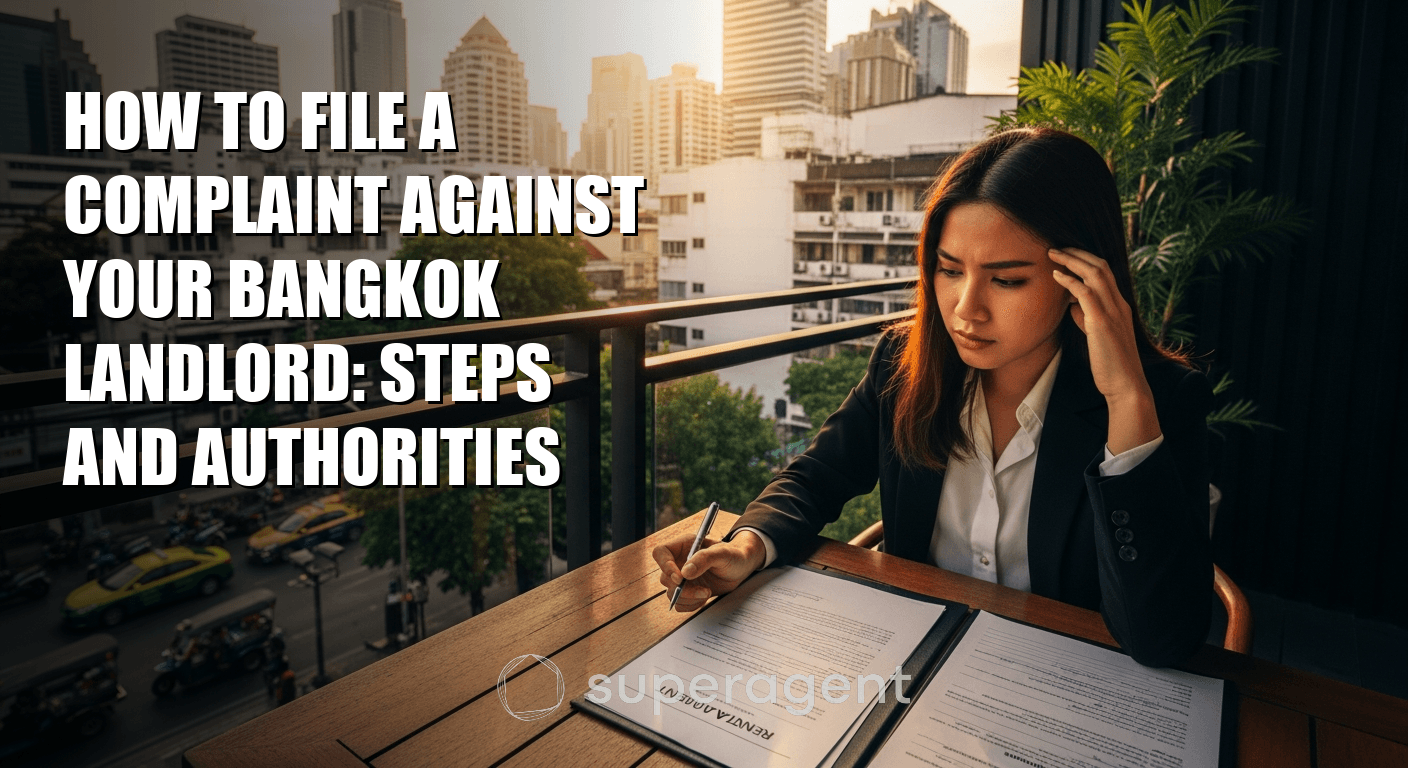
Summary
Learn how to file a rental house complaint in Bangkok with our comprehensive guide covering legal steps, required documents, and responsible authorities to
You signed a contract, paid your deposit, and moved into that nice condo in Thonglor. Three months in, your landlord keeps your security deposit because of "wear and tear" on walls you never touched. Or worse, you discover your unit has a mold problem and your landlord refuses to fix it, while still demanding full rent. Welcome to Bangkok's rental disputes, and if you're reading this, you probably need to know how to file a complaint against an unfair landlord.
The good news? Thailand's rental laws actually protect tenants more than you might think. The problem is most renters don't know where to start. This guide walks you through exactly what to do when a landlord crosses the line, which agencies will actually listen to you, and how to document everything so you have a real case.
When You Have a Legal Claim Against Your Landlord
Not every landlord drama qualifies as a legal violation. But certain behaviors absolutely do. First, understand that Thailand's Hire of Immovable Property Act 2542 (1999) sets clear rules for what landlords can and cannot do.
Your landlord cannot arbitrarily keep your deposit without itemized, documented proof of damage you caused. If you lived in a 1-bedroom condo in Asok near the Sukhumvit MRT for 12 months and paid 28,000 THB monthly, your landlord cannot claim 3,000 THB in damages for a faded wall when you move out. The burden of proof is on them, and the damage must be beyond normal wear and tear.
Your landlord cannot refuse to maintain the property. If the air conditioning stops working, the hot water pipes freeze up, or there is structural damage like a leaking ceiling, these are landlord obligations. You have the right to request repairs in writing. If ignored beyond a reasonable timeframe, you can reduce rent or break the lease legally.
Your landlord cannot enter your unit without notice or proper cause. Thai law requires landlords to give advance notice (typically 24 hours) except in emergencies. A landlord showing up with a key to "check on things" without your permission is a violation of your right to quiet enjoyment of the property.
Your landlord cannot charge hidden fees not in your signed contract. Maintenance charges, key replacement fees, or late-payment penalties must all be explicitly written in the lease. If you signed a contract stating 25,000 THB for a 1-bed unit in Phrom Phong with no additional fees, that is what you owe, period.
Step 1: Document Everything in Writing
Before you file any complaint, you need evidence. This is the most critical step and many renters skip it. Start documenting immediately once a problem arises.
Take photos and videos of the issue. If your landlord refuses to fix a broken air conditioning unit in your Ekamai condo, photograph the unit, the thermostat showing it is not cooling, the date, and the time. If there is water damage, photograph it from multiple angles with your phone's timestamp visible. Store these files in the cloud, not just on your phone.
Send written requests via email or Line (or both). Do not rely on verbal conversations. Email your landlord or property manager saying something like: "I am writing to formally request repair of the air conditioning unit in unit 1005. The unit has not been cooling since January 15, 2024. This is a maintenance issue under our lease agreement. Please confirm receipt and provide an estimated repair date." Keep this email professional and factual.
Save all responses, or the lack of them. If your landlord ignores your repair request for two weeks, that documented silence is powerful evidence. If they respond dismissively in a Line message, screenshot it with the timestamp visible.
Step 2: File a Complaint With the Land Department
The Land Department (Department of Lands) is Thailand's primary agency for rental disputes. This is your first official move.
The Land Department has a dedicated Rental Dispute Resolution Center. You can file a complaint at any Land Department office, including the main office in Chatuchak or regional offices near Phaya Thai MRT, Lumphini, or your district office. According to the Department of Lands official website, they handle complaints for free or at minimal cost.
Bring your original lease contract, a copy of your passport (or Thai ID if you have one), your documented evidence (photos, emails, video), and a written summary of your complaint. Include dates, amounts, and specific violations. Write this summary in English or Thai, depending on which you are comfortable with. The Land Department has English-speaking staff in Bangkok.
The process typically works like this: you file the complaint, the Land Department contacts your landlord and invites both of you to a mediation session. This mediation is free and non-binding. Many disputes are resolved here without escalation. If mediation fails, the Land Department can refer the case to the Property Courts.
Expect the process to take 1 to 2 months for mediation and longer if it reaches court. This is not quick, but it is official and it creates a paper trail that matters if you need to pursue legal action later.
Step 3: Contact Your Local District Office or Community Leaders
If you want a faster, more informal resolution, try the Tambon (subdistrict) office first. These offices exist in every neighborhood and they have community liaisons who help with tenant complaints.
For example, if you rent in Soi 39 Sukhumvit (near Phrom Phong BTS), you would go to the Watthana District Office. They have a community mediation desk that handles small rental disputes. This approach works best for disputes under 50,000 THB and can be resolved in days rather than weeks.
Bring the same documentation: your lease, evidence, and a written summary. The district officer will contact your landlord and try to broker a settlement. Because these offices represent local authority and the meeting is formal, landlords often cooperate quickly.
Some buildings also have community committees or condo committees. If your unit is in a managed condominium, the condo committee can sometimes pressure a landlord to comply with legal obligations, especially regarding maintenance and repair. Check your condo's bylaws or ask at the management office whether they mediate tenant-landlord disputes.
Step 4: Escalate to the Consumer Protection Board or Small Claims Court
If informal mediation fails and your claim is under 100,000 THB, the Small Claims Court or Consumer Protection Board might be your best path. These courts are faster and cheaper than regular civil court.
The Consumer Protection Board handles disputes over consumer goods and services, which sometimes includes rental disputes. You can file a complaint online or in person at their office. The filing fee is minimal (around 100 to 500 THB) and they review complaints for free. Visit their website or call their hotline for Bangkok.
Small Claims Court in Bangkok handles monetary disputes under 100,000 THB. The cases move faster than civil court and you do not need a lawyer. You file at the Small Claims Court division nearest your location. Bring all your documentation, your lease, and evidence. The judge will hear both sides and issue a ruling. Expect this process to take 2 to 3 months.
Step 5: Hire a Lawyer if You Need to Sue
If your dispute involves large sums, complex contract violations, or you need someone to represent you in civil court, you will need a lawyer. Many law firms in Bangkok specialize in tenant rights and property disputes.
Before hiring, interview at least two lawyers and understand their fee structure. Some work on a flat fee basis (3,000 to 10,000 THB for document review and advice), others take contingency, and some charge hourly rates (1,500 to 3,000 THB per hour for Bangkok-based lawyers). A lawyer can strengthen your case significantly by pointing out violations you might miss.
A lawyer familiar with Thai rental law can also draft a formal cease-and-desist letter on their letterhead, which often motivates landlords to settle. Many disputes end once a landlord realizes you are serious enough to hire legal representation.
Comparison of Complaint Channels
- Land Department Mediation: Free to 500 THB | 4 to 8 weeks | All dispute types, official process
- District Office: Free | 1 to 2 weeks | Disputes under 50,000 THB, quick resolution
- Small Claims Court: 100 to 1,000 THB filing | 2 to 3 months | Monetary claims under 100,000 THB
- Civil Court: Filing fees plus lawyer costs | 6 months to 2 years | Complex cases, large amounts, or when other channels fail
- Private Lawyer Consultation: 3,000 to 15,000 THB initial | Varies by case | Advice, cease-and-desist letters, strategy
Practical Tips From Bangkok Renters Who Have Won Disputes
Stay calm and keep communication professional. Even when your landlord is frustrating, every message you send (email, Line, letter) is evidence. Emotional outbursts weaken your case. Stick to facts: dates, amounts, specific actions, documented responses.
Never stop paying rent unless a court orders it. Even if your landlord is in violation, stopping rent gives them grounds to evict you. Instead, file a complaint and continue paying. If you win your case, back rent or repair costs can be awarded as damages.
Know that Thai courts and mediation offices favor documented evidence over hearsay. One clear email requesting a repair beats ten stories about how your landlord ignored you verbally. Every request, every response, every photograph matters.
Understand that average rent in popular Bangkok neighborhoods like Sukhumvit (Asok, Phrom Phong, Ekamai) typically ranges from 25,000 to 45,000 THB monthly for 1-bedroom units. If you are in a dispute over a deposit on a 30,000 THB/month unit, the cost of pursuing it through mediation or court might exceed the amount in question. Consider this calculation when deciding how far to escalate.
When you are ready to move out due to a serious dispute, do a thorough move-out inspection with your landlord or property manager present. Document the condition of the unit with photos and video. Request an itemized list of any deductions in writing within 7 days. This prevents surprise disputes after you leave.
How Superagent Helps You Avoid These Situations
The best dispute is the one you never have. When you search for rentals on Superagent, you gain access to verified landlord information, transparent lease terms, and a supportive community of renters who share their experiences with specific units and owners. Our platform helps you vet properties and landlords before you sign anything, reducing the likelihood that you end up in a legal fight down the road.
Filing a complaint against an unfair landlord is your legal right, but it takes time, documentation, and persistence. Start with the Land Department or your district office for the fastest route to mediation. Gather evidence immediately, communicate in writing, and escalate only when necessary. Bangkok's rental market is competitive, but you have protections under Thai law, and authorities do enforce them. Know your rights, document everything, and you will have a strong position if things go wrong.
You signed a contract, paid your deposit, and moved into that nice condo in Thonglor. Three months in, your landlord keeps your security deposit because of "wear and tear" on walls you never touched. Or worse, you discover your unit has a mold problem and your landlord refuses to fix it, while still demanding full rent. Welcome to Bangkok's rental disputes, and if you're reading this, you probably need to know how to file a complaint against an unfair landlord.
The good news? Thailand's rental laws actually protect tenants more than you might think. The problem is most renters don't know where to start. This guide walks you through exactly what to do when a landlord crosses the line, which agencies will actually listen to you, and how to document everything so you have a real case.
When You Have a Legal Claim Against Your Landlord
Not every landlord drama qualifies as a legal violation. But certain behaviors absolutely do. First, understand that Thailand's Hire of Immovable Property Act 2542 (1999) sets clear rules for what landlords can and cannot do.
Your landlord cannot arbitrarily keep your deposit without itemized, documented proof of damage you caused. If you lived in a 1-bedroom condo in Asok near the Sukhumvit MRT for 12 months and paid 28,000 THB monthly, your landlord cannot claim 3,000 THB in damages for a faded wall when you move out. The burden of proof is on them, and the damage must be beyond normal wear and tear.
Your landlord cannot refuse to maintain the property. If the air conditioning stops working, the hot water pipes freeze up, or there is structural damage like a leaking ceiling, these are landlord obligations. You have the right to request repairs in writing. If ignored beyond a reasonable timeframe, you can reduce rent or break the lease legally.
Your landlord cannot enter your unit without notice or proper cause. Thai law requires landlords to give advance notice (typically 24 hours) except in emergencies. A landlord showing up with a key to "check on things" without your permission is a violation of your right to quiet enjoyment of the property.
Your landlord cannot charge hidden fees not in your signed contract. Maintenance charges, key replacement fees, or late-payment penalties must all be explicitly written in the lease. If you signed a contract stating 25,000 THB for a 1-bed unit in Phrom Phong with no additional fees, that is what you owe, period.
Step 1: Document Everything in Writing
Before you file any complaint, you need evidence. This is the most critical step and many renters skip it. Start documenting immediately once a problem arises.
Take photos and videos of the issue. If your landlord refuses to fix a broken air conditioning unit in your Ekamai condo, photograph the unit, the thermostat showing it is not cooling, the date, and the time. If there is water damage, photograph it from multiple angles with your phone's timestamp visible. Store these files in the cloud, not just on your phone.
Send written requests via email or Line (or both). Do not rely on verbal conversations. Email your landlord or property manager saying something like: "I am writing to formally request repair of the air conditioning unit in unit 1005. The unit has not been cooling since January 15, 2024. This is a maintenance issue under our lease agreement. Please confirm receipt and provide an estimated repair date." Keep this email professional and factual.
Save all responses, or the lack of them. If your landlord ignores your repair request for two weeks, that documented silence is powerful evidence. If they respond dismissively in a Line message, screenshot it with the timestamp visible.
Step 2: File a Complaint With the Land Department
The Land Department (Department of Lands) is Thailand's primary agency for rental disputes. This is your first official move.
The Land Department has a dedicated Rental Dispute Resolution Center. You can file a complaint at any Land Department office, including the main office in Chatuchak or regional offices near Phaya Thai MRT, Lumphini, or your district office. According to the Department of Lands official website, they handle complaints for free or at minimal cost.
Bring your original lease contract, a copy of your passport (or Thai ID if you have one), your documented evidence (photos, emails, video), and a written summary of your complaint. Include dates, amounts, and specific violations. Write this summary in English or Thai, depending on which you are comfortable with. The Land Department has English-speaking staff in Bangkok.
The process typically works like this: you file the complaint, the Land Department contacts your landlord and invites both of you to a mediation session. This mediation is free and non-binding. Many disputes are resolved here without escalation. If mediation fails, the Land Department can refer the case to the Property Courts.
Expect the process to take 1 to 2 months for mediation and longer if it reaches court. This is not quick, but it is official and it creates a paper trail that matters if you need to pursue legal action later.
Step 3: Contact Your Local District Office or Community Leaders
If you want a faster, more informal resolution, try the Tambon (subdistrict) office first. These offices exist in every neighborhood and they have community liaisons who help with tenant complaints.
For example, if you rent in Soi 39 Sukhumvit (near Phrom Phong BTS), you would go to the Watthana District Office. They have a community mediation desk that handles small rental disputes. This approach works best for disputes under 50,000 THB and can be resolved in days rather than weeks.
Bring the same documentation: your lease, evidence, and a written summary. The district officer will contact your landlord and try to broker a settlement. Because these offices represent local authority and the meeting is formal, landlords often cooperate quickly.
Some buildings also have community committees or condo committees. If your unit is in a managed condominium, the condo committee can sometimes pressure a landlord to comply with legal obligations, especially regarding maintenance and repair. Check your condo's bylaws or ask at the management office whether they mediate tenant-landlord disputes.
Step 4: Escalate to the Consumer Protection Board or Small Claims Court
If informal mediation fails and your claim is under 100,000 THB, the Small Claims Court or Consumer Protection Board might be your best path. These courts are faster and cheaper than regular civil court.
The Consumer Protection Board handles disputes over consumer goods and services, which sometimes includes rental disputes. You can file a complaint online or in person at their office. The filing fee is minimal (around 100 to 500 THB) and they review complaints for free. Visit their website or call their hotline for Bangkok.
Talk to us about renting
Share your details and keep reading — we’ll get back to you.
Small Claims Court in Bangkok handles monetary disputes under 100,000 THB. The cases move faster than civil court and you do not need a lawyer. You file at the Small Claims Court division nearest your location. Bring all your documentation, your lease, and evidence. The judge will hear both sides and issue a ruling. Expect this process to take 2 to 3 months.
Step 5: Hire a Lawyer if You Need to Sue
If your dispute involves large sums, complex contract violations, or you need someone to represent you in civil court, you will need a lawyer. Many law firms in Bangkok specialize in tenant rights and property disputes.
Before hiring, interview at least two lawyers and understand their fee structure. Some work on a flat fee basis (3,000 to 10,000 THB for document review and advice), others take contingency, and some charge hourly rates (1,500 to 3,000 THB per hour for Bangkok-based lawyers). A lawyer can strengthen your case significantly by pointing out violations you might miss.
A lawyer familiar with Thai rental law can also draft a formal cease-and-desist letter on their letterhead, which often motivates landlords to settle. Many disputes end once a landlord realizes you are serious enough to hire legal representation.
Comparison of Complaint Channels
- Land Department Mediation: Free to 500 THB | 4 to 8 weeks | All dispute types, official process
- District Office: Free | 1 to 2 weeks | Disputes under 50,000 THB, quick resolution
- Small Claims Court: 100 to 1,000 THB filing | 2 to 3 months | Monetary claims under 100,000 THB
- Civil Court: Filing fees plus lawyer costs | 6 months to 2 years | Complex cases, large amounts, or when other channels fail
- Private Lawyer Consultation: 3,000 to 15,000 THB initial | Varies by case | Advice, cease-and-desist letters, strategy
Practical Tips From Bangkok Renters Who Have Won Disputes
Stay calm and keep communication professional. Even when your landlord is frustrating, every message you send (email, Line, letter) is evidence. Emotional outbursts weaken your case. Stick to facts: dates, amounts, specific actions, documented responses.
Never stop paying rent unless a court orders it. Even if your landlord is in violation, stopping rent gives them grounds to evict you. Instead, file a complaint and continue paying. If you win your case, back rent or repair costs can be awarded as damages.
Know that Thai courts and mediation offices favor documented evidence over hearsay. One clear email requesting a repair beats ten stories about how your landlord ignored you verbally. Every request, every response, every photograph matters.
Understand that average rent in popular Bangkok neighborhoods like Sukhumvit (Asok, Phrom Phong, Ekamai) typically ranges from 25,000 to 45,000 THB monthly for 1-bedroom units. If you are in a dispute over a deposit on a 30,000 THB/month unit, the cost of pursuing it through mediation or court might exceed the amount in question. Consider this calculation when deciding how far to escalate.
When you are ready to move out due to a serious dispute, do a thorough move-out inspection with your landlord or property manager present. Document the condition of the unit with photos and video. Request an itemized list of any deductions in writing within 7 days. This prevents surprise disputes after you leave.
How Superagent Helps You Avoid These Situations
The best dispute is the one you never have. When you search for rentals on Superagent, you gain access to verified landlord information, transparent lease terms, and a supportive community of renters who share their experiences with specific units and owners. Our platform helps you vet properties and landlords before you sign anything, reducing the likelihood that you end up in a legal fight down the road.
Filing a complaint against an unfair landlord is your legal right, but it takes time, documentation, and persistence. Start with the Land Department or your district office for the fastest route to mediation. Gather evidence immediately, communicate in writing, and escalate only when necessary. Bangkok's rental market is competitive, but you have protections under Thai law, and authorities do enforce them. Know your rights, document everything, and you will have a strong position if things go wrong.
Share this article
Properties you may like
![[For Rent] CONDO I Aguston Sukhumvit 22 I Pet Friendly I 2 Beds I 2 Baths I Rent 55,000THB/mo](/_next/image?url=https%3A%2F%2Fstorage.googleapis.com%2Fsuperagent-web%2Fattachments%2Flistings%2F2266%2Fd3afcd25-6b79-46cb-9f1f-396acdc3dd10-955-3.jpg&w=3840&q=75)
฿55,000
2 Bed295 sqm
[For Rent] CONDO I Aguston Sukhumvit 22 I Pet Friendly I 2 Beds I 2 Baths I Rent 55,000THB/mo
Phrom Phong
Condo![[For Rent] CONDO I SUPALAI PLACE Sukhumvit 39 I 2 Beds I 2 Baths (1 Jacuzzi) I 55,555THB/mo](/_next/image?url=https%3A%2F%2Fstorage.googleapis.com%2Fsuperagent-web%2Fattachments%2Flistings%2F6743%2Fba530743-48b9-4ac6-92d3-c2247e743cf6-01-supalai-place-skv39-2b-link-heaven.jpg&w=3840&q=75)
฿55,555
2 Bed2142 sqm
[For Rent] CONDO I SUPALAI PLACE Sukhumvit 39 I 2 Beds I 2 Baths (1 Jacuzzi) I 55,555THB/mo
Phrom Phong
Condo![[For Rent] CONDO I Maru Ekkamai 2 I Pet friendly I 2 Beds I 2 Baths I 68,000 THB/mo](/_next/image?url=https%3A%2F%2Fstorage.googleapis.com%2Fsuperagent-web%2Fattachments%2Flistings%2F6602%2F9f1d8f71-ee43-435f-9a44-da16c4092c92-968-1.jpg&w=3840&q=75)
฿68,000
2 Bed360 sqm
[For Rent] CONDO I Maru Ekkamai 2 I Pet friendly I 2 Beds I 2 Baths I 68,000 THB/mo
Ekkamai
Condo![[For Rent] CONDO I Noble State 39 I 2 Beds I 2 Baths I 63,000THB/mo](/_next/image?url=https%3A%2F%2Fstorage.googleapis.com%2Fsuperagent-web%2Fattachments%2Flistings%2F2237%2F60eb58f3-eae5-41ed-a80b-406e004f05d8-940-1.jpg&w=3840&q=75)
฿63,000
2 Bed260 sqm
[For Rent] CONDO I Noble State 39 I 2 Beds I 2 Baths I 63,000THB/mo
Phrom Phong
Condo![[For Rent] CONDO I Rhythm Sukhumvit 36-38 I 2 Beds I 2 Baths I 38,999THB/mo](/_next/image?url=https%3A%2F%2Fstorage.googleapis.com%2Fsuperagent-web%2Fattachments%2Flistings%2F1788%2F942a0215-4128-4c2c-a064-f607e84e7aa4-656-2.jpg&w=3840&q=75)
฿38,999
2 Bed256 sqm
[For Rent] CONDO I Rhythm Sukhumvit 36-38 I 2 Beds I 2 Baths I 38,999THB/mo
Thonglor
Condo![[For Rent] CONDO I CLOUD Thonglor-Phetchaburi I 1 Bed I 1 Bath I 22,500THB/mo](/_next/image?url=https%3A%2F%2Fstorage.googleapis.com%2Fsuperagent-web%2Fattachments%2Flistings%2F6742%2F6cef5361-0dac-4dba-98f1-b0d187559c84-1118-1.jpg&w=3840&q=75)
฿22,500
1 Bed132 sqm
[For Rent] CONDO I CLOUD Thonglor-Phetchaburi I 1 Bed I 1 Bath I 22,500THB/mo
Thonglor
Condo![[For Rent] CONDO I City Smart Sukhumvit 18 I 3 Beds I 3 Baths I 65,000mo/THB](/_next/image?url=https%3A%2F%2Fstorage.googleapis.com%2Fsuperagent-web%2Fattachments%2Flistings%2F6741%2Fd371c89d-a913-42c4-a673-e540afae4f46-1116-1.jpg&w=3840&q=75)
฿65,000
3 Bed3125 sqm
[For Rent] CONDO I City Smart Sukhumvit 18 I 3 Beds I 3 Baths I 65,000mo/THB
Condo![[For Rent] CONDO I The Coast Bangkok I 1 Bed I 1 Bath I 20,000mo/THB](/_next/image?url=https%3A%2F%2Fstorage.googleapis.com%2Fsuperagent-web%2Fattachments%2Flistings%2F6740%2F498477ce-4ffa-4e4c-ab08-0e565d9c4bbe-1115-3.jpg&w=3840&q=75)
฿20,000
1 Bed146 sqm
[For Rent] CONDO I The Coast Bangkok I 1 Bed I 1 Bath I 20,000mo/THB
Bang Na
Condo![[For Rent] CONDO I IDEO Sukhumvit-RAMA 4 I 2 Beds I 2 Baths I 55,000mo/THB](/_next/image?url=https%3A%2F%2Fstorage.googleapis.com%2Fsuperagent-web%2Fattachments%2Flistings%2F6739%2F15df221d-5b8e-497c-b7ce-a6b9b6412cab-1113-1.jpg&w=3840&q=75)
฿55,000
2 Bed265 sqm
[For Rent] CONDO I IDEO Sukhumvit-RAMA 4 I 2 Beds I 2 Baths I 55,000mo/THB
Phra Khanong
Condo![[For Rent] CONDO I Downtown 49 I Pet Friendly I 1 Bed I 1 Bath I 23,000mo/THB](/_next/image?url=https%3A%2F%2Fstorage.googleapis.com%2Fsuperagent-web%2Fattachments%2Flistings%2F6738%2F11cf2ffe-1f01-4ccc-991c-2ad608f1ba73-1112-1.jpg&w=3840&q=75)
฿23,000
1 Bed135 sqm
[For Rent] CONDO I Downtown 49 I Pet Friendly I 1 Bed I 1 Bath I 23,000mo/THB
Thonglor
CondoMore like this
 In Guides · Superagent EditorialHidden Costs of Renting a Condo in Bangkok Nobody Warns You AboutBangkok condo rent looks affordable until month one hits. Here are the real costs beyond the headline figure that catch most renters off guard.25 May 20261 min read
 In Guides · Superagent EditorialWhat a Long-Vacant Bangkok Condo Unit Is Actually Telling YouA Bangkok condo vacant for months signals overpricing, landlord issues, or real problems. Here is how to read the signs.25 May 20261 min read
 In Guides · Superagent EditorialRed Flags in a Bangkok Rental Contract to Watch Out ForBangkok rental contracts often hide risky clauses. Here are the red flags every tenant must catch before signing any lease.25 May 20261 min read
 In Guides · Superagent EditorialWorking Online from a Condo: How to Choose the Perfect Room for ProductivityLearn how to choose the best condo room for working online with tips on lighting, noise, and furniture setup to maximize productivity.9 May 20261 min read