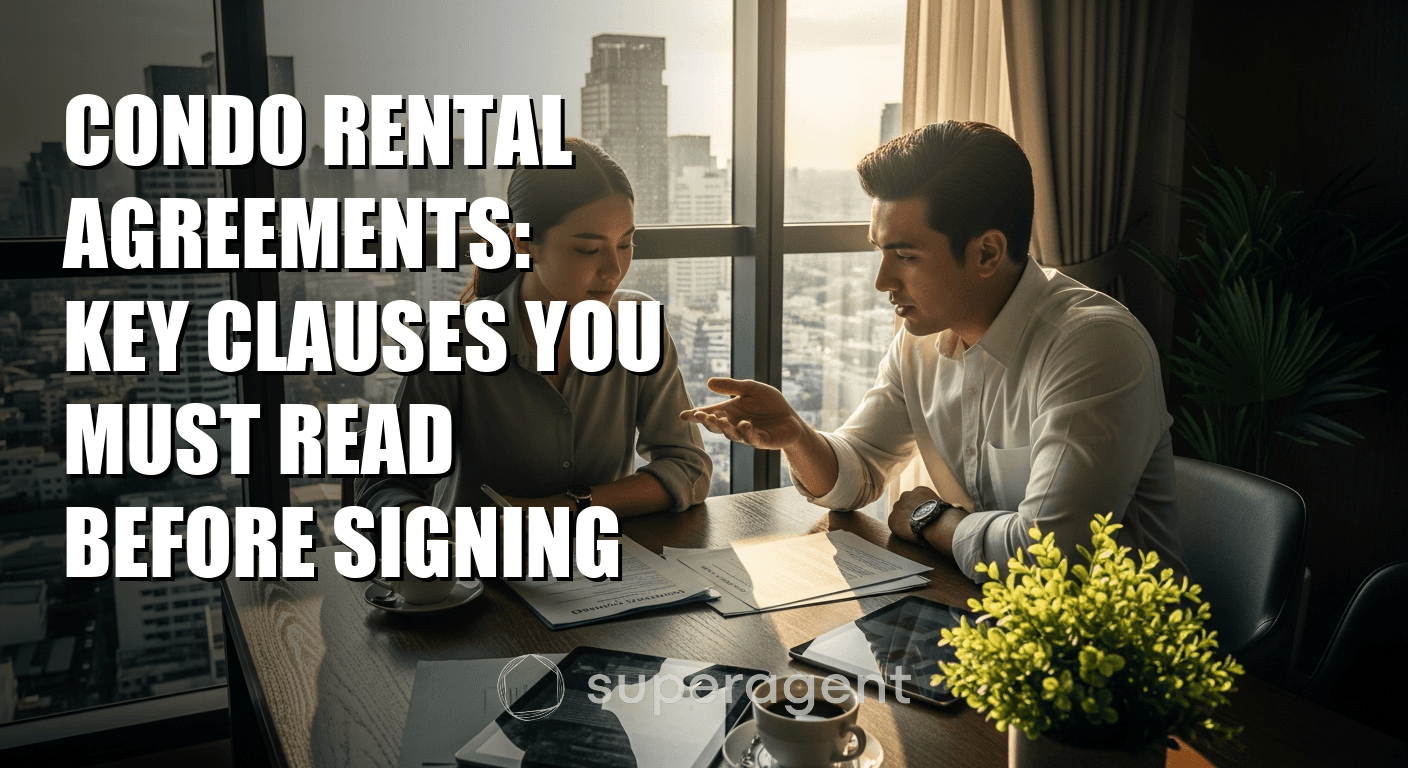
Condo Rental Agreements: Key Clauses You Must Read Before Signing
Guides
Condo Rental Agreements: Key Clauses You Must Read Before Signing
Master the essential terms and protections in Thai condo rental contracts.
Summary
สัญญาเช่าคอนโดภาษาไทย requires careful review. Learn critical clauses protecting tenants and landlords before signing any rental agreement in Bangkok.
You're about to sign a condo rental contract in Bangkok, and something in that Thai document doesn't sit right with you. Maybe it's the cancellation clause, or the deposit terms, or that weird line about who pays for the water tank cleaning. You're not alone. Every week, expats and locals land in Superagent's inbox asking the same question: what am I actually agreeing to here?
The truth is, condo rental contracts in Thailand are not created equal. Some landlords use proper legal templates. Others hand you a two-page scribble that leaves you vulnerable to disputes, surprise charges, and deposit nightmares. Before you click pen to paper, you need to know exactly what you're signing and what red flags to watch for.
This guide walks you through the critical clauses in Thai condo rental contracts, the terms that actually matter, and the ones landlords sometimes slip in hoping you won't notice.
The Core Contract: What Every Bangkok Condo Lease Must Cover
A proper condo rental contract in Thailand should clearly state five things from day one. The tenant's name and identification number, the landlord's name and ownership proof, the unit address and room number, the rental period with clear start and end dates, and the monthly rent plus any additional fees.
That last part trips people up. A contract that lists 18,000 THB "rent" but then adds 2,000 THB for utilities, 1,500 THB for building maintenance, and 800 THB for parking is not 18,000 THB a month. It's 22,300 THB. Bangkok landlords sometimes separate these on purpose, hoping you focus only on the base number.
According to DDproperty's 2024 rental survey, average monthly rent for a 1-bedroom condo in central Bangkok areas like Thong Lor or Phrom Phong ranges from 25,000 to 40,000 THB, with utilities and fees running an additional 3,000 to 6,000 THB. If your quoted rent seems unusually low, verify what's actually included before you celebrate.
Get a copy of the contract in English if you can. Many landlords have both versions. If they don't, hire a translator who specializes in real estate documents, not just a friend who speaks Thai. The cost is 1,000 to 3,000 THB and worth every baht.
The Deposit Trap: Why 2 Months' Security Feels Fair but Isn't Always
Thai custom says landlords hold two months' rent as a security deposit. That's the standard. But what happens to that deposit when you move out is where contracts get slippery.
A good contract explicitly lists what deductions are allowed. Unpaid rent, obvious damage beyond normal wear, missing keys, unpaid utilities. A bad contract says something vague like "deductions for any damage" without defining what that means. I knew someone in Ari who lost 8,000 THB because the landlord charged for "scuff marks on the kitchen cabinet" that had been there when they moved in.
Always, always photograph your condo on the first day. Walk through every room with your phone camera rolling. Get wide shots and close-ups of walls, floors, appliances, furniture, bathroom tiles, and kitchen counters. Send this footage or these photos to the landlord in an email with the date stamp visible. This becomes your proof if the landlord later claims pre-existing damage was your fault.
The contract should also specify a timeline for returning the deposit. Most say 7 to 14 days after you move out. If yours says "within 30 days" or "as soon as inspections are complete" without a deadline, push back. Add a clause that says the deposit must be returned within 7 business days or the landlord forfeits the right to deductions.
Utilities and Hidden Charges: Reading the Fine Print on Water and Electricity
Water bills in Bangkok condos are often calculated three ways. Some buildings charge a flat rate per person, some charge per cubic meter consumed, and some charge a communal rate split across all units. Your contract must spell out which method applies to you.
Electricity is usually metered individually, so you pay exactly what you use. But I've seen contracts where a landlord includes a base electricity charge even if you're away for a month. That's not standard and worth negotiating out.
Common charges that surprise first-time renters in Bangkok include building maintenance (1,000 to 3,000 THB per month), water tank cleaning (usually 400 to 800 THB charged once or twice yearly), elevator maintenance, and security fees. Some buildings near BTS stations like Asoke or Nana add parking premiums of 2,000 to 4,000 THB if you have a car.
Ask your landlord to give you three months of actual utility bills from the unit or from a similar unit. This shows you what you're actually paying, not a theoretical estimate. A condo claiming 2,500 THB monthly water costs when most units pay 800 THB is probably overcharging you.
Cancellation and Early Exit: What Happens if Life Changes
This is the clause that bites hardest. Bangkok is a transient city. Jobs end, visas change, families move. A contract that locks you in with no exit option will cost you thousands if circumstances shift.
The best contracts have a clear cancellation clause that lets you break the lease with 30 to 60 days' notice and a small penalty, usually one month's rent. The worst contracts say "cancellation by tenant is not permitted" or require you to pay the full remaining lease amount as a penalty.
Here's a real example: a 1-year lease at a 30,000 THB a month condo in Ploenchit with "no cancellation" language would cost you 360,000 THB even if you have to leave after 6 months. If the contract had a "one month penalty" clause, you'd pay 30,000 THB to exit. That's an 330,000 THB difference that should absolutely be negotiated.
If your landlord resists a cancellation clause, propose a compromise. Cancellation allowed after 6 months with one month's notice and one month's penalty. Or cancellation after 1 year with no penalty. Something that gives you an exit ramp without bankrupting you.
Maintenance Responsibility and Repair Costs: Whose Job Is It?
A clear contract specifies what the landlord maintains and what you maintain. Generally, the landlord handles structural issues, electrical panel problems, plumbing main lines, and appliances that came with the unit. You handle broken windows, damage from misuse, and small items you've added.
But I've seen contracts that say tenants are responsible for repainting, recaulking bathroom tiles, and even fixing broken doors. That's landlord work being pushed onto you. Don't accept it.
The contract should also say who pays for repairs and how quickly they happen. A unit near Victory Monument with a broken hot water heater needs fixing within 2 to 3 days in the rainy season. If your contract doesn't specify urgency timelines, add one. For essential services like water, electricity, or cooling, request a 24 to 48 hour repair window. For cosmetic issues, 7 to 10 days is fair.
Write down any existing damage in the contract before signing. "Air conditioner in bedroom operates but makes rattling sound." "Kitchen cabinet door closes slowly." This protects you from being charged for pre-existing problems later.
House Rules and Behavioral Clauses: Know What They're Actually Restricting
Most Bangkok condos have house rules attached to the lease. No loud noise after 10 PM, no pets without permission, no altering the unit structure, no subletting. These are standard and reasonable.
Watch for vague restrictions like "tenant must not cause disturbance" or "tenant must maintain quiet and peaceful behavior." These are too broad and could be used to harass you. Concrete rules are better. "No noise-generating activities between 10 PM and 7 AM" is enforceable. "Maintain reasonable conduct" is not.
If you have a pet, work dog, or partner who occasionally stays over, make sure the contract explicitly permits these things. A contract that says "no pets" will give a landlord grounds to evict you if you adopt a rescue dog three months in, even if it's quiet and well-behaved.
Some contracts also require you to notify the building or landlord of visitors staying longer than 3 days. This is common in stricter buildings but worth knowing upfront. If you have a partner who'd like to move in eventually or family visiting from another country, discuss this before signing.
Language, Legality, and Your Protection: Ensuring the Contract Is Actually Valid
In Thailand, a rental contract doesn't legally need to be registered with the Land Department to be valid. But registering it at the Land Department (Krung Thep office) costs about 100 THB and takes 30 minutes. It gives you a legally recognized document and protects you if the landlord denies you ever had a lease.
If your landlord refuses to register the contract, that's a red flag. It suggests they either don't want a paper trail of the rental or they're hiding something. Professional landlords and property management companies always register properly.
The contract must be written in Thai to be legally binding in Thai courts. However, you have the right to a translation in English or another language. Some contracts have both versions. If they differ, clarify with your landlord which version is the binding one. This should be stated in the contract itself.
Check that the landlord's name on the contract matches the ID and the building's ownership records. You can verify ownership at the District Office or through DDproperty. If there's a mismatch, the person signing might not actually own the unit, and you could end up in a major dispute.
- Cancellation: "No cancellation permitted" or "Full lease balance due upon early exit" | "Tenant may cancel with 30 days' notice and one month rent penalty after 6 months" | Negotiate before signing. This protects your exit.
- Deposit Return: "Returned within 30 days" or "Deductions at landlord's discretion" | "Returned within 7 business days. Deductions only for unpaid rent, utilities, or documented damage beyond normal wear" | Request a move-out inspection checklist and photo evidence. Email it to landlord.
- Repairs: "Tenant responsible for all maintenance and repairs" | "Landlord maintains structure, electrical, plumbing. Tenant pays for damage from misuse" | List any existing damage in writing before signing.
- Utilities: "Utilities included in rent, actual costs billed monthly" | "Tenant pays actual water and electricity metered consumption. Maintenance fee 1,500 THB fixed" | Request 3 months of previous utility bills for the unit or similar units.
- House Rules: "Tenant must maintain reasonable and peaceful conduct" | "No noise between 10 PM and 7 AM. No pets without written permission. No subleasing" | Confirm any specific needs (pets, frequent guests) are explicitly permitted.
Before you hand over your signature and deposit, do this. Read the contract twice, ideally once in the language it's written and once in translation. Mark any clauses that don't match what you discussed verbally with the landlord. Email those concerns to them with specific requests for changes. Get written confirmation of any agreed changes and attach them as an addendum to the contract.
A good landlord will respect reasonable requests. They know a transparent contract protects both of you. If your landlord refuses to clarify vague terms or won't negotiate on fair protections like a cancellation clause, that tells you something about how they'll handle disputes later. Those instincts matter more than saving a few thousand baht on rent.
Finding the right condo is only half the battle in Bangkok. Making sure your lease contract actually protects you is the other half. Take your time with this step. You're signing away a significant portion of your monthly income and committing months or years of your life to a specific unit and landlord. That deserves careful attention.
When you're ready to start your Bangkok condo search with clarity on what to look for and how to protect yourself, Superagent makes it simpler. Browse hundreds of verified listings, filter by neighborhood, budget, and amenities, and connect with landlords who use proper, transparent rental agreements. Start your search at superagent.co today.
You're about to sign a condo rental contract in Bangkok, and something in that Thai document doesn't sit right with you. Maybe it's the cancellation clause, or the deposit terms, or that weird line about who pays for the water tank cleaning. You're not alone. Every week, expats and locals land in Superagent's inbox asking the same question: what am I actually agreeing to here?
The truth is, condo rental contracts in Thailand are not created equal. Some landlords use proper legal templates. Others hand you a two-page scribble that leaves you vulnerable to disputes, surprise charges, and deposit nightmares. Before you click pen to paper, you need to know exactly what you're signing and what red flags to watch for.
This guide walks you through the critical clauses in Thai condo rental contracts, the terms that actually matter, and the ones landlords sometimes slip in hoping you won't notice.
The Core Contract: What Every Bangkok Condo Lease Must Cover
A proper condo rental contract in Thailand should clearly state five things from day one. The tenant's name and identification number, the landlord's name and ownership proof, the unit address and room number, the rental period with clear start and end dates, and the monthly rent plus any additional fees.
That last part trips people up. A contract that lists 18,000 THB "rent" but then adds 2,000 THB for utilities, 1,500 THB for building maintenance, and 800 THB for parking is not 18,000 THB a month. It's 22,300 THB. Bangkok landlords sometimes separate these on purpose, hoping you focus only on the base number.
According to DDproperty's 2024 rental survey, average monthly rent for a 1-bedroom condo in central Bangkok areas like Thong Lor or Phrom Phong ranges from 25,000 to 40,000 THB, with utilities and fees running an additional 3,000 to 6,000 THB. If your quoted rent seems unusually low, verify what's actually included before you celebrate.
Get a copy of the contract in English if you can. Many landlords have both versions. If they don't, hire a translator who specializes in real estate documents, not just a friend who speaks Thai. The cost is 1,000 to 3,000 THB and worth every baht.
The Deposit Trap: Why 2 Months' Security Feels Fair but Isn't Always
Thai custom says landlords hold two months' rent as a security deposit. That's the standard. But what happens to that deposit when you move out is where contracts get slippery.
A good contract explicitly lists what deductions are allowed. Unpaid rent, obvious damage beyond normal wear, missing keys, unpaid utilities. A bad contract says something vague like "deductions for any damage" without defining what that means. I knew someone in Ari who lost 8,000 THB because the landlord charged for "scuff marks on the kitchen cabinet" that had been there when they moved in.
Always, always photograph your condo on the first day. Walk through every room with your phone camera rolling. Get wide shots and close-ups of walls, floors, appliances, furniture, bathroom tiles, and kitchen counters. Send this footage or these photos to the landlord in an email with the date stamp visible. This becomes your proof if the landlord later claims pre-existing damage was your fault.
The contract should also specify a timeline for returning the deposit. Most say 7 to 14 days after you move out. If yours says "within 30 days" or "as soon as inspections are complete" without a deadline, push back. Add a clause that says the deposit must be returned within 7 business days or the landlord forfeits the right to deductions.
Utilities and Hidden Charges: Reading the Fine Print on Water and Electricity
Water bills in Bangkok condos are often calculated three ways. Some buildings charge a flat rate per person, some charge per cubic meter consumed, and some charge a communal rate split across all units. Your contract must spell out which method applies to you.
Electricity is usually metered individually, so you pay exactly what you use. But I've seen contracts where a landlord includes a base electricity charge even if you're away for a month. That's not standard and worth negotiating out.
Common charges that surprise first-time renters in Bangkok include building maintenance (1,000 to 3,000 THB per month), water tank cleaning (usually 400 to 800 THB charged once or twice yearly), elevator maintenance, and security fees. Some buildings near BTS stations like Asoke or Nana add parking premiums of 2,000 to 4,000 THB if you have a car.
Ask your landlord to give you three months of actual utility bills from the unit or from a similar unit. This shows you what you're actually paying, not a theoretical estimate. A condo claiming 2,500 THB monthly water costs when most units pay 800 THB is probably overcharging you.
Cancellation and Early Exit: What Happens if Life Changes
This is the clause that bites hardest. Bangkok is a transient city. Jobs end, visas change, families move. A contract that locks you in with no exit option will cost you thousands if circumstances shift.
The best contracts have a clear cancellation clause that lets you break the lease with 30 to 60 days' notice and a small penalty, usually one month's rent. The worst contracts say "cancellation by tenant is not permitted" or require you to pay the full remaining lease amount as a penalty.
Here's a real example: a 1-year lease at a 30,000 THB a month condo in Ploenchit with "no cancellation" language would cost you 360,000 THB even if you have to leave after 6 months. If the contract had a "one month penalty" clause, you'd pay 30,000 THB to exit. That's an 330,000 THB difference that should absolutely be negotiated.
If your landlord resists a cancellation clause, propose a compromise. Cancellation allowed after 6 months with one month's notice and one month's penalty. Or cancellation after 1 year with no penalty. Something that gives you an exit ramp without bankrupting you.
Maintenance Responsibility and Repair Costs: Whose Job Is It?
A clear contract specifies what the landlord maintains and what you maintain. Generally, the landlord handles structural issues, electrical panel problems, plumbing main lines, and appliances that came with the unit. You handle broken windows, damage from misuse, and small items you've added.
But I've seen contracts that say tenants are responsible for repainting, recaulking bathroom tiles, and even fixing broken doors. That's landlord work being pushed onto you. Don't accept it.
The contract should also say who pays for repairs and how quickly they happen. A unit near Victory Monument with a broken hot water heater needs fixing within 2 to 3 days in the rainy season. If your contract doesn't specify urgency timelines, add one. For essential services like water, electricity, or cooling, request a 24 to 48 hour repair window. For cosmetic issues, 7 to 10 days is fair.
Write down any existing damage in the contract before signing. "Air conditioner in bedroom operates but makes rattling sound." "Kitchen cabinet door closes slowly." This protects you from being charged for pre-existing problems later.
House Rules and Behavioral Clauses: Know What They're Actually Restricting
Most Bangkok condos have house rules attached to the lease. No loud noise after 10 PM, no pets without permission, no altering the unit structure, no subletting. These are standard and reasonable.
Talk to us about renting
Share your details and keep reading — we’ll get back to you.
Watch for vague restrictions like "tenant must not cause disturbance" or "tenant must maintain quiet and peaceful behavior." These are too broad and could be used to harass you. Concrete rules are better. "No noise-generating activities between 10 PM and 7 AM" is enforceable. "Maintain reasonable conduct" is not.
If you have a pet, work dog, or partner who occasionally stays over, make sure the contract explicitly permits these things. A contract that says "no pets" will give a landlord grounds to evict you if you adopt a rescue dog three months in, even if it's quiet and well-behaved.
Some contracts also require you to notify the building or landlord of visitors staying longer than 3 days. This is common in stricter buildings but worth knowing upfront. If you have a partner who'd like to move in eventually or family visiting from another country, discuss this before signing.
Language, Legality, and Your Protection: Ensuring the Contract Is Actually Valid
In Thailand, a rental contract doesn't legally need to be registered with the Land Department to be valid. But registering it at the Land Department (Krung Thep office) costs about 100 THB and takes 30 minutes. It gives you a legally recognized document and protects you if the landlord denies you ever had a lease.
If your landlord refuses to register the contract, that's a red flag. It suggests they either don't want a paper trail of the rental or they're hiding something. Professional landlords and property management companies always register properly.
The contract must be written in Thai to be legally binding in Thai courts. However, you have the right to a translation in English or another language. Some contracts have both versions. If they differ, clarify with your landlord which version is the binding one. This should be stated in the contract itself.
Check that the landlord's name on the contract matches the ID and the building's ownership records. You can verify ownership at the District Office or through DDproperty. If there's a mismatch, the person signing might not actually own the unit, and you could end up in a major dispute.
- Cancellation: "No cancellation permitted" or "Full lease balance due upon early exit" | "Tenant may cancel with 30 days' notice and one month rent penalty after 6 months" | Negotiate before signing. This protects your exit.
- Deposit Return: "Returned within 30 days" or "Deductions at landlord's discretion" | "Returned within 7 business days. Deductions only for unpaid rent, utilities, or documented damage beyond normal wear" | Request a move-out inspection checklist and photo evidence. Email it to landlord.
- Repairs: "Tenant responsible for all maintenance and repairs" | "Landlord maintains structure, electrical, plumbing. Tenant pays for damage from misuse" | List any existing damage in writing before signing.
- Utilities: "Utilities included in rent, actual costs billed monthly" | "Tenant pays actual water and electricity metered consumption. Maintenance fee 1,500 THB fixed" | Request 3 months of previous utility bills for the unit or similar units.
- House Rules: "Tenant must maintain reasonable and peaceful conduct" | "No noise between 10 PM and 7 AM. No pets without written permission. No subleasing" | Confirm any specific needs (pets, frequent guests) are explicitly permitted.
Before you hand over your signature and deposit, do this. Read the contract twice, ideally once in the language it's written and once in translation. Mark any clauses that don't match what you discussed verbally with the landlord. Email those concerns to them with specific requests for changes. Get written confirmation of any agreed changes and attach them as an addendum to the contract.
A good landlord will respect reasonable requests. They know a transparent contract protects both of you. If your landlord refuses to clarify vague terms or won't negotiate on fair protections like a cancellation clause, that tells you something about how they'll handle disputes later. Those instincts matter more than saving a few thousand baht on rent.
Finding the right condo is only half the battle in Bangkok. Making sure your lease contract actually protects you is the other half. Take your time with this step. You're signing away a significant portion of your monthly income and committing months or years of your life to a specific unit and landlord. That deserves careful attention.
When you're ready to start your Bangkok condo search with clarity on what to look for and how to protect yourself, Superagent makes it simpler. Browse hundreds of verified listings, filter by neighborhood, budget, and amenities, and connect with landlords who use proper, transparent rental agreements. Start your search at superagent.co today.
Share this article
Properties you may like
![[For Rent] CONDO I Aguston Sukhumvit 22 I Pet Friendly I 2 Beds I 2 Baths I Rent 55,000THB/mo](/_next/image?url=https%3A%2F%2Fstorage.googleapis.com%2Fsuperagent-web%2Fattachments%2Flistings%2F2266%2Fd3afcd25-6b79-46cb-9f1f-396acdc3dd10-955-3.jpg&w=3840&q=75)
฿55,000
2 Bed295 sqm
[For Rent] CONDO I Aguston Sukhumvit 22 I Pet Friendly I 2 Beds I 2 Baths I Rent 55,000THB/mo
Phrom Phong
Condo![[For Rent] CONDO I SUPALAI PLACE Sukhumvit 39 I 2 Beds I 2 Baths (1 Jacuzzi) I 55,555THB/mo](/_next/image?url=https%3A%2F%2Fstorage.googleapis.com%2Fsuperagent-web%2Fattachments%2Flistings%2F6743%2Fba530743-48b9-4ac6-92d3-c2247e743cf6-01-supalai-place-skv39-2b-link-heaven.jpg&w=3840&q=75)
฿55,555
2 Bed2142 sqm
[For Rent] CONDO I SUPALAI PLACE Sukhumvit 39 I 2 Beds I 2 Baths (1 Jacuzzi) I 55,555THB/mo
Phrom Phong
Condo![[For Rent] CONDO I Maru Ekkamai 2 I Pet friendly I 2 Beds I 2 Baths I 68,000 THB/mo](/_next/image?url=https%3A%2F%2Fstorage.googleapis.com%2Fsuperagent-web%2Fattachments%2Flistings%2F6602%2F9f1d8f71-ee43-435f-9a44-da16c4092c92-968-1.jpg&w=3840&q=75)
฿68,000
2 Bed360 sqm
[For Rent] CONDO I Maru Ekkamai 2 I Pet friendly I 2 Beds I 2 Baths I 68,000 THB/mo
Ekkamai
Condo![[For Rent] CONDO I Noble State 39 I 2 Beds I 2 Baths I 63,000THB/mo](/_next/image?url=https%3A%2F%2Fstorage.googleapis.com%2Fsuperagent-web%2Fattachments%2Flistings%2F2237%2F60eb58f3-eae5-41ed-a80b-406e004f05d8-940-1.jpg&w=3840&q=75)
฿63,000
2 Bed260 sqm
[For Rent] CONDO I Noble State 39 I 2 Beds I 2 Baths I 63,000THB/mo
Phrom Phong
Condo![[For Rent] CONDO I Rhythm Sukhumvit 36-38 I 2 Beds I 2 Baths I 38,999THB/mo](/_next/image?url=https%3A%2F%2Fstorage.googleapis.com%2Fsuperagent-web%2Fattachments%2Flistings%2F1788%2F942a0215-4128-4c2c-a064-f607e84e7aa4-656-2.jpg&w=3840&q=75)
฿38,999
2 Bed256 sqm
[For Rent] CONDO I Rhythm Sukhumvit 36-38 I 2 Beds I 2 Baths I 38,999THB/mo
Thonglor
Condo![[For Rent] CONDO I CLOUD Thonglor-Phetchaburi I 1 Bed I 1 Bath I 22,500THB/mo](/_next/image?url=https%3A%2F%2Fstorage.googleapis.com%2Fsuperagent-web%2Fattachments%2Flistings%2F6742%2F6cef5361-0dac-4dba-98f1-b0d187559c84-1118-1.jpg&w=3840&q=75)
฿22,500
1 Bed132 sqm
[For Rent] CONDO I CLOUD Thonglor-Phetchaburi I 1 Bed I 1 Bath I 22,500THB/mo
Thonglor
Condo![[For Rent] CONDO I City Smart Sukhumvit 18 I 3 Beds I 3 Baths I 65,000mo/THB](/_next/image?url=https%3A%2F%2Fstorage.googleapis.com%2Fsuperagent-web%2Fattachments%2Flistings%2F6741%2Fd371c89d-a913-42c4-a673-e540afae4f46-1116-1.jpg&w=3840&q=75)
฿65,000
3 Bed3125 sqm
[For Rent] CONDO I City Smart Sukhumvit 18 I 3 Beds I 3 Baths I 65,000mo/THB
Condo![[For Rent] CONDO I The Coast Bangkok I 1 Bed I 1 Bath I 20,000mo/THB](/_next/image?url=https%3A%2F%2Fstorage.googleapis.com%2Fsuperagent-web%2Fattachments%2Flistings%2F6740%2F498477ce-4ffa-4e4c-ab08-0e565d9c4bbe-1115-3.jpg&w=3840&q=75)
฿20,000
1 Bed146 sqm
[For Rent] CONDO I The Coast Bangkok I 1 Bed I 1 Bath I 20,000mo/THB
Bang Na
Condo![[For Rent] CONDO I IDEO Sukhumvit-RAMA 4 I 2 Beds I 2 Baths I 55,000mo/THB](/_next/image?url=https%3A%2F%2Fstorage.googleapis.com%2Fsuperagent-web%2Fattachments%2Flistings%2F6739%2F15df221d-5b8e-497c-b7ce-a6b9b6412cab-1113-1.jpg&w=3840&q=75)
฿55,000
2 Bed265 sqm
[For Rent] CONDO I IDEO Sukhumvit-RAMA 4 I 2 Beds I 2 Baths I 55,000mo/THB
Phra Khanong
Condo![[For Rent] CONDO I Downtown 49 I Pet Friendly I 1 Bed I 1 Bath I 23,000mo/THB](/_next/image?url=https%3A%2F%2Fstorage.googleapis.com%2Fsuperagent-web%2Fattachments%2Flistings%2F6738%2F11cf2ffe-1f01-4ccc-991c-2ad608f1ba73-1112-1.jpg&w=3840&q=75)
฿23,000
1 Bed135 sqm
[For Rent] CONDO I Downtown 49 I Pet Friendly I 1 Bed I 1 Bath I 23,000mo/THB
Thonglor
CondoMore like this
 In Guides · Superagent EditorialHidden Costs of Renting a Condo in Bangkok Nobody Warns You AboutBangkok condo rent looks affordable until month one hits. Here are the real costs beyond the headline figure that catch most renters off guard.25 May 20261 min read
 In Guides · Superagent EditorialWhat a Long-Vacant Bangkok Condo Unit Is Actually Telling YouA Bangkok condo vacant for months signals overpricing, landlord issues, or real problems. Here is how to read the signs.25 May 20261 min read
 In Guides · Superagent EditorialRed Flags in a Bangkok Rental Contract to Watch Out ForBangkok rental contracts often hide risky clauses. Here are the red flags every tenant must catch before signing any lease.25 May 20261 min read
 In Guides · Superagent EditorialWorking Online from a Condo: How to Choose the Perfect Room for ProductivityLearn how to choose the best condo room for working online with tips on lighting, noise, and furniture setup to maximize productivity.9 May 20261 min read