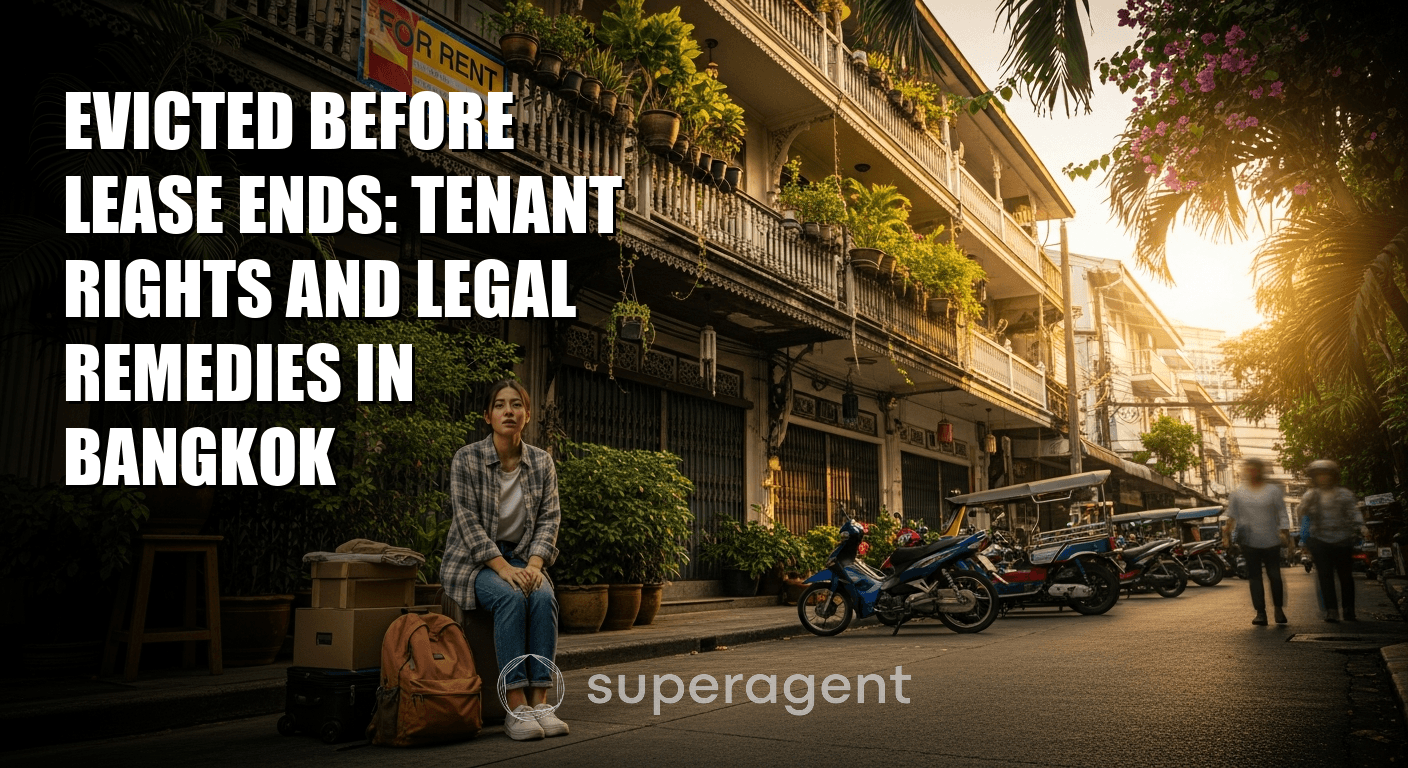
Evicted Before Lease Ends: Tenant Rights and Legal Remedies in Bangkok
Guides
Evicted Before Lease Ends: Tenant Rights and Legal Remedies in Bangkok
Know your legal protections if your landlord tries to evict you early.
Summary
Learn about tenant rights when evicted before lease ends. Understand legal remedies, compensation options, and how to protect yourself as a renter in Bangk
Getting an eviction notice before your lease ends is one of the worst things that can happen when you rent a condo in Bangkok. You've paid your deposit, signed the contract, and planned your life around that space, and suddenly you're told to leave. It happens more often than you'd think, especially in Thailand's rental market where tenant protections can feel foggy if you don't know where to look. The good news? You have rights, and there are real legal remedies available to you. This guide walks you through exactly what those rights are, what makes an eviction legal or illegal in Thailand, and what steps you can take to protect yourself.
What Counts as Illegal Eviction in Thailand
Thai law actually gives renters more protection than many expats realize. The Residential Tenancy Act and civil law set clear rules about how and why a landlord can terminate a lease early. An eviction is illegal if your landlord hasn't given you proper written notice, hasn't provided legal grounds for termination, or is evicting you for discriminatory reasons.
Here's what matters: Thai law requires a landlord to give you at least 30 days written notice for most termination reasons. That notice must be formal, documented, and delivered properly, not just a WhatsApp message or a conversation with the building staff. If your landlord tries to lock you out, remove your belongings, or shut off utilities without going through the courts, that's also illegal, even if they have legitimate grounds to evict you.
Real example: A tenant in a condo near BTS Thong Lo received an eviction notice on a Friday with a demand to leave by Monday because the landlord said they violated the lease. No specific violation was named, no chance to respond was given, and no court order existed. That's illegal under Thai residential law.
The legal reasons a landlord can actually evict you before the lease ends are narrow: non-payment of rent for three consecutive months, repeated violation of lease terms after written warning, subleasing without permission, or if the property is being reclaimed for the landlord's personal use or family use. Even then, they must follow proper procedure.
Your Rights Under Thai Rental Law
As a renter in Thailand, you have documented legal rights whether you're a Thai national or an expat. The Civil and Commercial Code protects lease agreements, and the Residential Tenancy Act (which applies to most Bangkok condos) sets specific protections for tenants.
Your landlord cannot evict you without proper legal grounds and proper notice. They cannot discriminate based on nationality, occupation, or family status. They cannot enter your unit without permission or reasonable notice. They must return your security deposit minus legitimate deductions for damages within 30 days of lease end. These aren't guidelines or suggestions, they're the law.
If your landlord breaches the lease, you have the right to request repairs or reduce rent until repairs are made. If living conditions become uninhabitable, you can break the lease without penalty. For example, if your condo in a building near MRT Rama 9 has no water supply for a week and the landlord refuses to fix it, you have legal grounds to terminate early and recover your deposit.
You also have the right to be heard. Before any eviction, you're entitled to a chance to respond to the allegations. Your landlord cannot just declare you're evicted, they have to follow legal procedure. If they want to go to court, the burden is on them to prove their case to a judge.
Step-by-Step Response to an Eviction Notice
The moment you receive an eviction notice, write down the exact date, who delivered it, and what it says. Take photos of the notice itself. This documentation will matter if you end up in court.
Check the notice carefully. Does it give at least 30 days notice? Does it specify legal grounds for termination or is it vague? Is it written in Thai or English, and if you don't speak Thai, did they provide translation? A notice that doesn't meet legal requirements is not valid, even if it looks official.
Next, respond in writing. If the grounds are false or if you've been unfairly accused of violations, write a formal letter (in Thai or English) explaining your position. Keep a copy. Send it registered mail or email so you have proof of delivery. This creates a paper trail that shows you took the eviction seriously and responded appropriately.
Calculate your timeline. If the notice says 30 days, count carefully from the date it was delivered. You don't have to leave before that period ends, and any attempt to force you out earlier is illegal. If you need more time, request it in writing with your reasons.
When to Involve a Lawyer
You should consult a lawyer specializing in Thai rental law if the eviction notice cites specific violations you didn't commit, if you believe you're being evicted for an illegal reason, or if you need to stay in the unit and want to fight the eviction. Don't wait until the deadline passes.
A lawyer can help you file a complaint with the court, which stops the eviction clock and gives you time to argue your case in front of a judge. They can also negotiate with your landlord on your behalf. Many lawyers in Bangkok specialize in expat tenant issues and understand both Thai law and common misunderstandings between landlords and renters.
If you cannot afford a lawyer, the Bar Association of Thailand and some NGOs offer legal aid. The cost of a consultation with a Thai lawyer ranges from 500 to 2,000 THB typically, and hiring someone to represent you in court usually costs 10,000 to 50,000 THB depending on complexity.
Example scenario: A tenant in a building near BTS Asoke was accused of keeping a pet in violation of the lease, but the contract they signed actually allowed one pet under 10 kilograms. A lawyer reviewed the lease, found the contract language favored the tenant, and sent a letter to the landlord. The eviction notice was withdrawn.
Recovery Options if You're Wrongfully Evicted
If a court rules that your eviction was illegal, you can recover actual damages. This typically means the cost of finding new housing, lost rent if you had to relocate, and in some cases compensation for inconvenience and emotional distress. You can also demand that your security deposit be returned in full immediately.
You can also sue for breach of contract. If the landlord broke the lease agreement, the law allows you to claim damages equal to rent for the remaining lease term, minus any rent you could have earned by renting elsewhere. This is harder to prove but it's available.
If the landlord illegally locked you out or removed your belongings, you can file a police complaint for criminal trespassing or theft, depending on circumstances. You can also file a civil case for damages related to loss of use and possession.
The process is slow, often 6 months to a year or more, but Thai courts do protect tenant rights when the law is clear. Many wrongfully evicted tenants recover 50 to 80 percent of their claim, though full recovery is rare.
Prevention: How to Protect Yourself From the Start
The best protection is a clear, detailed lease agreement in both Thai and English. Before you sign anything, read every line. Make sure lease terms match the verbal agreement. Clarify all house rules, subletting policies, pet policies, and what counts as a violation. If the landlord refuses to put something in writing, that's a red flag.
Keep all communication with your landlord documented. Use email or Line messages, not just verbal conversations. When you pay rent, get a receipt or bank transfer confirmation. If the landlord requests repairs or points out any issue, respond in writing and keep records.
Pay rent on time and in full every single month. Non-payment is the easiest grounds for eviction and it's almost impossible to defend. If you have a dispute with your landlord about something else, rent is not the place to take a stand.
Know your lease length and renewal date. Some renters get caught off guard when a landlord decides not to renew, which is technically not eviction but it has the same effect. Read the renewal clause carefully and start looking for a new place 2 to 3 months before renewal if you sense the landlord may not want to extend.
- 30 days written notice citing lease violation, with chance to respond: Possibly legal if violation is real vs Review lease, respond in writing, gather evidence that violation didn't occur
- No notice, verbal demand to leave immediately: Illegal vs Refuse to leave, contact lawyer immediately, file complaint if forced out
- Notice citing non-payment of rent for 3 months: Legal if proven accurate vs Verify claim, pay immediately if legitimate, respond in writing if false
- Eviction because you're a foreigner or have a family: Illegal (discrimination) vs Document, consult lawyer, file discrimination complaint with authorities
- Notice but landlord locks unit before period ends: Illegal regardless of grounds vs Call police, contact lawyer, file criminal and civil case
For tenants in Bangkok's popular expat areas like Thong Lo, Asoke, and Rama 9, rent typically ranges from 18,000 to 40,000 THB monthly for a 1-bedroom condo with a clear contract, which means landlords want stable tenants too. Most disputes arise from unclear lease agreements or communication breakdowns, not from legitimate grounds for eviction.
If you're facing an eviction notice, move quickly. Get the notice in writing if you haven't already, document everything, and reach out to a lawyer within a few days. Thai courts do protect tenant rights, but you have to assert them properly and on time. Don't assume the notice is final or that you have no options, because you absolutely do.
When you're ready to find a new rental or want to avoid these problems entirely, Superagent makes it simple to search verified condos with transparent landlords and clear agreements. Every listing on the platform includes full lease details upfront, so you know exactly what you're signing.
Getting an eviction notice before your lease ends is one of the worst things that can happen when you rent a condo in Bangkok. You've paid your deposit, signed the contract, and planned your life around that space, and suddenly you're told to leave. It happens more often than you'd think, especially in Thailand's rental market where tenant protections can feel foggy if you don't know where to look. The good news? You have rights, and there are real legal remedies available to you. This guide walks you through exactly what those rights are, what makes an eviction legal or illegal in Thailand, and what steps you can take to protect yourself.
What Counts as Illegal Eviction in Thailand
Thai law actually gives renters more protection than many expats realize. The Residential Tenancy Act and civil law set clear rules about how and why a landlord can terminate a lease early. An eviction is illegal if your landlord hasn't given you proper written notice, hasn't provided legal grounds for termination, or is evicting you for discriminatory reasons.
Here's what matters: Thai law requires a landlord to give you at least 30 days written notice for most termination reasons. That notice must be formal, documented, and delivered properly, not just a WhatsApp message or a conversation with the building staff. If your landlord tries to lock you out, remove your belongings, or shut off utilities without going through the courts, that's also illegal, even if they have legitimate grounds to evict you.
Real example: A tenant in a condo near BTS Thong Lo received an eviction notice on a Friday with a demand to leave by Monday because the landlord said they violated the lease. No specific violation was named, no chance to respond was given, and no court order existed. That's illegal under Thai residential law.
The legal reasons a landlord can actually evict you before the lease ends are narrow: non-payment of rent for three consecutive months, repeated violation of lease terms after written warning, subleasing without permission, or if the property is being reclaimed for the landlord's personal use or family use. Even then, they must follow proper procedure.
Your Rights Under Thai Rental Law
As a renter in Thailand, you have documented legal rights whether you're a Thai national or an expat. The Civil and Commercial Code protects lease agreements, and the Residential Tenancy Act (which applies to most Bangkok condos) sets specific protections for tenants.
Your landlord cannot evict you without proper legal grounds and proper notice. They cannot discriminate based on nationality, occupation, or family status. They cannot enter your unit without permission or reasonable notice. They must return your security deposit minus legitimate deductions for damages within 30 days of lease end. These aren't guidelines or suggestions, they're the law.
If your landlord breaches the lease, you have the right to request repairs or reduce rent until repairs are made. If living conditions become uninhabitable, you can break the lease without penalty. For example, if your condo in a building near MRT Rama 9 has no water supply for a week and the landlord refuses to fix it, you have legal grounds to terminate early and recover your deposit.
You also have the right to be heard. Before any eviction, you're entitled to a chance to respond to the allegations. Your landlord cannot just declare you're evicted, they have to follow legal procedure. If they want to go to court, the burden is on them to prove their case to a judge.
Step-by-Step Response to an Eviction Notice
The moment you receive an eviction notice, write down the exact date, who delivered it, and what it says. Take photos of the notice itself. This documentation will matter if you end up in court.
Check the notice carefully. Does it give at least 30 days notice? Does it specify legal grounds for termination or is it vague? Is it written in Thai or English, and if you don't speak Thai, did they provide translation? A notice that doesn't meet legal requirements is not valid, even if it looks official.
Next, respond in writing. If the grounds are false or if you've been unfairly accused of violations, write a formal letter (in Thai or English) explaining your position. Keep a copy. Send it registered mail or email so you have proof of delivery. This creates a paper trail that shows you took the eviction seriously and responded appropriately.
Calculate your timeline. If the notice says 30 days, count carefully from the date it was delivered. You don't have to leave before that period ends, and any attempt to force you out earlier is illegal. If you need more time, request it in writing with your reasons.
When to Involve a Lawyer
You should consult a lawyer specializing in Thai rental law if the eviction notice cites specific violations you didn't commit, if you believe you're being evicted for an illegal reason, or if you need to stay in the unit and want to fight the eviction. Don't wait until the deadline passes.
A lawyer can help you file a complaint with the court, which stops the eviction clock and gives you time to argue your case in front of a judge. They can also negotiate with your landlord on your behalf. Many lawyers in Bangkok specialize in expat tenant issues and understand both Thai law and common misunderstandings between landlords and renters.
If you cannot afford a lawyer, the Bar Association of Thailand and some NGOs offer legal aid. The cost of a consultation with a Thai lawyer ranges from 500 to 2,000 THB typically, and hiring someone to represent you in court usually costs 10,000 to 50,000 THB depending on complexity.
Example scenario: A tenant in a building near BTS Asoke was accused of keeping a pet in violation of the lease, but the contract they signed actually allowed one pet under 10 kilograms. A lawyer reviewed the lease, found the contract language favored the tenant, and sent a letter to the landlord. The eviction notice was withdrawn.
Recovery Options if You're Wrongfully Evicted
If a court rules that your eviction was illegal, you can recover actual damages. This typically means the cost of finding new housing, lost rent if you had to relocate, and in some cases compensation for inconvenience and emotional distress. You can also demand that your security deposit be returned in full immediately.
Talk to us about renting
Share your details and keep reading — we’ll get back to you.
You can also sue for breach of contract. If the landlord broke the lease agreement, the law allows you to claim damages equal to rent for the remaining lease term, minus any rent you could have earned by renting elsewhere. This is harder to prove but it's available.
If the landlord illegally locked you out or removed your belongings, you can file a police complaint for criminal trespassing or theft, depending on circumstances. You can also file a civil case for damages related to loss of use and possession.
The process is slow, often 6 months to a year or more, but Thai courts do protect tenant rights when the law is clear. Many wrongfully evicted tenants recover 50 to 80 percent of their claim, though full recovery is rare.
Prevention: How to Protect Yourself From the Start
The best protection is a clear, detailed lease agreement in both Thai and English. Before you sign anything, read every line. Make sure lease terms match the verbal agreement. Clarify all house rules, subletting policies, pet policies, and what counts as a violation. If the landlord refuses to put something in writing, that's a red flag.
Keep all communication with your landlord documented. Use email or Line messages, not just verbal conversations. When you pay rent, get a receipt or bank transfer confirmation. If the landlord requests repairs or points out any issue, respond in writing and keep records.
Pay rent on time and in full every single month. Non-payment is the easiest grounds for eviction and it's almost impossible to defend. If you have a dispute with your landlord about something else, rent is not the place to take a stand.
Know your lease length and renewal date. Some renters get caught off guard when a landlord decides not to renew, which is technically not eviction but it has the same effect. Read the renewal clause carefully and start looking for a new place 2 to 3 months before renewal if you sense the landlord may not want to extend.
- 30 days written notice citing lease violation, with chance to respond: Possibly legal if violation is real vs Review lease, respond in writing, gather evidence that violation didn't occur
- No notice, verbal demand to leave immediately: Illegal vs Refuse to leave, contact lawyer immediately, file complaint if forced out
- Notice citing non-payment of rent for 3 months: Legal if proven accurate vs Verify claim, pay immediately if legitimate, respond in writing if false
- Eviction because you're a foreigner or have a family: Illegal (discrimination) vs Document, consult lawyer, file discrimination complaint with authorities
- Notice but landlord locks unit before period ends: Illegal regardless of grounds vs Call police, contact lawyer, file criminal and civil case
For tenants in Bangkok's popular expat areas like Thong Lo, Asoke, and Rama 9, rent typically ranges from 18,000 to 40,000 THB monthly for a 1-bedroom condo with a clear contract, which means landlords want stable tenants too. Most disputes arise from unclear lease agreements or communication breakdowns, not from legitimate grounds for eviction.
If you're facing an eviction notice, move quickly. Get the notice in writing if you haven't already, document everything, and reach out to a lawyer within a few days. Thai courts do protect tenant rights, but you have to assert them properly and on time. Don't assume the notice is final or that you have no options, because you absolutely do.
When you're ready to find a new rental or want to avoid these problems entirely, Superagent makes it simple to search verified condos with transparent landlords and clear agreements. Every listing on the platform includes full lease details upfront, so you know exactly what you're signing.
Share this article
Properties you may like
![[For Rent] CONDO I Aguston Sukhumvit 22 I Pet Friendly I 2 Beds I 2 Baths I Rent 55,000THB/mo](/_next/image?url=https%3A%2F%2Fstorage.googleapis.com%2Fsuperagent-web%2Fattachments%2Flistings%2F2266%2Fd3afcd25-6b79-46cb-9f1f-396acdc3dd10-955-3.jpg&w=3840&q=75)
฿55,000
2 Bed295 sqm
[For Rent] CONDO I Aguston Sukhumvit 22 I Pet Friendly I 2 Beds I 2 Baths I Rent 55,000THB/mo
Phrom Phong
Condo![[For Rent] CONDO I SUPALAI PLACE Sukhumvit 39 I 2 Beds I 2 Baths (1 Jacuzzi) I 55,555THB/mo](/_next/image?url=https%3A%2F%2Fstorage.googleapis.com%2Fsuperagent-web%2Fattachments%2Flistings%2F6743%2Fba530743-48b9-4ac6-92d3-c2247e743cf6-01-supalai-place-skv39-2b-link-heaven.jpg&w=3840&q=75)
฿55,555
2 Bed2142 sqm
[For Rent] CONDO I SUPALAI PLACE Sukhumvit 39 I 2 Beds I 2 Baths (1 Jacuzzi) I 55,555THB/mo
Phrom Phong
Condo![[For Rent] CONDO I Maru Ekkamai 2 I Pet friendly I 2 Beds I 2 Baths I 68,000 THB/mo](/_next/image?url=https%3A%2F%2Fstorage.googleapis.com%2Fsuperagent-web%2Fattachments%2Flistings%2F6602%2F9f1d8f71-ee43-435f-9a44-da16c4092c92-968-1.jpg&w=3840&q=75)
฿68,000
2 Bed360 sqm
[For Rent] CONDO I Maru Ekkamai 2 I Pet friendly I 2 Beds I 2 Baths I 68,000 THB/mo
Ekkamai
Condo![[For Rent] CONDO I Noble State 39 I 2 Beds I 2 Baths I 63,000THB/mo](/_next/image?url=https%3A%2F%2Fstorage.googleapis.com%2Fsuperagent-web%2Fattachments%2Flistings%2F2237%2F60eb58f3-eae5-41ed-a80b-406e004f05d8-940-1.jpg&w=3840&q=75)
฿63,000
2 Bed260 sqm
[For Rent] CONDO I Noble State 39 I 2 Beds I 2 Baths I 63,000THB/mo
Phrom Phong
Condo![[For Rent] CONDO I Rhythm Sukhumvit 36-38 I 2 Beds I 2 Baths I 38,999THB/mo](/_next/image?url=https%3A%2F%2Fstorage.googleapis.com%2Fsuperagent-web%2Fattachments%2Flistings%2F1788%2F942a0215-4128-4c2c-a064-f607e84e7aa4-656-2.jpg&w=3840&q=75)
฿38,999
2 Bed256 sqm
[For Rent] CONDO I Rhythm Sukhumvit 36-38 I 2 Beds I 2 Baths I 38,999THB/mo
Thonglor
Condo![[For Rent] CONDO I CLOUD Thonglor-Phetchaburi I 1 Bed I 1 Bath I 22,500THB/mo](/_next/image?url=https%3A%2F%2Fstorage.googleapis.com%2Fsuperagent-web%2Fattachments%2Flistings%2F6742%2F6cef5361-0dac-4dba-98f1-b0d187559c84-1118-1.jpg&w=3840&q=75)
฿22,500
1 Bed132 sqm
[For Rent] CONDO I CLOUD Thonglor-Phetchaburi I 1 Bed I 1 Bath I 22,500THB/mo
Thonglor
Condo![[For Rent] CONDO I City Smart Sukhumvit 18 I 3 Beds I 3 Baths I 65,000mo/THB](/_next/image?url=https%3A%2F%2Fstorage.googleapis.com%2Fsuperagent-web%2Fattachments%2Flistings%2F6741%2Fd371c89d-a913-42c4-a673-e540afae4f46-1116-1.jpg&w=3840&q=75)
฿65,000
3 Bed3125 sqm
[For Rent] CONDO I City Smart Sukhumvit 18 I 3 Beds I 3 Baths I 65,000mo/THB
Condo![[For Rent] CONDO I The Coast Bangkok I 1 Bed I 1 Bath I 20,000mo/THB](/_next/image?url=https%3A%2F%2Fstorage.googleapis.com%2Fsuperagent-web%2Fattachments%2Flistings%2F6740%2F498477ce-4ffa-4e4c-ab08-0e565d9c4bbe-1115-3.jpg&w=3840&q=75)
฿20,000
1 Bed146 sqm
[For Rent] CONDO I The Coast Bangkok I 1 Bed I 1 Bath I 20,000mo/THB
Bang Na
Condo![[For Rent] CONDO I IDEO Sukhumvit-RAMA 4 I 2 Beds I 2 Baths I 55,000mo/THB](/_next/image?url=https%3A%2F%2Fstorage.googleapis.com%2Fsuperagent-web%2Fattachments%2Flistings%2F6739%2F15df221d-5b8e-497c-b7ce-a6b9b6412cab-1113-1.jpg&w=3840&q=75)
฿55,000
2 Bed265 sqm
[For Rent] CONDO I IDEO Sukhumvit-RAMA 4 I 2 Beds I 2 Baths I 55,000mo/THB
Phra Khanong
Condo![[For Rent] CONDO I Downtown 49 I Pet Friendly I 1 Bed I 1 Bath I 23,000mo/THB](/_next/image?url=https%3A%2F%2Fstorage.googleapis.com%2Fsuperagent-web%2Fattachments%2Flistings%2F6738%2F11cf2ffe-1f01-4ccc-991c-2ad608f1ba73-1112-1.jpg&w=3840&q=75)
฿23,000
1 Bed135 sqm
[For Rent] CONDO I Downtown 49 I Pet Friendly I 1 Bed I 1 Bath I 23,000mo/THB
Thonglor
CondoMore like this
 In Guides · Superagent EditorialHidden Costs of Renting a Condo in Bangkok Nobody Warns You AboutBangkok condo rent looks affordable until month one hits. Here are the real costs beyond the headline figure that catch most renters off guard.25 May 20261 min read
 In Guides · Superagent EditorialWhat a Long-Vacant Bangkok Condo Unit Is Actually Telling YouA Bangkok condo vacant for months signals overpricing, landlord issues, or real problems. Here is how to read the signs.25 May 20261 min read
 In Guides · Superagent EditorialRed Flags in a Bangkok Rental Contract to Watch Out ForBangkok rental contracts often hide risky clauses. Here are the red flags every tenant must catch before signing any lease.25 May 20261 min read
 In Guides · Superagent EditorialWorking Online from a Condo: How to Choose the Perfect Room for ProductivityLearn how to choose the best condo room for working online with tips on lighting, noise, and furniture setup to maximize productivity.9 May 20261 min read